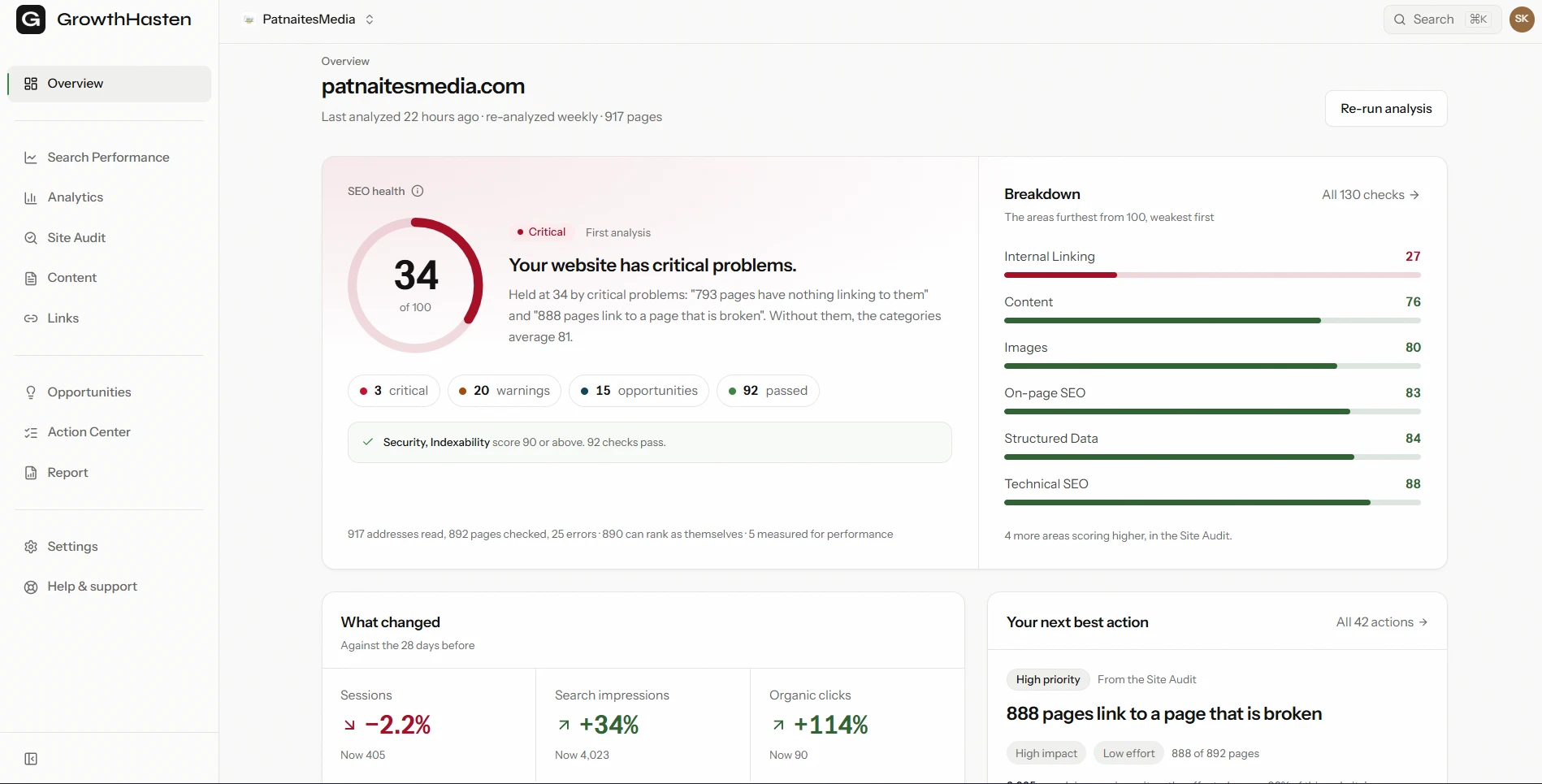


SaaS SEO is the practice of building organic search visibility that moves people through a software company's funnel, from the first educational search to a signup you can trace to revenue. It differs from generic SEO because the product itself is a ranking asset, the sales cycle is long, and traffic on its own means very little. This guide is written for SaaS founders, growth leads, and marketing teams who want the full map before they commit a quarter to it. It covers how SaaS SEO differs, how to map keywords to the funnel, the page types that carry the work, product-led and free-tool plays, where programmatic SEO fits, and how to measure what matters. Read it once end to end, then use it as a reference for the deeper pieces.
The short version
- Traffic is the wrong headline metric. Signups, activation, and retention are the ones that pay rent.
- SaaS SEO is funnel-driven: educational content at the top, comparison and alternative pages in the middle, product and pricing pages at the bottom.
- Your product is a content engine. Free tools, templates, and use-case pages often outrank pure blog posts because they solve the problem on the page.
- The gap most SaaS sites have is bottom-funnel pages: "vs" pages, alternative pages, and integration pages that competitors already own.
- Long sales cycles mean retention and onboarding content is SEO too, not a separate job.
What is SaaS SEO, and how is it different from regular SEO?
SaaS SEO is search optimization organized around a subscription product and its funnel, rather than around traffic to a page. The mechanics of crawling, indexing, and ranking are identical to any other site. What changes is the goal and the shape of the demand you are chasing.
Three differences matter most. The product is a first-class SEO asset, so a free calculator or an integration page can rank and convert better than a blog post. The sales cycle is long, so a single visitor may research for weeks across many queries before signing up. And the true conversion is a signup that activates and retains, not a click, which forces you to measure further down the funnel than most SEO programs bother to.
The honest caveat: none of this replaces fundamentals. If your pages cannot be crawled or do not match intent, no amount of SaaS-specific tactics will help. Our complete guide to SEO covers the groundwork this piece assumes you already have in place.
Why does the SaaS sales cycle change how you do SEO?
Because a SaaS buyer rarely converts on the first visit, and the search journey spans months. Someone might start with "how to reduce customer churn," move to "churn prevention software," then "Vendor A vs Vendor B," and finally "Vendor A pricing" weeks later. Each of those queries carries a different intent and needs a different page.
This has a practical consequence: you cannot win with one page. You need content that meets the reader at every stage and hands them to the next one through internal links. A top-of-funnel article that never points toward a solution or a product page is a dead end, no matter how well it ranks.
It also means attribution is messy. A signup may follow ten touches across informational and commercial pages. If you judge each page by its own last-click conversion, you will kill the educational pages that started the journey.
How do you map keywords to the SaaS funnel?
By reading the intent behind each query and sorting it into a funnel stage before you write anything. Keyword research for SaaS is less about volume and more about where a term sits in the buyer's journey and whether you can realistically win it. A low-volume term that signals a buying decision usually beats a high-volume term that never converts.
The three stages break down cleanly:
- Top of funnel (TOFU), educational. Problem-aware searches like "what is customer churn" or "how to onboard new users." The reader has a problem, not a shortlist. You earn trust here, not signups.
- Middle of funnel (MOFU), comparison and alternative. Solution-aware searches like "best churn prevention tools," "Vendor A vs Vendor B," or "Vendor A alternatives." The reader is building a shortlist.
- Bottom of funnel (BOFU), product and pricing. Vendor-aware searches like "Vendor A pricing," "Vendor A integrations," or a specific feature name. The reader is close to a decision.
Start at the bottom and work up. BOFU pages are fewer, easier to write, and convert best, so they earn their keep fastest. Our keyword research guide covers how to cluster terms and read intent from the live results.
What are the core page types every SaaS site needs?
Six page types carry most SaaS organic growth, and each maps to a stage and an intent. Missing any one usually shows up as a visible gap in the funnel.
| Page type | What it does | Funnel stage |
|---|---|---|
| Feature pages | Rank for a capability the product delivers and show it in action | BOFU |
| Solution pages | Frame the product around a problem or an industry, not a feature | MOFU to BOFU |
| Comparison ("vs") pages | Capture buyers comparing you to a named competitor | MOFU |
| Alternative pages | Capture searches for "[competitor] alternatives" from unhappy users | MOFU |
| Integration pages | Rank for "[your product] + [tool]" and prove you fit their stack | MOFU to BOFU |
| Use-case pages | Show a specific job the product does for a specific role | MOFU |
| Trial and demo pages | Convert a self-serve trial signup or a sales-led demo request, and decide whether the page itself should carry search demand | BOFU |
Comparison and alternative pages are the ones most SaaS sites skip, usually out of discomfort with naming competitors. That discomfort is exactly why the pages convert: a searcher typing "Vendor A vs Vendor B" has already decided to buy something, and whoever owns that page frames the comparison. Write it honestly, and it earns trust rather than looking defensive, and our guide to building SaaS comparison and alternative pages covers the template, the keyword-sourcing method, and the legal guardrails for doing it well.
A note on honesty in comparison pages
Comparison and alternative pages work only when they are fair. If yours claims you win on every axis, readers stop believing it and so do search engines assessing quality. Name the cases where a competitor is the better fit. Conceding the wrong-fit customer is how you keep the right-fit one.
What does the SaaS SEO funnel-to-page-type map look like?
Here is the framework we use to plan a SaaS content system. It ties each funnel stage to the intent, the page types that serve it, and the metric that tells you the stage is working. Build it bottom-up so revenue-adjacent pages exist before you invest in top-of-funnel volume.
| Funnel stage | Intent and example query | Pages and the metric that matters |
|---|---|---|
| BOFU (decision) | Vendor-aware: "Vendor A pricing," "[feature] integration" | Pricing, feature, integration pages. Metric: signups and demo requests |
| MOFU (evaluation) | Solution-aware: "best [category] tools," "Vendor A vs Vendor B" | Comparison, alternative, solution, use-case pages. Metric: signups assisted and email captures |
| TOFU (awareness) | Problem-aware: "how to reduce churn," "what is [concept]" | Blog posts, guides, free tools, templates. Metric: qualified traffic and downstream assists |
The rule that keeps this honest: every TOFU and MOFU page must link toward the next stage. An educational article with no path to a use-case, comparison, or product page is a leak, not an asset. The map is only as strong as the internal links that connect its rows.
What is product-led SEO, and how do free tools and templates fit?
Product-led SEO is using the product, or a slice of it, as the ranking page itself. Instead of writing about how to solve a problem, you build a free tool, calculator, template, or generator that solves a piece of it on the page. The searcher gets immediate value, and the page earns links and rankings that a plain article rarely matches.
Free-tool and template plays work because they satisfy intent completely. A page titled "free invoice template" that hands over a usable template outperforms an article describing how to make one. It also creates a natural signup moment: save your work, unlock the full version, or export the result behind a free account.
When not to build a free tool: if it has no honest connection to your product, it pulls traffic that never converts and costs engineering time to maintain. A password generator on a project-management site earns visitors who will never become customers. The tool has to sit on the path to your actual product, not beside it.
How do content and technical SEO support SaaS growth?
Content builds the demand and authority; technical SEO makes sure search engines can reach and trust it. They are not competing priorities. On a fast-scaling SaaS site, technical debt shows up quickly because engineering ships constantly and pages multiply.
On the content side, the job is topical authority: covering a subject completely enough that search engines treat you as a credible source on it. That is what turns a scattered blog into a system. Our guide to content marketing for SEO lays out the pillar-and-cluster model this depends on, and our guide to building a SaaS content engine applies that model to the acquisition-through-expansion funnel a subscription product actually runs on.
On the technical side, the SaaS-specific risks are worth naming. Marketing pages and app pages often live on the same domain, so a stray noindex or a crawl trap in the app can bleed into the marketing site. JavaScript-heavy pages may render content that crawlers see late or not at all. And rapid publishing without internal linking creates orphan pages. Google's Search Central documentation is the primary reference for how each of these behaves, and its Search Essentials set the baseline every page should clear.
Where does programmatic SEO fit for SaaS?
Programmatic SEO fits wherever you have a repeatable page pattern and real data to fill it. SaaS sites are unusually well suited to it because integration pages, use-case pages, comparison pages, and location or template pages all follow a template you can populate at scale. One good template can become hundreds of pages that each target a specific long-tail query.
The danger is generating thin, near-duplicate pages that add nothing. A programmatic page still has to satisfy intent on its own, with genuine data or content behind each variation. Pages built purely to exist, with a swapped keyword and nothing else, invite quality problems rather than traffic. Our guide to programmatic SEO covers how to build these pages so they earn their place instead of diluting the site.
When not to go programmatic: if you have fewer than a handful of high-value manual pages ranking, building a thousand templated ones first is premature. Prove the pattern converts on a few pages before you scale it.
How do you measure SaaS SEO beyond traffic?
By following the visitor past the click into signups, activation, and retention. Traffic is a leading indicator, useful but shallow. A page that pulls thousands of visits and no signups is worse than a quiet page that quietly sends qualified users into a trial.
A workable measurement stack tracks four layers, in rising order of what they mean:
- Qualified organic traffic. Not all sessions, but sessions from queries tied to your product's problem space.
- Signups from organic. Free trials or accounts created by organic visitors, attributed across the whole journey, not just last click.
- Activation. The share of those signups that reach the product's first value moment, the point where they have actually used it.
- Retention and expansion. Whether organic-sourced users stay and grow, which is the only signal that ties SEO to real revenue.
Retention content belongs in this picture too. Help documentation, onboarding guides, and best-practice articles keep existing customers succeeding, and they often rank for the exact queries your trial users type in week one. Treating them as SEO rather than a separate support job is one of the higher-return moves available to a SaaS team. If you would rather bring in help than build this in-house, our roundup of the best SaaS SEO agencies compares nine specialists against the same scorecard before you commit to a partner.
What are the most common SaaS SEO mistakes?
Most SaaS SEO failures come from a short, repeatable list. Recognizing them is faster than diagnosing each one from scratch.
- Chasing volume over intent. Publishing high-volume TOFU content while the bottom of the funnel has no pages to convert the demand into signups.
- No bottom-funnel pages. Skipping comparison, alternative, and integration pages, then wondering why traffic does not turn into revenue.
- Measuring traffic, not signups. Celebrating sessions on pages that never send a qualified user into a trial.
- Ignoring retention content. Treating onboarding and help content as support's problem, leaving rankings and renewals on the table.
- Orphaned content. Publishing fast without internal links, so educational pages never hand readers to the next funnel stage.
- Thin programmatic pages. Scaling a template with no real data behind each variation and inviting quality problems.
When should you not invest in SaaS SEO?
When the conditions that make SEO pay off are not in place yet. SEO is a compounding channel that rewards patience, and there are situations where the money and attention belong elsewhere first.
Hold off, or spend lightly, when your product has not reached a basic fit with a market, because you will optimize for the wrong buyer and rewrite everything later. Hold off when you need revenue this quarter to survive, since paid channels deliver faster and SEO rarely moves the needle in weeks. And reconsider the scale of the investment if your total addressable search demand is tiny, a highly novel category may have almost no one searching for it yet, in which case demand creation matters more than capturing it.
None of these are permanent. They are timing signals. The point is to start SEO when a right-fit buyer is already searching and you can afford to wait a few months for the compounding to begin.
Where should a SaaS team start?
Start at the bottom of the funnel and work up. Build or fix the pages closest to revenue first: pricing, top feature pages, your most important comparison and alternative pages. These convert existing demand, so they pay back quickest and fund the slower top-of-funnel work.
Then map the middle: the use-case, solution, and integration pages that catch buyers building a shortlist. Only once those exist should you pour effort into educational TOFU content, and every piece of it should link down toward the pages you already built. Sequencing this way means each new layer has somewhere to send the readers it earns.
The one habit worth building is to judge every page by the funnel stage it serves, not by its traffic. Before you publish anything, name its stage, its intent, and the next page it should hand the reader to. If you cannot name all three, the page is not ready. This week, list your five highest-intent queries, the ones where a searcher is close to buying, and check whether you have a page built specifically for each. Wherever you do not, you have found your first BOFU page to write.
See What Your SaaS Site Needs Fixed First
GrowthHasten is AI-native SEO software. It crawls your marketing site, joins it to your own Search Console and Analytics, and orders what it finds so the work worth doing first sits at the top. The free plan covers one website of up to 900 pages, with no card.
Analyze Your WebsiteQuestions
Frequently asked questions
What is SaaS SEO?
SaaS SEO is search engine optimization organized around a software subscription product and its funnel. The crawling, indexing, and ranking mechanics are the same as any site, but the goal is different: it aims to move people from an educational search through evaluation to a signup that activates and retains. That means the product itself becomes a ranking asset, and success is measured in qualified signups and revenue rather than raw traffic.
How is SaaS SEO different from regular SEO?
Three things set it apart. The product is a first-class SEO asset, so free tools, calculators, and integration pages can rank and convert better than blog posts. The sales cycle is long, so one buyer researches across many queries over weeks and needs a page for each stage. And the real conversion is an activated, retained signup, not a click, which forces you to measure much further down the funnel than a typical content program does.
What page types does a SaaS website need for SEO?
Six carry most of the work: feature pages, solution pages, comparison or "vs" pages, alternative pages, integration pages, and use-case pages. Feature and pricing pages capture bottom-funnel buyers close to a decision. Comparison, alternative, and integration pages catch people building a shortlist. Use-case and solution pages frame the product around a problem or role. The pages most SaaS sites skip are comparison and alternative pages, which is exactly why competitors who build them win those high-intent searches.
What is product-led SEO?
Product-led SEO uses the product, or a free slice of it, as the ranking page itself. Instead of writing about solving a problem, you build a free tool, calculator, template, or generator that solves part of it directly on the page. This satisfies intent completely, earns links a plain article rarely matches, and creates a natural signup moment. It works only when the tool has an honest connection to your product, so it attracts visitors who could actually become customers.
How do you measure SaaS SEO success?
By following visitors past the click through four layers: qualified organic traffic, signups from organic attributed across the whole journey, activation (the share of signups that reach the product's first value moment), and retention or expansion. Traffic alone is a shallow, leading indicator. A page with heavy traffic and no signups is worth less than a quiet page that sends qualified users into a trial. Retention content that keeps existing customers succeeding counts as SEO too.

Written by
GrowthHasten Team
Editorial Team, GrowthHasten
Articles from the GrowthHasten editorial team, grounded in primary research, our own testing, and what analyzing real websites shows, fact-checked in-house.
View profile