

A SaaS SEO agency is a search partner built around a software product and its funnel, not around generic keywords and traffic. This guide is for founders, heads of growth, and marketing leads at seed to Series B B2B SaaS companies who are weighing whether to hire one, and which one. Most lists that rank these agencies are written by the agency sitting at the top of their own list, with criteria you never get to see. This one runs the other way around: the scorecard first, the nine agencies second, and an honest section on when hiring anyone is the wrong move.
The short version
- The best agency for a product-led (PLG) company is rarely the best one for a sales-led company. Fit beats rank.
- In 2026, an agency that ignores AI search (AEO and GEO) is optimizing for half the funnel.
- Judge a partner on whether it ties work to signups and pipeline, not to rankings and raw traffic.
- The order below reflects how specifically each firm is built for SaaS, not a verdict on quality.
- Sometimes the right move is an in-house hire or a consultant, not an agency. One section covers when.
How did we choose these agencies?
We ranked on public, verifiable positioning alone, not on private results we cannot check. Every factual claim about the nine agencies comes from that agency's own website or another Tier-1 or Tier-2 source, and nothing is lifted from competing listicles. We have not worked with or audited any of them, so this is research and synthesis, not a report on their delivery.
The order blends three transparent signals, each read from public positioning:
- SaaS specialization: how exclusively the firm is built for SaaS and product-led growth, rather than serving software as one vertical among many.
- Modern search coverage: whether the public offer covers both traditional SEO and AI search (Answer Engine Optimization and Generative Engine Optimization), not just blue links.
- Public footprint and maturity: how established and publicly documented the firm is.
Across the agencies and sources we reviewed, self-reported results figures (revenue multiples, client counts, retention rates) were common and impossible to verify independently, so we left them out. If a number is not something you can confirm, it should not decide your shortlist. For the wider context on evaluating any search partner, see our guide on how to choose an SEO partner. And if funding stage and budget matter more to you than product motion, our guide to SEO agencies for startups ranks the same market by stage fit instead.
What does a SaaS SEO agency do differently from a general SEO agency?
It optimizes the product's funnel, not just its blog. A general agency chases keyword volume and domain authority; a SaaS specialist maps search demand to how the product is actually bought and adopted, which is a different job for a product-led motion than for a sales-led one.
The work that separates the two usually includes:
- Product-led keyword mapping: tying queries to trial, activation, and expansion, not only to top-of-funnel awareness. Our complete guide to SaaS SEO walks through the funnel model.
- Comparison and alternative pages: the high-intent "X vs Y" and "alternative to X" pages that capture buyers already in-market. This is a specialist capability, covered in our breakdown of comparison and alternative pages.
- Technical SEO for app marketing sites: JavaScript rendering, migrations, and site architecture that many software marketing sites get wrong.
- AI search visibility: earning and measuring presence in AI answers, which is where a growing share of buyer research now starts. See our view on AI search visibility (AEO and GEO).
- Signup-tied measurement: reporting that traces back to trials and pipeline, not sessions.
For companies with long, multi-stakeholder deals, the same specialism overlaps with B2B SEO for complex sales cycles, where the buying committee matters as much as the keyword. And if authority building and earned coverage are the bigger gap for your team than technical execution, our guide to digital PR agencies for SaaS covers partners built for that specific job.
The 9 best SaaS SEO agencies for 2026
Here are nine agencies worth evaluating, ordered by how specifically each is built for SaaS rather than by any verdict on quality. Read the "Best for" line first: the right choice depends on your funnel motion and stage, and the fifth agency here may fit you better than the first.
1. MADX Digital
Best for: SaaS companies that want one team covering SEO, AI search, content, and links.
What they say they do: MADX positions itself as "The Search Agency for SaaS" and states on its own site that it works with SaaS exclusively, generating inbound pipeline through Google and LLMs such as ChatGPT and Perplexity.
Notable public focus: an integrated model where a single team runs traditional SEO, GEO, content, and link building as one system.
What to check before hiring: ask how the "SaaS-only" focus actually shows up in keyword mapping for your funnel, and to substantiate any headline results figures against a company at your exact stage.
2. SimpleTiger
Best for: B2B SaaS and AI companies that want SEO tied to pipeline and revenue attribution.
What they say they do: SimpleTiger describes itself on its own site as a B2B SaaS marketing agency that is "100% B2B SaaS & AI-focused," pairing SEO with Answer Engine Optimization and pipeline and RevOps reporting.
Notable public focus: full-funnel attribution and revenue tracking over vanity metrics, with SEO and AEO framed together.
What to check before hiring: ask how attribution is modeled for your CRM and sales cycle before you accept "pipeline influence" as a headline number.
3. Skale
Best for: funded SaaS and tech brands that want an AI-search-first organic program measured in qualified leads.
What they say they do: Skale calls itself an AI search-first organic growth agency building "organic growth engines for SaaS brands" on its own site, with services spanning SaaS SEO, GEO, AI brand mentions, link building, content, and migrations.
Notable public focus: SQLs, pipeline, and revenue over traffic and rankings, plus a stated GEO practice.
What to check before hiring: ask which named services are delivered in-house versus subcontracted, and how GEO results are measured.
4. Omniscient Digital
Best for: B2B software companies that want SEO, GEO, and content run as compounding growth channels.
What they say they do: Omniscient Digital positions itself on its own site as an organic growth agency helping B2B software turn SEO, GEO, and content into growth channels, naming programmatic SEO, technical SEO, CRO, link building, and digital PR. It publicly lists full-service engagements starting at $10,000 a month.
Notable public focus: content-led organic growth plus programmatic SEO, with a transparent starting price.
What to check before hiring: with a five-figure monthly floor, confirm the scope maps to your stage before you commit.
5. Ten Speed
Best for: B2B SaaS and tech teams that want visibility across both Google and LLMs.
What they say they do: Ten Speed describes itself on its own site as a US-based organic growth agency helping B2B companies increase search visibility "across Google & LLMs" to generate pipeline, naming SEO, AEO, technical SEO, content, and digital PR.
Notable public focus: AEO alongside classic SEO, across industries spanning PLG and SaaS, fintech, data and AI, and cybersecurity.
What to check before hiring: ask for the reporting view that ties LLM visibility to pipeline, not just to raw mentions.
6. Kalungi
Best for: early-to-growth B2B SaaS that needs full marketing leadership, not only SEO.
What they say they do: Kalungi describes itself on its own site as a B2B SaaS marketing agency offering "GTM-as-a-Service," with content and SEO as one part of a stack that also includes CMO-as-a-Service, ABM, RevOps, paid media, and web, tiered by ARR stage.
Notable public focus: the "T2D3" growth playbook and outsourced marketing leadership.
What to check before hiring: if you only need SEO, confirm you are not paying for a broader GTM retainer you will not use.
7. Directive
Best for: larger B2B and SaaS companies that want SEO inside a broader performance-marketing program.
What they say they do: Directive describes itself on its own site as a B2B marketing agency focused on qualified pipeline, organized into Performance (media, SEO, creative, RevOps), Commerce, and Communications, serving SaaS, technology, manufacturing, and professional services.
Notable public focus: pipeline over MQLs, backed by a proprietary methodology and intelligence platform.
What to check before hiring: since SEO is one line inside a wider offer, confirm how much senior SEO time you are actually buying.
8. First Page Sage
Best for: enterprise and mid-market brands that want thought-leadership content alongside SEO and GEO.
What they say they do: First Page Sage describes itself on its own site as an SEO and GEO agency built around thought-leadership content, white papers, and research, and its public client roster skews enterprise rather than early-stage SaaS.
Notable public focus: thought-leadership content marketing paired with tracking and attribution.
What to check before hiring: if you are early-stage SaaS, ask whether an enterprise content model fits your budget and your speed.
9. NoGood
Best for: startups and scaleups that want growth marketing across channels, with SaaS as one of several verticals.
What they say they do: NoGood describes itself on its own site as a growth marketing agency working with startups, scaleups, and large brands, naming SEO, AEO, paid media, CRO, content, and fractional CMO work, and listing SaaS and B2B among six verticals.
Notable public focus: experimentation-led growth across paid and organic, positioned as "AI native."
What to check before hiring: confirm how much of the engagement is organic search versus paid, so SEO is not a minor line in a broad growth retainer.
The SaaS SEO agency scorecard: how do you evaluate any partner?
Score any agency on these seven questions before rank ever enters the conversation. A strong partner answers most of them with specifics; a weak one answers with adjectives.
| Criterion | Strong signal | Weak signal |
|---|---|---|
| SaaS and PLG understanding | Maps keywords to your funnel stage and to a product-led versus sales-led motion | Talks only about keyword volume and domain rating |
| Comparison and alternative pages | Builds them and can show live examples | Only blog posts and top-of-funnel guides |
| AI search (AEO and GEO) | Has a stated method to earn and measure AI-answer visibility | Treats AI search as "coming soon" or ignores it |
| Measurement tied to signups | Reports trials, signups, activation, and pipeline | Reports rankings and sessions only |
| Technical SEO for app marketing sites | Handles JavaScript rendering, migrations, and architecture | Content only, no technical capability |
| Transparency of method | Explains exactly what they will do and shows the work | Secretive, leans on a "proprietary" black box |
| Realistic timelines | Frames results in quarters and offers no guarantees | Promises fast, guaranteed rankings |
The last two rows echo official guidance. Google's documentation on hiring an SEO states plainly that no one can guarantee a number-one ranking and warns against firms that are secretive about their methods. For the AI-search row, Google's guidance on optimizing for AI features is a useful reference point for what a credible AEO approach actually rests on.
How much do SaaS SEO agencies cost, and what drives the price?
Three models, and the right one depends on your stage and how predictable the scope is. Most agencies do not publish figures, so treat any single number you see elsewhere with caution unless it comes from the agency's own site.
- Monthly retainer: the common model for ongoing SEO, content, and links. It suits work that is continuous and hard to scope as a one-off.
- Fixed-scope project: a defined deliverable such as a technical audit, a migration, or a set of comparison pages. It suits a clear, bounded need.
- Performance-based: fees tied to agreed outcomes. It shifts risk but needs airtight definitions of what counts as a result.
Published prices are rare enough that they are worth noting when they exist. Omniscient Digital, for example, states on its own site that full-service engagements start at $10,000 a month, which is a useful anchor for the senior end of the market. Whatever the model, ask any agency to map its fee to deliverables and to reporting you can trace to signups, rather than accepting a flat number without scope.
What should you ask a SaaS SEO agency before you sign?
Ask the questions that separate specialists from generalists, and write down the answers so you can compare them side by side.
- Process on our funnel: what specific work would you run in the first 90 days for a company with our motion and stage?
- Who does the work: which parts are in-house senior time, and which are subcontracted or junior?
- AI search: how do you earn and measure visibility in AI answers, not just classic rankings?
- Reporting: what does the monthly report show, and how does it connect to trials, signups, and pipeline?
- References: can we speak to a client at our stage and in a similar motion?
- Timeline: when should we realistically expect movement, and what happens if it does not come?
Google's own advice on evaluating an SEO lines up with this: interview thoroughly, check references, and be wary of anyone who guarantees results. A good partner will answer every question above without flinching.
When should you not hire a SaaS SEO agency?
When the work is narrow and permanent enough to own in-house, or when you are not yet ready to feed a program. Hiring the wrong way, or too early, wastes budget that an early-stage company cannot spare.
- Hire in-house when: SEO is a permanent core channel and you can fund a dedicated team that compounds knowledge of your product.
- Hire a consultant when: you need senior strategy and direction but already have the execution capacity internally.
- Hire an agency when: you need senior, multi-disciplinary capability (technical, content, links, AI search) faster than you can hire it. At enterprise scale this calculation changes, because the constraint is approval and deploy access rather than strategy.
- Do not hire anyone yet when: you have no product-market fit signal, no capacity to produce or review content, or you expect results in weeks rather than quarters.
How do you measure whether SaaS SEO is working?
By tracking movement toward signups and pipeline, not just rankings. Rankings and traffic are leading indicators; they matter only insofar as they turn into product activity.
- Non-brand organic signups and trials: the clearest sign that search is reaching buyers, not just readers.
- Indexed, ranking product-relevant pages: comparison, alternative, integration, and use-case pages moving up for in-market queries.
- Assisted pipeline: deals where organic search played a role in the journey, read through your attribution model.
- AI-answer citations: whether your brand and pages get surfaced inside ChatGPT, Perplexity, and Google AI Overviews.
- Activation: whether the users search brings in actually adopt the product.
Durable SaaS SEO compounds over quarters, not weeks. Treat any agency promising fast, guaranteed rankings as a red flag, whatever its position on someone else's list.
The habit worth building is simple: shortlist two or three agencies, run each through the scorecard above, and ask every one of them to show reporting that ties to signups rather than sessions. Rank is the last thing to look at, not the first.
This week, before you take a single sales call, write down two things: whether your motion is product-led or sales-led, and the one metric that would tell you SEO is working. Bring both to every conversation, and the right partner becomes much easier to spot.
Know What Your Site Needs Before You Hire Anyone
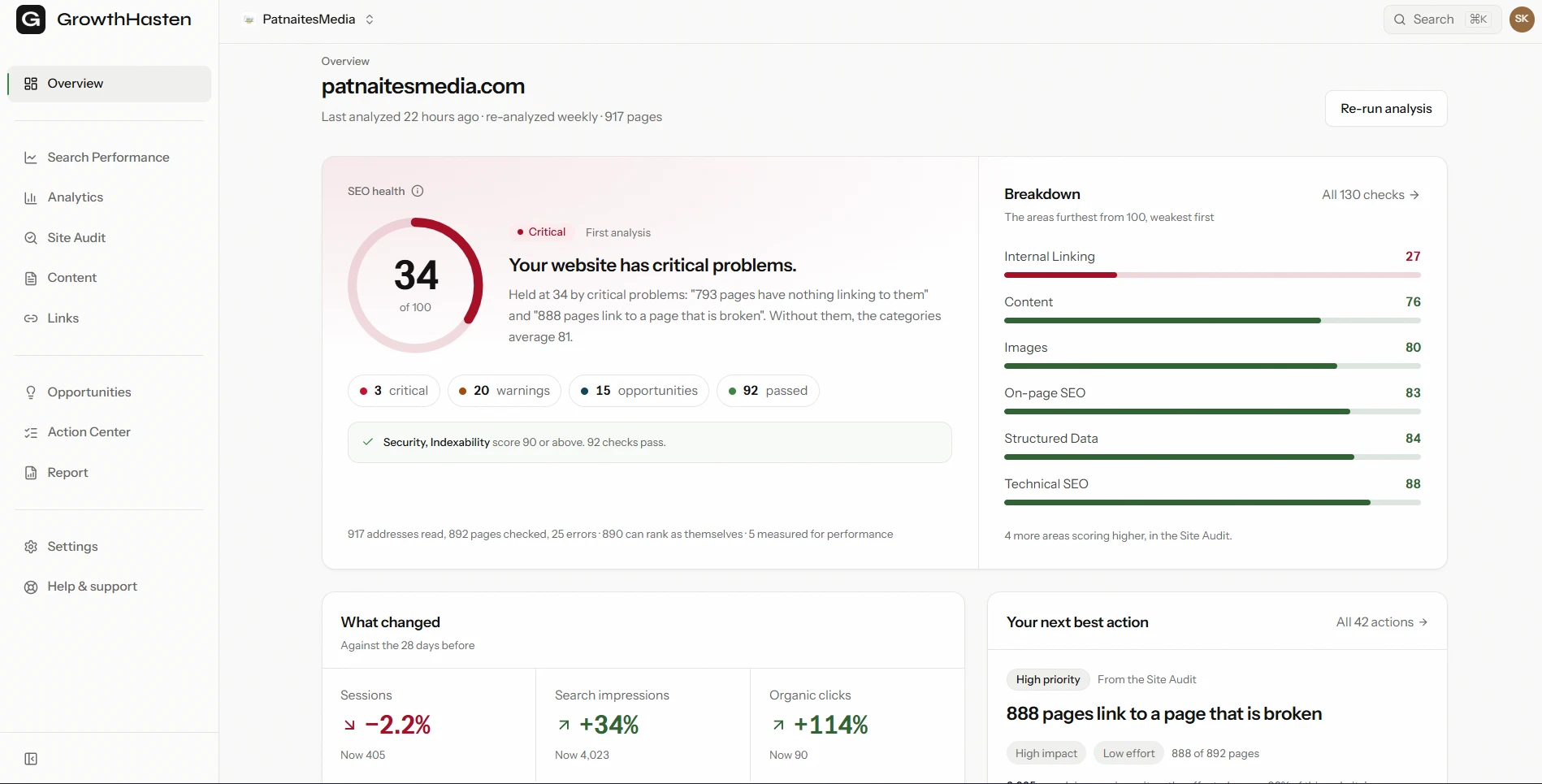
Brief any agency, consultant or hire from evidence. GrowthHasten crawls your website, joins it to your own Search Console and Analytics, and turns the result into one prioritized queue of fixes and opportunities. Free plan: one website of up to 900 pages, no card.
Analyze Your WebsiteQuestions
Frequently asked questions
What does a SaaS SEO agency do that a general SEO agency doesn't?
A SaaS SEO agency builds around the product and its funnel: product-led keyword mapping, comparison, alternative, and integration pages, trial and demo landing pages, and increasingly AI-search visibility. The goal is signups and pipeline, not just rankings, so measurement is tied to product activation rather than sessions. A general agency tends to optimize for traffic and domain authority alone.
How much does a SaaS SEO agency cost?
Pricing usually follows one of three models: a monthly retainer, a fixed-scope project, or a performance-based fee. The right model depends on your stage and how predictable the scope is. Few agencies publish figures, so ask any partner to map its fee to specific deliverables and to reporting you can trace to signups, rather than accepting a flat number with no scope attached.
When should a SaaS company hire an SEO agency instead of building in-house?
An agency fits when you need senior expertise faster than you can hire it, or when the work is broad (technical, content, links, and AI search) and a single in-house hire cannot cover it all. Build in-house when SEO is a permanent core channel and you have the budget for a dedicated team that compounds product knowledge over time.
Do SaaS SEO agencies handle AI search now?
The better ones do. In 2026, a growing share of buyer research happens inside AI answers such as ChatGPT, Perplexity, and Google AI Overviews, so an agency that only optimizes for classic blue links is covering part of the funnel. Ask any agency how it earns and measures AI-search visibility, and treat a vague answer as a gap.
How long does SaaS SEO take to show results?
It depends on domain history, competition, and how much of your site is already indexed. Durable SaaS SEO compounds over quarters, not weeks, so treat any agency promising fast, guaranteed rankings as a red flag. Expect leading indicators like rankings and impressions first, then signups and pipeline as the program matures.

Written by
GrowthHasten Team
Editorial Team, GrowthHasten
Articles from the GrowthHasten editorial team, grounded in primary research, our own testing, and what analyzing real websites shows, fact-checked in-house.
View profile