

A SaaS integration page is a dedicated page that shows how your product connects with one specific tool your buyers already use, built to rank for searches like [your product] + Slack or [your product] Salesforce integration. It exists to answer one question a buyer asks late in the decision: does this fit the stack I already run? This guide is for SaaS founders, heads of growth, and product-marketing or SEO managers who have a growing list of integrations and want to turn that list into an organic acquisition channel. It covers the keyword pattern these pages rank for, a copyable template, the decision rule that keeps them out of thin-content territory, and the internal-linking model that wires them into the rest of your funnel. Integration pages sit next to comparison and alternative pages in the bottom-funnel cluster, but they answer a different question and need a different build, which is where most teams get them wrong.
The short version
- Not every integration deserves its own page. The fastest route to a thin-content problem is one auto-generated page per integration whether anyone searches for it or not.
- Integration pages capture "[your tool] + [their tool]" searches that buyers run right before they commit, when they are checking compatibility, not comparing vendors.
- Two structures do the work: one integration hub, plus individual pages for the integrations that earn them.
- Wire them into your comparison, alternative, and feature pages. An integration page on an island gets neither crawled nor converted.
What is a SaaS integration page, and why does it convert?
It is a page dedicated to a single connection between your product and another tool, written for a buyer who has already decided they like you and now needs to confirm you work with something they cannot give up. That is a specific and valuable moment. A prospect who runs their whole revenue team on Salesforce will not adopt a tool that forces them to abandon it, so the question "does this integrate with Salesforce" is often the last blocker before a signup.
These pages convert because of the intent behind the search, not because of any trick on the page. Someone typing [your product] + HubSpot is not learning about a category or weighing five vendors. They have a shortlist, a stack, and a compatibility question. Answer it clearly and you remove the final objection.
An integration page is not a feature page, and conflating the two is the common mistake. A feature page explains what your product does. An integration page explains how your product fits into a workflow the buyer already owns, with the other tool named in the title. The named tool is what makes the page rank for that buyer and reassure them at the same time.
When not to build one at all: if your product has two integrations and neither has meaningful search demand, skip the page type entirely and put the information on a single feature or documentation page. Integration pages earn their keep once you have enough qualifying connections that the pattern scales.
How is an integration page different from a comparison page?
Different query, different buyer, different template. A comparison page answers "which tool should I choose" for someone still evaluating vendors. An integration page answers "does this work with what I already use" for someone who has mostly chosen you and is checking fit. They share a place in the funnel and nothing else.
| Dimension | Integration page | Comparison page |
|---|---|---|
| The search | [you] + [tool], [you] [tool] integration | [you] vs [competitor], [competitor] alternatives |
| The buyer | Checking compatibility with their stack | Choosing between vendors |
| Job of the page | Reassure on fit, remove the last blocker | Win a fair, direct comparison |
| Named tool | A partner or adjacent tool | A competitor |
| Conversion logic | Compatibility reassurance | Competitive displacement |
If a visitor is comparing you against a rival, an integration page is the wrong destination, and you should route that intent to a comparison build instead. Our guide to comparison and alternative pages covers that page type in full. Keep the two clean and separate: a page that tries to be both reassures no one and ranks for neither query well.
How do you do keyword research for integration pages?
Start from your actual integration list and expand each connection into its query set, then validate demand before you commit a page. The pattern is predictable, which is what makes it scalable: for every integration, buyers search some mix of [your product] [tool], [your product] [tool] integration, and [your product] + [tool], sometimes with modifiers like sync, connect, or zapier.
Three inputs decide which pairings are worth pursuing:
- Search demand for the pairing: Pull volume for the
[brand] + [tool]terms in your keyword tool. Apply the intent read from our keyword research guide, where a low-volume commercial term beats a high-volume informational one. Integration queries are usually low volume and very high intent. - Search Console reality: If a page or your docs already exist, check Google Search Console for the integration queries you already earn impressions on. Impressions with no dedicated page is a page waiting to be built.
- Sales and support signal: The integrations prospects ask about on calls and in support tickets are demand your keyword tool will underreport, especially for newer or niche tools. If sales hears "does it connect to [tool]" every week, that pairing deserves a page even at low measured volume.
Set a rough threshold and hold to it. When a pairing has real demand from any of those three sources, it is a candidate for a standalone page. When it has none, it belongs in a table, which is the decision the next section makes concrete.
Which integrations deserve a page? (the decision tree)
Not all of them, and treating every integration as page-worthy is exactly how a SaaS ends up with index bloat that drags the whole domain down. A standalone, indexable page is warranted only when the pairing clears a real bar. Run each integration through four questions before it earns a URL.
| Question | Earns a standalone page when | Belongs in a hub table when |
|---|---|---|
| Is there search demand for the pairing? | Measured volume, GSC impressions, or repeated sales questions | No searches and no one asks |
| Is the integration meaningful? | A real two-way sync or a core workflow | A shallow one-off or a Zapier passthrough |
| Is the partner strategic? | A widely used tool or a named partner | A long-tail tool few of your buyers run |
| Can you write genuinely unique content? | Real setup steps, screenshots, and use cases exist | The page would just swap a logo and a name |
Read it as a tree, not a scorecard. If a pairing fails the first question, stop: no demand means no standalone page, regardless of how deep the integration is. If it passes demand but fails the last question, it still fails, because a page you cannot fill with unique, useful content is a thin page by definition. The bar is: real demand and a page you can genuinely fill.
This is the guardrail every competitor skips, and it matters because Google treats mass-produced, near-identical pages as a spam signal. Its spam policies on doorway abuse describe pages created to rank for similar queries that lead to a less useful destination, which is precisely what fifty templated integration pages become when only five had any demand. The fix is not better markup. It is building fewer pages that each deserve to exist. The same thin-content discipline runs through our guide to scaling pages without thin content.
What goes on the integration page? (the template)
A working integration page follows a fixed skeleton that confirms compatibility fast, proves it, shows the buyer how to set it up, and points them onward. Here is the template, annotated slot by slot. Every qualifying integration can reuse this structure.
- H1 with both tools named: Title it plainly, such as "[Your product] and Salesforce integration." Both product names in the H1 is what matches the query and reassures the reader in one line.
- Above-fold value and compatibility proof: One short paragraph that states what the integration does and confirms it is live, plus a logo lockup or a "works with" badge. A skimmer and an AI answer engine should both get the yes in the first two sentences.
- What the integration does: The specific data or actions that move between the two tools, in plain language. "Sync contacts both ways" beats "powerful integration." Be concrete about direction and triggers.
- Setup steps: A numbered, genuinely useful walkthrough of connecting the two tools. This is the section that makes the page unique and un-thin, and it is the one templated pages leave empty.
- Use cases: Two or three real workflows this pairing unlocks, framed around the buyer's job. Use cases are what a feature list cannot give you and what an AI summary tends to quote.
- FAQ: The compatibility questions buyers actually ask, such as data direction, sync frequency, plan requirements, and security. Mark it up so it is eligible for rich results.
- Schema block: Structured data describing the software and the page, covered in the technical section below.
- Internal-link slots and one call to action: Links to related integrations, the relevant feature page, and a single next step (start a trial or open the docs). One action, not five competing buttons.
The rule that keeps this template honest: if you cannot fill the setup steps and use cases with something specific to this exact pairing, the integration does not clear the decision tree, and it should be a row in the hub table instead of a page.
How do you structure integration pages at scale?
Use a hub-and-spoke model: one integration hub that lists everything, category pages if the list is large, and individual pages only for the integrations that earned them. The hub does three jobs at once. It gives buyers a single place to browse compatibility, it houses the long tail of low-demand integrations as table rows rather than thin pages, and it creates the crawl path that helps Google discover the individual pages.
The structure, from top down:
- The hub page: A
/integrations/index that lists every integration you offer. Qualifying integrations link out to their own page; the rest sit in the table with a short description and no dedicated URL. Where that index is rendered by a product or docs team rather than the marketing CMS, settle who owns each URL and where it ships from before you plan the pages. - Category pages: If you have dozens of integrations, group them, for example CRM, analytics, or communication. Category pages give structure and rank for broader terms like "[category] integrations for [your product]."
- Individual pages: One per integration that cleared the decision tree, each built from the template above.
Go programmatic only after a hand-built template has proven it ranks and converts, and only with the quality guardrails in place. Generating pages from a database works when each page carries unique setup detail and real use cases, and fails the moment it starts swapping a logo and a name across otherwise identical pages. Our guide to scaling pages without thin content covers how to template at volume without manufacturing doorway pages.
What schema and technical setup does an integration page need?
Use SoftwareApplication or WebPage markup, add BreadcrumbList for the hub-to-page path, and add FAQPage if the page carries an FAQ. Schema helps search and AI engines parse what the page is about, which matters more for a niche pairing that Google sees rarely. Google's introduction to structured data explains how the markup lets it understand page content precisely, and the SoftwareApplication type on Schema.org is the natural fit for a page describing software. For the full markup mechanics, our structured data guide walks through implementation.
Two technical decisions carry more weight than the schema:
- Indexation control: Index the integration pages that cleared the decision tree. Keep the thin, near-identical ones out with
noindex, or better, do not create them as pages at all. Schema does not rescue a thin page; it just describes one. - Crawl budget: A large programmatic integration section can consume crawl budget on low-value URLs. A clean hub, sensible internal links, and a tidy XML sitemap that lists only the pages worth indexing keep Google focused on the pages that convert.
Mark up the page accurately and it becomes easier to understand and eligible for richer results. Mark up a thin page and you have described a thin page in more detail. Earn the ranking with the content first.
How do you wire integration pages into the funnel?
Integration pages need inbound internal links from your commercial pages, or Google may never find them and buyers certainly will not. The page type is only as strong as the links pointing at it, so treat the wiring as part of building the page. The goal is to route both link equity and buyers through the bottom-funnel cluster rather than stranding integration pages on an island.
The funnel-wiring model we use:
- Hub to spokes and back: The
/integrations/hub links to every individual page, and every individual page links back to the hub and to two or three related integrations. This is the backbone crawl path. - Feature pages to integration pages: The feature page for a capability links to the integrations that extend it. A reporting feature links to the analytics integrations, for example.
- Integration pages to comparison pages: A buyer confirming you work with their stack is close to comparing you against a rival. A contextual link from the integration page to the relevant comparison and alternative pages catches that next question.
- Integration pages to trial and pricing: Every integration page should offer one clear path to the trial, demo, or pricing page so the equity keeps flowing toward conversion.
Use descriptive anchor text that names the destination, never "click here." If you are planning the wiring across a large site, our internal linking guide covers anchor text, hub design, and equity flow in depth. Wired well, the integration layer feeds your comparison and feature pages instead of competing with them.
How do you measure integration pages?
Measure query coverage, page-level engagement, and assisted conversions, not raw sessions. These pages are built for low-volume, high-intent traffic, so judging them by pageviews will always make them look weak. Track four things: whether you rank for the target [brand] + [tool] queries in Search Console, impressions and clicks per integration page, whether the pages sit on assisted-conversion paths in analytics, and the qualitative signal from sales when a prospect says the integration is why they signed up.
The warning that matters most: do not declare a page a success or a failure on small numbers. An integration page might see a few dozen visits a month by design, so a couple of signups can be a genuine win and a quiet two weeks can be noise. Avoid attributing a single signup to one page when the buyer likely touched several before converting, and be honest that early-stage pages have too little data to judge at all. At low volume, ranking for the pairing and hearing it cited on sales calls tells you more than a conversion-rate decimal.
The habit worth building is one test applied to every integration before it gets a page: build the page the buyer needs, not the page the scraper can. If a pairing has real demand and you can write something genuinely useful about it, it earns a URL. If not, it is a row in the hub. This week, pull your integration list, run it through the four-question decision tree, and ship one page for the highest-demand pairing you can fill with real setup detail. Then wire it into your hub and one feature page before you build the second. If you want help building the integration layer into a full system, our SaaS SEO strategy guide maps how it connects to the rest of the funnel.
See What Your SaaS Site Needs Fixed First
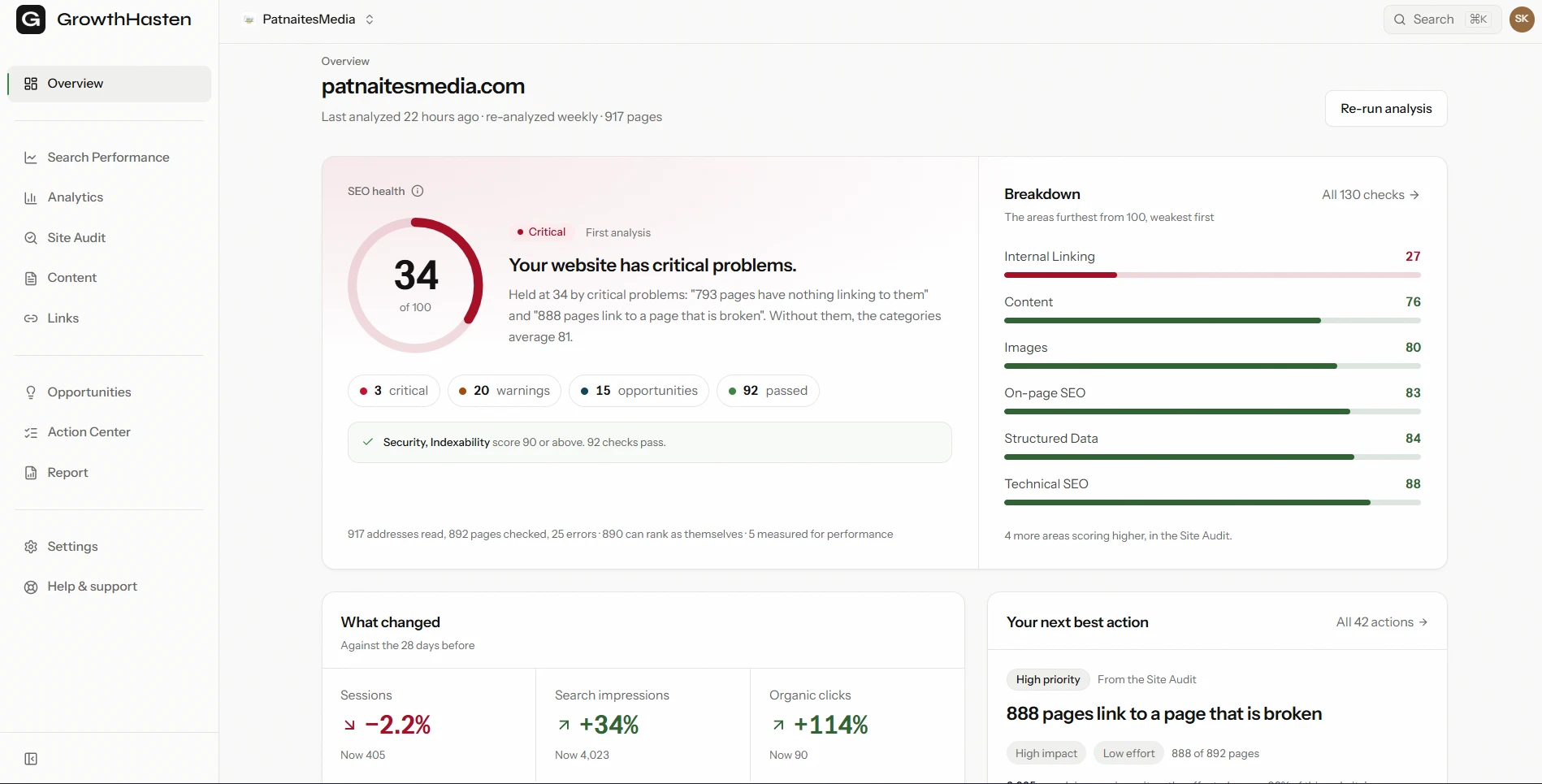
GrowthHasten is AI-native SEO software. It crawls your marketing site, joins it to your own Search Console and Analytics, and orders what it finds so the work worth doing first sits at the top. The free plan covers one website of up to 900 pages, with no card.
Analyze Your WebsiteQuestions
Frequently asked questions
What is a SaaS integration page?
It is a page dedicated to how your product connects with another tool, built to rank for searches like "[your product] + Slack." It reassures a buyer that your software fits their existing stack and captures high-intent, mid-funnel traffic that generic feature pages miss. The other tool is named in the title, which is what makes the page both rank and reassure.
How is an integration page different from a comparison page?
A comparison page answers "which tool should I choose" for a buyer still evaluating vendors, targeting "X vs Y" and "X alternatives." An integration page answers "does this work with what I already use." Different query, different buyer, different template. Build both, but keep them as separate pages rather than merging the two intents.
Should every integration have its own page?
No. A standalone page is worth it when there is real search demand for that pairing, the integration is meaningful, and you can write genuinely useful, unique content about it. Low-demand or shallow integrations belong as rows in a hub table, not as thin standalone pages that create a doorway-content risk and drag down site quality.
Should integration pages be built programmatically?
They can be, once you have a proven template and enough qualifying integrations. Programmatic generation only works with quality guardrails: unique content per page, real setup detail, and indexation control. Without those it produces index bloat that drags the domain down. Prove a hand-built page ranks and converts before you scale the pattern.
What schema should an integration page use?
Typically SoftwareApplication or WebPage, plus BreadcrumbList for the hub-to-page path and FAQPage if you include an FAQ. Schema helps search and AI engines understand the page precisely, which matters for niche pairings Google sees rarely. It does not rescue thin content, though. Earn the ranking with real setup steps and use cases first, then mark the page up.
How do you keyword research for integration pages?
Start from your integration list and expand each connection into its query set: "[brand] [tool]," "[brand] [tool] integration," and "[brand] + [tool]." Validate demand three ways: keyword volume, existing Search Console impressions on those terms, and the integrations sales and support hear asked about repeatedly. Real demand from any of the three makes a pairing a candidate for a standalone page.

Written by
GrowthHasten Team
Editorial Team, GrowthHasten
Articles from the GrowthHasten editorial team, grounded in primary research, our own testing, and what analyzing real websites shows, fact-checked in-house.
View profile