

SaaS content marketing is the practice of creating and distributing content that attracts, converts, activates, and retains the users of a software product. It differs from generic content marketing in one structural way: a SaaS business runs on recurring revenue, so content has to keep earning after the first signup, not just before it. This guide is for the content or growth marketer, or the founder, whose blog publishes steadily and converts poorly. It covers how to give every stage of the buyer journey a specific job, from first search to expansion revenue, and how to prove that the work moved signups rather than pageviews.
The short version
- Most SaaS blogs over-index on awareness content, then wonder why the traffic never turns into trials.
- A content engine gives each stage a job: awareness, consideration, decision, activation, retention, and expansion.
- Bottom-of-funnel and post-signup content punch far above their search volume. Publish them on purpose, not by accident.
- Early on, depth on a few high-intent topics compounds faster than breadth across many shallow ones.
- Measure content against trials and signups, not pageviews.
What is SaaS content marketing, and why is it different from generic content marketing?
The recurring-revenue model. Generic content marketing usually ends its job at the sale, but a SaaS customer who signs up and churns two months later is a loss, not a win. That changes what content is for. A SaaS content engine has to serve the whole customer lifecycle: it earns the trial, it helps the user reach value quickly, and it keeps them expanding their usage over time.
Three things follow from that. First, the audience is narrower and more technical than most content teams assume, which rewards depth over reach. Second, the product itself is often the best story, so product-led content tends to convert where thin thought leadership does not. Third, the metric that matters sits downstream of traffic, which means a post can rank beautifully and still fail the business.
This is also where SaaS content marketing meets SaaS SEO without being the same thing. The SEO discipline decides how your pages get discovered and ranked; content marketing decides what those pages should be and what job each one does. If you want the ranking mechanics, our SaaS SEO system covers page types and keyword strategy in depth. This piece stays at the level above that: the engine that decides what to make and why.
Why does your SaaS blog publish a lot and convert little?
Because almost every post targets the same stage. Awareness content is the easiest to brief, the easiest to rank, and the most fun to write, so teams keep making it. The result is a blog full of "what is" and "how to" posts that pull in traffic with no obvious next step, and a founder asking why none of it turns into trials.
The missing layers are the ones that do the converting. A visitor who reads a definition post is not ready to sign up; they are ready to learn one more thing. If the next thing they would search for, a comparison, an alternative page, a pricing explainer, or a real tutorial, does not exist on your site, they find it on a competitor's. The awareness post did its job and then handed the reader away.
Post-signup content is missing even more often. Onboarding guides, best-practice walkthroughs, and expansion content rarely get briefed at all, because they do not show up in a traffic report the way a viral top-of-funnel post does. Yet they are what keeps a trial from going cold. Our analysis of the guides ranking for this topic found the same blind spot repeatedly: they optimize hard for acquisition and stop at the signup, as though the customer relationship ends there.
What content belongs at each stage of the SaaS lifecycle?
Each stage has a different job and a different success metric. The table below maps content types to the full lifecycle, including the activation, retention, and expansion stages that most SaaS content plans leave out. Read it as a coverage checklist: if a stage has no content assigned to it, that is a gap the product is paying for.
| Stage | The job | Content types | Success metric |
|---|---|---|---|
| Awareness | Get found by people with the problem, before they know your category | Educational posts, thought leadership, industry data, glossary and definition pages | Qualified organic impressions and new sessions |
| Consideration | Help a problem-aware reader shortlist solutions | Comparison pages, alternative pages, use-case content, buying guides | Time on page, return visits, email or trial micro-conversions |
| Decision | Remove the last doubt before a trial or purchase | Product-led tutorials, ROI and pricing explainers, documentation, case studies | Free-trial or demo registrations |
| Activation | Get the new user to first value fast | Onboarding guides, setup walkthroughs, in-product help, quick-start templates | Activation rate, time to first value |
| Retention | Turn a habit into a renewal | Best-practice guides, workflow content, feature deep-dives, changelogs | Feature adoption, renewal and churn rate |
| Expansion | Grow account value with existing customers | Advanced use cases, integration guides, upgrade and add-on explainers | Expansion revenue, seats or usage per account |
Notice how the content types shift from broad to specific as you move down. Awareness content can afford to be general because its job is discovery. Decision and post-signup content cannot, because its job is to answer a question a real user is holding right now: "will this work for my stack?" or "how do I get this running today?" That specificity is exactly why lower-funnel content converts and why it is worth briefing deliberately.
How do you decide what to make first?
Start at the bottom, not the top. Decision-stage content is scarce, high-intent, and closest to revenue, so it usually delivers the fastest return even though it carries the lowest search volume. A comparison page that catches ten in-market buyers a month is worth more than an explainer that catches a thousand casual readers. Build the pages that convert first, then widen out to the awareness topics that feed them.
Anchor each decision in the job the reader is trying to get done, not the keyword alone. The Jobs to Be Done framework is a useful lens here: people do not want a project-management tool, they want their team to stop missing deadlines. Content that speaks to the job converts better than content that only matches the query. This matters even more in complex B2B sales cycles, where a buying committee researches for months and each member has a different job in mind.
Sequencing beats volume. Based on our research across the ranking guides, the programs that work do not chase a publishing target; they cover a focused topic completely before moving to the next. That is where topical authority comes from, and the method for building it is worth its own read: our guide to building topical authority sets out the pillar-and-cluster approach so you do not have to reverse-engineer it here.
How much content does a SaaS company actually need?
Enough to cover the buyer journey completely, which is a smaller number than most publishing calendars assume. Once you have that count, what a program that size should cost is the next question worth answering. The goal is coverage, not cadence. A young SaaS company with fifteen genuinely useful pages that answer every high-intent question in its category will usually out-convert a competitor pushing out three thin posts a week.
Depth compounds; breadth dilutes. When you cover one topic thoroughly, each new page reinforces the others and signals subject expertise to both search engines and readers. When you spread thin across unrelated topics, nothing reaches the depth that ranks or converts. The honest limit: coverage-first works best when you have chosen the right narrow territory. Pick the wrong topic to go deep on and depth just gets you ranked for something nobody buys against.
Cadence still matters for freshness and momentum, so this is not a license to publish four posts a year. It is a reminder that the question "how much" is the wrong one. The right question is "what is still missing from the journey," and you answer it by auditing coverage, not by counting output.
How do you distribute SaaS content so people actually find it?
Publishing is not distribution. A post with no promotion plan is a bet that search alone will carry it, and for a new site with little authority that bet takes months to pay off, if it pays off at all. Treat distribution as part of the brief, not an afterthought once the post is live.
The three channels, and what each is good for:
| Channel | Examples | Best for |
|---|---|---|
| Owned | Email list, in-product surfaces, your own social accounts, internal links | Reaching people who already know you; activating and retaining users |
| Earned | Organic search, backlinks, mentions, communities, word of mouth | Compounding reach over time and building authority |
| Paid | Search and social ads, sponsorships, syndication | Buying attention fast for high-value decision-stage assets |
For most SaaS teams, owned and earned do the heavy lifting, and the fastest owned win is the one already sitting on your site: internal links from your high-traffic awareness posts into the decision-stage pages that convert. That single move routes existing readers toward the content that matters without spending a cent. The other lever is reaching people who were never going to find your blog in the first place, and our guide to extending your reach through content syndication covers how to republish your best posts elsewhere without the canonical mistake that lets a copy outrank the original.
How should SaaS content be structured for the AI-search era?
Structure it so a machine can quote it cleanly. AI answer engines and Google's AI Overviews increasingly sit between your content and the reader, and they favor content that answers a question directly and self-containedly. Google's own documentation on how Search works still rewards helpful, clearly organized pages, and the same qualities make a passage easy for an AI system to extract.
The practical moves are concrete. Lead each section with a one-sentence answer, then expand. Use descriptive, question-shaped headings. Put comparisons in tables and steps in lists. Define the entities in your space, such as activation, churn, and product-led growth, in plain language a model can lift. These are the same habits that win featured snippets, and they carry over almost entirely to AI citation. The mechanics of writing individual pages this way are covered in our guide to writing pages that rank and get cited.
One caveat worth stating plainly. Being cited by an AI engine does not guarantee a click, and the visibility is harder to measure than a classic ranking. Treat AI citation as an authority and demand-capture signal, not as a channel you can attribute a signup to today. Google has not published a formula for how AI Overviews select sources, so structure your content on the durable principle Google does document, people-first, genuinely helpful content, rather than any rumored trick.
How do you measure whether SaaS content is driving signups?
Tie content to trials and signups, not to pageviews. Pageviews tell you a post got attention; they say nothing about whether that attention became a customer. The measurement that matters connects a content entry point to a downstream action: a free-trial registration, a demo request, or an activation event inside the product.
A workable measurement stack for a SaaS content program:
- Discovery: Use Google Search Console for impressions, clicks, and the queries each page earns. This is where you see whether content is being found at all.
- On-site behavior: Use GA4 to follow the path from a content entry page to a signup or trial event, including assisted conversions where content was an early touch rather than the last click.
- Activation: Look at whether users who arrived through content reach first value, using your product analytics, not just whether they registered.
Attribution is genuinely hard in SaaS, and it is honest to admit the limits. A buyer might read five posts over two months, sign up from a branded search, and register as "direct" in your analytics. So weight assisted conversions, not just last-click, and accept that some content value shows up as brand demand you cannot cleanly trace. The rule of thumb: if traffic is climbing while trials are flat, that is your signal to rebalance the calendar toward lower-funnel and post-signup content.
Which mistakes quietly kill SaaS content programs?
Most failures are not dramatic. They are small, repeated decisions that add up to a blog nobody converts from. The ones we saw most often across the ranking guides and in common practice:
- Awareness overload: Publishing only top-of-funnel content because it is easy to rank, leaving no path from reader to trial.
- No funnel job: Briefing posts by keyword volume alone, without asking which stage the piece serves or what the reader should do next.
- Abandoning the customer at signup: Treating the trial as the finish line and briefing no activation, retention, or expansion content.
- Volume over coverage: Chasing a publishing cadence instead of completely covering a focused topic and its decision-stage queries.
- Publishing without distributing: Betting on search alone and skipping the owned and earned promotion that gets early posts seen.
- Measuring the wrong thing: Reporting pageviews to leadership while trials stay flat, which hides the real problem instead of surfacing it.
If you recognize your own program in three or more of these, the fix is rarely "write more." It is to rebalance what you write toward the stages that convert and retain.
The one habit worth building is small and changes everything downstream: give every post a funnel job before it is briefed. Not a keyword, a job. Which stage does this serve, and what should the reader do next? A calendar where every entry answers that question produces a content engine instead of a content archive.
The action for this week: pull your last ten published posts and tag each one by funnel stage. If eight of them are awareness, you have just found why the blog does not convert, and you have your next three briefs.
See Which Pages to Write, Refresh or Leave Alone
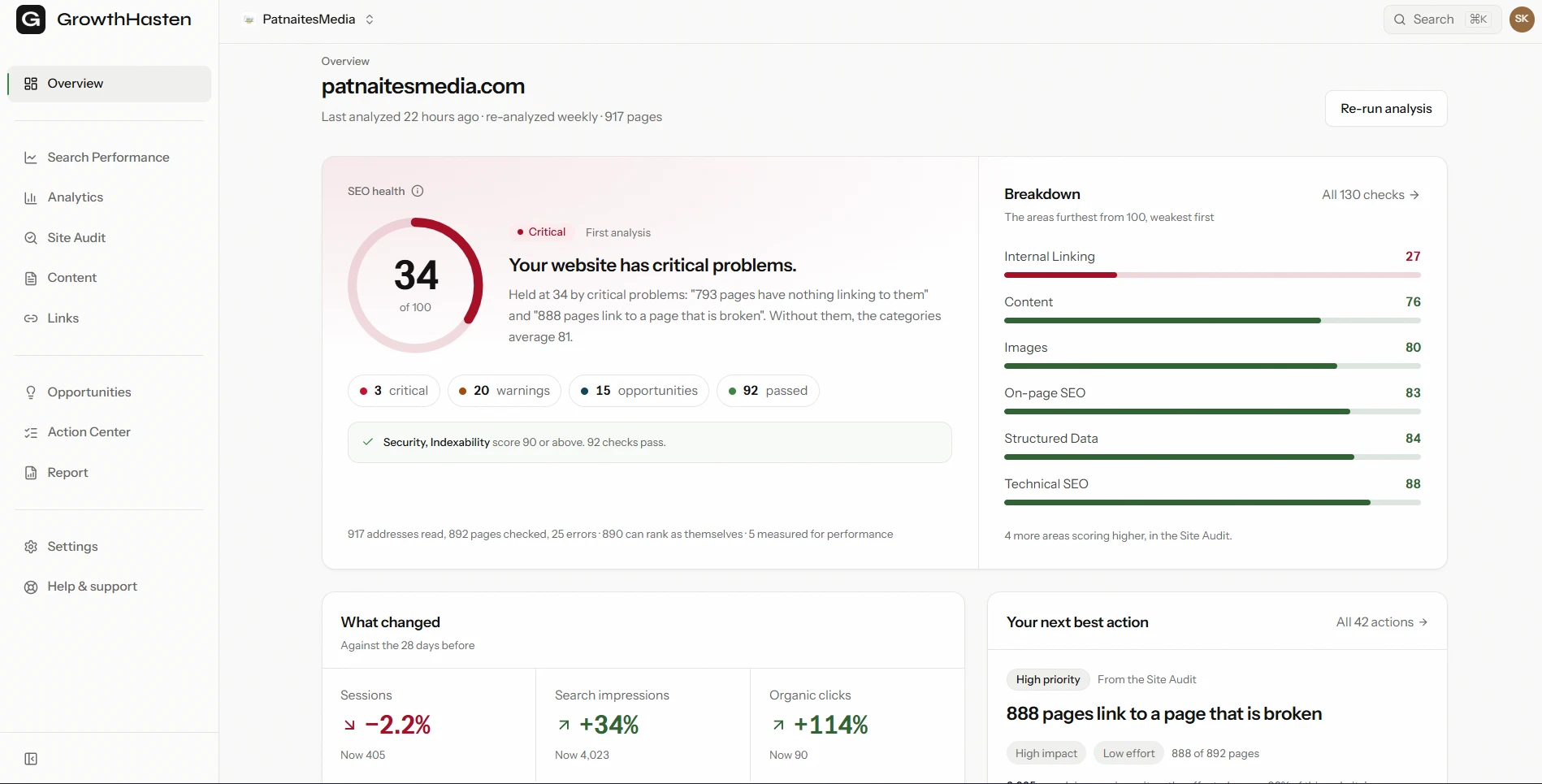
Connect Search Console and GrowthHasten's Content section puts every page's word count beside its clicks, flags the pages losing traffic and the pages competing for the same search, and groups topics as covered, partial or missing against what you already publish.
Explore the Content SectionQuestions
Frequently asked questions
What is SaaS content marketing?
It is the practice of creating and distributing content that attracts, converts, and retains the customers of a software product. Because SaaS runs on recurring revenue, the goal is not only acquisition but activation, retention, and expansion, so a strong program produces content for the whole customer lifecycle, not just the top of the funnel.
Why doesn't our SaaS blog convert?
Usually because almost every post targets the awareness stage. Awareness content builds traffic, but without consideration, decision, and post-signup content there is nothing to move a reader toward a trial or keep them after one. The fix is to give each post a specific funnel job before it is briefed.
What content works at each funnel stage for SaaS?
Awareness favors educational posts and thought leadership; consideration favors comparison, alternative, and use-case content; decision favors product-led tutorials, ROI content, and documentation; and post-signup favors onboarding, best-practice, and expansion content. Each stage has a different job and a different success metric.
How do you measure SaaS content marketing?
Tie content to trials and signups rather than pageviews. Track assisted conversions, free-trial registrations, and activation from content entry points, and use Search Console for discovery and GA4 for on-site behavior. Vanity traffic without downstream signups is a signal to rebalance toward lower-funnel content.
How much content does a SaaS company need?
Enough to cover the buyer journey completely rather than to hit a volume target. Full coverage of a focused topic and its decision-stage queries beats a high publishing cadence spread thin, especially early, when depth on a few high-intent topics compounds faster than breadth.

Written by
GrowthHasten Team
Editorial Team, GrowthHasten
Articles from the GrowthHasten editorial team, grounded in primary research, our own testing, and what analyzing real websites shows, fact-checked in-house.
View profile