

A SaaS pricing page sits nearer the transaction than anything else you publish, and it is usually the last page anyone checks for whether a search engine can read it. It gets designed for conversion, iterated on by the growth team, and shipped without anyone confirming that the number on it exists in the document a crawler stores. This is written for whoever owns that page: a growth lead, a VP of marketing, an SEO manager who cannot say with confidence whether it is a search asset or only a conversion asset. It covers the one decision that pulls the two jobs apart, how to confirm a crawler can see your price, the markup that belongs on the page, and why an answer engine may quote a figure you never set.
The short version
- A pricing page does two jobs, and they conflict on exactly one decision: whether to publish the number at all. Everything else is a shared win.
- If the price is injected by JavaScript, the crawler may hold no price for the page at all. Confirm that before optimizing anything else on it.
- "Contact sales" is a legitimate commercial choice and a search cost at the same time. A published starting figure keeps a number in the document without giving up the qualifying conversation.
- An answer engine quotes whatever figure it can extract. When yours is not extractable, it reaches for a review site instead.
Is a pricing page an SEO asset, or just a conversion page?
Both, and the search half is the one that goes unowned. A pricing page answers a vendor-aware query, which is about as far down the funnel as organic search reaches: someone typing your product name plus "pricing" has a shortlist, a budget, and a reason to be there this week.
They are not evaluating the category any more. They are checking whether you are affordable before booking time with sales, and the page either answers that in a few seconds or sends them to a review site that will answer it for you, less accurately.
So treat it as the bottom rung of a ladder rather than a standalone asset: it should receive links from the feature, comparison, and integration pages above it, and hand the visitor one clear action. Our guide to the SaaS page types that carry bottom-funnel intent maps where it sits. What conversion goal it should carry is settled elsewhere on this site, so this piece stays on the search side.
Should your pricing page be indexed?
Almost always yes, with two SaaS-specific exceptions worth handling separately. A gated enterprise tier that exists to capture a form fill belongs on its own URL, where you can keep it out of the index without taking the main pricing page with it. Per-region price variants need canonical handling rather than a noindex, because they are the same offer expressed in different currencies and you want the signals to consolidate rather than disappear. Beyond those two, blocking the page sends vendor-aware demand to listings you do not control. For every other page type, including paid and campaign pages, work through the full index or noindex decision tree in our landing page SEO guide.
Should you publish prices, a band, or "contact sales"?
This one call shapes every other choice on the page, and it is the only place the search job and the sales job genuinely pull in opposite directions. The useful move is to stop arguing about it as a single question and score the three options separately on what each costs you in search and in pipeline. Start with what a machine can do with each.
| Approach | Can a crawler store a price? | Can an answer engine quote you? |
|---|---|---|
| Publish exact tier prices | Yes, if the figure is in the served HTML | Yes, and it can quote a specific number |
| Publish a starting price or a band | Yes, the floor or the range | Yes, as a "starts at" figure |
| Gate everything behind "contact sales" | No number exists to store | No, so it uses a third-party source |
Now the commercial side of the same three options, which is where the argument usually starts.
| Approach | "[Competitor] pricing" capture | Lead qualification |
|---|---|---|
| Publish exact tier prices | Strongest, you own the number buyers compare | Weakest filter, and the page does the qualifying |
| Publish a starting price or a band | Good, the floor anchors the comparison | Buyers who are far below the floor self-select out |
| Gate everything behind "contact sales" | Weakest, third parties fill the gap | Strongest filter, applied to a smaller pool |
Read the two together and the trade is clear. Gating does not remove your price from the internet. It moves the price from a page you control to a page you do not, and the version that circulates is whatever a review site recorded, possibly two pricing changes ago.
Based on my experience, a published starting figure is the right default for a B2B SaaS company with any self-serve tier underneath. It keeps an extractable number in the document, anchors the comparison on your terms, and still filters out buyers who were never going to fit. The teams that genuinely should not publish are the ones with bespoke enterprise contracts and nothing self-serve at all, where a number misleads rather than helps.
The limit on that recommendation: if your pricing is usage-based and varies by an order of magnitude between similar customers, a starting figure invites the wrong expectation. Publish the unit rate instead, and make the unit unambiguous.
Can a crawler actually see your price?
Often not, and this check has to come first, because every other optimization on the page assumes a number is there to optimize. What puts the price at risk is everything that tends to sit around it on a SaaS marketing page: a monthly and annual toggle that swaps the figure, a currency switcher keyed to location, a billing configuration fetched after load.
Google processes JavaScript pages in three phases, and rendering is the middle one. Pages are queued for rendering after the initial crawl, and Google's documentation on JavaScript SEO basics notes that a page can sit in that queue for a few seconds, and sometimes longer than that. Until the render completes, the stored version of your pricing page is the one with no price in it.
In audits, the pricing page is a routine offender here, and the reason is structural rather than careless: it is the page most likely to have a toggle, a switcher, or a config fetch sitting between the visitor and the number. It looks perfect to whoever built it, because a human sees the finished state.
The failure modes worth checking specifically:
- Toggle-dependent prices: neither the monthly nor the annual figure exists in the served document; the toggle writes one in after load.
- Geo or currency switching: a client-side lookup picks the price, so the served document carries a placeholder or nothing.
- Prices rendered as images: the number sits inside a design asset, so there is no text to extract.
- Interaction-gated tiers: figures appear only after a click, and a crawler does not click.
The fix is the same in every case: render one state of the price into the initial HTML and let JavaScript change it, rather than create it. Our guide to JavaScript that a crawler may never execute covers the rendering strategies and the wider set of symptoms this causes.
How do you check what Google stored?
Five checks, run in order, each answering a different question. Do not stop at the first pass: they fail independently, and a page can clear one while failing the next.
Check 1. Read the served document: fetch the URL without a browser, or use view-source, and search for the price string. If the number is absent here, everything downstream is at the mercy of rendering.
Check 2. Read Google's rendered HTML: open the URL in Search Console's inspection tool and read the rendered output it returns, not the view on your own screen. If the figure shows up for you but not there, a required resource never loaded, a script broke, or the render did not finish in time.
Check 3. Validate the structured data: run the page through the Rich Results Test and confirm the offer parses and the price it reports matches what a visitor sees. A schema block that survives while the visible number does not is a mismatch you want to find yourself.
Check 4. Look at your own snippet: run a site: query for the pricing URL and read what Google chose to show. It tells you which text Google treats as the summary, and whether a figure made it in.
Check 5. Run a plain-text extraction test: strip the page to text with no scripts and no interaction, and see whether a price survives. This is the closest cheap proxy for what an answer engine has to work with, and it is the check to reach for when an assistant is quoting the wrong number.
Each failure points somewhere different. Check 1 blames rendering, check 3 blames the markup, and check 5 is the one to act on when buyers are being told the wrong number by an assistant.
See Whether the Pricing Page Earns Its Clicks
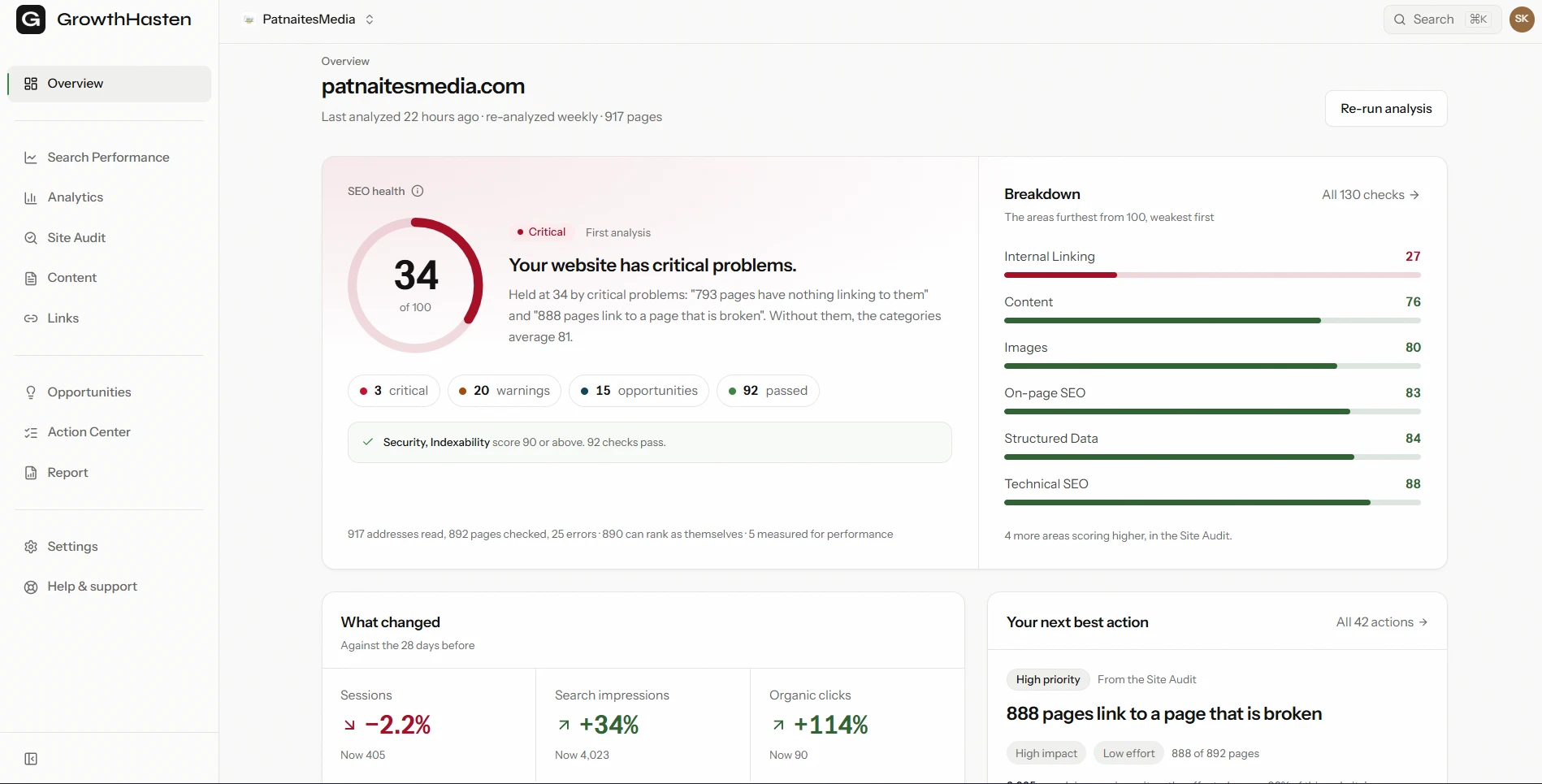
Connect Search Console and GrowthHasten's Search Performance view flags pages that rank well but get ignored, and queries close enough to page one to be worth the push, from 16 months of your own data.
Explore Search PerformanceWhat structured data belongs on a pricing page?
For software, a SoftwareApplication with a nested Offer, and a PriceSpecification where you publish a range rather than a single figure. The Offer type is defined by Schema.org as an offer to transfer some rights to an item or provide a service, and it carries the price, priceCurrency, and url properties that do the actual work here.
A minimal block for a single published tier:
<script type="application/ld+json">
{
  "@context": "https://schema.org",
  "@type": "SoftwareApplication",
  "name": "Your Product",
  "applicationCategory": "BusinessApplication",
  "offers": {
    "@type": "Offer",
    "name": "Growth",
    "price": "49",
    "priceCurrency": "USD",
    "url": "https://example.com/pricing"
  }
}
</script>
When you publish a band rather than an exact figure, swap the flat price for a nested specification. Schema.org's PriceSpecification type defines minPrice and maxPrice for exactly this case, described as the lowest and highest price where the price is a range:
"priceSpecification": {
  "@type": "PriceSpecification",
  "priceCurrency": "USD",
  "minPrice": "49",
  "maxPrice": "199"
}
Where several tiers sit on one URL, AggregateOffer is the type built for a single item associated with multiple offers, and it carries lowPrice, highPrice, and offerCount. Keep the individual Offer entries underneath it if you want each tier named.
One rule governs all of it, and it is the one most likely to get a pricing page in trouble. Google's structured data general guidelines state directly that you should not mark up content that is not visible to readers of the page. Markup claiming a price the visitor cannot see is a policy violation, not a clever workaround for a gated tier, and it costs rich result eligibility rather than earning it. If your enterprise tier says "contact us" on the page, your schema says "contact us" too. Our guide to how structured data is built and validated covers the format and the validators to run before this ships.
Why do AI answer engines get your pricing wrong?
Because they could not extract a number from your page and used something else. An assistant asked what your product costs needs a figure it can attribute. If your page offers only a toggle, an image, or a form, there is nothing to lift, so it falls back to whatever did publish one: a review listing, a competitor's comparison page.
That substitute is rarely current. Review listings record a price at the moment someone wrote the entry and are not updated when you change plans, so the figure circulating about you can be a version you retired a year ago. The engine is not wrong to cite it. It is citing the only extractable number available.
What makes a price extractable is unglamorous: a visible figure, in text, in the served document, next to the plan name it belongs to. A "starts at $49 per user per month" line does more here than any amount of schema, because schema supports the claim while the visible text is the claim.
When this matters less: if you sell exclusively into enterprise procurement and no buyer would ever accept a list price as meaningful, being unquotable costs you little. The cost lands on companies with a self-serve tier, where the buyer genuinely is comparing numbers before they talk to anyone.
What happens when you change your prices?
Three things go stale at different speeds, and treating them as one job is how old prices survive in search results. The visible page updates on deploy. The structured data updates only if it is generated from the same source as the visible price. The version Google holds updates whenever the page is next crawled and rendered, which you do not schedule.
So make the page and the markup move together, then verify rather than wait. Generate the schema from the same pricing data that renders the page, so the two cannot drift. Then request indexing and check the rendered output to confirm the new figure is what Google has. Recrawling is not immediate, and any day count would be a guess, so check rather than assume a timeline.
Caching deserves a separate look. A CDN or a static build can keep an old price live for both visitors and crawlers well after the deploy that changed it, and the authoring tool will keep showing you the new value throughout. Invalidate the cache for that URL as part of the pricing change, not as a follow-up ticket.
How do you capture "[competitor] pricing" searches?
Not with your own pricing page. Someone searching a competitor's pricing wants a comparison, and a page about your plans does not answer that query, so it will not hold a position even if it briefly ranks.
That demand belongs on a dedicated page that names the competitor, sets the two pricing models side by side, and sends the reader to your live pricing instead of freezing numbers into a second page. The template for that, how to pick which rivals earn one, and the guardrails for naming them all sit in our comparison and alternative pages guide.
What are the most common SaaS pricing page SEO mistakes?
The recurring ones cluster into a short list, and most are invisible from the browser that built the page.
- Never checking the served document: assuming the price a designer sees is the price a crawler stored.
- Schema that outlives the page: hand-maintained markup carrying last quarter's price.
- Marking up a hidden price: putting a figure in the structured data for a tier the page shows as "contact us".
- Blocking the page from search: a
noindexon the whole pricing URL when only the gated enterprise variant needed handling. - Chasing competitor pricing queries with your own page: targeting a comparison intent without a comparison.
- Treating a price change as a design task: shipping the number without invalidating the cache or verifying the re-render.
When should you not optimize your pricing page for search?
When the page is not stable enough to be worth the work, or when there is no search demand for your name yet. Three situations make this the wrong quarter for it.
Before product-market fit: if the packaging is still moving, you will optimize a structure you are about to replace, and every stale price left behind becomes a cleanup job later.
When pricing changes weekly: a page that genuinely reprices on a short cycle should lean on an unambiguous unit rate rather than tier figures, and the verification loop above becomes overhead you will quietly stop running.
When nobody searches your brand yet: vendor-aware queries need a vendor people have heard of. If your name gets no searches, the page has no demand to capture and your effort belongs further up the funnel.
None of these are permanent, and none argue for blocking the page. They argue for leaving it indexed, honest, and unoptimized until the work would pay for itself.
The habit that keeps this from decaying is small: make the crawl-truth check part of shipping a price change, the way you would test a checkout flow after touching it. Pricing pages break quietly, and they break at the moment you are least likely to look, right after a change everyone was focused on getting live.
This week, open your pricing page in view-source and search for the number your visitors see. If the figure is not there, start there, because the alternative is learning about it from a buyer who asked an assistant what you cost and got someone else's number.
See What Your SaaS Site Needs Fixed First
GrowthHasten is AI-native SEO software. It crawls your marketing site, joins it to your own Search Console and Analytics, and orders what it finds so the work worth doing first sits at the top. The free plan covers one website of up to 900 pages, with no card.
Analyze Your WebsiteQuestions
Frequently asked questions
Should a SaaS pricing page be indexed?
Almost always yes. It is the page vendor-aware buyers search for by name, and blocking it hands that demand to third-party listings you do not control. Two exceptions deserve separate handling rather than a blanket rule. A gated enterprise tier belongs on its own URL so it can stay out of the index without taking the main page with it. Per-region price variants need canonical handling, because they are the same offer in different currencies and the signals should consolidate rather than disappear.
Should you show prices or say "contact sales"?
Publishing a starting price or a band keeps an extractable number in the document, which is what both a crawler and an answer engine need. "Contact sales" is a legitimate choice for genuinely bespoke enterprise deals, but publishing nothing does not remove your price from the internet. It moves the number buyers see from a page you control to a review site or a competitor's comparison page, where it is often a version of your pricing you retired long ago.
What schema markup should a pricing page use?
For software, use SoftwareApplication with a nested Offer carrying price, priceCurrency and url. Where you publish a range rather than a single figure, add a PriceSpecification with minPrice and maxPrice. Where several tiers share one URL, AggregateOffer describes the set with lowPrice, highPrice and offerCount. One rule governs all of it: Google's structured data guidelines say not to mark up content that is not visible to readers, so the markup must never state a price the page does not show.
Why does ChatGPT or Perplexity quote the wrong price for my product?
Because it could not extract a price from your page and used another source instead. Figures written in by a monthly and annual toggle, rendered inside an image, or hidden behind a form give an assistant nothing to lift, so it falls back to a review listing or a roundup post. Those sources record a price at the moment someone wrote the entry and are not updated when you reprice. A visible "starts at" figure in the served HTML is what makes you quotable.
Do monthly and annual pricing toggles hurt SEO?
They can, if the price only exists after JavaScript runs. Google queues pages for rendering after the initial crawl, and until that render completes the stored version of your page may carry no price at all. The fix is not to remove the toggle. Render one of the two states into the initial HTML and let the toggle switch between them, so a price is always present in the served document rather than created in the browser.
How do you rank for "[competitor] pricing" searches?
Not with your own pricing page. That query wants a comparison, and a page about your own plans does not answer it, so it will not hold a position for it even if it briefly ranks. Build a dedicated comparison page that names the competitor, sets the two pricing models side by side, and points back at your live pricing instead of copying numbers that quietly go out of date.

Written by
GrowthHasten Team
Editorial Team, GrowthHasten
Articles from the GrowthHasten editorial team, grounded in primary research, our own testing, and what analyzing real websites shows, fact-checked in-house.
View profile