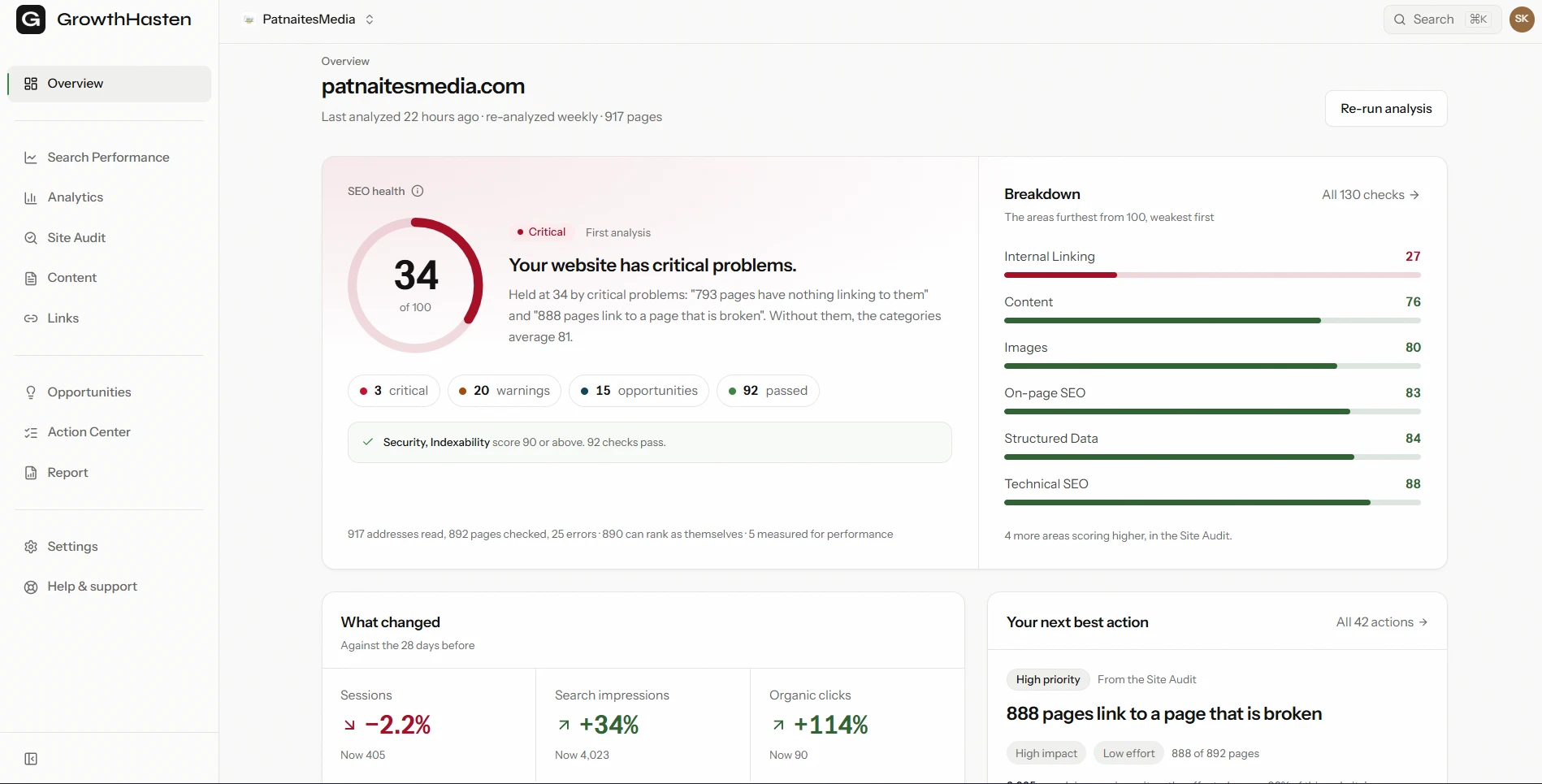


Search engine optimization (SEO) is the practice of earning visibility in search results by making your site the clearest, most trustworthy answer to what people are looking for. This guide is the hub for everything we publish on the topic, written for founders and marketing teams who want the whole map before they pick a starting point. It covers how search engines work, the four pillars that carry the work, how keywords and intent fit together, what makes content and links count, the technical foundations you can't skip, and how AI answer engines change the picture. Each section is a tight overview that links to a deeper playbook. Read it end to end once, then use it as a table of contents for the rest.
The short version
- SEO isn't about pleasing an algorithm. It's about being the result a search engine can confidently hand to a person.
- It's a system, not a one-time fix. Results compound over months, and the compounding is the point.
- Four pillars carry the load: on-page, off-page, technical, and content. Neglect any one and the others underperform.
- AI answer engines are a second search surface. You earn citations there with the same clarity and credibility that earn rankings.
- Sequence matters: fix technical health and match intent before you chase links.
What is SEO, and why does it still matter?
SEO is the work of aligning your site with what search engines are trying to do: return the most useful, credible result for a query. It matters because search is still where most buying journeys begin, and because organic visibility, once earned, keeps working without paying for every click. Paid ads stop the moment the budget does. A page that ranks keeps compounding.
The honest caveat: SEO is slow. New sites and new pages take time to earn trust, and no reputable practitioner can promise a specific ranking on a specific date. What you can build is a durable position that gets cheaper to defend over time.
How do search engines actually work?
In three stages: crawling, indexing, and ranking. A crawler like Googlebot discovers URLs by following links and reading your sitemap.xml. Indexing is the step where the engine renders the page, understands its content, and decides whether to store it. Ranking is the final step, where the engine orders stored pages for a given query using hundreds of signals.
Keeping these three separate saves days of guesswork. A page that isn't crawled can't be indexed; a page that's indexed can still rank poorly. When something goes wrong, the first question is always which stage broke. Google's documentation on how Search works walks through each stage in detail, and our own breakdown of how Google Search works translates it into what to check first.
What are the four pillars of SEO?
On-page, off-page, technical, and content. They aren't competing strategies, they're four surfaces of the same job, and the weakest one usually sets your ceiling.
| Pillar | What it covers | Go deeper |
|---|---|---|
| On-page | Titles, headings, internal links, and how each page signals its topic to search engines | On-page SEO checklist |
| Content | The substance that answers the query: depth, accuracy, and genuine usefulness | Content marketing for SEO |
| Technical | Crawlability, indexing, site speed, structured data, and rendering | Technical SEO guide |
| Off-page | Backlinks, brand mentions, and the external signals of authority and trust | Covered below |
If you're deciding where to spend the next month, find the pillar you've most neglected. That's almost always where the return is highest.
How do you find the right keywords?
Start with the questions your customers already ask, then validate them against real search demand. Keyword research is the process of mapping the language people use, grouping it by the topic and intent behind it, and prioritizing terms you can realistically win. A term with modest volume that matches a buying decision usually beats a high-volume term that never converts.
The common trap is chasing volume alone. A page that ranks for a popular query no one acts on is a vanity result. Our keyword research guide covers how to build topic clusters and read difficulty without overpaying for tools.
When not to obsess over keywords: if you have fewer than a dozen pages and none of them are technically healthy, keyword expansion is premature. Fix the foundation first.
What is search intent, and why does it decide everything?
Search intent is the goal behind a query, and matching it is the single biggest factor in whether a page ranks. The same words can carry different intents. Someone searching "running shoes" wants to browse and buy; someone searching "how to clean running shoes" wants instructions. Serve the wrong format and no amount of optimization rescues the page.
Intent usually falls into four buckets: informational, navigational, commercial, and transactional. Before you write anything, look at what already ranks for your target query. The current results are the engine telling you, plainly, which intent it believes the query carries. Our dedicated guide to search intent covers how to read each of the four from a live results page, which modifiers are reliable signals and which only look like they are, and how to diagnose a mismatch on a page you have already published.
What makes content rank, and where does E-E-A-T fit?
Content ranks when it answers the query more completely and more credibly than the alternatives. Length isn't the lever. Coverage is. A page that resolves the question, anticipates the follow-up, and does it in fewer words often outperforms a longer, padded competitor.
E-E-A-T: experience, expertise, authoritativeness, and trustworthiness, is how Google's quality guidelines describe the credibility signals raters look for. It isn't a score you can set. It's the accumulated evidence that a real, qualified source stands behind the page: clear authorship, first-hand experience, accurate claims, and citations to primary sources. Google's Search Essentials set the baseline every page should meet.
In our experience, the fastest credibility win is also the least glamorous: cite the primary source instead of paraphrasing a competitor who paraphrased it first.
Do backlinks still matter?
Yes, but their role is narrower than the folklore suggests. A backlink is a vote of confidence from another site, and links from relevant, trusted domains still help establish authority. Our link building guide covers the tactics that earn them without the risk. What no longer works is volume for its own sake, networks of low-quality links are a liability, not an asset.
The durable approach is to earn links by publishing things worth citing: original data, useful frameworks, clear explanations. Digital PR and genuine relationships do the rest. The reverse direction is worth getting right too, and our guide to external links and when to nofollow covers which attribute each outbound link needs.
When not to chase links: if your pages don't yet deserve to rank on content and intent, links won't save them. Authority amplifies quality; it doesn't substitute for it.
What are the technical foundations you can't skip?
The non-negotiables are crawlability, indexability, and a clean site structure. If a search engine can't reach, render, and understand your pages, nothing else you do registers.
Crawl control. robots.txt governs crawling, not indexing, a URL blocked there can still appear in results if other pages link to it. Index control. Use a noindex tag to keep a page out of the index, and allow crawling so the engine can actually see that tag. Duplication control. A canonical tag tells the engine which version of similar pages is the original. Discovery. A current sitemap.xml helps crawlers find your important URLs. Our technical SEO guide sets out the full sequence.
What is Core Web Vitals, and how much does speed matter?
Core Web Vitals are Google's measures of loading, interactivity, and visual stability, and they're a real but modest ranking factor. They matter more as a tiebreaker and a user-experience floor than as a growth lever on their own. A fast page that answers the wrong query still loses.
The practical reading: get your vitals into the "good" range, then stop optimizing milliseconds and go back to content and intent. Google's guidance on Core Web Vitals defines the current thresholds. Structured data is a related technical win, marking up your pages with supported structured data types can earn richer results without changing your rankings directly.
Does local SEO apply to you?
Only if you serve customers in a specific place. Local SEO optimizes for "near me" and city-based queries through a Google Business Profile, consistent name-address-phone details, and local reviews. It's a distinct discipline with its own mechanics.
For most SaaS and B2B companies, our core focus, local SEO is off to the side. If your customers don't care where you're located, the effort is better spent on the pillars above. We flag it here so you know it exists and can recognize when it's genuinely relevant.
What is AI search, and how is it changing SEO?
AI search is the shift from ten blue links to synthesized answers, and it adds a second surface you optimize for. Google's AI Overviews, ChatGPT, Perplexity, and Claude increasingly answer questions directly and cite a handful of sources. Getting cited is the new visibility, and the practices behind it have names: answer engine optimization (AEO) and generative engine optimization (GEO).
The reassuring part is that the fundamentals transfer. Answer engines favor content that states its answer plainly up front, is well structured, and comes from a credible source, the same qualities that win featured snippets. The new work is making passages easy to quote in isolation. Our AI SEO guide covers how to structure pages for citation.
Which SEO tools do you actually need?
One free tool covers the most important job: Google Search Console, which reports your real impressions, clicks, and indexing data straight from Google. Add a paid tool only when a specific job, keyword research, technical crawling, or page speed, demands it.
| Category | Job to be done | Representative tools |
|---|---|---|
| Search Console | See real impressions, clicks, and indexing status | Google Search Console |
| Keyword and competitor research | Estimate demand, difficulty, and gaps | Ahrefs, Semrush |
| Technical crawling | Find broken links, redirects, and crawl issues | Screaming Frog |
| Performance | Measure Core Web Vitals and page speed | PageSpeed Insights, Lighthouse |
When not to buy the expensive suite: if you're not yet acting on the free data you already have, a second paid tool just adds dashboards to ignore.
What are the most common SEO mistakes?
Most failures come from a short, repeatable list. Recognizing them is faster than diagnosing them one at a time.
- Targeting keywords, not intent. Publishing a blog post for a query that wants a product page.
- Publishing volume over quality. Ten thin pages where two strong ones would rank, though publishing at real scale can work when it's built right, which is the subject of our programmatic SEO guide.
- Ignoring the technical stage. Great content on pages Google can't crawl or index.
- Cannibalizing your own topics: Several pages competing for one query, splitting the signal. This is usually created by the plan rather than by the writing, which our guide to content planning covers in detail, and our guide to diagnosing the overlap once it has already happened covers what to do about it.
- Chasing links before earning them. Spending on authority a page doesn't yet deserve.
- Measuring rankings instead of outcomes. Celebrating position one on a term that never converts.
How do you measure whether SEO is working?
By outcomes, in a rough order of trustworthiness. Rankings move first and mean least; organic clicks and qualified conversions move later and mean most. Watch the trend over months, not the wobble week to week.
A workable measurement stack: Search Console for impressions and clicks, your analytics for organic sessions and conversions, and a rank tracker for the specific terms tied to revenue. If impressions climb but clicks don't, your title tags and descriptions are the problem. If clicks climb but conversions don't, you're ranking for the wrong intent.
Where should you start? The GrowthHasten SEO roadmap
Start by fixing what blocks results, then build what earns them. Doing this out of order is the most common way to waste a quarter. Here's the sequence we follow.
Phase 1, Foundation (weeks 1–2). Confirm pages can be crawled and indexed. Fix robots.txt mistakes, resolve canonical conflicts, submit a clean sitemap.xml, and get Core Web Vitals into the "good" range.
Phase 2, Intent and mapping (weeks 3–4). Research keywords, group them into topics, and match each to the right page type and intent. Kill or merge pages that cannibalize each other. Deciding which topics become new pages and which become updates to existing ones is its own step, and our guide to deciding what to publish next covers how to route each one.
Phase 3, Content (ongoing). Build the pages that answer your priority topics better than what ranks now. Lead with the answer, cite primary sources, and structure passages so an answer engine can quote them.
Phase 4, Authority (ongoing, after content). Earn links and mentions to the pages that already deserve them.
The decision rule: never advance a phase while the previous one is broken. If a page can't be indexed, no content or link work on it counts. If you're unsure which phase you're in, you're in Phase 1 until proven otherwise.
When not to follow this literally: an established site with strong technical health can skip straight to Phase 2 or 3. The sequence is a safeguard against skipping foundations, not a mandate to redo work that's already sound.
Putting it together
The one habit worth building is diagnosis before action: whenever a page underperforms, ask which stage broke, crawling, indexing, intent, content, or authority, before you change anything. That single question prevents most wasted effort in SEO.
This week, open Google Search Console and run the URL Inspection tool on your three most important pages. Confirm each is indexed and serving the query you expect. That five-minute check tells you whether you're working on the right phase at all.
If you are weighing whether to handle SEO in-house or bring in help, our guide to SEO services explains what to expect and how to choose a partner.
See What Your Site Needs Fixed First
GrowthHasten is AI-native SEO software. It crawls your website, runs 130+ deterministic checks across 12 categories, and orders what it finds so the work worth doing first sits at the top. The free plan covers one website of up to 900 pages, with no card.
Analyze Your WebsiteQuestions
Frequently asked questions
How long does SEO take to show results?
Most sites see meaningful movement in three to six months, and competitive terms can take longer. New pages need time to be crawled, indexed, and trusted before they rank. Technical fixes can show faster, sometimes within weeks, but content and authority compound gradually. Anyone promising rankings in days is describing paid ads, not SEO. Treat the first quarter as building the foundation rather than harvesting results.
What are the four main types of SEO?
On-page, off-page, technical, and content SEO. On-page covers titles, headings, and internal links that signal each page's topic. Content is the substance that answers the query. Technical SEO handles crawlability, indexing, speed, and structured data. Off-page covers backlinks and external trust signals. They work together rather than in isolation, and the weakest pillar usually caps how well the others can perform.
Is SEO still relevant with AI search and AI Overviews?
Yes, and the fundamentals transfer directly. AI answer engines like AI Overviews, ChatGPT, and Perplexity still pull from and cite web pages, and they favor content that states its answer clearly and comes from a credible source. The new work is making passages easy to quote in isolation, a practice called answer engine optimization. Strong traditional SEO is the foundation that makes a page citable by AI in the first place.
Do I need to pay for SEO tools to get started?
No. Google Search Console is free and gives you your real impressions, clicks, and indexing data, which is the most important information for any SEO program. Free tools like PageSpeed Insights and Lighthouse cover performance. Paid suites like Ahrefs or Semrush add keyword and competitor research that speeds up the work, but they are worth buying only once you are already acting on the free data you have.
What is the difference between SEO and SEM?
SEO earns unpaid, organic visibility in search results by improving your site's relevance and authority. SEM, or search engine marketing, usually refers to paid search advertising where you bid for placement. SEO takes longer but keeps working after the effort is spent; paid search delivers immediate traffic that stops the moment the budget does. Many companies run both, using paid search to test demand while SEO compounds underneath.
How do I know if my SEO is actually working?
Measure outcomes rather than rankings alone, and watch the trend over months. Use Search Console for impressions and clicks, and your analytics for organic sessions and conversions. If impressions rise but clicks do not, your titles and meta descriptions need work. If clicks rise but conversions do not, you are ranking for the wrong intent. Revenue-linked conversions are the most trustworthy signal that the program is paying off.
Tags

Written by
GrowthHasten Team
Editorial Team, GrowthHasten
Articles from the GrowthHasten editorial team, grounded in primary research, our own testing, and what analyzing real websites shows, fact-checked in-house.
View profile