
The Findings No Single Source Could Have Made
"26 pages have no structured data" is a finding, and it lives on the audit. "Those 26 pages carry almost all of your impressions" is an insight, and it exists only because Search Console is connected too.
Free plan: one website of up to 900 pages, and three re-analyses. No card, no trial clock.
- 11
- Detector families
- 0
- Numbers AI may edit
- 3
- Distinct empty states
- Free
- Cost
Every Tool Reports. Almost None Of Them Join.
A crawler knows what is wrong with your pages. Search Console knows which pages matter. Analytics knows what happened after the click. Kept apart, each produces a competent report and none of them produces a priority.
The failure mode of an intelligence engine is not missing something. It is confidently reporting noise: a detector with no floor under it will find a pattern in any data set you give it, and the third time somebody follows one of those and finds nothing there, the whole screen stops being read.
- A technical issue list with no sense of which items touch pages anybody visits
- Traffic changes nobody can attribute to anything the site did
- Recommendations that read as plausible and turn out to be statistical noise
- Three tools open at once, and the join between them done in somebody's head
Eleven Detectors, Each With A Floor Under It
11 detector families run over the crawl, the audit, Search Console and Analytics together: traffic-weighted issues, search opportunities, organic traffic change, click to engagement, conversions not configured, health improved, where to start, the pages carrying the most, the weakest category, nothing connected, and what changed. Each has a floor under it in configuration, because a detector that always finds something is a detector nobody believes.
Results are ranked by impact times confidence times relevance over effort, and deduplicated by subject, so the same underlying problem does not arrive three times wearing different hats.
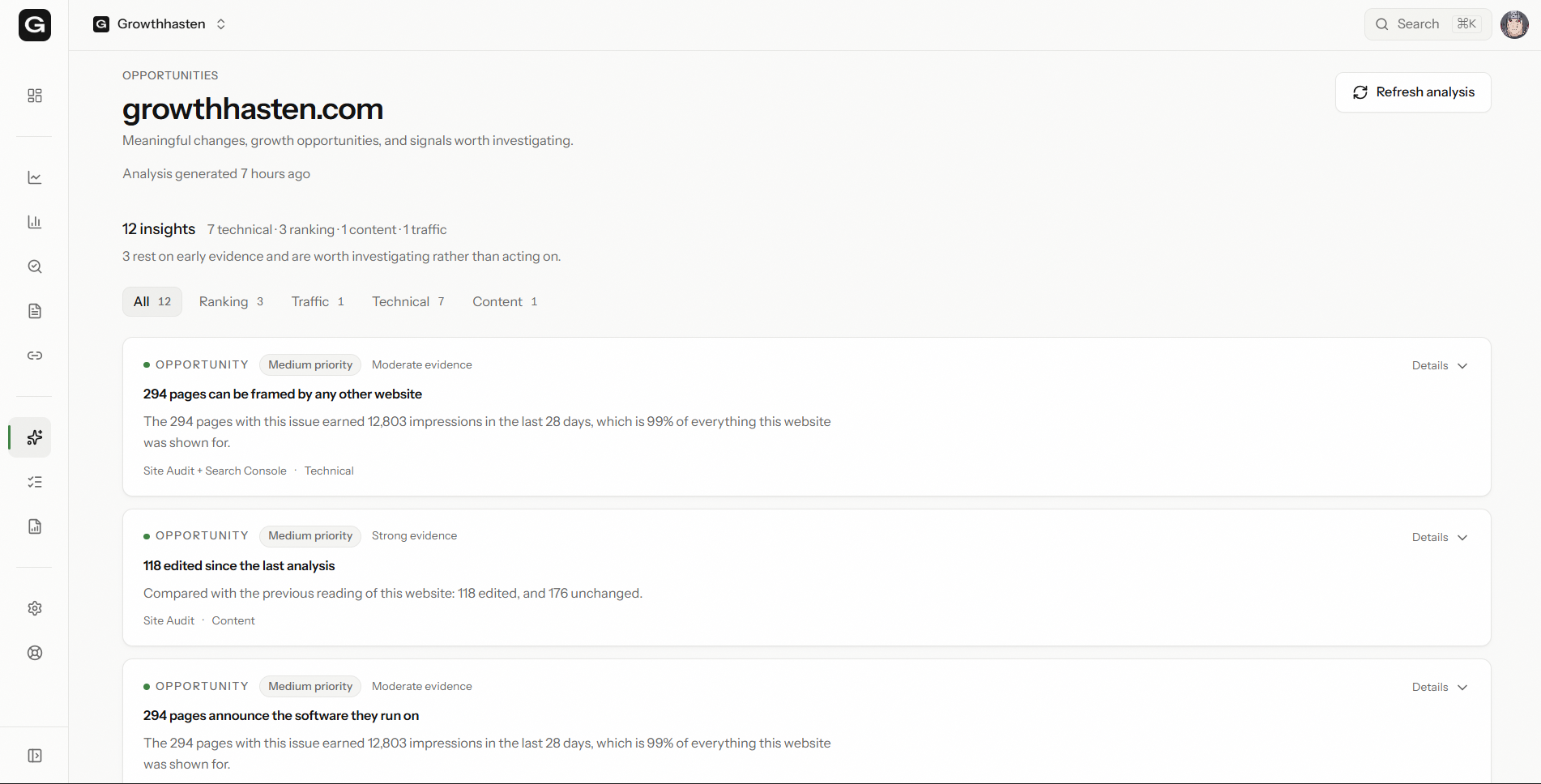
Each card carries its fact, its evidence, why it matters and what to do, all written by the detector that found it. The reasoning layer can rewrite the prose and can never touch a number: the response type has nowhere to put one, and an explanation about an insight we did not send is dropped.
The detector families
- Traffic-weighted issues: which technical problems sit on the pages that matter
- Search opportunities, organic traffic change, and click to engagement
- Conversions not configured, and health improved since the last run
- Where to start, the pages carrying the most, and the weakest category
- Nothing connected, and what changed
How it behaves
- Ranked by impact times confidence times relevance, over effort
- Deduplicated by subject
- Every card carries its fact, its evidence, why it matters, and what to do
- Three different empty states: nothing connected, nothing detected, nothing matching the filter
- A stale notice when the sources have changed since the run read them
What You Get, And What It Will Not Do
What you get
- A priority that accounts for traffic, not just severity
- Fewer, better recommendations, because every detector has a floor
- An explanation you can check, since the evidence travels with the card
- One screen where three data sources have already been joined
What it will not do
- It degrades rather than disappears. No key, no budget, a refusal or a timeout all leave every insight complete with its detector's own sentences, and the screen says which happened.
- The reasoning layer may rewrite prose and may never touch a number.
- With nothing connected it says so, rather than producing crawl-only insights dressed up as a full picture.
About Opportunities
What is the difference between an insight and an audit finding?
An audit finding comes from one source: the crawl. An insight is something no single source can compute. Twenty-six pages having no structured data is a finding. Those twenty-six pages carrying almost all of your impressions is an insight, and it only exists because Search Console is connected too.
Can AI change the numbers?
No, and not as a policy: as a type. The reasoning layer's response has nowhere to put a number, and any explanation referring to an insight we did not send is dropped before it renders.
What happens if the AI is unavailable?
Every insight still arrives complete, written in its detector's own sentences, and the screen says which of the four things happened: no key, no budget, a refusal, or a timeout. The product degrades rather than disappearing.
It Does Not Work Alone
Every part of GrowthHasten reads the same project, which is what lets one of them know something another one found.
Free To Start
Run Opportunities On Your Website
Sign up with your domain and the first analysis starts before the redirect finishes. Free plan: one website of up to 900 pages, and three re-analyses. No card, no trial clock.