

B2B SEO is the practice of building organic search visibility that feeds a sales pipeline, where a small, high-value audience researches for months and several people sign off before anyone buys. It differs from B2C, and even from generic SaaS SEO, because the audience is tiny, the sale is a committee decision, and a ranking that does not influence a deal is a vanity metric. This guide is for B2B founders, demand-gen leads, and marketers who sell to other businesses and want the full map before committing a quarter. It covers how B2B SEO differs, how to map content to a multi-stakeholder buyer journey, keyword strategy for low-volume high-intent terms, the bottom-funnel assets that move pipeline, and how to measure the work by influenced revenue rather than position. Read it once end to end, then treat it as a reference.
The short version
- Volume is the wrong target. In B2B, a term with 40 searches a month can be worth more than one with 4,000.
- You are not writing for one reader. A single deal runs through a champion, an economic buyer, and a technical evaluator, each searching different queries.
- The sales cycle is long, so SEO influences deals it can never last-click. Measure pipeline influenced, not conversions attributed.
- The gap most B2B sites have is bottom-funnel: comparison, alternatives, ROI, integration, and case-study pages that competitors already own.
- Without a feedback loop from sales, you will optimize for the wrong questions. The best keywords are the ones prospects ask on calls.
What is B2B SEO, and how is it different from B2C?
B2B SEO is search optimization organized around a considered, high-value purchase made by a group, rather than an impulse or single-person purchase. The crawling, indexing, and ranking mechanics are identical to any site. What changes is the shape of the demand and the definition of success.
Three differences matter most. The audience is small, so the total addressable search demand for your exact buyer is a fraction of a consumer market, and chasing volume pulls in the wrong people. The purchase is a committee decision, so the same account may generate a dozen searches from different roles with conflicting priorities. And the sale is slow and expensive, which means a page can shape a deal months before it closes and never show up in a last-click report.
It also differs from generic SaaS SEO. A self-serve SaaS product can convert a signup on the first visit; a B2B deal with a procurement process and an annual contract almost never does. Our guide to SaaS SEO covers the product-led and free-tool plays that suit self-serve motions, many of which do not apply when the buyer is a committee signing a six-figure contract.
Why does a long, multi-stakeholder sales cycle change B2B SEO?
Because no single page can carry a deal that takes months and involves several people. A buying group might start with "how to reduce onboarding time," move to "Vendor A vs Vendor B," and finally "Vendor A security compliance" from a different person entirely, weeks apart. Each query carries a different intent, a different stage, and often a different reader.
This has a practical consequence: you plan a system, not a post. Content has to meet each stakeholder at their stage and hand them toward the next through internal links. An educational article that never points at a solution, a comparison, or a proof asset is a dead end, however well it ranks.
It also makes attribution messy on purpose. A closed deal may follow twenty touches across informational and commercial pages read by three people. Judge each page by its own last-click conversion and you will kill the top-of-funnel pages that started the conversation.
How do you map content to the B2B buyer journey?
By sorting every query into one of four stages before you write, then building for the stage rather than the keyword. The B2B journey runs from problem-aware to solution-aware to vendor-aware to decision, and each stage needs a different page type and a different metric to judge it. Here is the funnel-to-content map we use to plan a B2B system. Build it from the bottom up so the revenue-adjacent pages exist before you invest in awareness volume.
| Stage and intent | Content that serves it | The metric that matters |
|---|---|---|
| Decision: vendor-aware, ready to justify a choice ("Vendor A pricing," "Vendor A security") | Pricing, security, ROI calculator, case studies, demo pages | Pipeline created and demo requests |
| Vendor-aware: building a shortlist ("Vendor A vs Vendor B," "Vendor A alternatives") | Comparison pages, alternative pages, integration pages | Pipeline influenced and email captures |
| Solution-aware: evaluating approaches ("best [category] software," "how teams solve X") | Category guides, buyer's guides, use-case pages | Qualified traffic and assisted deals |
| Problem-aware: naming the pain ("why is [process] so slow," "what is [concept]") | Educational articles, thought-leadership, original research | Qualified traffic and downstream assists |
The rule that keeps this map honest: every problem-aware and solution-aware page must link toward the next stage. A guide with no path to a use-case, comparison, or proof page is a leak, not an asset. The map is only as strong as the internal links connecting its rows. Most B2B deals sit on top of a SaaS product, so the same stage-by-stage discipline, extended through activation, retention, and expansion, is what our guide to post-signup SaaS content marketing covers for the half of the funnel this piece doesn't reach.
How do you write for multiple stakeholders in one deal?
By recognizing that a B2B deal is not one reader but a buying group, and each member searches for different things and needs different proof. The champion wants to look smart for backing you. The economic buyer wants the business case. The technical evaluator wants to know it will not break. A page that speaks only to one of them stalls when it reaches the others.
The three roles map to distinct content needs:
- The champion. Reads problem-aware and solution-aware content, then shares it internally. Give them a clear point of view and material they can forward without embarrassment.
- The economic buyer. Wants ROI, total cost, and risk. Serves best from an ROI page, a pricing explanation, and case studies that name a comparable company and a result.
- The technical evaluator. Wants security, integrations, and implementation detail. Serves best from documentation, integration pages that prove technical fit, and a security or compliance page.
You do not need a separate page per role on every topic. You need the whole set to exist, because a deal stalls at whichever stakeholder has no page for their objection. Which pages that set contains is a separate exercise, and our inventory of the page types a B2B website needs works through twenty-one of them.
How do you do keyword research for low-volume, high-intent terms?
By reading intent and fit before volume, and accepting that the best B2B keywords often show almost no search volume in your tools. A term like "SOC 2 compliant [category] software" might report 30 searches a month, but every one of those searchers is a qualified buyer with a budget. That beats a 5,000-volume term that pulls students and job seekers who will never buy.
Three habits make low-volume research work. Trust intent over volume: a query that names a category, a competitor, or a buying requirement signals a real buyer even when the number is small. Mine the language your prospects actually use, which is usually more specific than the head terms keyword tools surface. And treat zero-volume terms as real when the intent is unmistakable, because tools round small numbers to zero and miss the exact long-tail phrases decision-makers type. Our keyword research guide covers clustering and reading intent from the live results, which matters more here than raw estimates.
When not to trust the volume number: never dismiss a term solely because a tool shows zero. In B2B, the highest-intent phrases are often the ones with too little volume to register, and you will only find them by talking to sales and reading real deal conversations.
Which bottom-funnel pages actually drive pipeline?
The pages closest to a buying decision, which most B2B sites underbuild because they feel less like content and more like sales. These are the assets that convert existing demand, so they pay back fastest and deserve to be built first.
| Page type | What it captures | Which stakeholder it serves |
|---|---|---|
| Comparison ("vs") pages | Buyers comparing you to a named competitor | Champion and economic buyer |
| Alternative pages | Searches for "[competitor] alternatives" from unhappy users | Champion |
| ROI and pricing pages | The business case and total cost of ownership | Economic buyer |
| Case studies | Proof that a comparable company got a result | Economic buyer and champion |
| Integration and security pages | Fit with the existing stack and risk requirements | Technical evaluator |
Comparison and alternative pages are the ones B2B teams most often skip, usually out of discomfort with naming competitors. That discomfort is exactly why the pages convert: someone typing "Vendor A vs Vendor B" has already decided to buy something, and whoever owns that page frames the comparison. Write it fairly, concede where a competitor genuinely fits better, and it earns trust rather than looking defensive, and our comparison and alternatives page playbook gives the section-by-section structure and the honesty guardrails that keep it fair.
Where do thought leadership and demand generation fit?
At the top of the funnel, where they create demand you will capture later rather than convert it now. In a small market, most of your future buyers are not searching yet, so problem-aware content, original research, and a genuine point of view build the awareness and authority that make later searches favor you.
Thought leadership earns its place when it says something only you can say, backed by your data or your experience. A generic overview competes with a hundred others; a piece built on original research or a contrarian, well-argued position travels through the exact buying committees you want to reach. Our guide to content marketing for SEO lays out the pillar-and-cluster model this depends on.
When not to lead with thought leadership: if your bottom-funnel pages do not exist yet, awareness content has nowhere to send the demand it creates. Build the comparison, ROI, and proof pages first, then invest in demand generation once there is a funnel to catch it.
How do you measure B2B SEO by pipeline, not rankings?
By following the account past the click into pipeline and influenced revenue, because rankings and traffic are leading indicators that say nothing about whether a deal moved. A page that ranks first and pulls thousands of visits but touches no opportunity is worth less than a quiet page read by three people inside an active deal.
A workable measurement stack tracks four layers, in rising order of what they mean:
- Qualified organic traffic. Sessions from queries tied to your buyer's problem space, not all sessions.
- Marketing-qualified leads from organic. Form fills, demo requests, and content downloads from organic visitors who fit the profile.
- Pipeline influenced. Deals where an organic page appears anywhere in the buying group's journey, credited across touches rather than last click.
- Influenced revenue. Closed-won revenue from accounts that organic search touched, which is the only signal that ties SEO to the business.
Influenced beats attributed here on purpose. Because B2B journeys are long and multi-person, a strict last-click model will undercount SEO badly and lead you to cut the pages that quietly shape deals. Multi-touch influence is imperfect, but it sits closer to the truth than a single conversion event.
How do you align SEO with sales?
By building a two-way feedback loop, so the questions prospects ask on calls become the content you publish, and the content you publish becomes ammunition sales can send. Marketing owning SEO in isolation is how B2B sites end up ranking for terms that never touch a real deal.
The loop runs in both directions. From sales to content: the objections, comparisons, and questions that come up on calls are your highest-intent keyword list, already validated by real buyers. From content to sales: comparison pages, ROI pages, and case studies are assets a rep can send mid-deal to move a stalled stakeholder. Sit in on a few sales calls a month and you will find keyword ideas no tool would surface.
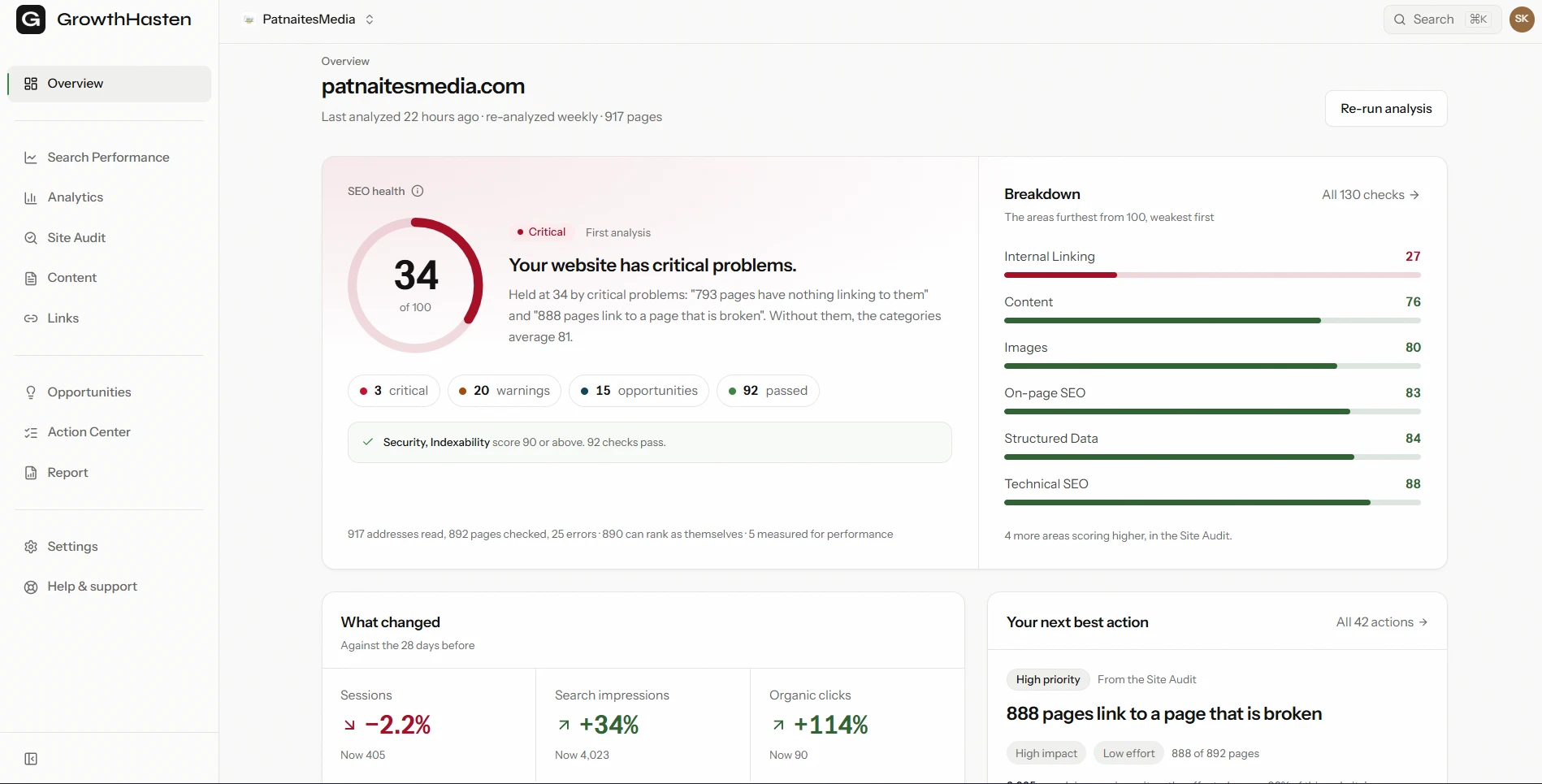
Set this up deliberately. A shared list of "questions we hear on calls," reviewed monthly, turns the sales team into a keyword research engine and makes every published page more likely to earn its keep in pipeline. If you want to see where your own site stands first, GrowthHasten's Site Audit crawls it and orders the fixes by what they are worth. And if you are early enough that funding stage matters as much as scope, our guide to SEO agencies for startups matches partners to exactly that constraint.
What are the most common B2B SEO mistakes?
Most B2B SEO failures come from a short, repeatable list. Recognizing them is faster than diagnosing each from scratch.
- Chasing volume over intent. Publishing broad, high-volume content that pulls the wrong audience while the terms your actual buyers search go uncovered.
- Ignoring the bottom funnel. Skipping comparison, alternative, ROI, and integration pages, then wondering why traffic never becomes pipeline.
- Writing for one stakeholder. Serving the champion well and leaving the economic buyer and technical evaluator with no page to answer their objections.
- No sales feedback loop. Building a keyword list from tools alone, disconnected from the questions real prospects ask.
- Measuring rankings, not revenue. Reporting positions and traffic while nobody can say whether a single deal was influenced.
- Orphaned content. Publishing without internal links, so top-of-funnel pages never hand a reader toward proof or a product page.
When should you not invest in B2B SEO?
When the conditions that make SEO pay off are not in place yet, because it is a compounding channel that rewards patience and punishes impatience. There are situations where the money and attention belong elsewhere first.
Hold off, or spend lightly, when your positioning is still shifting, since you will optimize for the wrong buyer and rewrite everything later. Hold off when you need revenue this quarter to survive, because paid channels and outbound deliver faster and SEO rarely moves a long B2B cycle in weeks. And reconsider the scale of the investment when your category is so new that almost no one searches for it yet, where demand creation through other channels matters more than capturing search demand that does not exist. None of these are permanent. They are timing signals, and the point is to start when a right-fit buyer is already searching and you can afford to wait for the compounding.
The one habit worth building is to judge every page by the stage and the stakeholder it serves, not by its ranking. Before you publish, name the stage, the intent, the stakeholder, and the next page it should hand the reader to. If you cannot name all four, the page is not ready. This week, ask your sales team for the ten questions they hear most on calls, then check whether you have a page built to answer each one. Wherever you do not, you have found your next page to write. For the technical fundamentals every one of these pages depends on, Google's Search Central documentation is the primary reference, and its Search Essentials set the baseline every page should clear.
See What Your Site Needs Fixed First
GrowthHasten is AI-native SEO software. It crawls your website, runs 130+ deterministic checks across 12 categories, and orders what it finds so the work worth doing first sits at the top. The free plan covers one website of up to 900 pages, with no card.
Analyze Your WebsiteQuestions
Frequently asked questions
What is B2B SEO?
B2B SEO is search engine optimization organized around a considered, high-value purchase made by a group of stakeholders rather than a single consumer. The crawling, indexing, and ranking mechanics are identical to any site, but the goal is different: it aims to move a buying committee from an early problem-aware search through evaluation to a signed deal. Success is measured in pipeline and influenced revenue, not raw traffic or rankings.
How is B2B SEO different from B2C SEO?
Three things set it apart. The audience is small, so chasing high search volume pulls in the wrong people instead of qualified buyers. The purchase is a committee decision, so one account generates many searches from different roles with different priorities. And the sales cycle is long and expensive, so a page can influence a deal months before it closes and never appear in a last-click report. You plan a content system, not a single ranking page.
How do you do keyword research for low-volume B2B terms?
By reading intent and buyer fit before volume. In B2B, a term with 30 monthly searches naming a category, competitor, or buying requirement can be worth more than a 5,000-volume term that pulls students and job seekers. Treat zero-volume phrases as real when the intent is unmistakable, because tools round small numbers to zero. The strongest keyword source is your sales team: the exact questions prospects ask on calls are validated, high-intent queries no tool surfaces.
How do you measure B2B SEO success?
By following accounts past the click through four layers: qualified organic traffic, marketing-qualified leads from organic, pipeline influenced, and influenced revenue. Rankings and traffic are leading indicators that say nothing about whether a deal moved. Because B2B journeys are long and involve several people, use multi-touch influence rather than last-click attribution. A strict last-click model undercounts SEO badly and leads teams to cut the top-of-funnel pages that quietly shape deals.
What are the most common B2B SEO mistakes?
The frequent ones are chasing volume over intent, ignoring the bottom funnel, and writing for only one stakeholder. Many B2B sites publish broad awareness content while skipping the comparison, alternative, ROI, and integration pages that actually convert demand into pipeline. Others build keyword lists from tools alone, with no feedback loop from sales, and report rankings while nobody can say whether a single deal was influenced. Orphaned content with no internal links compounds all of these.

Written by
GrowthHasten Team
Editorial Team, GrowthHasten
Articles from the GrowthHasten editorial team, grounded in primary research, our own testing, and what analyzing real websites shows, fact-checked in-house.
View profile