

Content marketing for SEO is the practice of building a connected body of genuinely useful content so search engines and readers treat you as a credible source on a subject. It is how you capture the demand that technical SEO and keyword research surface. This guide is for marketers and founders who publish regularly but watch individual posts stall, and who want to understand why depth outranks volume, a pattern that shows up sharply in our B2B SEO guide, where a handful of buyers with a long sales cycle need a very different cluster than a high-volume consumer topic does. It covers topical authority, the pillar-and-cluster model, planning clusters from intent research, content briefs, E-E-A-T, the editorial workflow, internal linking, and how to measure success without inventing numbers.
The short version
- Publishing more posts rarely helps. Publishing deeper coverage of fewer subjects does.
- Topical authority is earned by covering a subject completely, not by repeating a keyword.
- The pillar-and-cluster model works because internal links tell search engines which pages belong together.
- The content brief is the highest-leverage document in the workflow. It decides the outcome before a word is written.
- Measure content in stages: impressions and rankings first, engagement next, assisted conversions and AI citations last.
What does content marketing actually do for SEO?
It supplies the thing search engines rank: the answer. Technical SEO makes a site crawlable and fast, and keyword research tells you what people search for, but neither produces the page that satisfies the query. Content marketing does.
Think of it as a division of labor. Technical work and keyword research surface demand. Content captures it by answering the question better than the pages already ranking. Our complete guide to SEO sets out how these layers stack; this piece is about the layer that turns discovered demand into pages worth ranking.
Google's own guidance points the same direction. Its guidance on creating helpful, reliable content asks whether a page is written for people first and demonstrates real expertise. That is a content-marketing question, not a technical one.
What is topical authority, and why does depth beat scattered posts?
Topical authority is the credibility a site earns by covering a subject thoroughly rather than touching it once. When you answer every reasonable question a reader has about a topic, search engines gather more evidence that you understand it, and readers have fewer reasons to leave for another site.
Depth beats scatter because relevance is judged across a subject, not one URL at a time. Ten unrelated posts read like ten strangers who happen to share a byline. Ten connected posts read like a body of work.
In our opinion, topical authority produces stronger long-term results than isolated publishing, because it helps search engines understand subject depth and gives readers a path from one answer to the next. Here is the contrast we see most often.
| Dimension | Scattered posts | Topic cluster |
|---|---|---|
| How search engines read it | Isolated pages, weak subject signal | Connected pages, clear subject depth |
| Internal links | Accidental or absent | Deliberate, pillar-to-cluster |
| Ranking pattern | A few winners, many stalls | Compounding across the set |
| Maintenance | Each post refreshed alone | Refresh the cluster as a unit |
| Best for | One-off announcements | Subjects you want to own |
How does the pillar-and-cluster model work?
A pillar page covers the whole subject broadly; cluster articles cover each sub-topic in depth; internal links connect them both ways. The pillar links down to each cluster article, and every cluster article links back up to the pillar and across to its siblings where relevant.
The pillar targets the broad, high-intent term. The cluster articles target the specific long-tail questions underneath it. Together they signal that you cover the subject at both altitudes.
The internal links are not decoration. They are how you tell a crawler which pages form a set and which page is the canonical entry point for the subject. A pillar with no inbound cluster links is just a long article that happens to exist.
How do you plan a cluster from keyword and intent research?
Start from intent, then group by it. List the questions a reader asks across their whole journey with the subject, sort them into a small number of themes, and confirm each theme has real search demand before it becomes an article.
The practical sequence we use:
- Seed the subject. Write the broad term as the pillar candidate, then expand it with People Also Ask, related searches, and autocomplete.
- Group by intent, not keyword. Two phrasings of the same question are one article. A different question is a different article, even if the words overlap. Our guide to search intent covers how to read which is which from the live results page.
- Check the SERP for each group. If the results for two groups look nearly identical, you have one topic, not two. Merging early prevents keyword cannibalization later, and that guide covers how to diagnose and fix it once it has already happened.
- Assign the format the SERP rewards. A comparison query wants a table; a how-to query wants steps. Match the shape, not just the words.
The full method sits in our keyword research guide. The point for cluster planning: one article per intent, and never two articles chasing the same one.
How do you build a cluster, step by step?
In a repeatable sequence, so each article strengthens the set instead of standing alone. This is the build order we follow, and it is the part most teams skip straight past to drafting.
- Define the subject and its boundary. Name what the cluster covers and, just as important, what it does not. A boundary keeps the set focused and prevents overlap with your other clusters.
- Draft the pillar outline first. The pillar's H2s become your list of candidate cluster articles. If a sub-topic needs more than a section to answer, it earns its own page.
- Validate each cluster topic. Confirm demand and a distinct intent for every candidate. Cut the ones that duplicate an existing page or another cluster article. Our guide to content planning covers this routing in full, including when a candidate should update an existing page rather than become a new one.
- Write a brief per article. No drafting before the brief exists.
- Publish the pillar, then the clusters. Ship the pillar early so cluster articles have somewhere to link up to from day one. Then work through the clusters in priority order.
- Wire the internal links as you go. Each new cluster article links up to the pillar, and you add the pillar's link down to it. Link to sibling articles only where a reader would actually want the jump.
- Cover the intent completely before starting a new cluster. A half-built cluster sends a weaker signal than a small, finished one. Finish what you started.
- Schedule the refresh. Put a review date on the whole cluster, not scattered dates on individual posts, so the set stays coherent.
Sequence matters because the internal-link graph is built as a byproduct. Publish in a random order and you spend a later week retrofitting links you could have added for free.
Why does a content brief change the outcome?
Because it settles the hard decisions before drafting, when they are cheap to change. A writer working without one is guessing at all of that mid-sentence.
Our recommendation: treat the brief as the deliverable that gets approved, not the draft. The fields it fixes, and the template we use, are in our guide to the content brief.
How does E-E-A-T show up in the content itself?
Experience, expertise, authoritativeness, and trustworthiness are not badges you add at the end; they are visible in whether the writing shows first-hand knowledge, cites real sources, and admits limits.
Concretely, that means three things on the page:
- Experience. Implementation detail, trade-offs, and the mistakes you have actually seen, written from doing the work rather than summarizing others.
- Expertise and sourcing. Claims of fact linked to primary documentation. For search behavior, that means Google Search Central rather than a secondhand blog.
- Trust. Named author, honest scope, and transparency when something is an observation rather than a confirmed rule.
One caution: never manufacture experience. Invented numbers, borrowed case studies, and vague "studies show" claims are the fastest way to lose the trust the rest of the article is trying to build. If a figure is not verifiable, cut it.
What does the editorial workflow look like end to end?
Six stages, each with a clear handoff: research, brief, draft, edit, publish, refresh. Keeping them separate is what makes the process repeatable instead of heroic.
- Research. Read the top ranking pages and the primary documentation. Decide what you can add.
- Brief. Lock intent, questions, links, and the original asset. Get it approved.
- Draft. Write to the brief. Answer the question first, then expand.
- Edit. Check facts, voice, and structure. Remove anything that does not earn its place.
- Publish. Add on-page elements, internal links, and schema. Our on-page SEO checklist covers this stage.
- Refresh. Put the piece on a review cycle and treat it as living, not finished.
The workflow is deliberately boring. Predictable stages are what let a small team ship consistently, which is the actual precondition for topical authority. It is also, not coincidentally, roughly what content marketing services take over end to end when a team lacks the bandwidth to run every stage in-house.
The last stage, refresh, is a loop rather than an endpoint. On a set cadence you check each cluster for stale facts, broken links, shifted search intent, and ranking decline, then update the pages that need it and re-confirm the internal links. Refresh the cluster as a unit, since updating the pillar's framing usually means the cluster articles need a matching touch. Our recommendation is a review every six to twelve months, and sooner after a major algorithm update or a change in the tools you reference.
How does internal linking hold a cluster together?
It converts a pile of related articles into a structure a crawler can read. Internal links pass relevance and a share of ranking signal between pages, and they tell search engines which page you consider the primary answer for the subject.
Two rules keep the graph honest. Link with descriptive anchor text that names the destination, not click here. And link only where a reader would genuinely want the jump, because a forced link teaches search engines nothing.
The pillar should be the most-linked page in the cluster, since it is the entry point you want to rank for the broad term. Cluster articles link up to it and across to close siblings. We treat the internal-link map as part of the brief so it is designed, not discovered after the fact.
How do you measure whether the content is working?
In stages, because the signals arrive in order and impatience misreads them. Rankings and impressions move first, engagement next, and business outcomes last. Judging a two-week-old article by conversions tells you nothing useful.
| Signal | When it moves | What it tells you |
|---|---|---|
| Impressions and rankings | Earliest | Search engines are indexing and testing the page |
| Engagement (time, scroll) | Once traffic arrives | Whether the page actually satisfies the intent |
| Assisted conversions | Later, across sessions | Whether the cluster supports real business outcomes |
| AI citations and mentions | Gradually | Whether AI answer engines treat you as a source |
That last row matters more each quarter. AI answer engines and AI Overviews increasingly summarize and cite sources, and clear, well-structured, genuinely useful content is what gets quoted. Our AI SEO guide covers how to make pages more quotable, and our guide to what a specialist AI SEO agency engagement includes covers what to expect if you hire that work out. We deliberately give no benchmark numbers here, because meaningful targets depend on your starting authority and competition, and a made-up figure would mislead more than it helps.
When should you NOT build a topic cluster?
When you cannot commit to finishing it. A half-built cluster sends a weaker signal than a small, complete one, and abandoned clusters leave orphaned pages that dilute the subject rather than reinforce it.
Skip the model, at least for now, when any of these are true:
- The subject is off your business. Ranking for something you do not serve buys traffic that never converts.
- There is not enough distinct demand. If every sub-topic collapses into the same intent, you have one strong article, not a cluster. Build the one.
- You lack genuine expertise. Depth requires something to say. Without first-hand knowledge, the cluster reads thin no matter how many pages it has.
- You cannot maintain it. If nobody will own the refresh, a large cluster becomes a decay liability within a year.
The honest default: one excellent, complete article beats a sprawling cluster you cannot sustain.
The habit worth building is finishing before expanding. Complete one subject fully before you open the next, and let each finished cluster raise the floor for the whole site.
This week, pick a single subject you already understand deeply. Draft the pillar outline, turn its H2s into a candidate list of cluster articles, and validate that each one has a distinct intent. That outline is your cluster plan, and it is the difference between publishing more and publishing with purpose.
See Which Pages to Write, Refresh or Leave Alone
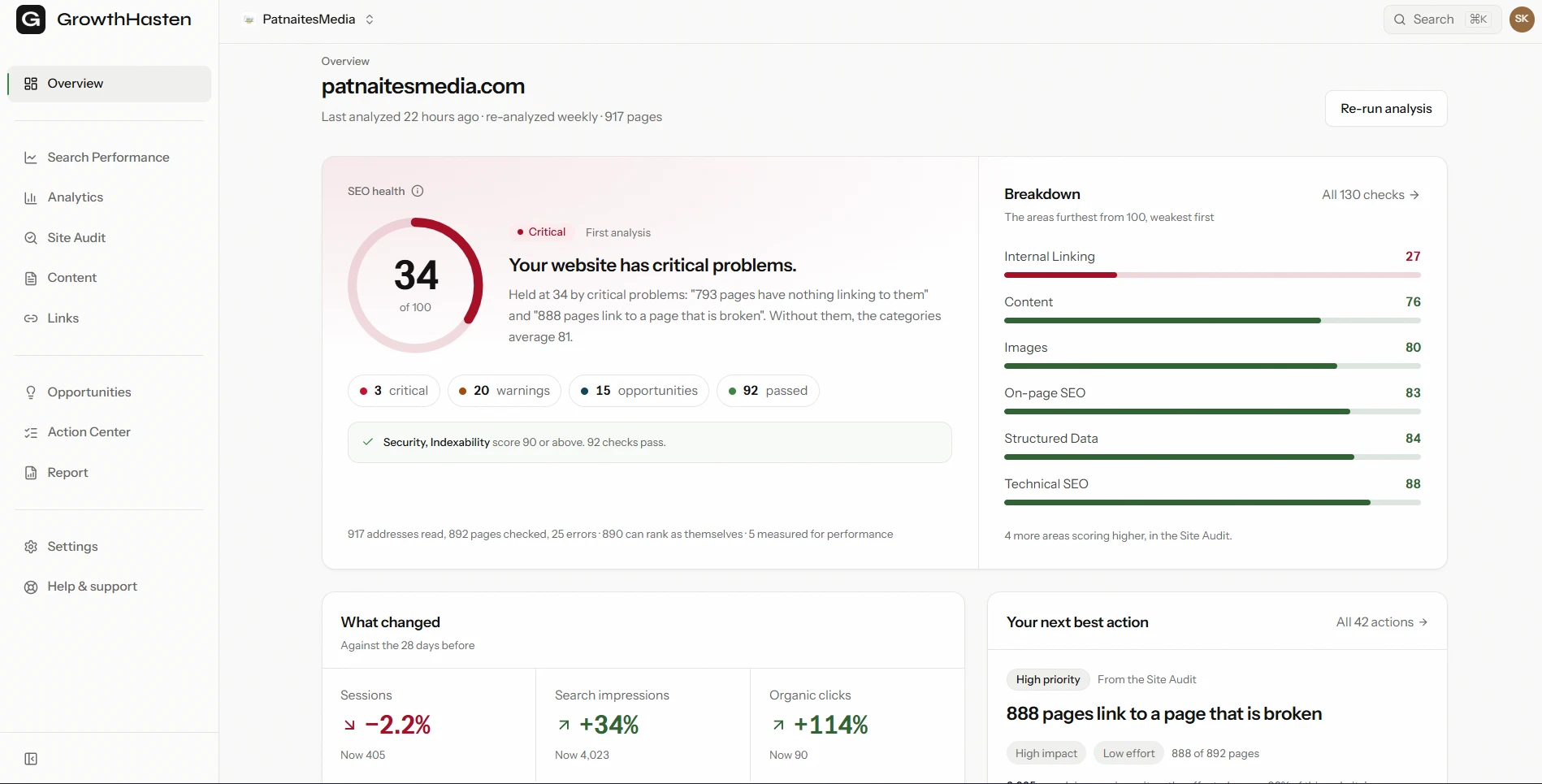
Connect Search Console and GrowthHasten's Content section puts every page's word count beside its clicks, flags the pages losing traffic and the pages competing for the same search, and groups topics as covered, partial or missing against what you already publish.
Explore the Content SectionQuestions
Frequently asked questions
What is the difference between content marketing and SEO?
SEO is the broader practice of making a site findable and rankable, covering technical health, keyword research, and links. Content marketing is the part that produces the pages themselves. SEO surfaces demand and makes pages accessible; content marketing captures that demand by answering the query better than the pages already ranking. You need both, working together.
How many articles do you need in a topic cluster?
There is no fixed number. A cluster has as many articles as the subject has distinct search intents, plus one pillar page. Some subjects support five supporting articles, others twenty. Let intent decide, not a quota: one article per distinct question, and never two chasing the same intent. A small, complete cluster beats a large, half-built one.
What is a pillar page?
A pillar page is a comprehensive page covering an entire subject broadly, designed to rank for the main term and act as the hub of a topic cluster. It links down to each in-depth cluster article, and those articles link back up to it. The pillar gives readers the overview; the cluster articles answer the specific questions the pillar only introduces.
How long does it take to build topical authority?
Longer than a single post and shorter than many fear, though there is no guaranteed timeline. Authority accrues as you publish connected, genuinely useful coverage and as search engines re-crawl and re-evaluate the set. Expect gradual movement over months rather than weeks, faster on lower-competition subjects and slower on contested ones. Consistency and completeness matter more than speed.
Does content marketing help with AI search and AI Overviews?
Yes. AI answer engines and AI Overviews summarize and cite sources, and they favor content that is clearly structured, self-contained, and genuinely useful, the same qualities that earn topical authority in traditional search. Defining concepts plainly, answering questions directly, and using tables and lists makes a page easier for an AI system to quote accurately.
Tags

Written by
GrowthHasten Team
Editorial Team, GrowthHasten
Articles from the GrowthHasten editorial team, grounded in primary research, our own testing, and what analyzing real websites shows, fact-checked in-house.
View profile