
One Document, And Every Figure Says Where It Came From
Built for the person who was not in the room: a developer picking up the work, a client reading the result, a manager deciding whether to fund the next quarter.
Free plan: one website of up to 900 pages, and three re-analyses. No card, no trial clock.
- 0
- Figures computed at render
- 4
- Provenance tags
- Print or PDF
- Export
- Free
- Cost
A Report Nobody Can Interrogate Is A Report Nobody Believes
Most SEO reports are a screenshot of a dashboard with commentary underneath. The reader cannot tell which figures were measured, which were computed, which were written by a model, and which are missing because nothing could measure them.
That matters most for the person furthest from the work. A developer asked to spend two weeks on a recommendation reasonably wants to know whether the number behind it was read from Google or generated by a paragraph.
- A monthly deck the client skims and nobody acts on
- Numbers in the report that do not match the numbers on the screen
- No way to tell an AI-written sentence from a measured fact
- Gaps presented as zeros, so an unmeasured dimension looks like a failing one
Nothing Is Computed For The Report
Every figure is read from the same rows the screens read, so a report and the screen it came from cannot disagree. This is the one structural decision that makes the document trustworthy, and it is the reason no number here is calculated at render time.
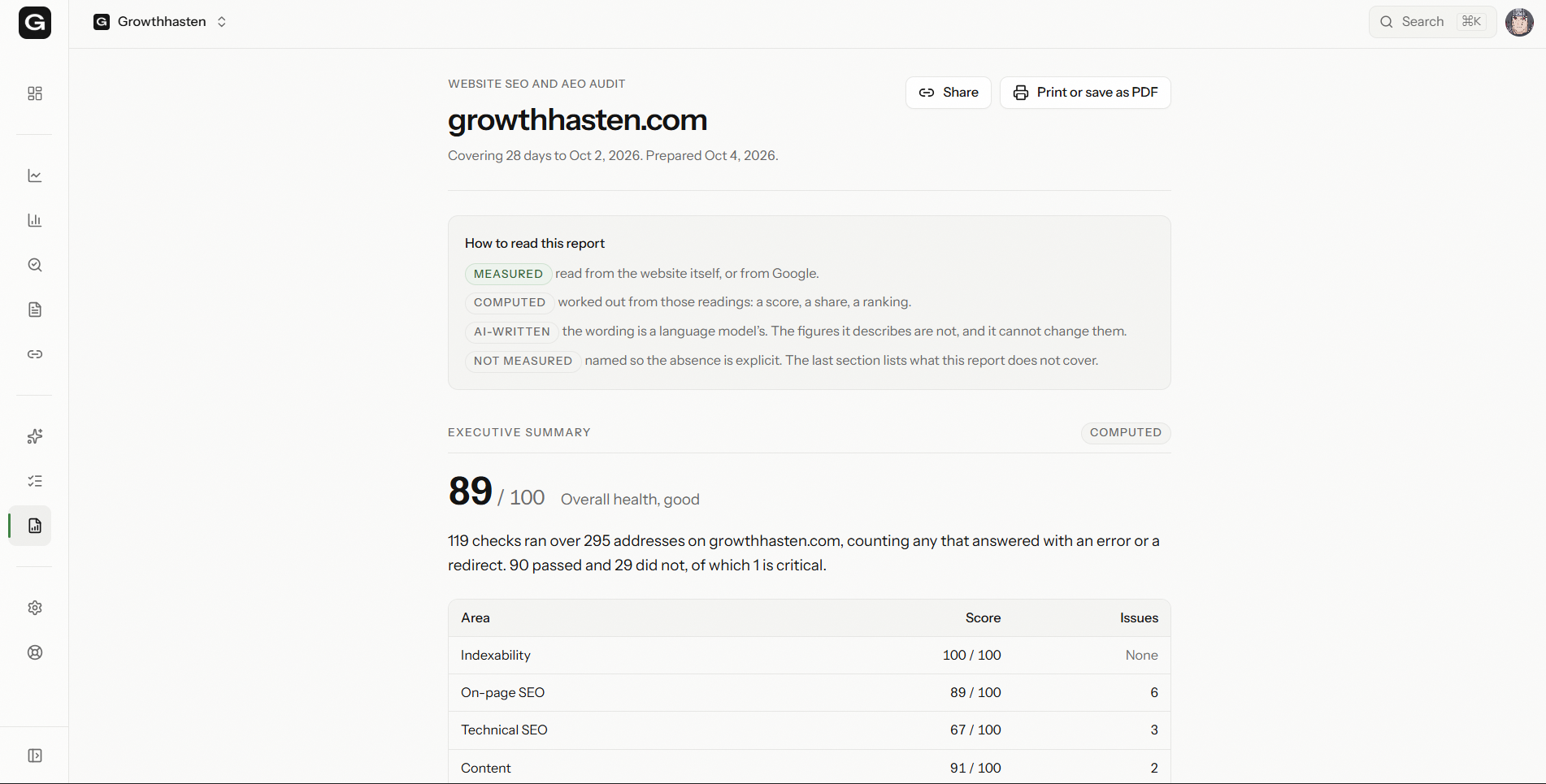
The document opens with a summary and verdict, then works through each category showing its working, with what passed listed beside what failed. Core Web Vitals appear against their targets rather than as bare numbers. A priority matrix turns the findings into a sequence, and the closing section names what was not measured at all.
Every section carries a provenance tag: Measured, Computed, AI-written or Not measured. Print or save as PDF straight from the page.
What the document contains
- Summary and verdict, derived from the stored category scores
- Each category showing its working, with what passed beside what failed
- Core Web Vitals against their targets
- A priority matrix turning findings into a sequence
- A closing section naming what was not measured at all
Provenance
- Measured: read from a source
- Computed: derived from measured figures
- AI-written: prose, never numbers
- Not measured: named rather than omitted
What You Get, And What It Will Not Do
What you get
- A document a developer can act on without a meeting first
- A client conversation about sequence rather than about whether the numbers are real
- Gaps stated as gaps, which is what makes the rest of the figures credible
- One artefact that cannot disagree with the product it came from
What it will not do
- There is no white-label mode, no custom branding and no scheduled email delivery.
- It reports the account as it stands. It is not a historical archive of every previous report.
About Reports
Can I export it as a PDF?
Yes. Print or save as PDF directly from the page. There is no separate export pipeline, which is deliberate: the document you print is the document on screen.
Can I white-label it for a client?
Not today. There is no custom branding and no scheduled delivery, and the product does not imply either.
Why does it list things that were not measured?
Because a gap presented as a zero reads as a failure, and a report that quietly omits what it could not measure is the easiest kind to over-read. Naming the gaps is what makes the rest of the figures worth trusting.
It Does Not Work Alone
Every part of GrowthHasten reads the same project, which is what lets one of them know something another one found.
Free To Start
Run Reports On Your Website
Sign up with your domain and the first analysis starts before the redirect finishes. Free plan: one website of up to 900 pages, and three re-analyses. No card, no trial clock.