

A conversion endpoint is a page whose job is to complete an action rather than answer a question: a free trial signup, a book-a-demo form, a plan checkout. Some of those pages also carry real search demand, and that is what makes the index decision genuinely hard. This guide is for growth leads and founders at SaaS companies running a self-serve trial, a sales-led demo, or both. It covers one question: which of these pages belong in Google's index, and what to do when one URL has to convert and rank at once.
The short version
- A bare signup form fails on content grounds, not on intent grounds. Transactional intent is not what makes it thin. Having nothing on the page is.
- A free trial page and a "book a demo" page get opposite defaults, because in a sales-led motion the searcher's destination and your conversion endpoint stop being the same place.
- When one URL has to convert and rank, split it into two URLs instead of compromising one. The landing page gets indexed; the form endpoint gets
noindex.robots.txtis the wrong instrument for any of this. A URL you block from crawling never gets to show Google itsnoindex.- A trial page is not one page. It is a chain, and the index question only has a clean answer once you separate the links in it.
Is a trial page a search asset, or just a conversion endpoint?
Usually both, and that is the whole difficulty. Page-type decisions in SEO are normally easy, because the page has one job. A feature page answers a query. A checkout page finishes a transaction. A trial page sits on top of both jobs at once, and the two jobs want opposite things from the same URL.
A search asset needs substance: something a reader who has never heard of you can learn, enough of it to deserve a position, and a query it plausibly answers. A conversion endpoint needs the reverse: everything that is not the action is friction, so the ideal endpoint is close to empty. Optimize the URL for search and you slow the signup. Optimize it for signup and you have published a form with a headline on it.
The general framework for this decision is a five-branch tree, and our guide to the index-or-noindex decision tree is where it lives. It handles almost everything you publish. It has a gap here, and the gap is structural rather than an oversight. Its thin-utility branch catches thank-you pages, confirmations and gated downloads, all of which have no query to answer at all. A trial page does have a query to answer, so it falls through to the default branch, index it. What the tree never does is name a trial, demo or signup page, so it leaves you to work out on your own which link in a trial chain the ruling is supposed to apply to.
The distinction that closes the gap is smaller than it sounds. A trial page is not one page. It is a chain: a landing page that explains the trial, a form that starts it, and a first app screen the new user arrives on. When all three share a URL, the index question has no single correct answer, because you are pointing at three jobs and calling them one page. Separate them and the question gets easy.
Should your free trial page be indexed?
Yes by default, on two conditions. The URL has to be a real landing page rather than the form itself, and there has to be branded demand for something like "[product] free trial" that the form endpoint cannot satisfy on its own.
That second condition is the one people skip. Someone searching your product name plus "free trial" already knows who you are and is looking for the door. If the door is not in the index, they hunt for it on your homepage, or they land on a third-party page describing trial terms that went stale two pricing changes ago. That is a query you own the correct answer to.
From my experience, the honest default is to index the trial landing page and stop treating the decision as risky. The risk people are actually worried about is thin content, and thin content is a fixable property of one page rather than a permanent property of trial pages.
Three things flip the answer:
- The URL is the form: if
/free-trialrenders a headline and four input fields, indexing it does nothing for you. Split it first, then index the half that has something on it. - There is no branded demand yet: before people know the product name, "[product] free trial" has no searchers, and optimizing the page is effort spent on a query that does not exist yet.
- There are several near-identical trial URLs: one per plan, one per campaign, one per region. Pick the one you want ranking and canonical the rest to it.
One boundary worth naming: "free trial [category] software" is a different query from "[product] free trial". The first wants a list of options, which is comparison content's job, not your trial page's. Do not stretch the trial page to reach for it.
Should your "book a demo" page be indexed?
Usually not, and the reason has nothing to do with SEO. It comes from the motion.
In a self-serve motion, the searcher's destination and your conversion endpoint are the same place. Someone searching "[product] free trial" wants to start a trial. Your trial page starts trials. The thing they came for and the thing you want them to do are one action, so indexing the page serves both at once.
In a sales-led motion they come apart. Someone searching "[product] demo" wants to see the product: a recorded walkthrough, an interactive tour, real screenshots of the actual interface. A "book a demo" page does not show them the product. It asks for a work email and offers a calendar. Point that query at the booking form and you have answered a "show me" request with a "talk to us" page. It converts the visitors who arrived ready to buy and gives everybody else nothing they came for.
That is a ranking problem as much as a conversion problem. Google has not confirmed this behavior, but a result that does not answer the query it ranked for is a weak candidate to keep the position.
So the page that should rank for "[product] demo" is a demo page with the demo on it: the walkthrough, the tour, the screenshots, plus a plain explanation of what a live session covers, how long it runs, and who should attend. That page earns its index slot. The booking form is one route off it, not the destination itself.
The condition that flips this: when the live session genuinely is the product experience, because the software is complex enough that there is nothing meaningful to show without a human driving it, index the demo page and then put enough on it to justify the position. What the session covers, what you need ready beforehand, what happens after. Which conversion goal that page should then carry is a separate question, and our guide to which conversion goal each page type should carry answers it properly.
Where should the signup form itself live?
On its own URL, and out of the index. This is the pattern that dissolves the trade-off rather than splitting the difference on it.
Two URLs, two jobs:
- The landing page, indexable:
/free-trial. What the trial includes, how long it lasts, whether a card is required, the seat and feature limits, what happens when it ends, what setup involves. One clear route to start. - The form endpoint, noindexed:
/signup, orapp.example.com/signup. No content obligation and no search obligation. Optimized purely for completion.
Now neither page is compromised. The landing page never has to be stripped down to protect a conversion rate, and the form never has to carry three paragraphs of explanation to justify a position it was never going to win. This is the same split we recommend for a gated enterprise tier on a pricing page, which makes a useful sanity check: the shape is not invented for this article, it is the ruling we already apply to the sibling page type.
In practice, the part that trips teams up is not the split itself but the instrument they reach for to hold it. The rules that keep it clean:
- Use
noindex, not a canonical: the form endpoint is not a duplicate of the landing page, so a canonical pointing from one to the other makes a claim that is false. Google's canonicalization documentation callsrel="canonical"a strong signal rather than a requirement, so Google stays free to pick a different one. A robots meta tag is a directive. Pick the directive. - Serve the rule in the response when you cannot edit the page: if the endpoint is an app route your marketing CMS does not control, use the
X-Robots-TagHTTP header instead. Google's documentation on robots meta tags and the X-Robots-Tag header confirms that any rule available in the meta tag can be delivered in the header. Our guide to the two ways to serve a noindex directive covers exactly when the header is the only option and how to confirm it took effect. - Keep the endpoint crawlable: counterintuitive, and it is the whole of the next section.
The app subdomain boundary
The signup flow usually ends up on app.example.com, and the application host has no business in the index. The instinct is to drop Disallow: / into that subdomain's robots.txt and call it handled.
That is the wrong instrument, and Google's introduction to robots.txt says so directly: the file "is not a mechanism for keeping a web page out of Google". A disallowed URL can still be indexed when other sites link to it. And Google's guidance on combining the two rule types is unambiguous: block the crawl, and any indexing rule on that page will not be found, so it gets ignored.
The block and the instruction cancel each other out. Allow the crawl, serve noindex on the response for the whole application host, and the rule becomes reachable, which is the only condition under which it gets applied.
The login page is the leak worth checking first. Authenticated app routes return a login screen to a crawler, so the URL that gets stored is not a dashboard. It is the login page, once per redirect parameter: app.example.com/login?redirect=/settings, then ?redirect=/billing, and on down your route table. A late Disallow: / does not clear those: Google already found them through links, and blocking the crawl leaves it unable to read the rule that would remove them.
Watch Whether the New Page Earns Its Clicks
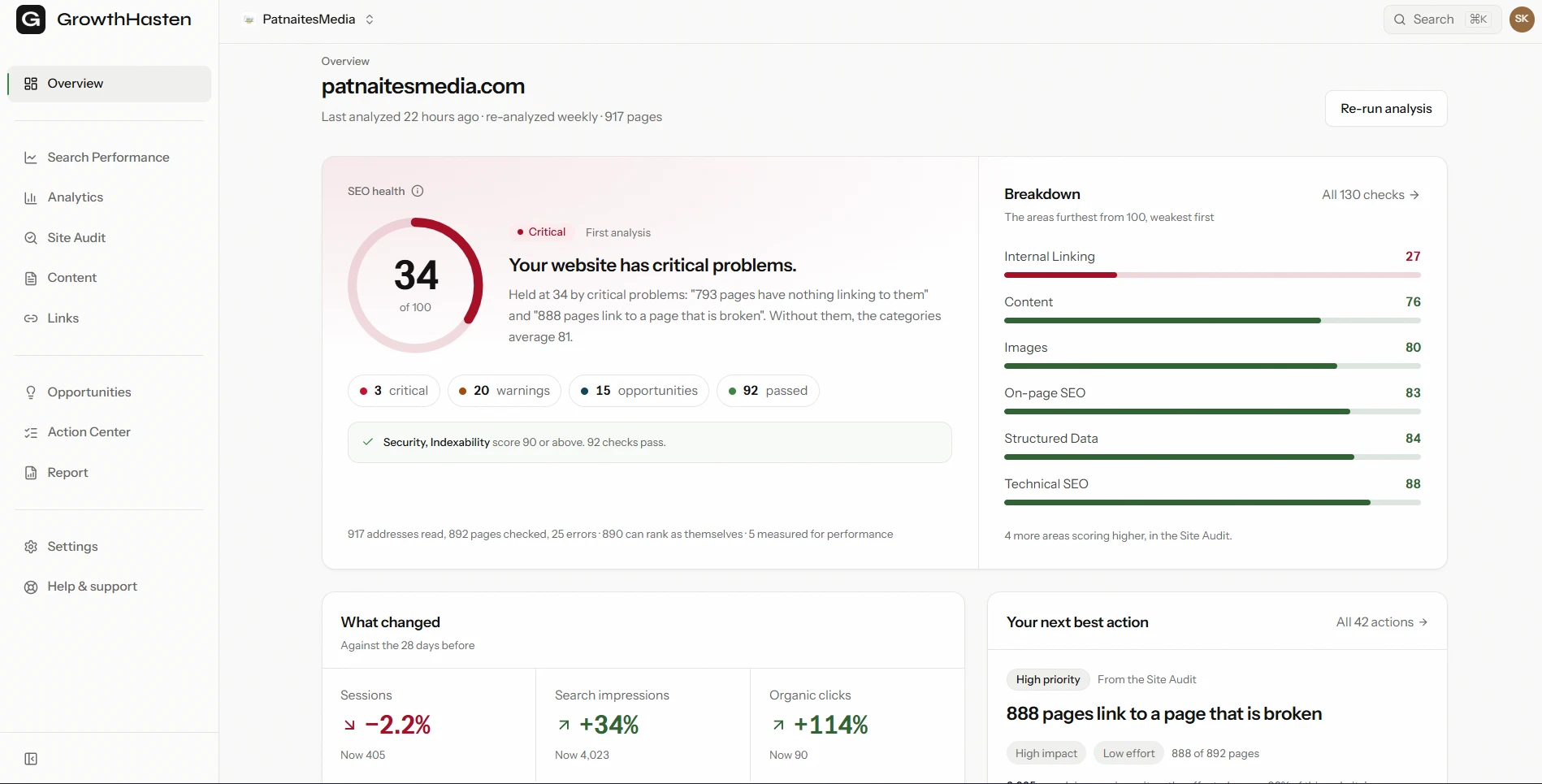
Once the split is live, connect Search Console and GrowthHasten's Content section puts each page's word count beside its clicks and flags the pages losing traffic, 90 days against the 90 before, so you can see whether the new landing page is earning its place.
Explore the Content SectionIs a bare signup form thin content?
Yes, and on content grounds rather than intent grounds. That distinction is what lets you classify your own page in one step instead of arguing about intent.
Here is the test. Delete the form, the navigation and the footer. Read what is left. If a person who had never heard of your product could not learn one useful thing from it, the page is thin, and no amount of commercial intent repairs that.
Transactional intent is not a thin-content problem, which is why the intent test misleads people. A pricing page and a product page are transactional too, and both index without trouble when there is something on them. Reduced to a slogan, "it has a query, so index it" is correct about the query and says nothing about the substance. Having a query is one half of the requirement. Having something to say is the other half, and a bare form has none of it.
Substance on a trial page is not marketing copy. It is the specifics a searcher wants and cannot get from a form: the real duration, the seat and record limits, whether a card is required, which features are held back, what happens to the data at the end, and how long setup honestly takes. That information is also what an AI assistant needs before it will summarize your trial terms for someone, which is a second reason to publish it rather than gate it.
How do you route your own trial and demo pages?
One question decides every row below. Does the searcher's destination coincide with your conversion endpoint? When they are the same place, index the page. When they diverge, index the destination and keep the endpoint out.
| Page and motion | Verdict | Instrument |
|---|---|---|
| Trial landing page, self-serve motion | Index | Self-referencing canonical, plus enough substance to deserve the position |
| Signup form endpoint, either motion | Noindex | noindex in the page or the response; keep it crawlable |
| Demo page with the product actually on it, sales-led | Index | Index normally; the booking form is a route off it |
| Bare "book a demo" form, sales-led | Noindex | noindex; link it from the demo page and the nav instead |
| Several near-identical trial URLs, per plan or campaign | Index one | Canonical the variants to the one you want ranking |
| Post-signup screens on the app host | Noindex | X-Robots-Tag: noindex at the edge for the whole host, never Disallow: / |
| Trial page with no branded demand yet | Index, do not optimize | Leave it crawlable and spend the effort upstream |
The rule generalizes past these two page types, which is why it is worth stating as a question rather than a list. Any page where the two jobs pull apart is a candidate for the split.
How do you check what Google actually did with these pages?
URL Inspection in Google Search Console, on both halves of the split, and nothing else counts. Your CMS reports what you intended. URL Inspection reports what Google stored.
What to read on each URL: whether the indexing verdict matches the instruction you think you shipped, whether the rendered HTML actually contains the noindex you believe is there, and which of your two URLs Google selected as canonical. The third one catches the failure that is easiest to miss, where Google picks the form endpoint as the canonical and quietly drops the landing page you wanted ranking. The full crawl-truth method, including how to read the rendered HTML and what to do when the stored version disagrees with the live one, sits in the pricing page guide linked above.
Which mistakes should you check for first?
Noindexing the whole trial URL: only the form endpoint needed it. The fix is to split the page, not to reverse the rule and put a form back in the index.
Reaching for robots.txt: it governs crawling, not indexing, and using it here means the rule you wanted applied never gets read.
Canonicalizing the form to the landing page: they are not duplicates, so this is a false signal, and it is a hint rather than a directive even when Google honors it.
Pointing "[product] demo" at a booking form: a "show me" query answered with a "talk to us" page. Build the demo page and let the form sit behind it.
Gating the substance: when the duration, the limits and the card requirement all live behind the form, the indexable page has nothing left to rank on and nothing for an answer engine to quote.
Letting the login page multiply: every distinct ?redirect= value is a distinct URL, and they accumulate quietly.
One trial URL per campaign: near-duplicates competing with each other for the same branded query, none of them winning it cleanly.
When should you not try to rank a trial or demo page at all?
Four situations, and in all four the honest answer is the same: leave the page crawlable, make it convert, and spend the SEO effort elsewhere.
- No branded demand yet: pre-launch or pre-product-market-fit, nobody is searching your product name, so a page targeting "[product] free trial" is optimized for a query with no volume behind it. Answer category questions instead until the brand queries appear.
- A named-account, outbound-led motion: when pipeline comes from lists, events and referrals, the demo page needs to convert the traffic sales sends it. Ranking is not the job.
- A trial that is not really self-serve: if signup routes into a qualification call, the trial page is a lead form wearing a trial's clothes. Fix the motion or the page's promise before you fix its indexation.
- The query belongs to comparison content: "best [category] free trial" wants a list, and your trial page will never be that list. Cede it and build the comparison page.
This mistake is hard to notice, because the page keeps converting the traffic it already gets while the SEO work quietly returns nothing.
What is the habit worth building?
Classify a page's job before you optimize it. Not its template, not its funnel stage, its job: does a searcher arriving here want the thing this page does, or does this page exist to finish something they already decided? Ask that once per page and the index decision answers itself, along with the content decisions downstream of it. The rest of the set is covered in our overview of the SaaS page types that carry organic growth.
This week, open your trial page and your demo page and answer one question for each: is the searcher's destination the same place as the conversion endpoint? Then run URL Inspection on both URLs and see whether Google agrees with what you thought you shipped. Where the answer turns out to be tangled up in a wider architecture problem, treat it as a site-level fix rather than a page-level one, and a site audit shows how far it reaches.
See What Your SaaS Site Needs Fixed First
GrowthHasten is AI-native SEO software. It crawls your marketing site, joins it to your own Search Console and Analytics, and orders what it finds so the work worth doing first sits at the top. The free plan covers one website of up to 900 pages, with no card.
Analyze Your WebsiteQuestions
Frequently asked questions
Does a free trial page belong in Google's index?
Yes, when the URL is a real landing page rather than the form itself, and when people search your product name alongside "free trial". Those searchers already know you and are looking for the entry point, so the page answers a query you own. If the URL is nothing but a signup form, split it first: publish an indexable landing page that explains the trial, and keep the form endpoint on its own noindexed URL.
Why does a book-a-demo page get a different answer from a free trial page?
Because the motion changes where the searcher wants to end up. In a self-serve motion, someone searching for your trial wants to start a trial, so your conversion endpoint is also their destination. In a sales-led motion they usually want to see the product working, and a booking form offers them a calendar instead. Index a demo page that actually contains the demo, and keep the bare booking form out of the index.
What separates a free trial page from a demo page in search?
The query behind them. A product name plus "free trial" is a navigational request from someone ready to act, and a trial landing page satisfies it directly. A product name plus "demo" is usually a request to see the software working, which a booking form cannot deliver. Which of the two your company should offer is a go-to-market question about sales cost and product complexity. For search, treat them as two different page types.
Where should a SaaS signup form live, the marketing site or the app subdomain?
Either works, provided the form endpoint carries a noindex rule and stays crawlable. The application host itself should not be in the index, but robots.txt is the wrong way to enforce that. Google's documentation is explicit that robots.txt governs crawling rather than indexing, and a URL you block from crawling never gets to reveal the rule that would remove it. Allow the crawl and serve noindex in the response instead.
My trial page is indexed and still gets no clicks. What should I check?
Three things, in order. First, substance: delete the form and the navigation, then see whether anything is left that a stranger could learn from, because a page carrying only a form is thin regardless of its intent. Second, branded demand, since a page targeting your product name earns nothing before people know the name. Third, canonical selection, in case Google chose your form endpoint over the landing page you wanted ranking.

Written by
GrowthHasten Team
Editorial Team, GrowthHasten
Articles from the GrowthHasten editorial team, grounded in primary research, our own testing, and what analyzing real websites shows, fact-checked in-house.
View profile