
Every Page Checked, Ranked By What To Fix First
A crawl of your whole website, more than 130 checks run over what it found, and a single ordered list at the end. Not one check is a model call, so the same site returns the same answer twice.
Free plan: one website of up to 900 pages, and three re-analyses. No card, no trial clock.
- 900
- Pages, free plan
- 130+
- Deterministic checks
- 12
- Categories
- 0
- Checks that are model calls
A List Of 400 Problems Is Not A Plan
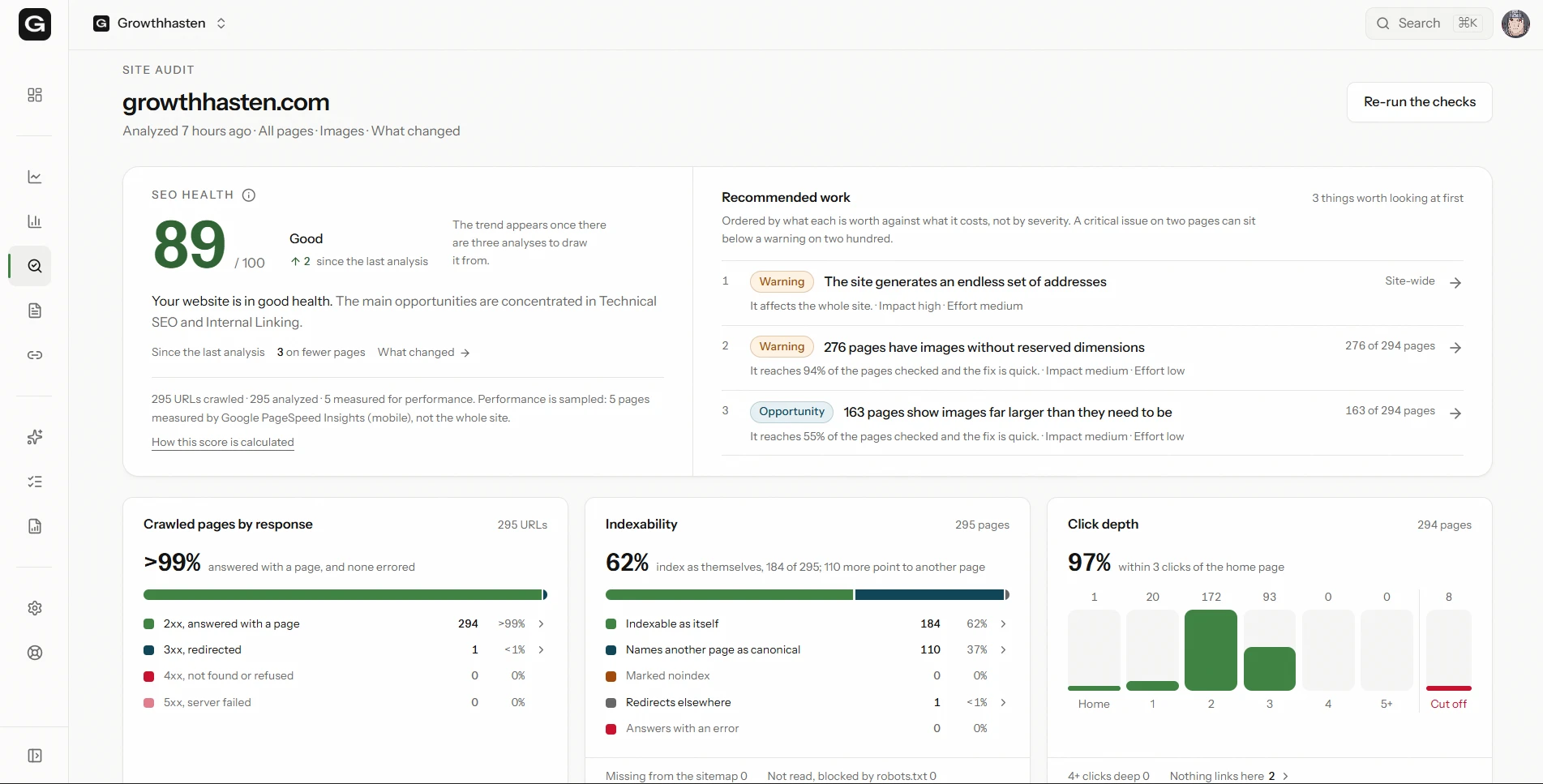
Most audit tools are generous with findings and silent about sequence. You export 400 rows, sort by severity, and start at the top, which is how teams spend a quarter on a critical issue affecting two pages while a warning across two hundred goes untouched.
Severity is a property of a problem. Priority is a property of a problem, its reach, the confidence behind it and the effort it takes. Those are different quantities and only one of them tells you what to do on Monday.
- An audit export nobody has opened since the day it was produced
- Fixes chosen by whichever row was coloured red, not by what they are worth
- Findings you cannot check, from a tool that will not say how it decided
- A perfect score in a category the tool could not actually measure
- The same template problem reported as six separate page-level issues
Deterministic Checks, Then Explanation
The crawl reads your pages from your domain, following your sitemap and internal links, and records what each page says about itself: status and redirect chain, title, description, canonical, robots directives, headings, word count with site-wide boilerplate removed, images, internal and external links with their anchor text, structured data, hreflang, response time, and whether the page needs JavaScript to render at all.
More than 130 checks then run over that record. Every one is a function of markup already parsed, which is why a finding can be trusted: the reasoning layer is given verified facts and asked to explain and order them, and it is never able to introduce one. A recommendation about an issue the checks did not find is discarded before it reaches you.
Ten of the 12 categories carry the health score with weights summing to 100. Accessibility and Security Hardening are scored and shown but kept out of it, because neither says anything about how search engines treat a site. A category nothing could be measured for has its weight redistributed across the ones that could, never counted as zero: a site with no images is not a site failing its image checks.
What the crawl reads
- Websites of up to 900 pages on the free plan, with per-prefix and per-page link caps so one generated section cannot swallow the budget
- Status codes, redirect chains and their length, canonical, robots directives and the X-Robots-Tag header
- Titles, descriptions, headings, word count, and own word count with site-wide boilerplate removed
- Structured data, Open Graph and Twitter cards, breadcrumb markup, hreflang alternates and html lang
- The dates a page declares about itself, server response time, and insecure resources on secure pages
- robots.txt, every URL the sitemap declares, llms.txt, the TLS certificate, and which AI crawlers are refused
The twelve categories
- On-page SEO, Indexability, Technical SEO and Content
- Performance, including Core Web Vitals from real Chrome visitors
- Internal Linking, Structured Data, Images and Security
- AI Accessibility: whether robots.txt lets the crawlers behind ChatGPT, Claude, Perplexity and Google's AI answers fetch your pages
- Accessibility, from axe-core violations found while rendering
- Security Hardening: CSP, framing, nosniff, referrer policy, cookie flags, CORS
Reading the result
- Recommended work: three items, ordered by impact times confidence times reach over effort
- One page per issue: what it is, why it matters, what to do, then which pages
- Pages sliced into what is broken, what is hidden, and what is merely hard to find
- Changes: this audit against the previous one, rule by rule, and this crawl against the previous one, page by page
- AI-written titles, meta descriptions and alt text, held to Google's own length ranges
- Rendering in three modes, adding lab timings and what JavaScript changed about the page
What You Get, And What It Will Not Do
What you get
- One ordered list instead of an export nobody opens
- Template problems grouped, so you fix the template once rather than six times
- A score you can explain to an engineer, because every point of it traces to a check
- A record of what changed since last time, separated from what is merely new
What it will not do
- It will not score a dimension it could not measure. Unmeasured is reported as unmeasured, never as zero.
- Orphan checks refuse to run on a crawl that stopped at its budget, because a page looks orphaned when the page linking to it is one nobody read.
- Performance is measured over a sample of pages, so its findings say measured pages rather than pages.
- The free plan analyses websites of up to 900 pages and includes three re-analyses. A larger website is refused before anything is read, rather than silently truncated.
About Site Audit
How many pages does it crawl?
On the free plan, websites of up to 900 pages. The crawler itself handles several thousand, and a website whose sitemap lists more than 900 is refused before anything is read or stored, with a message saying so rather than a partial crawl presented as a whole one. The crawl runs as many short slices against saved state rather than one long request, so closing the tab pauses the analysis instead of losing it.
Is the audit written by AI?
No. Every check is a deterministic function of markup already parsed, and returns the same answer on the same input every time. AI is given those verified findings afterwards and asked to explain them and put them in order. It has nowhere to put a number, and an explanation about a finding we did not send is dropped.
How is the health score calculated?
Ten categories carry weights summing to 100. A finding costs weight times severity floor plus the affected share, so one broken page in four thousand still registers rather than rounding to a perfect site, and a warning across two hundred pages outranks a critical confined to two. A category that could not be measured has its weight redistributed, never counted as zero.
Does it check Core Web Vitals?
Yes, through PageSpeed Insights over a sample of pages, and it includes Core Web Vitals from real Chrome visitors, which is the only source of INP. Lab timings are added for pages that get rendered.
How often can I re-analyse?
The free plan includes three re-analyses for the life of the account, because re-reading a whole website is the one thing here that costs real money per page. Re-running the checks over pages already stored is not one of them: that is a handful of queries and is not rationed. Weekly automatic re-analysis needs a paid plan.
It Does Not Work Alone
Every part of GrowthHasten reads the same project, which is what lets one of them know something another one found.
Free To Start
Run Site Audit On Your Website
Sign up with your domain and the first analysis starts before the redirect finishes. Free plan: one website of up to 900 pages, and three re-analyses. No card, no trial clock.