
Your Words, Beside Your Clicks
An inventory of every page with its word count next to its search performance, the pages losing traffic ranked worst first, and the ones quietly competing with each other for the same query.
Free plan: one website of up to 900 pages, and three re-analyses. No card, no trial clock.
- 90 days
- Comparison window
- 5
- Page statuses
- Your pages
- Coverage decided by
- None
- Invented search volume
Nobody Knows Which Page To Rewrite
Content decisions are usually made from memory. Somebody remembers a post doing well two years ago, somebody else thinks a page is thin, and the refresh list gets written from a meeting rather than from evidence.
The evidence exists. It is just split across two systems that never meet: your website knows how long a page is and when it was last touched, and Search Console knows whether anybody reads it. Neither one alone tells you what to do.
- A refresh list built from opinion because no report pairs length with performance
- Pages slowly losing traffic that nobody noticed until a quarter had gone
- Two of your own articles ranking for the same query and splitting it
- A content calendar full of new pages when the fix was improving an old one
The Pairing That Exists Nowhere Else
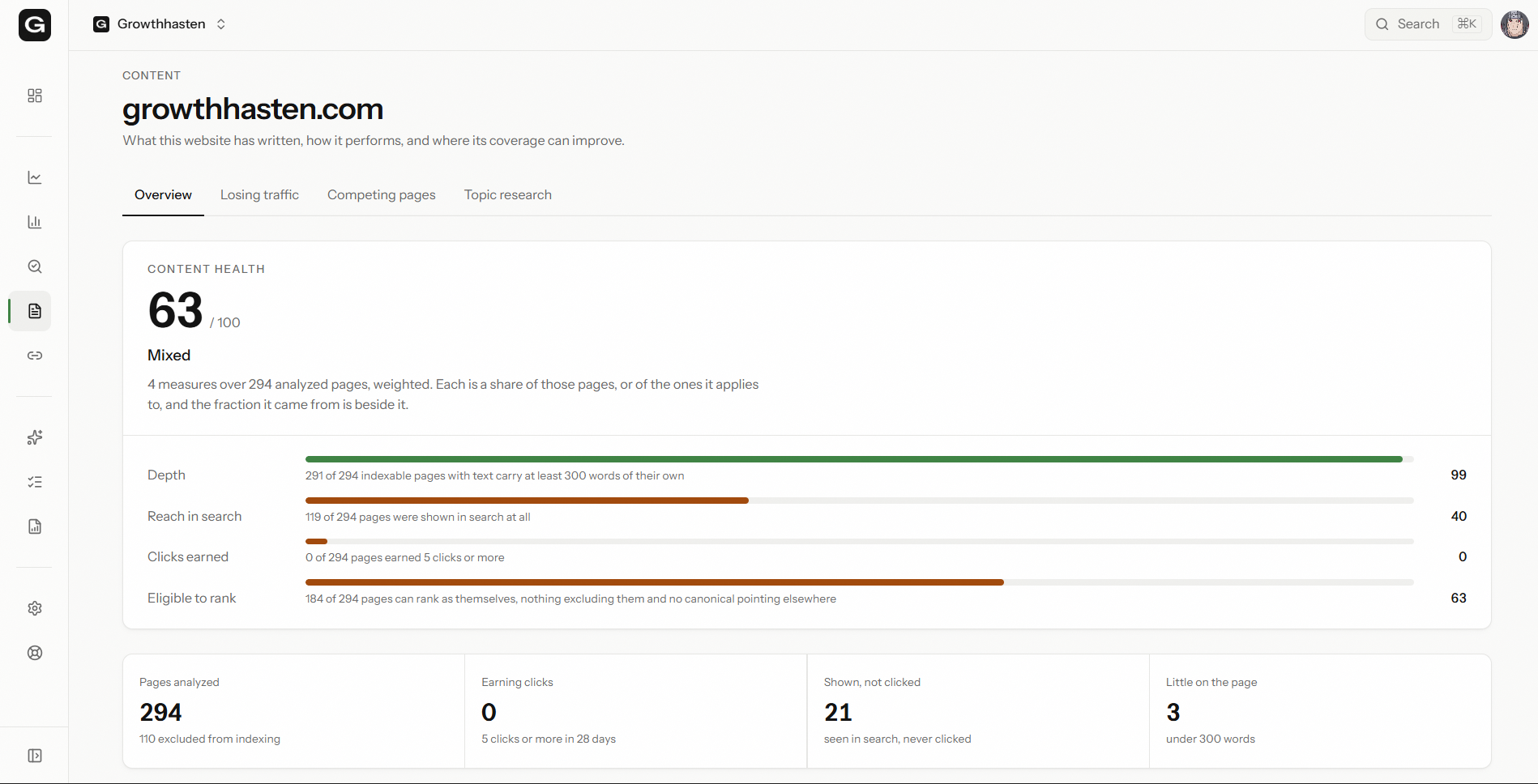
The inventory lists every page with its words beside its clicks, searchable, sortable and paginated. That single pairing is the reason this section exists: it is the view that turns two systems of record into one decision.
Pages are grouped by status: performing, declining, unclicked, thin, steady. Every count above the table is a link into the table filtered to itself, because a figure nobody can open is a figure somebody has to take on trust.
Declining pages compare clicks over the last 90 days against the 90 before, worst first, with the date each page declares it was last updated. A page losing traffic that has not been touched in two years is the clearest refresh there is. Competing pages catches two of your own pages taking turns for the same search, with brand queries excluded, because several pages appearing for a site's own name is sitelinks doing their job.
The inventory
- Every page with its word count beside its clicks
- Pages by status: performing, declining, unclicked, thin, steady
- Every count above the table opens the table filtered to itself
- A content health reading, with the reasons behind it
What to do next
- Declining pages: 90 days against the 90 before, worst first, with the date each page says it was last updated
- Competing pages: two of your own pages taking turns for the same search, brand queries excluded
- Topic research: name a subject and get what that subject is made of, with the source of the map recorded on the run
- Coverage and gaps: every topic grouped as covered, partial or missing, with the matched pages as evidence
What You Get, And What It Will Not Do
What you get
- A refresh list built from evidence rather than from a meeting
- Decay caught in the quarter it starts, not the year after
- Cannibalisation made visible from outside the website
- A clear answer to the question of whether this should be a new page at all
What it will not do
- Coverage is decided from your own pages, deterministically. The model is never asked what your website covers, so it cannot be wrong about it.
- Without a connected data provider it reports no search volume and no keyword difficulty, rather than inventing one.
- Where a topic map came from the reasoning layer rather than from your own search data, the run says so above the results.
About Content
How does it decide a page is declining?
Clicks over the last 90 days against the 90 before, worst first, from your own Search Console data. Alongside each one it shows the date the page declares it was last updated, read from its structured data or article tags, because a page losing traffic that has not been touched in two years is the clearest refresh there is.
What is competing pages?
Two of your own pages taking turns to rank for the same search. It is invisible from the website and obvious from Search Console. Brand searches are excluded, because several pages appearing for a site's own name is sitelinks working correctly.
Does topic research give me search volume?
No, unless a data provider is connected. Reporting a volume nobody measured would be inventing the one number people most want to be true. Where no provider exists, the topic map is derived from your own Search Console queries instead, which is narrower and arrives with measured demand attached.
Does it need Search Console connected?
The inventory and the thin-page view work from the crawl alone. Declining pages, competing pages and anything pairing words with clicks need Search Console, because clicks are its data and nobody else has them.
It Does Not Work Alone
Every part of GrowthHasten reads the same project, which is what lets one of them know something another one found.
Free To Start
Run Content On Your Website
Sign up with your domain and the first analysis starts before the redirect finishes. Free plan: one website of up to 900 pages, and three re-analyses. No card, no trial clock.