

Content marketing services are the strategy, research, writing, optimization, and measurement a business pays for to attract and convert an audience through content that ranks in search and gets cited by AI answer engines. This guide is for the person deciding whether to hire: a founder, a marketing lead, or an operator weighing an agency against freelancers or an in-house hire. It covers what these services actually include, the deliverables that separate real work from busywork, how partners price the engagement, and how to choose one you can trust. It also names the red flags worth walking away from, and the cases where outsourcing is the wrong first move.
The short version
- The provider model matters less than fit. A focused freelancer can outperform a bloated agency, and one strong in-house writer can beat both when your brand needs a single deep voice.
- Strategy is the part that gets skipped and the part that decides everything. Words without a plan for intent, clusters, and internal links are just expensive filler.
- Judge a partner by their process, samples, and reporting, not their output volume. Anyone can publish more posts. Few can publish the right ones.
- Mass-produced AI content at scale is the loudest red flag on the market right now, and it is easy to spot once you know the tells.
- Sometimes the answer is not to outsource yet. Very early companies and voice-led brands are often better served in-house.
What are content marketing services?
They are an outsourced content function: a partner takes on some or all of the work of planning, producing, optimizing, and measuring content so you do not have to build the whole capability internally. The scope ranges from a single freelancer writing two articles a month to a full agency running strategy, production, distribution, and reporting as a system. What you are really buying is not words. It is the judgment about which words to publish, in what order, for which stage of the buyer's journey, and the discipline to measure whether any of it worked.
What do content marketing services actually include?
Eight distinct workstreams, though almost no engagement runs all eight at full intensity at once. When a partner says "content," ask which of these they mean, because the mix sets the price, the timeline, and whether the work fits your situation.
- Strategy and research. Audience and intent research, competitor analysis, keyword and topic mapping, and a prioritized roadmap. This is the layer that decides what gets written and why. Building it around clusters rather than one-off posts is how you compound authority, which our guide to topical authority walks through in detail.
- Editorial calendar. A publishing cadence tied to priority and capacity, not a wish list of titles.
- Content briefs. The document that tells a writer the intent, the angle, the sources, the internal links, and what "good" means for a given piece. See our content brief template for the full format. Weak briefs are the single most common cause of weak articles.
- SEO writing. Drafting that satisfies search intent and reads like a person wrote it. The craft of doing that deliberately is covered in our SEO content writing guide.
- On-page optimization. Titles, headings, internal links, and structure that map each page to the query it should answer.
- Content refreshes. Updating and pruning existing pages so your best work stops competing with your weakest. A structured content audit is where this starts.
- Distribution. Getting the work in front of people through newsletters, social, and syndication rather than publishing into silence.
- Measurement. Search Console and analytics reviews that tie the work to rankings, traffic, and conversions rather than to a post count.
The connective tissue across all of this is SEO. Content that is not built to be found rarely earns its keep, which is why our content marketing for SEO guide treats the two as one discipline rather than two departments.
What does a content marketing engagement include, stage by stage?
A real engagement moves through phases, and knowing them helps you tell a partner with a system from one who just takes orders. Here is what each stage should produce.
| Stage | What happens | What you should receive |
|---|---|---|
| Discovery | Learning your business, buyers, margins, and existing content | An audit and a gap analysis, not a template plan |
| Strategy | Mapping topics to intent and funnel stage, prioritizing clusters | A topic map and a roadmap with reasons for the order |
| Production | Briefing, writing, editing, and optimizing each piece | Published pages built from real briefs, not thin drafts |
| Optimization | Refreshing decaying pages and improving internal links | Measurable lifts on existing pages, not just new ones |
| Reporting | Reviewing performance and deciding what changes next | A report that ends in decisions rather than charts |
If a partner jumps straight to production without discovery or strategy, you are buying volume, not growth. That distinction is the whole ballgame.
Agency, freelancer, or in-house: which fits your situation?
It depends on your volume, budget, and how much of the work you can direct yourself. Fit beats category every time, and the honest version of this comparison admits that a strong operator in any column can beat a weak one in another.
| Factor | Content agency | Freelancers | In-house hire |
|---|---|---|---|
| Best when | You need strategy plus volume and range | Scope is focused and you can brief well | Content is a core channel and voice matters deeply |
| Breadth | Strategy, writing, SEO, and reporting under one roof | Usually one or two strengths per person | Narrow, but deepest on your brand over time |
| Brand voice | Consistent if the system is good; diluted if not | Varies by writer; needs your editing | Single, deep, native voice |
| Main risk | Junior execution behind a senior pitch | Capacity limits and continuity gaps | Single point of failure; slow to hire |
Many companies blend these: an internal owner who holds the voice and the strategy, directing an agency or freelancers for range and capacity. If what you lack is senior direction rather than hands, a consulting relationship can set the strategy your team then executes, and our guide to hiring an SEO consultant covers that model.
What does good look like in the deliverables?
Artifacts you can point to, tied to outcomes rather than activity. "We published 12 posts" is activity. A roadmap, a set of briefs, published pages that rank, and a report connecting them to search performance are deliverables. Over the first quarter of most engagements, expect to receive a content audit and gap analysis, a topic map tied to your funnel, real briefs for every piece, published pages rather than recommendations, and a report that ties the work to impressions, clicks, and conversions.
Quality inside those pages has a standard worth naming. Google's guidance on creating helpful, people-first content describes what search rewards: original insight, real expertise, and content that leaves a reader satisfied rather than sent back to search. A good partner writes to that bar and can show you where a draft demonstrates first-hand knowledge instead of paraphrasing the top ten results.
How do content marketing services get priced?
Content marketing is usually priced as a monthly retainer or per deliverable, and the per-word rates quoted publicly rarely include strategy, briefing, or editing. What actually drives that number, and how a retainer compares with per-piece and in-house once you count the whole cost, is in our guide to what content marketing costs for a B2B software company.
How do you choose a content marketing partner?
Interview their process and read their samples, not their promises. The strongest signal is how a partner thinks about your business before they have won it: whether they ask about your buyers, your margins, and your sales cycle, or just quote a per-post rate. Use these questions in the first conversation.
Questions to ask before you sign.
- Can I see three published pieces you wrote, and the brief behind one of them?
- How do you research a topic, and how do you decide what to publish first?
- Who actually writes: the person pitching, or someone I have not met?
- How do you handle subject-matter depth on a topic your team does not know?
- Where does AI fit in your process, and where does a human take over?
- What does your monthly report show, and can I see a real one?
- How do you measure whether a piece worked, beyond page views?
- What happens to the content and the strategy if we part ways?
The answers matter less than their shape. A partner who explains trade-offs and admits what they do not know is worth more than one with a confident answer for everything.
What are the red flags that should end the conversation?
A handful of signals reliably mark risk. None guarantees a bad partner alone, but each is common enough among low-quality ones to justify slowing down.
- Mass-produced AI content. Partners promising dozens of articles a week are almost always publishing lightly-edited model output. It reads generic, cites nothing first-hand, and Google's Search Essentials reward helpful, original content regardless of how it was produced.
- No strategy, just a content calendar. A list of titles is not a plan. Without intent mapping and clusters, the work rarely compounds.
- Vanity metrics in the reporting. Page views and "social impressions" with no line to rankings, qualified traffic, or conversions usually hide the absence of results.
- Guaranteed rankings or traffic numbers. No one controls the search results. A specific promise signals either inexperience or spin.
- No questions about your business. A partner who does not ask what a customer is worth cannot prioritize the work that pays back.
- No samples, or samples they will not attribute. If they cannot show you work they are proud of, assume there is a reason.
When should you not outsource content marketing?
More often than most agencies will admit. Content is a compounding channel, and a few situations make outsourcing the wrong first move:
- Before product-market fit. If you are still changing who you sell to and what you sell, content built around today's positioning may be obsolete before it ranks.
- When you need one deep in-house voice. Founder-led and highly technical brands often live or die on a single native voice. Outsourcing that early tends to dilute the exact thing that sets you apart.
- When you cannot feed the engine. Content needs subject-matter access, approvals, and review from your side. Without them, even a strong partner produces surface-level work.
- When the scope is tiny and well-defined. A handful of pages is often better served by a single freelancer or a one-off project than a full retainer.
Naming these honestly is part of the job. A good partner would rather tell a founder to keep content in-house for two more quarters than take a retainer that cannot pay back.
What does a good engagement feel like over time?
Structured onboarding, a visible roadmap, and a steady cadence you can audit. In the first weeks, a good partner learns your business and your data before recommending anything. Then they publish a prioritized plan you can see, ship work against it on a predictable rhythm, and report in terms of outcomes rather than output. The relationship should feel like a team extension, not a black box: you keep access to your accounts, you understand what shipped and why, and when something does not work the partner says so and adjusts.
The one habit worth building: judge every content conversation by its transparency, not its output volume. Partners who show their process, share real samples, and name their trade-offs are the ones who compound value over years. This week, take one proposal or provider you are considering and run it through the eight questions above, then ask for three writing samples and the brief behind one of them. The gaps between the pitch and the proof will tell you most of what you need to know.
Know What Your Site Needs Before You Hire Anyone
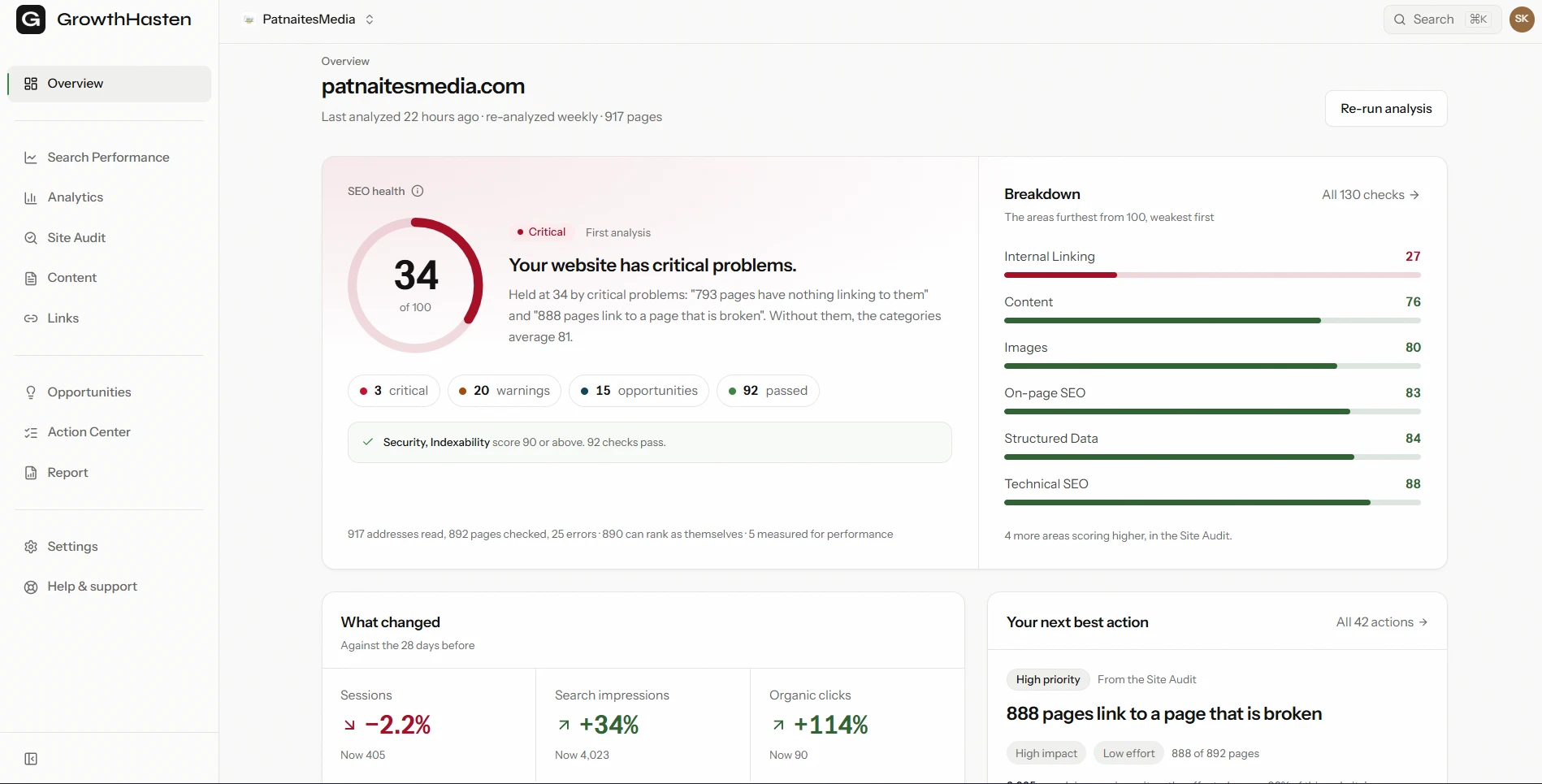
Brief any agency, consultant or hire from evidence. GrowthHasten crawls your website, joins it to your own Search Console and Analytics, and turns the result into one prioritized queue of fixes and opportunities. Free plan: one website of up to 900 pages, no card.
Analyze Your WebsiteQuestions
Frequently asked questions
What is the difference between a content marketing agency and freelancers?
An agency delivers strategy, writing, SEO, and reporting as a system under one roof, usually on a retainer. Freelancers bring focused strengths, typically writing, and depend on you to supply the strategy and briefs. Agencies suit companies that need range and volume without building a team. Freelancers suit a focused scope you can direct well and edit yourself.
How much do content marketing services cost?
There is no universal rate, because pricing depends on scope, seniority, and geography. Partners typically charge per piece, on a monthly retainer, per project, or on a performance basis, and which one fits depends on how compounding the work is.
How long do content marketing services take to show results?
Usually months, not weeks. Content compounds slowly: search engines need time to crawl, index, and trust new pages, and articles need time to earn links and rankings. Refreshing existing pages can show faster than net-new content. If you need measurable revenue within a single quarter, paid channels typically respond faster than content marketing does.
Should I be worried about AI-generated content from an agency?
Be worried about unedited AI content produced at scale, not about AI used as a tool. Partners promising dozens of articles a week are usually publishing lightly-edited model output that reads generic and cites nothing first-hand. Ask where AI sits in their process and where a human takes over. Good partners use AI to assist research and drafting, then add real expertise and editing.
What deliverables should a content marketing partner provide?
Expect artifacts tied to outcomes, not activity summaries. Over the first quarter, look for a content audit and gap analysis, a topic map tied to your funnel, a real brief for every piece, published pages rather than recommendations, and a report connecting the work to impressions, clicks, and conversions. If a partner keeps you out of your own Search Console or CMS, treat that as a warning rather than a convenience.
Is it better to keep content marketing in-house or outsource it?
It depends on volume and voice. In-house works when content is a core channel and a single deep, native voice sets your brand apart, which is common for founder-led and technical companies. Outsourcing fits when you need range and capacity without hiring for each skill. Many companies blend the two: an internal owner holds the voice and strategy while an agency or freelancers add volume.

Written by
GrowthHasten Team
Editorial Team, GrowthHasten
Articles from the GrowthHasten editorial team, grounded in primary research, our own testing, and what analyzing real websites shows, fact-checked in-house.
View profile