

A content audit is a structured review of every page you have published, scored against real performance signals so you can decide what to keep, refresh, consolidate, or remove. It is for founders, marketers, and content leads who have been publishing for a while and now suspect that some of that work is helping and some is quietly dragging the whole site down. This guide covers what a content audit is and why it matters, how to build the inventory and pull the right signals, a decision matrix for every page, and the mechanics of fixing decay, cannibalization, and thin content the right way. The goal is not a longer content library. It is a library where every page earns its place.
The short version
- Publishing more is not the same as ranking more. Past a certain point, weak pages dilute the strong ones, and pruning can lift the site.
- Five verdicts cover every page: keep, refresh, consolidate, prune, or noindex. The audit is the process of assigning one to each URL.
- Decay and cannibalization are the two problems audits catch that nobody notices day to day, because both happen slowly.
- Refresh means updating the same URL in place, not publishing a new one. Keep the address, update the substance, and let the page keep its history.
- Never delete a page that has backlinks or rankings without a redirect plan. Deleting the wrong page throws away equity you cannot easily rebuild.
What is a content audit, and why does it matter?
A content audit is a full inventory of your published pages, each one measured against performance and quality signals so you can decide its fate deliberately rather than let it sit untouched by default. It matters because content does not stay good on its own. Facts age, competitors publish deeper answers, and the pages you wrote years ago start competing with the ones you wrote last month.
Four problems build up quietly in any site that has been publishing for a while. Decay is a page that once ranked and has slipped as the SERP moved on. Thin content is a page that never had enough substance to rank in the first place. Cannibalization is two or more of your own pages fighting over the same query. Crawl waste is search engines spending their limited attention on pages that will never earn traffic, instead of the ones that could.
A content audit is narrower than a full site review. Where our SEO audit guide covers technical, on-page, backlink, and competitor analysis layers, a content audit focuses on one question: is each page pulling its weight, and if not, what do you do about it? It is one layer among several: our SEO audit checklist shows where content review sits in the full sequence, alongside crawling, links, competitors, and AI readiness.
What should you inventory, and which signals matter?
List every indexable URL, then attach the handful of signals that actually predict whether a page deserves to stay. The inventory itself is mechanical: export your URLs from the sitemap, the CMS, or a crawl. The judgment comes from the signals you pull next to each one.
Search signals. Pull impressions, clicks, average position, and query count from Search Console for each URL. Impressions with no clicks usually mean a title or intent mismatch. Clicks that have fallen over time point to decay. A page ranking on page two for a query you care about is a refresh candidate, not a deletion candidate.
Engagement signals. Look at how people behave once they land: time on page, scroll depth, and whether the page leads anywhere. A page nobody reads past the first paragraph is telling you something the ranking data alone will not.
Link and authority signals. Note which pages have earned backlinks and which have strong internal links pointing in. These pages carry equity, and equity changes what you are allowed to do with a page later. The same read works on someone else's page before you commit to outscaling it for links: no existing links means no demand to redirect, whatever the topic looks like on the surface.
Content quality signals. Record the last meaningful update, the word count relative to what ranks, and whether the facts, screenshots, or examples have gone stale. Google's guidance on creating helpful content is the standard worth measuring each page against.
If Search Console access is missing, the audit still works. You lean harder on rankings, backlinks, and a manual read of each page, and you say plainly in the report that the traffic data was unavailable rather than guessing at numbers.
How do you decide what to do with each page?
Assign one of five verdicts to every URL, based on the signals you gathered. This decision matrix is the core of the audit. Read each row as a pattern of signals, not a single number, because a page with backlinks and stale facts asks for something different than a thin page nobody has ever linked to.
| What the signals show | Verdict | What you do |
|---|---|---|
| Strong traffic, current facts, matches search intent, no overlap with other pages | Keep | Leave it alone. Monitor it on the next audit and protect it with internal links. |
| Ranked once and slipped, or ranks on page two, but the topic still matters and the URL has history | Refresh | Update facts, match current intent, add internal links, and keep the same URL. |
| Two or more pages target the same query and split clicks and signals between them | Consolidate | Merge the best parts into one page, then 301 the weaker URLs to it. |
| Thin, off-topic, or outdated, with no traffic, no backlinks, and no strategic role | Prune | Remove it and return a 410, or 301 it to the closest relevant page. |
| Useful to visitors but not meant for search: thank-you pages, internal filters, tag archives | Noindex | Keep the page live, add noindex, and stop it from wasting crawl budget. |
Most pages fall into keep or refresh. Consolidate and prune are the verdicts that make the audit worth running, because they are the ones almost nobody applies without a deliberate process.
How do you spot content decay before it costs you?
Compare each page's clicks and position across two time ranges and flag anything trending down. Decay is gradual, so it rarely triggers an alarm. A page loses a position, then another, then the click rate softens, and by the time it feels like a problem it has been one for months.
In Search Console, set a recent period against the same period a year earlier and sort by the biggest click losses. The pages at the top are your decay list. Then read each one against the results that currently rank, because the cause is usually one of a few things: the facts went stale, a competitor published a deeper answer, or the search intent shifted and your page no longer matches it.
Decay is good news in one sense. A page that ranked before has already proven it can, so a focused refresh usually recovers ground faster than a brand-new page could ever gain it.
How do you spot pages that overlap?
Filter the Search Console Performance report by a query and count how many of your own URLs earn impressions for it. More than one, or a ranking URL that keeps flipping between weeks, means two pages are splitting that query's signals. Flag those pairs for the consolidate verdict above; our guide to proving and fixing keyword cannibalization covers the full two-part evidence test and the four fixes it points to.
How do you refresh a page correctly?
Update the substance in place and keep the URL, so the page keeps every ranking signal it has already earned. A refresh is surgery on an existing page, not a replacement. The most common mistake is publishing a new post and letting the old one linger, which creates the exact cannibalization the audit is meant to remove.
Update the facts. Correct anything out of date, replace old screenshots and examples, and remove advice that no longer holds. Accuracy is the whole point of a refresh.
Match current intent. Re-read the query and the results that rank for it now. If the SERP has shifted toward comparisons or step-by-step formats and your page has not, restructure it to match.
Strengthen internal links. Add in-context links from your stronger pages to the refreshed one, and update its own links so they point at pages that still exist.
Keep the URL and update the date. Publish to the same address and bump the visible last-updated date only when you have made a real change. Google's Search Essentials is clear that the value comes from genuine improvement, not from editing a timestamp.
Do not refresh a page that no longer has a reason to exist. If the topic is dead or the page was always thin, a refresh is polishing something you should be removing instead.
When should you consolidate, delete, or redirect?
Consolidate when pages overlap, redirect when a removed page has any equity or inbound links, and delete outright only when a page has neither. The distinction protects the value your site has already accumulated, and getting it wrong is how audits do damage instead of good.
Consolidation is for two or more pages that cover the same topic. You pick the strongest URL, fold the best material from the others into it, and 301 the weaker URLs to the survivor so their signals transfer. Redirection alone is for a single page you are retiring that still has backlinks, internal links, or lingering rankings: send it to the most relevant live page with a 301 so that equity is not lost.
Here is the part most guides skip. Do not delete a page that has backlinks or rankings without a redirect plan. A hard delete that returns a 404 throws away every link a page earned and can drag down the pages that link to it internally. Reserve outright removal and a 410 for pages with no traffic, no links, and no strategic role. When in doubt, redirect rather than delete, because a redirect is reversible and a lost backlink usually is not.
How does a content audit feed topical authority?
Pruning the weak and consolidating the scattered makes your remaining pages read as a coherent, expert library rather than a pile of overlapping posts. Search engines assess how well a site covers a subject, and thin or duplicative pages work against that impression even when no single page is bad.
Every consolidation turns two mediocre pages into one strong one. Every prune removes a page that signaled shallow coverage. What remains is a tighter cluster where the important pages are clearly the important pages, connected by internal links that show how the topic fits together. Our topical authority guide explains how those clusters compound, and a content audit is how you clear the underbrush so the cluster can form.
This is also why a content audit pairs naturally with content strategy: it tells you not only what to remove but where the real gaps are, which is the starting point for planning what to publish next.
How often should you run a content audit?
Once a year for a full audit, with a lighter quarterly check on your highest-value pages and anything showing decay. The right cadence scales with how much you publish. A site adding a few posts a month drifts slowly; a site publishing weekly accumulates overlap and decay far faster and benefits from checking more often. Whether publishing that often earns anything is a separate question, and a nine-week record of very heavy publishing set beside its Search Console results is one data point on it.
The full annual audit is the deep pass: every URL, every verdict, the whole matrix. Between those, a quarterly review of your Search Console click-loss list catches decay while it is still cheap to reverse, and a quick cannibalization check after any burst of publishing keeps new posts from colliding with old ones.
Avoid the opposite extreme. Auditing constantly and rewriting pages every few weeks rarely helps and often resets signals that were doing fine. Give changes time to settle before you judge them.
What are the most common content audit mistakes?
The costly ones all share a theme: acting on a page without accounting for the equity it already holds. An audit is supposed to protect value, so the mistakes that destroy it matter more than the ones that merely waste an afternoon.
Deleting pages with links or rankings. The single most expensive error. Always check for backlinks and internal links before removing anything, and redirect instead of deleting when either exists.
Refreshing by republishing. Creating a new URL for updated content leaves the old one competing with it. Update in place and keep the address.
Chasing word count. Padding a thin page to hit a length target does not fix it. Depth is about answering the query fully, not about volume.
Auditing without a decision. A spreadsheet of every page with no verdict attached is a report nobody acts on. Every row needs a verdict and an owner, or the audit changes nothing.
What does the full content audit workflow look like?
Six steps, in order, each one narrowing a large library down to a short list of actions. Following the sequence keeps you from deleting a page in step five that step three would have told you to keep.
- Build the inventory. Export every indexable URL from the sitemap, CMS, or a crawl.
- Attach the signals. Pull search, engagement, link, and quality data next to each URL.
- Assign a verdict. Run each page through the matrix: keep, refresh, consolidate, prune, or noindex.
- Check equity before removing. Confirm backlinks and internal links for anything marked prune or consolidate, and set redirects.
- Execute in priority order. Do the high-impact, low-effort work first: quick refreshes and obvious consolidations.
- Record and recheck. Note what you changed and revisit those pages on the next audit to see whether it worked.
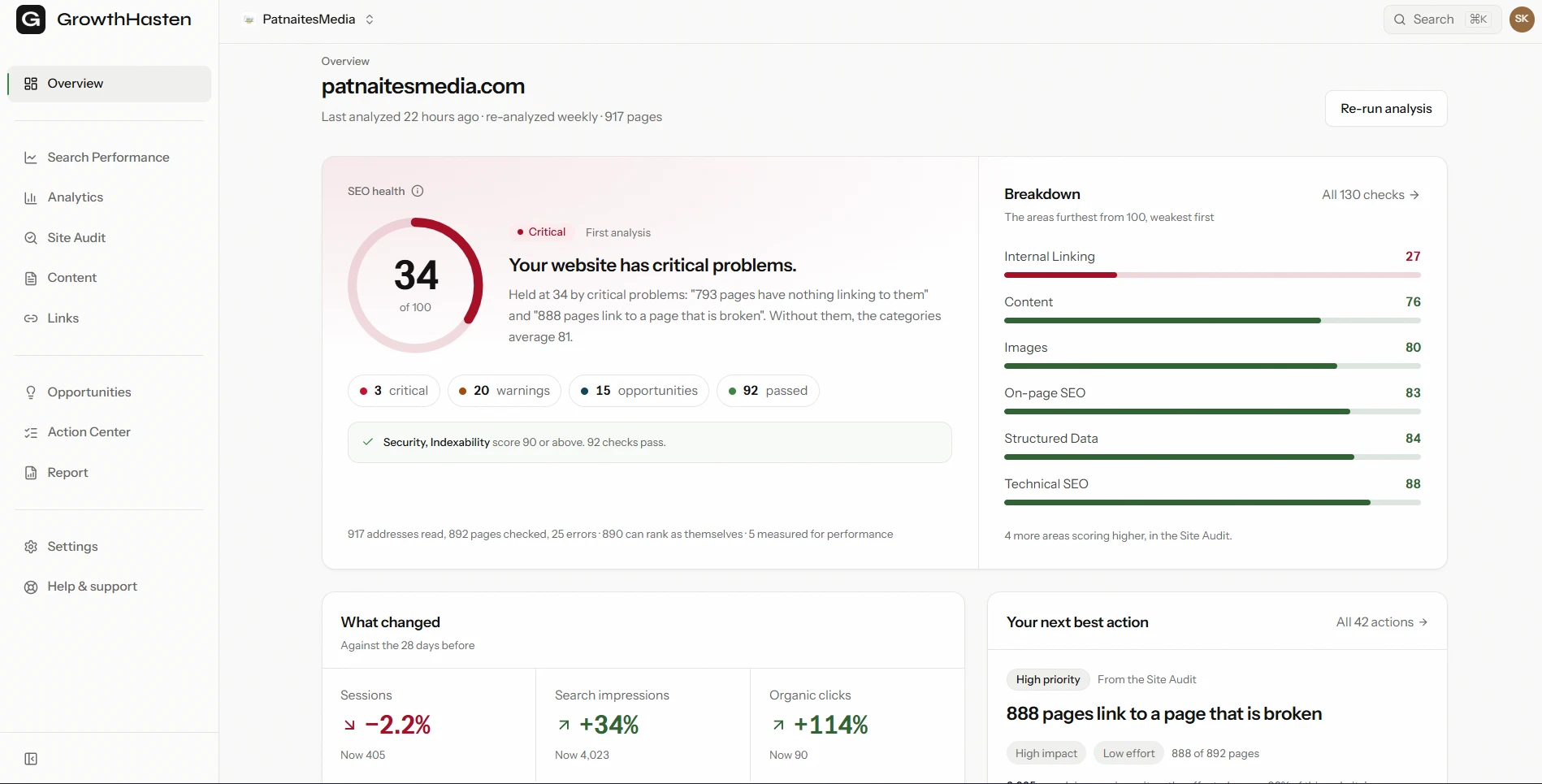
When an audit needs to run as an ongoing program rather than a once-a-year scramble, keep the inventory current. GrowthHasten's Content section lists every page with its word count beside its clicks and flags the pages losing traffic, 90 days against the 90 before.
The habit worth building is treating your content library like a portfolio you manage, not an archive you add to. Pages have a lifecycle, and the audit is how you decide when each one is worth holding, worth improving, or worth retiring. This week, open Search Console, set the last three months against the same period a year ago, and sort by the biggest click losses. The five pages at the top are your refresh list, and reviving a page that has already proven it can rank is the fastest win on your entire site.
See Which Pages to Write, Refresh or Leave Alone
Connect Search Console and GrowthHasten's Content section puts every page's word count beside its clicks, flags the pages losing traffic and the pages competing for the same search, and groups topics as covered, partial or missing against what you already publish.
Explore the Content SectionQuestions
Frequently asked questions
What is a content audit in SEO?
A content audit is a structured review of every page you have published, measured against performance and quality signals so you can decide what to keep, refresh, consolidate, or remove. It catches problems that build up slowly on any established site: pages that have decayed, thin pages that never ranked, several pages competing for the same query, and pages wasting crawl attention. The output is a verdict and an action for each URL, not just a list of pages.
How often should you run a content audit?
Run a full content audit once a year, and add a lighter quarterly check on your highest-value pages and anything showing decay. The right cadence scales with how much you publish. A site adding a few posts a month drifts slowly, while a site publishing weekly accumulates overlap and decay far faster and benefits from more frequent checks. Avoid auditing constantly, since rewriting pages every few weeks often resets signals that were performing fine.
Should you delete or redirect old blog posts?
Redirect any page that has backlinks, internal links, or lingering rankings, and delete only pages that have none of those. A hard delete returning a 404 throws away every link the page earned and can weaken the pages that link to it. Use a 301 redirect to send a retired page to the closest relevant live page so its equity transfers. Reserve outright deletion for genuinely valueless pages, because a redirect is reversible and a lost backlink usually is not.
What is the difference between refreshing and rewriting content?
Refreshing updates the substance of a page in place while keeping the same URL, so it retains every ranking signal it has already earned. You correct stale facts, match current search intent, and strengthen internal links. Rewriting from scratch or publishing a new URL for the same topic is usually a mistake, because it leaves the old page competing with the new one and discards the history the original had built. Update the existing page and keep its address.
When should a page get the consolidate verdict?
Two or more pages target the same query and split clicks and signals between them. Merge the strongest material into one page, then use a 301 redirect to send the weaker URLs to it so their signals transfer. This is one of five verdicts in the audit's decision matrix; the others are keep, refresh, prune, and noindex, each for a different pattern of signals.

Written by
GrowthHasten Team
Editorial Team, GrowthHasten
Articles from the GrowthHasten editorial team, grounded in primary research, our own testing, and what analyzing real websites shows, fact-checked in-house.
View profile