

An AI content agent is a system that takes a content task from brief to finished draft on its own, fetching what it needs through tools and following standards you wrote down before it started. This is for content leads, founders, and SEO teams who have prompted a chat window for an article, spent longer repairing the output than writing it would have taken, and concluded the whole idea does not work. It covers what separates an agent from a writing tool, what the agent needs in place before it writes a word, how to split the work into roles, which gates have to block publishing, and what breaks once the thing is actually running. The short answer up front: generation was never the hard part. This is the build guide; if the question you are actually asking is which parts of SEO you can hand to an agent at all, start with what to delegate to an SEO agent and what never to.
The short version
- The draft is the cheap half. Everything expensive lives in verification, which is why most content agents get built as far as the draft and abandoned there.
- Standards belong in files the agent reads on every run, not in a prompt. A prompt is forgotten when the session ends.
- A model that grades its own draft passes it. Generation and checking have to be separate roles with separate instructions.
- An agent that recalls a fact invents it. An agent that queries a tool reports it. In the finished draft, both look identical.
- Give every check exactly one owner. Three layers checking the same thing is not redundancy, it is nobody checking it properly.
What is an AI content agent?
A system that decides its own next step. That is the whole distinction, and it is worth being precise about, because the word is now attached to anything with a text box. Anthropic's engineering write-up on building effective agents draws the line cleanly: "Workflows are systems where LLMs and tools are orchestrated through predefined code paths. Agents, on the other hand, are systems where LLMs dynamically direct their own processes and tool usage."
For content production, most teams want the first thing and ask for the second. A fixed sequence of research, brief, draft, edit, publish is a workflow, and a workflow is easier to debug, cheaper to run, and far easier to trust. The agentic part earns its place inside individual steps: deciding which sources to read, noticing that a topic is already covered, choosing to check a claim nobody told it to check.
The same write-up gives the rule worth stealing: "you should consider adding complexity only when it demonstrably improves outcomes." A content pipeline that works as five prompts in a defined order does not need to be autonomous, and calling it autonomous adds failure modes without adding output.
How is an agent different from an AI writing tool?
By what it can check for itself. A writing tool produces text and hands you the verification problem intact. An agent can be given the ability to look things up, and that ability is the only thing that makes unsupervised output plausible. The rest of the comparison is packaging.
| Setup | Who decides the next step | What it can verify itself |
|---|---|---|
| Chat prompt | You, every turn | Nothing. It has no access to your site, your data, or the live results page. |
| Template tool | Whoever wrote the template | Structure only. It can enforce a shape, never a fact. |
| Workflow with tools | Your code, in a fixed order | Whatever the connected tools expose: existing posts, keyword data, index status. |
| Agent | The model, inside limits you set | The same, plus checks nobody asked for. That is the real upside and the real risk. |
The interesting column is the third. A system that cannot look anything up should not be trusted to write about anything specific, however good the prose is, because every concrete detail in the output is a recollection rather than a reading.
Why do content agents fail after the first draft?
Because the draft was never the constraint. Drafting is the part language models are genuinely good at, so it is the part every demo shows. The work standing between a draft and a published page is checking whether the claims are true, whether the piece duplicates something you already have, whether it sounds like your publication, and whether anyone will ever find it. None of that is writing.
Three causes account for most of the collapse. Standards that were never written down, so nothing can fail a draft. Self-review, where the model that wrote the piece is asked whether the piece is good. And recall in place of retrieval, where a number, a competitor claim, or an internal link comes from memory rather than a source.
The third is the dangerous one, because it is invisible. A fabricated statistic reads exactly like a sourced one. Our guide to AI content and SEO covers what Google's guidance actually targets here, and the short version is that the production method is not the problem. The unverified claim is.
What does the agent need before it writes anything?
A written standard for every judgment you do not want improvised. Teams skip this, and skipping it is why the output feels generically competent and unusably off-brand at the same time. The agent is not guessing your standards badly. It has no standards, so it defaults to the average of everything it has read.
What that set covers in practice:
- Voice, with a banned list: not "write in a confident tone" but the specific phrases that get a draft rejected. A named list of forbidden openers does more work than three paragraphs about personality.
- Structure, as a shape: where the summary block sits, whether headings are questions, how long a paragraph runs, what the closing paragraph has to contain.
- Evidence rules: which source tiers count for a fact, which count only for sentiment, and what happens to a number with no source. The right answer to the last one is that the number gets deleted.
- Taxonomy: the exact categories and tags that exist, plus an explicit ban on inventing new ones. Left unstated, an agent will helpfully create a category to make a distribution look balanced.
- Byline rules: which claims each author is allowed to make. An agent will write "in our experience" about work nobody did unless something stops it.
One test decides whether a rule is worth writing down: can it fail a draft? "Avoid fluff" cannot. "No bold lead-in label may be followed by a period" can. From what I have seen running this in practice, the rules that survive are almost always the second kind, and the aspirational ones quietly do nothing at all.
How do you split one agent into roles?
By permissions, not by subject. The division that matters is what each role may touch, because that is what makes a mistake recoverable. A researcher that cannot write and an editor that cannot publish will give you a worse first draft and a much better final page.
- Researcher: read-only. Its output is a brief with the target query, the angle, the sources, and an explicit note on what already exists on the site. It does not write the article.
- Writer: takes the brief, produces the draft, and has no access to the publishing system. This matters more than it sounds. A writer with publish rights eventually publishes.
- Editor: returns a verdict and nothing else. Pass or revise, with line-level reasons. Give it a different instruction set from the writer, or it will agree with itself.
- Publisher: the only role with write access. It runs the mechanical pre-flight, the checks that are true or false rather than matters of judgment, and then it ships.
One rule holds the structure together: every check has exactly one owner. If the writer, the editor, and the publisher all verify internal links, each does it partially, assuming someone else is doing it properly. Assign the check once, name the owner, and let the other layers trust it.
Which gates have to block publishing?
The ones where being wrong is expensive and quiet. The fact check is the clearest case, because Google's October 2026 guidance telling publishers to fact-check AI output before publishing puts that check on the publisher, not on Google. A gate that warns is not a gate. If the pipeline can proceed past a failed check, that check is documentation.
| Gate | What it proves | What happens if it only warns |
|---|---|---|
| Fact check | Every number and claim traces to a source that exists | Invented statistics, published under your name |
| Voice and slop | The draft carries none of the banned patterns | A library that reads like every other AI blog |
| Duplication | The piece does not compete with a page you already have | Two of your own pages splitting one query |
| Discovery | The new page has inbound links from pages that are themselves findable | A published page nothing points at, which is a page nobody reads |
| Landed and seen | The content is live, and the search engine has actually crawled it | A pipeline that reports success on its own paperwork |
The last row is the one worth arguing about. A content management system reporting status: published tells you what you intended. Whether a search engine has fetched the URL is a separate question with a separate answer, and treating the first as evidence of the second is how a batch of pages sits unseen for weeks while every internal check passes.
How do you give the agent live data instead of recall?
By connecting it to the systems that hold the answer, then forbidding it from answering from memory. This is what tool access is for. The Model Context Protocol, now the common way to wire it up, describes itself as "an open-source standard for connecting AI applications to external systems", and the practical effect for content work is that the agent reads your site instead of guessing at it.
The connections that change the output most:
- Your content management system: so the agent knows what you have published, which categories exist, and whether an internal link it wants to add points at a real page.
- Search Console: so "is this page indexed" gets answered with a verdict instead of an assumption.
- A keyword and results-page source: so demand and competition are numbers it fetched rather than numbers it produced.
Then set the rule that makes the connections count: no claim in the draft may be something the agent could have checked and did not. Search volume, competitor coverage, whether a post already exists, whether a link resolves. In every case a tool knows, and every time the agent skips it, the output degrades in a way that reading cannot detect.
How do you know the agent's output is good?
By testing it against the query it is meant to answer, which is a different question from whether you like the writing. Internal taste is a weak gate because it tracks familiarity rather than usefulness. Three checks earn their place: a fixed rubric applied identically to every draft, a reviewer who did not write the piece, and the live results page for the target query.
The third is the one teams skip and the one that catches most. Read what currently ranks, then ask what your draft adds. If the honest answer is a tidier arrangement of the same information, the piece will publish and do nothing. Our guide to SEO content writing sets out the information gain requirement in full, and it is the standard an agent fails most often, because synthesising available material is exactly what these systems are best at.
Watch the texture too. Uniform paragraph lengths, every section opening with a transition adverb, bold labels on every bullet, and the specific phrases that mark machine assembly. Our guide to editing the AI tells out of a draft lists the patterns worth adding to the editor's reject list.
Check the Plan Against What You Already Publish
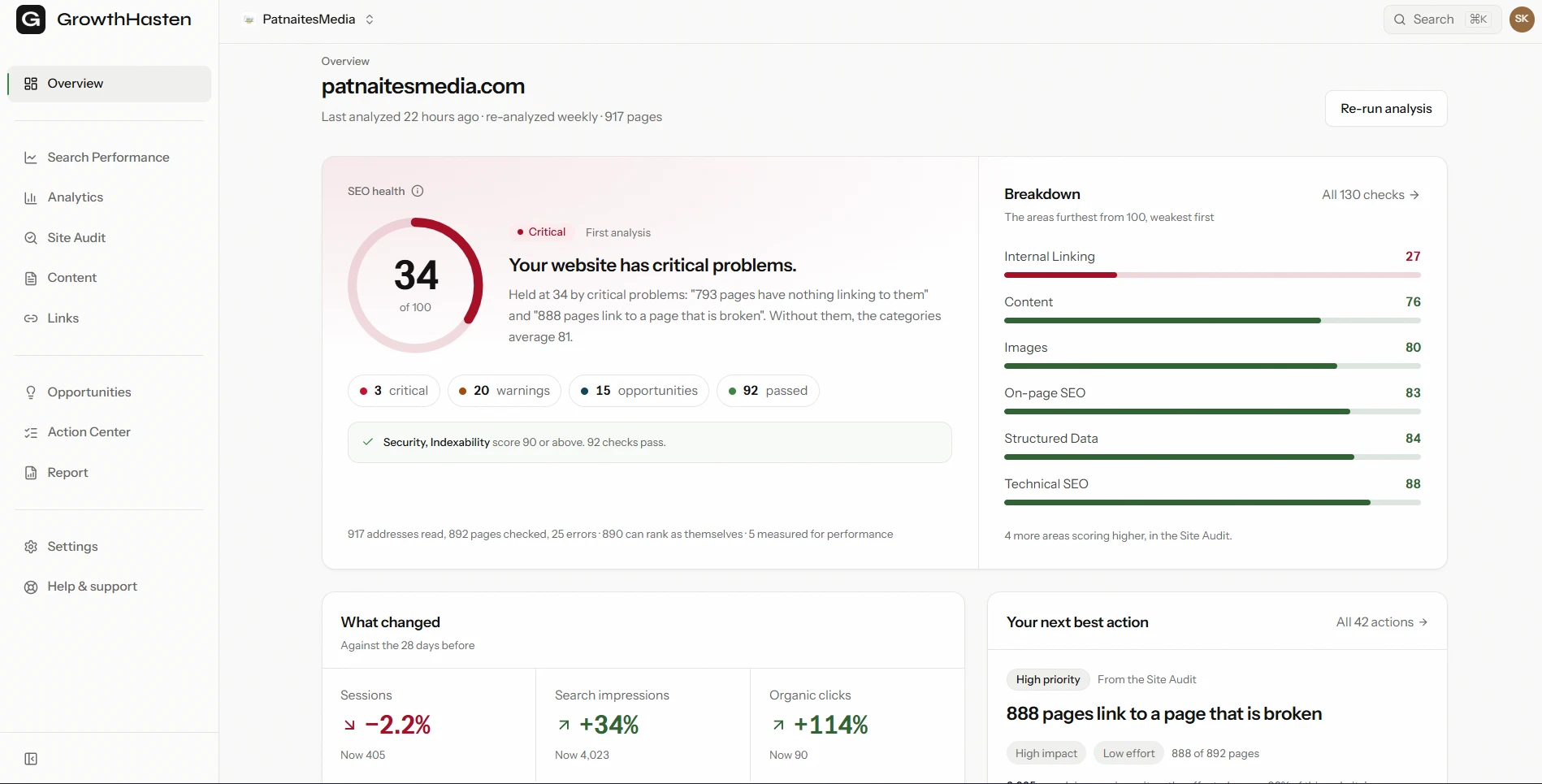
Before an agent drafts anything, see what your site already covers. GrowthHasten's Content section groups each topic as covered, partial or missing against your existing pages, with the matched pages as evidence, and flags pages competing for the same search.
Explore the Content SectionWhat actually breaks once the agent is running?
Not the writing. The operations around it, and nearly always at a seam between two steps. These are the failures worth designing for before you meet them:
- Two writes, one intention: publishing a page and adding its inbound links are separate operations. Anything that interrupts the run between them ships a live page with nothing pointing at it. We have shipped exactly that, and the fix is not more retries. It is treating the pair as one unit of work that is unfinished until both halves are confirmed.
- Confident paperwork: an agent that reports success because a write returned
200is reporting its own request, not the world. Verify the resulting state afterwards, from the system that owns it. - Stale verdicts: when a data connection is down and the agent carries the last known answer forward, "not indexed" ages into a false trend. Timestamp every verdict and refuse to reason across a gap.
- Silent overwrites: an agent holding a whole page payload in memory will revert whatever changed while it was thinking. Read the current version, modify it, write it back, and fail loudly when the text you meant to replace is no longer there.
- Drift: the agent follows the file you edited last, so the files are the actual product. When quality falls, the honest first suspect is the standard, not the model.
Notice what these share. Every one is a systems problem in an AI costume, and every one is fixed with ordinary engineering discipline rather than a better prompt. The system around the draft is what decides whether the draft ever performs.
When should you not build a content agent?
More often than the current enthusiasm suggests. The build only pays back on repetition, and several situations make it a bad trade:
- You need one article: writing it will be faster than specifying it. The agent starts paying for itself around the twentieth run of the same process.
- Your standards are not written down: then the first deliverable is the standards, not the agent. Building the pipeline first just automates the ambiguity.
- Nobody can judge the output: an agent with no competent reviewer produces confident volume, which is worse than nothing, because it is expensive to unpick later.
- The value is experience the agent does not have: case studies, implementation opinions, anything resting on work someone actually did. An agent can structure that material. It cannot supply it, and letting it try is how false claims get published.
- The goal is volume: Google's spam policies define scaled content abuse as generating many pages "for the primary purpose of manipulating search rankings and not helping users", and are explicit that this applies "no matter how it's created". An agent aimed at output per week is a policy problem wearing a productivity label.
There is a scoping answer that suits most teams: automate the work around the writing rather than the writing. Topic validation, duplication checks, brief assembly, link placement, and index verification are all mechanical, all tedious, and all safer to hand over than the paragraph itself. Our guide to building topical authority covers the planning layer where that leverage is largest.
The habit worth building is smaller than the architecture. Every time you correct the agent, put the correction in a file rather than in the chat. A correction in a conversation is spent when the session ends; a correction in a standard applies to every draft after it, and that is the only mechanism by which any of this compounds. This week, take the last three drafts you rejected, write down the single test each one failed, and add those three tests to the editor's list. That work is available before you build anything, and it is most of the value.
See Which Pages to Write, Refresh or Leave Alone
Connect Search Console and GrowthHasten's Content section puts every page's word count beside its clicks, flags the pages losing traffic and the pages competing for the same search, and groups topics as covered, partial or missing against what you already publish.
Explore the Content SectionQuestions
Frequently asked questions
What is an AI content agent?
An AI content agent is a system that takes a content task from brief to finished draft on its own, fetching what it needs through connected tools rather than answering from memory, and following standards defined before it starts. What separates it from a chat prompt is that it decides its own next step and can check some of its own work. What separates a useful one from a demo is verification, not writing quality.
What is the difference between an AI content agent and an AI writing tool?
A writing tool produces text and leaves you the entire verification problem. An agent can be connected to the systems that hold the answers, so it can check whether a claim is sourced, whether a topic is already covered on your site, and whether an internal link points at a real page. That ability to look things up is the only thing that makes lightly supervised output plausible.
Can an AI content agent publish without human review?
Only if the checks that stand in for the reviewer genuinely block publishing. In practice that means a fact check, a voice check, a duplication check, a discovery check, and a verification that the page actually landed. If any of those can be skipped, a human still has to hold the gate. A gate that only warns is documentation, not a gate.
What should an AI content agent never be allowed to do?
Write a number it did not fetch, claim experience nobody had, invent a category or a tag, or hold publishing rights in the same role that writes the draft. The first two produce false claims under your own byline. The second two produce quiet structural damage that is expensive to unpick months later, long after the drafts themselves look fine.
Do you need to write your standards before building a content agent?
Yes, and they are usually the harder deliverable. An agent has no house style, so with nothing written down it defaults to the average of everything it has read, which is exactly the output people describe as AI slop. The test for whether a rule is worth writing is whether it can fail a draft. Aspirational rules do nothing.

Written by
GrowthHasten Team
Editorial Team, GrowthHasten
Articles from the GrowthHasten editorial team, grounded in primary research, our own testing, and what analyzing real websites shows, fact-checked in-house.
View profile