

A content brief is the document that settles what an article will be before anyone drafts it: the query it targets, the reader it serves, the questions it has to answer, what it adds that the ranking pages do not, and who is qualified to sign it. This guide is for whoever commissions writing, from a freelancer, an agency, or an AI assistant, and keeps receiving drafts that are competent and still wrong. It covers what belongs in a brief, what does not, the four fields that decide whether a page is worth publishing at all, and what changes when the thing reading the brief is a model. The complete template is further down this page, in plain text, free to copy. No email address, no download, no request for a copy.
The short version
- Approve the brief, not the draft. Once a draft exists, the expensive decisions have already been made, and reversing one costs a rewrite instead of a sentence.
- Four fields decide whether the page is worth publishing: information gain, overlap with pages you already own, the byline, and what the page must be quotable for.
- A brief a person can follow is also a brief an AI assistant can follow. The reverse is not true.
- If you cannot fill in the information-gain field, the honest output is no article.
- The outline is not the brief. It is one field inside it.
What is a content brief, and what is it not?
It is the set of decisions an article is built from, written down before drafting starts. Everything downstream is execution against those decisions, which is why a good brief makes a draft faster to write and much faster to approve.
What it is not is an outline. That confusion is the most common reason briefs fail to change anything: a list of headings tells a writer what order to write in, and nothing about why the page should exist.
| Document | What it settles | Reused across articles? |
|---|---|---|
| Content brief | Why this page exists, who it is for, what it must add, what it links to, who signs it | No. One per article. |
| Outline | The order of the sections | No, and it is one field inside the brief |
| Style guide | How sentences sound, what words are banned, how links are formatted | Yes. Written once, applies to everything. |
A brief is also not a strategy document. It works one page at a time and assumes the strategy above it already exists: the subject you are building, the cluster this page sits in, and how a topic cluster is planned in the first place. If those are unsettled, the brief will not rescue them.
Who writes the brief, and who approves what?
Whoever owns the outcome, not whoever is writing the draft. The brief is where the costly decisions get made, so it belongs to the person accountable for whether the page should exist at all.
From my experience, the single change that improves output most is not a better template. It is moving the approval step: approve the brief, not the draft.
The reason is arithmetic. When the draft is the artifact that gets approved, feedback arrives as line edits on decisions that were settled three thousand words ago. "This is aimed at the wrong reader" is a two-word note on a brief and a rewrite on a draft. Every serious disagreement is cheap while it is still a bullet point.
There is a real cost, and it is worth naming. Approving briefs adds a step and a wait, and teams that publish reactively will feel it. The trade is that the wait moves to the front, where it costs a day, instead of the end, where it costs a rewrite. Once the brief is signed, writing the page once the brief is approved becomes a craft problem rather than a strategy argument.
What goes in a content brief?
Seven groups of fields: strategy, demand, overlap, outline, links, author, metadata. Here is the whole thing. Copy it, delete what your team does not use, and keep the four fields in the next section whatever else you cut.
CONTENT BRIEF

1. STRATEGY
Primary query:              one query, in the words a reader would type
Search intent:              informational / commercial / transactional / navigational,
                            read off the live results page, not guessed from the phrase
Reader:                     the role and the situation they are in, not a persona document
Business outcome:           the page or service this supports
Information gain:           what this page adds that the ranking pages do not have.
                            If this is blank, stop. There is no article yet.
Quotable for:               the one thing an answer engine should be able to lift
                            from this page and attribute to you

2. DEMAND
Volume / difficulty:        the figure and where it came from, or "not measured" and why.
                            Never a guess dressed as a measurement.
Secondary queries:          coverage targets inside this page, not separate articles
Entities to include:        the named things a complete answer mentions

3. OVERLAP
Do we already own this?:    create / update / expand / merge, decided against the live site
Query boundary:             what this page owns, and what the neighboring page keeps
Existing pages to change:   the exact section to cut or reduce, and the link that
                            hands the query over to the new page

4. OUTLINE
Working title:
Questions to answer:        three to eight, phrased the way a reader would ask them
Sections:                   the heading list, in order
Original asset:             the framework, table, checklist, decision tree or template
                            this page contributes and the others do not have

5. LINKS
Internal links out:         target URL plus the anchor text, decided here, not by the writer
Should link in:             existing pages that will point at this one, and where in them
External sources:           primary documentation only, opened before it is cited

6. AUTHOR
Byline:                     the name that goes on the page
Required expertise:         what that byline has to actually know for this to be honest
Must not claim:             the sentences this byline is not allowed to write

7. METADATA
Slug:
Meta title:                 60 characters or fewer
Meta description:           140 to 160 characters
Category and tags:
FAQs:                       four to six real questions, each answerable on its own
CTA:                        where the reader goes next, and why that is the right next step
A blank field is information, not an oversight. If nobody can name the original asset, the honest answer is that the article is not ready to commission, and the brief has just saved you a draft.
| Group | What it settles | The failure it prevents |
|---|---|---|
| Strategy | Why the page exists and what it must add | A competent article nobody needed |
| Demand | Whether anyone is asking, and how confident you are | Publishing on a hunch, or quoting a number nobody measured |
| Overlap | Whether this should be a new page at all | Two of your own pages competing for one query |
| Outline | The shape of the page and its original asset | A draft that wanders, or one that adds nothing |
| Links | Where readers and relevance flow, in both directions | A page nothing points at |
| Author | Which claims the page is allowed to make | Invented experience under a byline that cannot carry it |
| Metadata | How the page is filed, titled and shown | A good article filed where nothing links to it |
The search-intent line deserves a note, because it is the field most often filled in from the keyword rather than from the evidence. Intent is a property of the results page, not the phrase, and reading intent from the SERP settles what format the page has to be.
Which four fields decide whether the page is worth publishing?
Information gain, overlap, author, and what the page must be quotable for. Every other field describes the article. These four decide whether it should exist.
We opened two of the template pages ranking for this query and read them in full, beomniscient.com and minuttia.com. Neither carries any of the four, and both put the template behind a click: a download on one, a Google Doc copy on the other. We did not open the other seven, so that is a claim about those two pages and nothing wider.
These four are not additions invented for an article. They are in our own brief because we hit the failure each one prevents.
- Information gain: what this page contributes that is absent from the results currently on page one. Google's helpful content documentation puts the same question first: does a page offer original information, reporting, research or analysis, and substantial value next to what already ranks? The brief asks it before the writing rather than after. "More comprehensive" is not an answer to it.
- Overlap: whether you already own a page on this subject. Commissioning a second page for a query one of your own pages already holds is the most expensive mistake on this list, because it costs the article and damages the page you had. Decide whether the topic should be a new page at all before the brief goes any further, and record the boundary between the two pages in writing. A content research tool can run that overlap check before you get to this field; how eleven of them compare on what they read before recommending a topic is worth checking before you buy one.
- Author and required expertise: the byline is not a formatting detail at the end. It decides which sentences the draft may contain, because a claim about work someone has not done is a fabrication whoever types it. Google's guidance on who created the content, how, and why asks whether it is self-evident who wrote a page and whether it shows first-hand expertise. Our guide to what a byline can honestly claim covers how we split ours. Fill in the "must not claim" line even when it feels obvious.
- Quotable for: the one thing an answer engine should be able to lift from the page and attribute to you. Answer engines quote self-contained passages, so naming the passage in the brief is what stops it being buried in the middle of a section that only makes sense in order.
Do the Overlap Check Before You Write the Brief
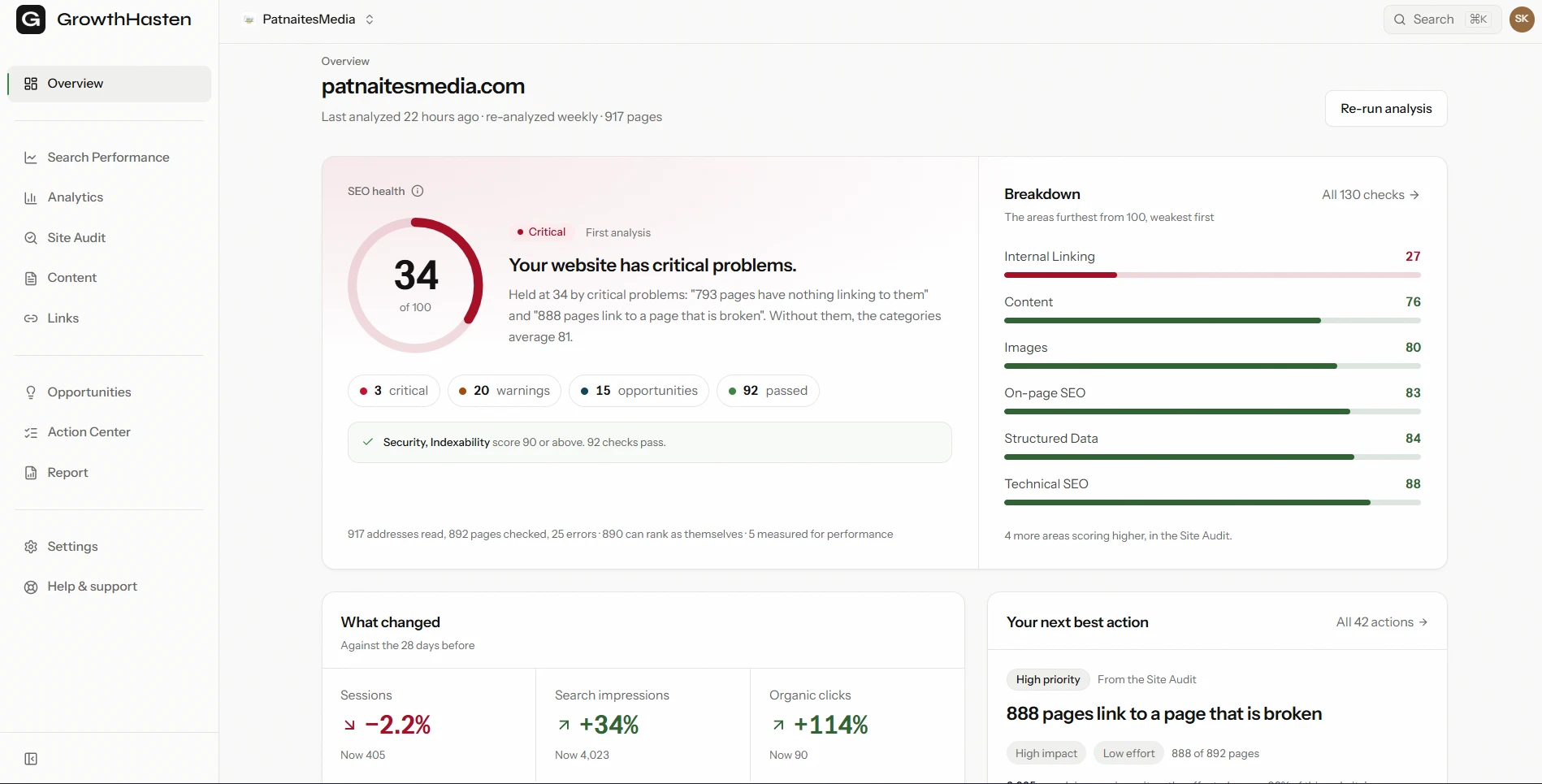
GrowthHasten's Content section reads your existing pages first: it groups each topic as covered, partial or missing with the matched pages as evidence, and flags two of your own pages competing for the same search. You still decide what the new page adds.
Explore the Content SectionWhat does a filled-in brief look like?
Here is the brief for the article you are reading, abbreviated to one line per field. Every row is checkable against this page, which is the reason for publishing it rather than describing it.
| Field | Entry |
|---|---|
| Primary query | content brief |
| Search intent | Informational shading into download intent. Of the nine results listed on 1 September 2026, seven carried "template" in the title or the URL. |
| Reader | A content or growth lead who commissions writing and keeps getting drafts that miss. |
| Information gain | The complete template on the page, ungated, plus four fields absent from both competitor templates we opened. |
| Quotable for | What belongs in a content brief, and the difference between a brief and an outline. |
| Volume / difficulty | Not measured. Our keyword tool was unavailable the day this was briefed, and no figure was estimated to fill the gap. |
| Do we already own this? | Create, with a trim. One existing page held the phrase in a heading without carrying a method or a template. |
| Query boundary | This page owns the document. The pillar keeps why a brief matters at cluster level, and links here for the fields. |
| Original asset | The template above, plus this worked example. |
| Byline | The GrowthHasten Team. Required expertise: runs this process. Must not claim: any result, adoption or ranking figure for the format. |
Two of those rows do more work than they look. The demand row says "not measured" instead of carrying a plausible number, because a brief that launders a guess into a figure is worse than one with a gap. The overlap row is what turned a section on an existing page into a link pointing here, rather than a second page competing with it.
What changes when the writer is an AI assistant?
Three fields get stricter and one gets added. The format does not change, which is the useful part: a brief precise enough for a model is simply a good brief, and the same document still works for a person.
| Field | With a person | With an AI assistant |
|---|---|---|
| Information gain | A direction. The writer fills in the specifics from research. | A stated fact the model cannot infer. Asked to add something new, a model will invent something new. |
| External sources | A list of good places to look | Exact URLs, with an instruction to open each one before citing it |
| Must not claim | Usually implicit in the byline | Written out in words, claim by claim |
| Verification | Assumed | A new line: which claims a human has to check before publishing |
The pattern behind all four is the same. A person who does not know something usually asks or leaves a gap. A model fills the gap fluently, and the failure arrives looking exactly like the success. So the brief stops being a set of directions and becomes a set of constraints as well.
What the brief cannot do is remove the human check at the end. Google treats pages made mainly to game rankings rather than help readers as scaled content abuse in its search spam policies, and no field in any template proves your page is not that. A person still reads it before it ships.
How long should a content brief be?
Long enough that every field has a real answer, and no longer. Length follows the topic rather than a house standard: the outline, the links and the overlap check take most of the room, and a contested query needs more of all three than a quiet one does.
The test for "too long" is not word count. It is this: if the brief contains sentences that could appear in the article, it has stopped being a brief and become a first draft written by the wrong person. At that point you are paying twice for the same paragraphs and the writer has nothing left to do but retype them.
The opposite failure is quieter. A brief that fits in a chat message is usually a title and a word count, and it will produce exactly what a title and a word count deserve.
What are the most common content brief mistakes?
Six. The first two are where most of the disappointment comes from.
- Calling an outline a brief: headings in order, no decisions. The writer still has to guess the reader, the angle, and the point.
- Writing the brief after the draft: usually to satisfy a process. It documents what happened instead of deciding what should.
- Leaving information gain as a slogan: "more in depth", "better written", "more comprehensive". None of those is a thing a reader gets that they cannot get elsewhere.
- Choosing internal links at draft time: links picked while writing follow the paragraph. Links picked in the brief follow the site.
- Skipping the overlap check: the check takes minutes and prevents the one mistake you cannot undo by editing.
- Filling the demand field with a number nobody measured: a figure with no source in a brief becomes a figure with no source in the article.
When do you not need a content brief?
When the writer is the decision maker. If the person drafting owns the subject, owns the outcome, and is the one who would have approved the brief, writing it down is bookkeeping.
Three cases where we skip it:
- Small updates to a page you already own: a stale figure, a changed interface, a broken link. The decisions were made when the page was commissioned.
- A piece only one person could write: when the value is the author's own judgment, a brief written by someone else narrows it rather than sharpening it.
- Genuinely time-sensitive notes: a response to a change your readers are asking about this week. Ship it, then decide whether it deserves a permanent page.
The line is not seniority and it is not article length. It is whether more than one person's judgment is involved. The moment it is, the brief is cheaper than the conversation you would have instead.
One rule is worth more than the template itself, and it survives staff changes, tool changes and busy quarters: nothing gets drafted before the brief is approved.
This week, take the next article on your calendar and fill in two fields from the template above, before anything else. Information gain, and whether you already own a page on the subject. If either one comes back blank, you have just saved yourself an article.
See Which Pages to Write, Refresh or Leave Alone
Connect Search Console and GrowthHasten's Content section puts every page's word count beside its clicks, flags the pages losing traffic and the pages competing for the same search, and groups topics as covered, partial or missing against what you already publish.
Explore the Content SectionQuestions
Frequently asked questions
What should a content brief include?
The target query and the intent behind it, the reader, the questions the page must answer, the outline, the internal and external links with their anchor text, the metadata, and the byline. Four further fields matter more than any of those: what this page adds that the ranking pages do not have, whether you already own a page on the subject, who is qualified to sign it, and what the page needs to be quotable for.
What is the difference between a content brief and a content outline?
An outline is the shape of the page: which sections appear, in what order. A brief is the whole decision behind the page: why it exists, who it is for, what it must add, what it links to, and who can sign it. The outline is one field inside the brief. Handing a writer only an outline leaves the expensive questions unanswered.
Who should write the content brief?
Whoever owns the outcome, not whoever is writing the draft. The brief is where the costly decisions get made, so it belongs to the person accountable for whether the page should exist at all. Our recommendation is that the brief, rather than the draft, is the thing that gets formally approved, because a disagreement is cheap to settle while it is still a bullet point.
How long should a content brief be?
Long enough that every field has a real answer, and no longer. The useful test is not word count. If the brief starts containing sentences that could appear in the finished article, it has stopped being a brief and become a first draft written by the wrong person. A brief short enough to fit in a chat message is usually just a title and a word count.
How do you brief an AI writing assistant?
Use the same format with three fields tightened. State the information gain as a fact the model cannot infer, because a model told to add something new will invent something new. List the exact source URLs, since a model will otherwise supply plausible ones. Write out in words what the piece may not claim. Then add a line naming which claims a person has to verify before publishing.
Do you need a content brief for every article?
No. A small update to a page you already own, or a piece that only one person could have written, often does not need one. The line is not article length or seniority. It is whether more than one person's judgment is involved in the outcome. Once it is, writing the decisions down costs less than the conversation you would have instead.

Written by
GrowthHasten Team
Editorial Team, GrowthHasten
Articles from the GrowthHasten editorial team, grounded in primary research, our own testing, and what analyzing real websites shows, fact-checked in-house.
View profile