

SEO content writing is the craft of writing a page that satisfies search intent so completely that it deserves to be the best answer, then structuring that answer so search engines and AI answer engines can read it cleanly. It is not keyword stuffing, and it is not writing for an algorithm. This guide is for founders, marketers, and writers who publish regularly but watch good pages stall on page two. It covers starting from intent and the SERP, structuring for readers and machines, writing the intro and the direct answer, using entities naturally, information gain, E-E-A-T in the prose, writing to be quoted by AI, ruthless editing, and a brief-to-publish workflow you can repeat.
The short version
- Write to satisfy the intent behind the query, not to place a keyword a set number of times.
- Start from the SERP, not the keyword. The results already show you the format and depth Google rewards.
- Answer the question in the first sentence, then earn the reader's time with the detail underneath.
- Information gain decides rankings now. If you add nothing the ranking pages lack, there is no reason to publish.
- Human judgment does the parts AI cannot: original insight, fact-checking, and knowing what to cut.
What is SEO content writing?
It is writing to be the best answer to a specific search, then formatting that answer so machines can parse it. The goal is to satisfy the person behind the query so well that ranking becomes a consequence rather than the target.
That framing rules out two failure modes at once. Writing purely for readers with no thought to structure leaves value a crawler cannot extract. Writing purely for the algorithm produces keyword-dense pages that no human finishes. Good SEO content writing serves both audiences with the same words.
It is also distinct from content strategy. Strategy decides which pages to build and how they connect into topical authority; writing is the craft of making any single page the best answer on its own. This guide is about that second job.
Why start from search intent and the SERP, not the keyword?
Because the keyword is a label, and intent is the actual question. Two people typing the same words can want different things, and the search results already tell you which want Google has decided to reward.
Open the top results before you write a line. They reveal the dominant intent, the format that ranks (guide, comparison, tool, or list), the depth expected, and the sub-questions every page feels obliged to answer. Reading the SERP is faster and more honest than guessing.
Four intents cover most queries, and each demands a different page.
| Intent | What the searcher wants | What the page should be |
|---|---|---|
| Informational | To learn or understand something | A clear explainer that defines and teaches |
| Commercial | To compare options before deciding | A comparison with tables and honest trade-offs |
| Transactional | To act, buy, or hire | A focused page that removes friction |
| Navigational | To reach a specific brand or page | The destination itself, not an article about it |
Get this wrong and no amount of polish saves the page. A comparison written as a tutorial loses to the comparison the searcher expected. Our keyword research guide covers how to read intent before you commit to a topic.
How do you structure a page for readers and machines?
Answer first, then organize the rest into scannable, self-contained blocks. A reader skims and a crawler parses, and both are served by the same discipline: state the point, label it with a clear heading, and keep each section able to stand alone.
The moves that do the heavy lifting:
- Descriptive, question-format headings. A heading that states the question lets a reader jump to the answer and gives a machine a clean topic label.
- Short paragraphs. Two to four sentences. Walls of text hide the answer a reader came for.
- Lists and tables where they fit. Steps become a numbered list; comparisons become a table. Do not force prose into a shape it resists, or a table where a sentence would do.
- Self-contained sections. Each block should make sense if an AI engine quotes it alone, without the paragraph before it.
There is a real tension between the two audiences, and naming it helps you serve both.
| Element | What the reader needs | What the machine needs |
|---|---|---|
| Headings | A signpost to skim by | A parseable topic label |
| Opening line | A reason to keep reading | An extractable direct answer |
| Formatting | Visual breathing room | Structured blocks like lists and tables |
| Depth | Enough to trust the page | Enough coverage to match the intent |
How do you write the intro and the direct answer?
Define the thing, name who it is for, and say what the page covers, all inside the first few sentences. Skip the runway. Nobody searching for an answer wants a paragraph about how the topic has never been more important.
Then answer the headline query directly and early, ideally within the first 150 words. That opening answer is what earns a featured snippet and what an AI engine lifts as its summary. A page that buries its answer three scrolls down forfeits both.
The pattern that works under every question heading: answer in the first sentence, often as a fragment, then expand. "Rarely." "In two stages." The short answer satisfies the skimmer and the snippet; the expansion satisfies the reader who stayed.
How do you use keywords and entities without stuffing?
Write naturally, then support the topic with the entities a real expert would mention. Modern search understands subjects through relationships, not repetition, so the goal is coverage of the concept, not density of the phrase.
Use the primary keyword where it reads naturally: the title, the opening, one or two headings, and wherever a human would reach for it anyway. Then bring in the related entities that prove you understand the subject. For a page like this one, that means search intent, featured snippets, People Also Ask, structured data, E-E-A-T, and AI Overviews, because those are the things the topic actually touches.
The test is simple. Read the sentence aloud. If the keyword makes it sound like a robot wrote it, rewrite the sentence. Google's Search Essentials is explicit that content should be made for people, and it lists keyword stuffing as a spam practice, not a ranking tactic.
What is information gain, and why does it decide rankings?
Information gain is what your page adds that the pages already ranking do not have. When ten results say the same thing, the eleventh copy has no reason to rank, and the page that contributes something new gives search engines a reason to prefer it.
It does not have to be dramatic. Gain can be an original framework, a decision rule, a comparison table nobody else built, a genuine trade-off the ranking pages avoid, or first-hand implementation detail. The bar is contribution, not novelty for its own sake.
Make this a gate, not an afterthought. Before drafting, name the one thing this page adds. If you cannot, you are about to write a thin rewrite, and a thin rewrite is the most common reason a well-written page never ranks. Google's guidance on creating helpful content asks whether a page offers substantial value compared with others in the results. Information gain is how you answer yes.
How does E-E-A-T show up in the writing itself?
In specifics only someone who did the work would include. Experience, expertise, authoritativeness, and trustworthiness are not a plugin you install at the end; they are visible in whether the prose shows first-hand detail, sources its claims, and admits its limits.
Three things put it on the page:
- First-hand detail. The trade-off you actually hit, the step people skip, the caveat that only surfaces in practice. Generic advice reads generic because nobody lived it.
- Real sourcing. Link claims of fact to primary documentation rather than a secondhand blog. For search behavior, that means Google Search Central.
- Honest limits. Say when something is an observation rather than a rule, and cut any number you cannot verify. Invented statistics are the fastest way to lose the trust the rest of the page built.
Our guide to E-E-A-T goes deeper on how experience and trust are evaluated. The short version for a writer: show the work, name the source, admit the edge.
How do you write to be quoted by AI answer engines?
Make every section quotable on its own. AI answer engines pull a self-contained passage that answers a question cleanly, so the writing that gets cited defines terms plainly, states the answer up front, and does not lean on the paragraph above it to make sense.
The habits that make prose extractable:
- Lead with the answer. A passage that opens with its conclusion is easy to lift; one that builds to it over five sentences is not.
- Define before you elaborate. A clean one-sentence definition is exactly what an engine quotes back to a user.
- Use lists and tables. Structured content is easier to parse and summarize accurately than a dense paragraph.
- Keep facts current and sourced. An engine is likelier to cite a page it can corroborate against a primary source.
This is the same discipline that wins featured snippets, which is why writing for people and writing to be quoted converge rather than conflict.
What does the brief-to-publish workflow look like?
Six stages, each with a clean handoff, so writing becomes execution instead of invention. This is the sequence we follow, and the original asset of this guide: a repeatable path from an approved brief to a published page.
- Brief. Lock the primary intent, the audience, the questions to answer, the internal and external links, and the one thing this page adds. No drafting before the brief exists. For a SaaS blog, that also means briefing content by SaaS funnel stage, awareness, decision, or post-signup, since it's usually the missing line in the brief, not the writing, that keeps a post from converting.
- Research. Read the top ranking pages and the primary documentation for every fact you plan to state. Decide what you can contribute that they do not.
- Draft. Write to the brief. Answer each heading in its first sentence, then expand. Speed here is fine, because the brief already made the hard calls.
- Edit. Cut fluff, vary the rhythm, force active voice, and verify every claim. This is where most of the quality is won or lost.
- Optimize. Add the title, meta, headings, internal links, alt text, and schema. Our on-page SEO checklist covers this stage in full, and our guide to the free tool stack for bloggers lists exactly what to run each check with, at no cost.
- Publish and schedule a refresh. Ship it, then put a review date on it. A page is living, not finished.
The workflow is deliberately unglamorous. Predictable stages are what let a small team publish consistently, and consistency is the real precondition for ranking.
How do you edit ruthlessly, and where does AI fit?
By cutting everything that does not earn its place, and by keeping a human in charge of the judgment AI cannot supply. A first draft is raw material. The edit is where a competent page becomes one worth citing, and it deserves as much time as the draft.
Run the draft through a short quality pass before it goes near the CMS. This checklist is separate from the on-page one; it is about the writing, not the tags.
- Does the first sentence under each heading answer the heading? If not, rewrite it to lead with the answer.
- Is every paragraph two to four sentences, with the length varied? Uniform rhythm reads like a machine wrote it.
- Is it active voice, present tense where possible? Passive constructions bury the actor and slow the read.
- Can you defend every fact and number? If a claim has no source, cut it or find one.
- Does each section stand alone if quoted? If it needs the previous paragraph, tighten it.
- Did you name the information gain? If you cannot point to it, the page is not ready.
AI helps with the scaffolding and fails at the judgment. It can brainstorm angles, draft an outline, summarize research, and suggest phrasings. It cannot supply original insight, verify a fact, or decide what to cut, and those are the parts that make a page worth ranking.
| Task | AI can help with | The human must own |
|---|---|---|
| Ideation | Suggesting angles and outlines | Choosing the intent and the gain |
| Research | Summarizing sources | Verifying each fact against the source |
| Drafting | Producing a first pass | Adding first-hand detail and opinion |
| Editing | Flagging wordiness | Deciding what to cut and how it sounds |
Treat AI output as a draft from a fast but unreliable junior writer. Everything it produces gets checked, and nothing ships without a human editor. Read the whole page aloud once, too: your ear catches the robotic sentence and the repeated opener faster than your eye does. For a step-by-step pass at removing those tells, see our guide on how to humanize AI content. And when this loop runs often enough to be worth automating, the design question shifts from prompting to plumbing: our guide to building an AI content agent you can publish from covers which of these checks have to become blocking gates rather than good intentions.
Draft With AI? Make It Read Like You.
GrowthHasten's free AI Humanizer strips the robotic rhythm out of an AI draft without touching your facts, links, or formatting. Use it for the first pass, then run the human edit above.
Try the AI HumanizerWhen should you NOT follow the SEO playbook?
When following it would make the page worse. The techniques here serve the reader, and the moment a technique fights the reader, drop it.
Three cases where the usual advice is the wrong move:
- Do not write for the algorithm. If you are adding a keyword, a heading, or a section only because a crawler might want it and no reader would, you are building the exact page search engines now demote. Write for the person.
- Do not pad word count. Length is a consequence of covering the topic, never a target. A complete short answer beats a padded long one, and the padding actively dilutes the page.
- Do not publish a thin rewrite. If you have nothing to add to the ranking pages, the honest move is to hold the page. Find the gain first, or write a different one.
The honest default: when the SEO instinct and the reader's interest disagree, the reader wins. Search engines are, slowly, converging on the same answer.
What are the most common SEO content writing mistakes?
Most weak SEO content fails in a handful of predictable ways, and all of them are fixable in the edit. Here are the ones we see most, and the fix for each.
| Mistake | Why it fails | The fix |
|---|---|---|
| Thin rewrite | Adds nothing the ranking pages lack | Name the information gain before drafting |
| Padding | Dilutes the answer to hit a word count | Cut to the shortest complete version |
| Robotic tone | Reads as machine-written and loses trust | Read aloud, vary rhythm, add first-hand detail |
| Buried answer | Loses the snippet and the skimmer | Answer in the first sentence |
| Keyword stuffing | Triggers spam signals and hurts readability | Write naturally and cover entities instead |
None of these is a writing-talent problem. They are process problems, and a real brief plus a real edit removes almost all of them before a reader ever sees the page.
The habit worth building is answer-first writing. Make the first sentence under every heading carry the answer, and let the detail earn its place underneath. Do that consistently and your pages get easier to skim, easier to rank, and easier for an AI engine to quote.
This week, take one page you have already published and edit only its openings. Rewrite the first sentence under each heading so it answers the heading directly, then delete any intro that restates the heading before answering it. You will feel the page sharpen, and that sharpness is exactly what search engines and readers both reward.
See Which Pages to Write, Refresh or Leave Alone
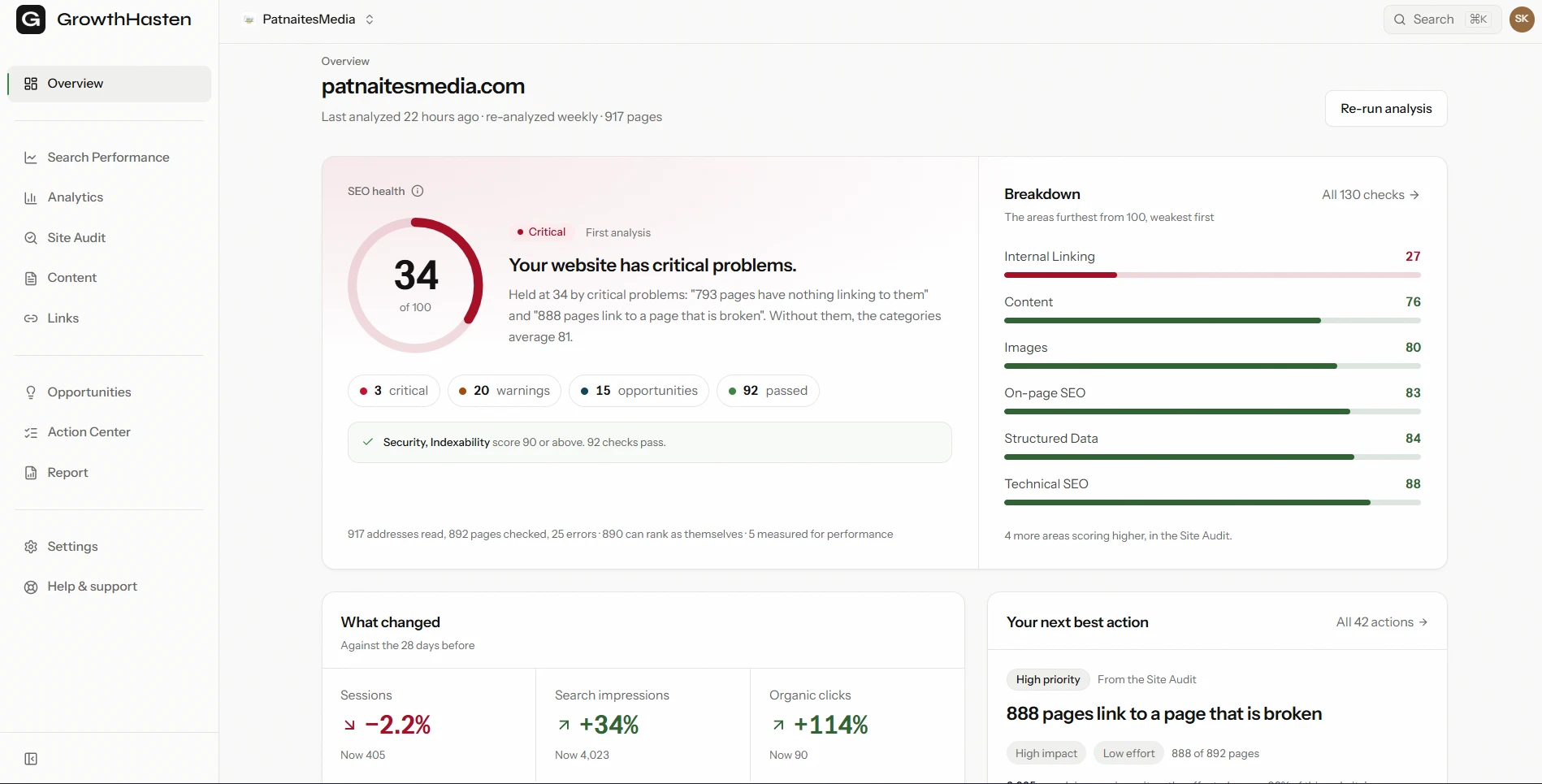
Connect Search Console and GrowthHasten's Content section puts every page's word count beside its clicks, flags the pages losing traffic and the pages competing for the same search, and groups topics as covered, partial or missing against what you already publish.
Explore the Content SectionQuestions
Frequently asked questions
Is SEO content writing just keyword stuffing?
No. Keyword stuffing is repeating a phrase to game rankings, and search engines treat it as spam. SEO content writing does the opposite: it satisfies the intent behind a search and covers the subject with the related entities a real expert would mention. You use the primary keyword where it reads naturally, then let genuine coverage and clear structure do the work.
How long should an SEO article be?
As long as it takes to answer the query completely, and no longer. There is no ideal word count. Length is a consequence of covering the topic, not a target you write toward. A complete short answer beats a padded long one, because padding dilutes the page and buries the answer. Match the depth the top results show, then stop when you have nothing left to add.
How do you write content that gets cited by AI answer engines?
Make each section quotable on its own. AI engines lift self-contained passages that answer a question cleanly, so lead with the answer, define terms plainly, and use lists and tables that are easy to parse. Keep facts current and linked to primary sources, since an engine prefers content it can corroborate. This is the same discipline that wins featured snippets, so the two goals reinforce each other.
What is the difference between SEO content writing and content strategy?
Content strategy decides which pages to build and how they connect into topical authority across a site. SEO content writing is the craft of making any single page the best answer on its own. Strategy works at the level of the library; writing works at the level of the page. You need both: a smart plan produces the wrong result if the individual pages do not deserve to rank.
Can AI write SEO content on its own?
Not to a standard worth publishing. AI is useful for brainstorming, outlining, and summarizing research, but it cannot supply original insight, verify a fact, or decide what to cut, and those are the parts that make a page rank. The workable approach is a human-plus-AI loop where a person owns the judgment, checks every claim against a primary source, and edits the draft before anything ships.

Written by
GrowthHasten Team
Editorial Team, GrowthHasten
Articles from the GrowthHasten editorial team, grounded in primary research, our own testing, and what analyzing real websites shows, fact-checked in-house.
View profile