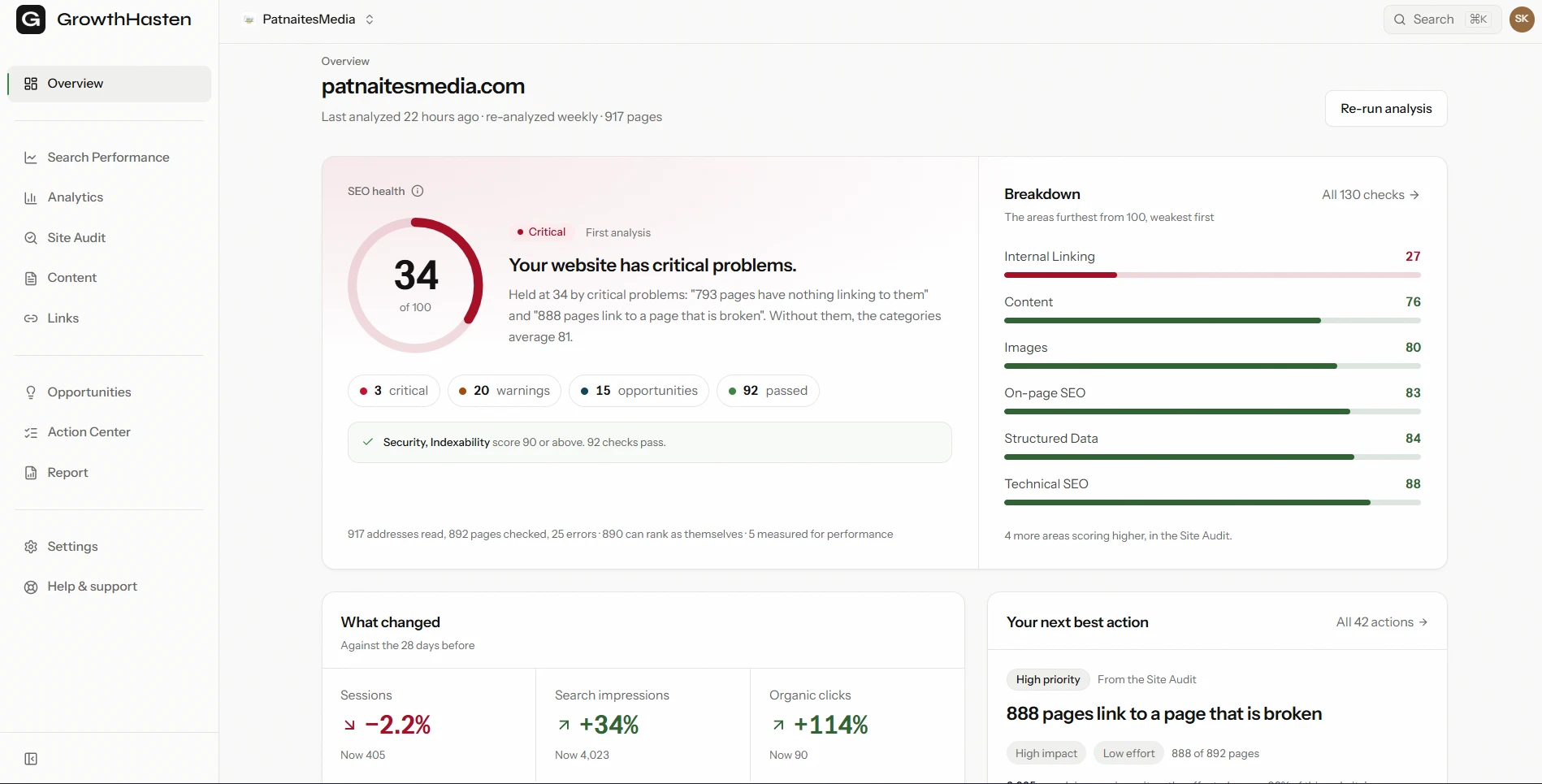


An SEO consultant is a specialist you hire for direction: someone who diagnoses what is holding your organic growth back, builds the strategy to fix it, and guides the people who carry it out. That is the line that separates a consultant from an agency, which executes the work at volume, and from an in-house hire, who owns the function full time. This guide is for founders, CMOs, and heads of growth deciding how to resource SEO, not which vendor to shortlist. It compares four models honestly, consultant, agency, in-house, and fractional, scored by your stage, budget, existing capability, and whether your real problem is diagnosis or execution. GrowthHasten makes SEO software rather than selling consulting, so read this as a decision aid, not a pitch for any one model.
The short version
- The title matters less than the scope. Two people both called an SEO consultant can sell completely different work, so compare deliverables, not labels.
- A consultant advises and diagnoses, an agency executes, an in-house hire owns the function, and a fractional lead runs strategy part time.
- Hire a consultant when your gap is direction, an audit, or a roadmap, not when you need hands on keyboards at volume.
- The right model is set by your stage, budget, in-house capability, and whether your problem is diagnosis or execution, not by whichever model a provider happens to sell.
What does an SEO consultant actually do?
A consultant diagnoses, plans, and advises. The defining trait is direction and expertise rather than executing large volumes of work, and the best ones earn their fee by finding the few changes that matter and telling you what to ignore.
Most engagements cover some mix of the following:
- Technical and content audit: A structured review of what search engines can crawl, index, and rank, and where your content misses intent. This is usually the first deliverable, and often the most valuable one. You can run an SEO audit yourself first to see how deep the problems go.
- Strategy and roadmap: A prioritized plan that ties SEO work to a business goal, sequenced by impact and effort so your team knows what to do first.
- Keyword and market analysis: The topics and queries worth competing for, mapped to your funnel and your realistic chances of ranking.
- Advising an internal team or another provider: Reviewing work, setting KPIs, and keeping an in-house team or agency pointed at the right problems.
- Training and enablement: Teaching your marketers and developers enough that they stop reintroducing the same issues.
What a consultant usually does not do: write and publish content at scale, build large volumes of links, or ship code. Some will implement a fix to prove a point, but if you need sustained execution across content, technical work, and digital PR, that is an agency or an in-house team, not a single advisor.
Consultant, agency, in-house, or fractional: which model fits?
Match the model to the problem, not the other way round. The four models solve different problems, and the most common and expensive mistake is buying execution when you needed diagnosis, or diagnosis when you needed throughput.
| Model | What it is | Best fit | Main trade-off |
|---|---|---|---|
| Consultant | An expert who diagnoses, sets strategy, and advises | You need direction, an audit, or a roadmap and have some capacity to execute | Little hands-on execution; results depend on someone else doing the work |
| Agency | A team that executes content, technical, and link work at volume | You know the direction and need throughput across several disciplines | Cost and coordination; strategy can turn generic if no one owns it internally |
| In-house | A full-time hire or team that owns SEO end to end | SEO is a core, long-term channel and you can keep a specialist busy | Slow and costly to hire; a single generalist rarely covers every skill |
| Fractional | Senior SEO leadership part time, setting strategy and leading execution | You need senior direction and accountability but not a full-time function yet | Limited hours; still depends on some execution capacity underneath |
To place yourself, score your situation across the four axes that actually decide it:
- Stage and budget: Early and lean points toward a consultant or a fractional lead; funded and scaling can support an agency or an in-house hire.
- Diagnosis or execution: If you do not yet know what is wrong, buy diagnosis first. If you already have a validated plan, buy execution.
- In-house capability: A consultant multiplies a team that can already execute. With no one to hand the plan to, you need an agency or a hire instead.
- Speed and throughput: A single advisor cannot produce volume. When you need output fast across many pages, that is an agency or a team.
These routes are not exclusive. Many companies start with a consultant to set direction, then bring in an agency or an in-house hire to execute, and keep the consultant on a light retainer to steer, which is a narrower arrangement than what a full delivery retainer buys month by month. Our guide to what SEO services include covers the agency side in more depth. There is a fifth arrangement this comparison leaves out, because it is the agency's decision rather than yours: white label SEO, where the agency you hire subcontracts the work.
What does an SEO consultant cost?
It depends far more on the pricing model and scope than on the word "consultant." The same expertise is sold four ways, and each suits a different kind of engagement.
| Pricing model | How you pay | Best when |
|---|---|---|
| Hourly | A rate per hour or per call | You need occasional advice, a second opinion, or ad hoc problem solving |
| Project | A fixed fee for a defined deliverable, such as an audit or a roadmap | The scope is clear and bounded, and you want a known cost |
| Retainer | A recurring monthly fee for ongoing guidance | You want continuous direction, reviews, and accountability over time |
| Fractional | A set number of days or hours a month as part-time leadership | You need senior strategy and oversight but not a full-time hire |
Rates vary widely by market, seniority, and specialism, so a headline number tells you little on its own. What matters is scope: a cheap audit that produces a generic checklist can cost you more than an expensive one that finds the single fix worth making. Compare what you will actually receive, who does the work, and how success is measured against real KPIs like qualified organic traffic and conversion rate, not just the rate on the invoice. For the fuller picture of what actually drives an SEO quote up or down and what a given budget buys, our guide to SEO pricing for SaaS and B2B companies breaks it down by band.
When should you hire an SEO consultant?
Hire one when the gap is direction rather than raw execution capacity. A consultant is the efficient first step when you know something is wrong but not what, or when you are about to make a decision that is expensive to reverse.
The common triggers:
- A launch or redesign: Getting SEO right before you build or migrate is far cheaper than fixing it after traffic drops, which makes it the single best moment to bring in outside help.
- New funding: Fresh budget and pressure to grow, but not yet the team to spend it well. A consultant sets the plan before you hire against it.
- A traffic drop: Rankings or organic traffic fall and no one internally can say why. Diagnosis is exactly what a consultant sells.
- Your first marketing hire: A generalist marketer who needs a senior specialist to set the SEO direction they can then run with.
- A plateau: You publish steadily and nothing moves, which usually points to a strategy or technical problem that no amount of content will fix.
The buyer here is often a SaaS or B2B company where organic is a serious channel. Our B2B SEO strategy guide sets out that context, and if your growth depends on AI-driven search as much as classic rankings, the choice may lean toward an AI SEO agency or a consultant fluent in AEO and GEO.
When is a consultant the wrong choice?
When your problem is execution, not diagnosis. If you already know what to do and simply lack the hands to do it, paying for more advice buys the one thing you least need.
In my experience, the companies that hire an agency or a consultant before they have had the diagnosis often pay twice: once for work aimed at the wrong problem, and again to redo it once the real constraint surfaces. The reverse is just as costly. Hiring a strategist when your plan is already sound and your bottleneck is throughput leaves you with a sharper roadmap and the same empty content calendar.
Skip the consultant when:
- The work is basic and well documented: A small site with straightforward needs can go a long way on Google's own SEO Starter Guide and Search Console before paying anyone.
- You need sustained output: Volume content, ongoing technical work, and link building are execution, so an agency or an in-house team fits better.
- There is no one to hand the plan to: A roadmap with no one to execute it is a document, not growth.
What is fractional SEO, and how is it different?
Fractional SEO is senior SEO leadership hired part time. Someone sets the strategy, prioritizes the work, and leads execution across a few days a month, without the cost or commitment of a full-time head of SEO.
The difference from a classic consultant is ownership. A consultant advises and then steps back; a fractional lead stays embedded, carries accountability for outcomes, and runs the people doing the work. It suits companies that have outgrown ad hoc advice but cannot yet justify a full-time senior hire, and it sits naturally between the consultant and in-house models on the matrix above.
The limit: a fractional lead still needs execution capacity underneath, whether that is junior marketers, a content team, or an agency. Part-time leadership with no one to lead produces the same stalled calendar as a consultant with no team.
How do you hire an SEO consultant without getting burned?
Judge them on how they diagnose, not on what they promise. The strongest signal is a consultant who asks sharp questions about your business before offering any answer, and the clearest warning sign is anyone who guarantees rankings.
Ask before you sign:
- Can you show examples of past work and results? Look for specifics and reasoning, not a wall of client logos.
- How will you measure success, and in what timeframe? You want KPIs tied to business outcomes, not vanity rankings.
- What will you actually deliver, and who does the work? Pin down the scope of work and whether execution is included or left to your team.
- What is your experience in my industry? SaaS and B2B SEO differ from local or e-commerce, and the playbooks do not transfer cleanly.
- Will you explain your reasoning and every change you make? A consultant who cannot teach you why is one you will depend on forever.
Google publishes a closely matching checklist in its guidance on whether you need an SEO and how to hire one, along with the red flags worth memorizing. Once those questions are answered and an agreement is in front of you, our clause-by-clause contract checklist covers what each line actually decides. If you are weighing an agency rather than a solo consultant, the full list of questions to ask an SEO agency before you hire adapts the same checks to a team that does the execution.
Red flags:
- Guaranteed rankings: No one controls Google's results, so a guarantee is either naive or dishonest.
- Undisclosed methods: Responsible SEO aligns with published guidance, and a consultant who will not explain their approach is usually hiding risk.
- A plan with no diagnosis: A roadmap produced before anyone has looked at your site is a template, not a strategy.
- Vanity metrics only: Reports full of impressions and rankings but silent on qualified traffic, conversion rate, or revenue.
What deliverables should you expect, and how do you scope the engagement?
Expect documents you can act on and a clear line between advice and execution. The most common source of disappointment is a mismatch of expectations: you thought you were buying execution, and you bought a report.
A well-scoped consulting engagement usually produces:
- An audit with prioritized findings: Not a list of two hundred issues, but the few that limit performance, ranked by impact and effort.
- A roadmap with owners and sequence: What to do, in what order, and who is responsible for each item.
- Clear measurement: The KPIs you will track, the baseline you start from, and how often you will review them in Search Console and analytics.
- A defined boundary: Exactly what the consultant does and what your team or an agency must do, agreed in writing before work starts.
What I've seen in practice is that the engagements that work best fix that boundary on day one. When the split between advising and doing stays vague, both sides assume the other owns execution, and the plan quietly stalls. If you would rather one partner set the strategy and stay accountable for it, that is what a consulting engagement is built to do.
The habit worth building is simple: match the model to the problem, not the other way round. Before you talk to anyone, write one sentence naming whether your real gap is diagnosis or execution, because that single answer rules out at least two of the four models before you spend anything. This week, write that sentence, then list what you already have the capacity to execute in-house. The honest version of that list decides whether you need a consultant, an agency, a hire, or a fractional lead far more reliably than any sales call will.
Know What Your Site Needs Before You Hire Anyone
Brief any agency, consultant or hire from evidence. GrowthHasten crawls your website, joins it to your own Search Console and Analytics, and turns the result into one prioritized queue of fixes and opportunities. Free plan: one website of up to 900 pages, no card.
Analyze Your WebsiteQuestions
Frequently asked questions
What does an SEO consultant do?
A consultant diagnoses and advises: they audit your site, build a strategy and roadmap, identify the highest-impact fixes, and often guide an internal team or another provider who does the implementation. The defining trait is direction and expertise rather than executing large volumes of work themselves.
SEO consultant vs agency: which should I hire?
Hire a consultant when you need diagnosis, strategy, or expert direction and have some capacity to implement. Hire an agency when you need content, technical work, links, and reporting all executed at volume. Many companies start with a consultant to set direction, then bring in an agency or in-house team to execute.
How much does an SEO consultant cost?
It depends on the model: hourly for advice, project-based for a defined audit or roadmap, a monthly retainer for ongoing guidance, or a fractional arrangement for part-time leadership. The label matters less than the scope, so compare deliverables, not just rates.
What is fractional SEO?
Fractional SEO is hiring senior SEO leadership part time: someone who sets strategy, prioritizes work, and leads execution across a few days a month, without the cost of a full-time hire. It suits companies that need direction and accountability but not a full in-house function yet.
When should a startup hire an SEO consultant?
Common triggers are a product launch, new funding, a traffic drop, the first marketing hire, or a plateau where you know something is wrong but not what. A consultant is the efficient first step when the gap is diagnosis and direction rather than raw execution capacity.

Written by
GrowthHasten Team
Editorial Team, GrowthHasten
Articles from the GrowthHasten editorial team, grounded in primary research, our own testing, and what analyzing real websites shows, fact-checked in-house.
View profile