

Topical authority is the credibility a site earns by covering a subject so completely that search engines and readers treat it as a reliable source, not just another page that happens to mention the keyword. It is a reputation you accumulate, not a setting you switch on. This guide is for founders and content leads who publish steadily but watch rankings flatten, and who suspect the cause is scattered coverage rather than weak writing. It covers how topic clusters signal expertise, why entities and semantic coverage matter, how to map a subject into pages by intent, the internal linking that binds a cluster, how E-E-A-T compounds over time, how to measure authority honestly, and the mistakes that quietly cap it.
The short version
- Authority is a byproduct of complete coverage, not a metric you can buy or optimize directly.
- Two pages chasing the same intent do not add authority. They split it, and search engines pick one at best.
- A pillar page with no inbound cluster links is just a long article, not the hub of anything.
- Entities and their relationships, not repeated keywords, are how modern search reads subject depth.
- You measure authority across a whole cluster, through share of voice, coverage, and citations, never by a single ranking.
What is topical authority, and why does depth beat scattered posting?
It is earned credibility on a subject, and depth wins because search engines judge relevance across a topic, not one URL at a time.
Ten unrelated posts under one byline read like ten strangers. Ten connected posts that answer every reasonable question about a subject read like a body of work, and that difference is what a ranking system is trying to detect.
Our guide to content marketing for SEO covers the full publishing system that produces this coverage. This piece zooms in on the authority that system is meant to earn: what the signals are, how they accumulate, and how you know they are working. If you want the wider map first, the complete guide to SEO shows where authority sits among crawling, content, and links.
How do topic clusters signal expertise to search engines?
By grouping pages so a crawler can see you cover a subject at more than one depth and can tell which pages belong together. A topic cluster has two parts: a pillar page that covers the whole subject broadly, and cluster articles that each answer one sub-topic in depth.
The pillar targets the broad term and acts as the entry point. The cluster articles target the specific questions underneath it. Internal links connect them both ways, and those links are the actual signal: they tell a search engine these pages form a set and this one is the canonical hub.
Without the structure, the same ten articles still exist, but nothing tells a crawler they add up to subject depth. Structure is what turns volume into evidence.
What do entities and semantic coverage have to do with authority?
Almost everything, because modern search reads subjects as networks of related concepts rather than strings of matching words. An entity is a thing a search engine recognizes and can relate to others: a concept, a product, a method, a person. Semantic coverage means addressing the entities a genuine expert on the subject would naturally cover.
Repeating a keyword ten times signals nothing. Covering the connected ideas around it signals understanding. A page about topical authority that never mentions clusters, intent, internal links, or E-E-A-T looks thin to a system that already knows those concepts belong together.
Google's Search Essentials frame this as being genuinely useful and clearly about a subject. The practical read: list the concepts a knowledgeable reader expects, then make sure your cluster addresses each one somewhere. Gaps in that map are gaps in your authority.
How do you map a topic into a cluster of pages by intent?
Start from the questions a reader asks, group them by intent, and let each distinct intent become one page. Two phrasings of the same question are one article. A genuinely different question is a different article, even when the words overlap.
The step most teams skip is checking the SERP for each group. If the results for two questions look nearly identical, the search engine has already decided they are one topic, and publishing two pages invites cannibalization. Our keyword research guide covers the intent analysis in full; the mapping itself is simple once intent is settled.
| Reader question | Intent | Page it becomes |
|---|---|---|
| What is topical authority? | Informational, definitional | The pillar page |
| How do I build a topic cluster? | Informational, procedural | A how-to cluster article |
| Topical authority vs domain authority | Comparison | A comparison cluster article |
| Topical authority tools | Commercial investigation | A cluster article or a service page |
What is GrowthHasten's framework for building topical authority?
We use a five-stage loop that treats authority as something you accumulate and defend, not a project you finish. We call it the Topical Authority Loop, and the order matters: each stage sets up the next.
- Claim a boundary you can defend: Pick a subject narrow enough to cover completely and close enough to what you sell to be worth owning. A boundary you name is a boundary you can finish.
- Map the entity space: List the concepts, questions, and related entities a real expert on the subject would address. This map is your coverage target and your defense against thin clusters.
- Build the spine, then the depth: Publish the pillar first so cluster articles have a hub to link to, then work through the clusters in priority order, one intent per page.
- Prove experience on every page: Each article carries at least one thing only a practitioner would include: a trade-off, a mistake you have seen, or a decision rule. Coverage without proof reads hollow.
- Consolidate and defend: Wire the internal links, merge pages that overlap, refresh the set as a unit, and extend the boundary only once the current one is genuinely covered.
Then the loop repeats on an adjacent subject. Sustained coverage like this is the heart of any content marketing program worth running, because authority on one subject makes the next one cheaper to earn.
How does internal linking bind a cluster into an authority signal?
It converts a pile of related pages into a structure a crawler can read as a single subject. Internal links pass relevance between pages and mark the pillar as the primary answer, which is why a well-linked cluster outperforms the same articles left unconnected.
Two rules keep the graph honest. Use descriptive anchor text that names the destination rather than click here, and link only where a reader would actually want the jump. Our internal linking guide sets out the hub-and-spoke approach, and anchor text covers the words themselves.
The pillar should be the most-linked page in the cluster. Cluster articles link up to it and across to close siblings, never at random.
How do E-E-A-T and consistent coverage compound authority over time?
Slowly, and only if the coverage is genuinely useful and genuinely yours. E-E-A-T stands for experience, expertise, authoritativeness, and trustworthiness, and it shows up in the content itself: first-hand detail, sourced claims, a named author, and honesty about limits.
Consistency is the other half. Authority accrues as you publish connected coverage and as search engines re-crawl and re-evaluate the set, which is why a steady cadence beats an occasional burst. Google's guidance on creating helpful content asks whether a page shows real expertise and first-hand knowledge; that is a question you answer across many pages, not one.
In our opinion, this compounding is why topical authority outlasts tactics. Rankings won by depth and trust are harder for a competitor to copy than a single optimized page.
How do you measure topical authority?
Across the cluster, and in stages, because no single number captures it and impatience misreads the early signals. The honest answer is that authority is inferred from several signals moving together, not read off one dashboard.
| Signal | How to read it | Caution |
|---|---|---|
| Share of voice on the subject | Your visibility across the topic's keywords versus competitors | Track the set, not one term |
| Rankings across the cluster | Whether the whole set climbs, not just the pillar | One page winning is not authority |
| Coverage completeness | How much of your entity map is actually published | Gaps cap the ceiling |
| AI citations and mentions | Whether answer engines quote your pages as a source | Gradual and hard to attribute |
That last row grows more important each quarter. Making pages quotable is its own discipline, covered in our AI SEO guide. We give no benchmark numbers here on purpose, because meaningful targets depend on your starting point and competition, and an invented figure would mislead more than it helps.
What are the most common topical-authority mistakes?
Most failures are structural, not editorial. The writing is often fine; the architecture is what leaks authority.
- Thin clusters: A handful of shallow posts that name a subject without covering it. Depth requires something to say, not more headings.
- Cannibalization: Two or more pages targeting the same intent, splitting links and confusing the search engine about which to rank. One intent, one page. Syndicating a page without a canonical tag creates the same split from outside your own site, when a republished copy on a partner's domain ends up outranking the page that earned the authority.
- No pillar: Cluster articles with no hub to link up to, so nothing signals which page owns the subject.
- Orphan cluster pages: Articles nobody links to, stranded outside the graph and invisible as part of the set.
Detecting these is a normal part of a content audit: look for pages competing on the same query, pages with no internal links in, and subjects with obvious coverage gaps.
When should you NOT chase topical authority?
When you cannot cover the subject deeply, and especially when you are tempted to go broad before you have gone deep. Spreading thin coverage across many subjects is the fastest way to earn authority on none of them.
Hold off, at least for now, when any of these are true:
- You lack genuine expertise: Without first-hand knowledge, the cluster reads thin no matter how many pages it holds.
- The subject is off your business: Authority you cannot convert is traffic you pay to maintain for no return.
- Demand collapses into one intent: If every sub-topic is really the same question, you have one strong article to write, not a cluster.
- Nobody owns the refresh: An unmaintained cluster becomes a decay liability within a year.
The honest default: finish one narrow subject completely before opening the next. A small, complete cluster signals more authority than a sprawling, half-built one.
The habit worth building is finishing before expanding. Cover one boundary fully, defend it with internal links and refreshes, and only then claim the next subject, so each finished cluster raises the floor for the whole site.
This week, pick one subject you already understand deeply and write its entity map: every concept, question, and related idea an expert would expect to see covered. Check that map against what you have already published, and the gaps become your cluster plan for the next quarter, once you have filtered the gap list down to what is worth writing.
See Which Pages to Write, Refresh or Leave Alone
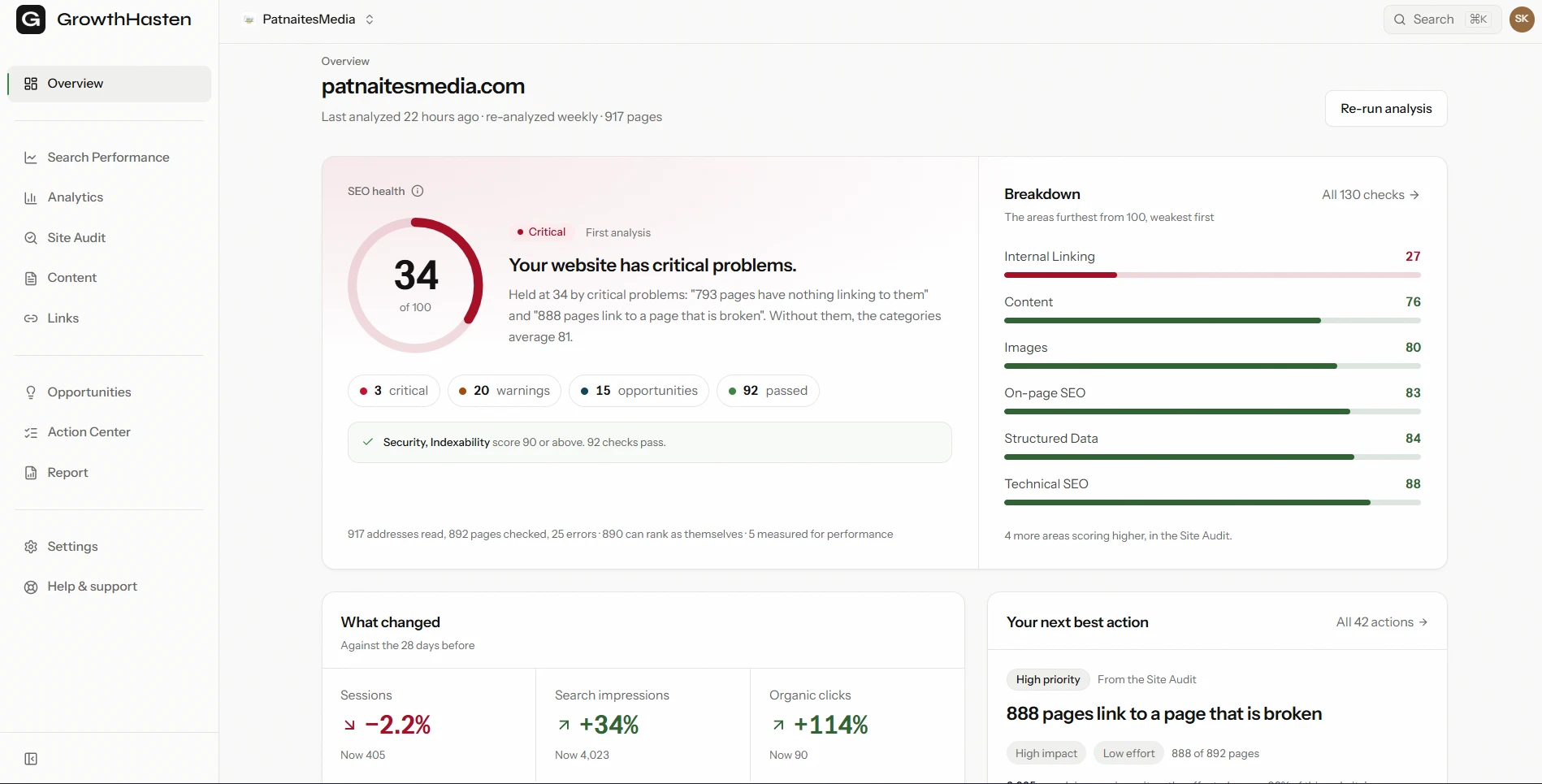
Connect Search Console and GrowthHasten's Content section puts every page's word count beside its clicks, flags the pages losing traffic and the pages competing for the same search, and groups topics as covered, partial or missing against what you already publish.
Explore the Content SectionQuestions
Frequently asked questions
What is the difference between topical authority and domain authority?
Topical authority is subject-specific credibility earned by covering one topic completely. Domain authority is a third-party metric that estimates a whole site's overall strength, largely from backlinks, and search engines do not use a public domain-authority score directly. You can hold strong topical authority on a narrow subject with a modest overall domain, which is exactly how smaller sites outrank larger ones on focused topics.
How long does it take to build topical authority?
There is no guaranteed timeline. Authority builds as you publish connected, genuinely useful coverage and as search engines re-crawl and re-evaluate the set. Expect gradual movement over months rather than weeks, faster on low-competition subjects and slower on contested ones. Consistency and completeness matter more than speed: a finished cluster on a narrow topic often moves before a half-built one on a broad topic.
Can a small site build topical authority?
Yes, and it is often the best strategy for a small site. Rather than competing across a broad field, a smaller site can pick one narrow subject, cover it more completely than anyone else, and win that space. Topical authority is subject-specific, so depth on a focused topic can outrank larger sites that treat the same subject shallowly. Focus beats breadth when resources are limited.
How many pages does topical authority require?
As many as the subject has distinct search intents, plus one pillar page. Some subjects support five supporting articles, others twenty. Let intent decide, not a quota, and never publish two pages chasing the same intent. Coverage completeness matters more than count: the goal is to address every concept an expert would expect, not to reach a page total.
Does topical authority help with AI search?
Yes. AI answer engines and AI Overviews favor sources that are clearly structured, self-contained, and genuinely useful, the same qualities that earn topical authority in traditional search. Complete coverage of a subject also gives these systems more relevant passages to quote. Defining concepts plainly, answering questions directly, and using tables and lists makes your pages easier for an AI system to cite accurately.

Written by
GrowthHasten Team
Editorial Team, GrowthHasten
Articles from the GrowthHasten editorial team, grounded in primary research, our own testing, and what analyzing real websites shows, fact-checked in-house.
View profile