

An SEO agency for startups is a search partner built to work inside real constraints: a limited budget, a short runway, and a product that may still be changing under it. This guide is for founders and first marketing hires at pre-seed to Series B startups who are trying to answer two questions at once, is it too early for SEO, and what can we actually afford. Most lists that rank these agencies are written by the agency sitting at the top of them, with criteria you never get to see. This one starts somewhere more useful: whether you should hire anyone yet, then which kind of partner fits your stage and budget.
The short version
- The right partner for a pre-seed startup looks nothing like the right one for a Series B, so match the agency to your stage, not to whoever ranks itself first.
- Sometimes the honest answer is "not yet," and a cheap technical foundation plus a consultant beats a full agency retainer. A section covers when.
- Budget realism matters more than the logo. Productized and founder-led options start well below the enterprise retainers most lists quietly assume.
- In 2026, buyer research increasingly starts inside AI answers, so AEO and GEO capability matters even at an early stage.
- The order below is a rough stage sequence, not a quality ranking. Read the "Best for" line before you read the number.
How did we choose these agencies?
We used public, verifiable information only, and organized the list around startup stage rather than any private results we cannot check. Every factual claim about the nine agencies comes from that agency's own website or another Tier-1 or Tier-2 source, and nothing is lifted from competing listicles. We have not worked with or audited any of them, so this is research and synthesis, not a report on their delivery.
Three principles shaped the list:
- Public positioning only: what each firm says it does, who it says it serves, and any pricing it publishes itself. Self-reported results we could not verify were left out.
- Stage and budget fit: the order runs roughly from the leanest, earliest-stage-friendly options toward fuller-service teams, because a founder's real question is affordability, not prestige.
- Modern search coverage: whether the public offer covers AI search (Answer Engine Optimization and Generative Engine Optimization) as well as classic SEO.
For the wider method of vetting any search partner, see our guide on how to choose an SEO partner. And if your real filter is product motion rather than funding stage, our SaaS-specific agency guide ranks the same market by how each firm is built for product-led growth, alongside our complete guide to SaaS SEO. This article is the one to read when stage and budget are your constraint.
Is your startup too early to hire an SEO agency?
Often, yes, and admitting it early saves budget you cannot spare. Before product-market fit, or when your runway cannot support a two-to-three-quarter horizon, most agency spend is premature, because SEO compounds over quarters and a startup that pivots resets the clock.
Use this as a quick decision box before you take a single sales call:
- Probably too early when: you have no clear product-market-fit signal, your runway is under two to three quarters of committed budget, you have no one to produce or review content, or you expect movement in weeks.
- Probably the right time when: organic search is a channel you intend to own long term, you have early retention or usage signals, and you can commit budget and attention for at least two to three quarters.
- The cheap-insurance exception: foundational technical work, a crawlable, fast, well-structured site, is worth doing early even pre-fit, because it is inexpensive and it removes debt you would otherwise pay down later.
Google's own documentation on hiring an SEO is blunt that no one can guarantee a number-one ranking, and it warns against firms that are secretive about their methods or that email you out of the blue. If your stage makes SEO premature, the honest move is a consultant or a small foundational project, not a full retainer. For companies with long, multi-stakeholder deals, the timing calculus differs, which our guide to B2B SEO for complex sales cycles covers in more depth.
The 9 best SEO agencies for startups in 2026
Here are nine agencies and service models worth evaluating, ordered roughly by the stage each one best fits, from the leanest early-stage options toward fuller-service teams. The number is a reading sequence, not a score. Start with the "Best for" line, because the sixth entry here may suit you better than the first.
1. Embarque
Best for: bootstrapped and pre-seed startups that need a fixed, predictable monthly cost.
What they say they do: Embarque calls itself a "Revenue-Driven SEO" agency on its own site, offering content, link building, technical SEO, and programmatic SEO through productized monthly tiers it publishes openly, starting at $1,500 a month.
Notable public focus: work "anchored to commercial intent, conversion paths, and revenue impact," with tiers that scale from solo founders up to enterprise scope.
What to check before hiring: confirm which single service the entry tier actually covers, and whether that scope moves a metric that matters to you this quarter.
2. Rock The Rankings
Best for: seed-stage B2B SaaS that wants founder-led, pipeline-tied SEO without a long lock-in.
What they say they do: Rock The Rankings describes itself on its own site as an SEO and AI-search agency building "SEO & GEO programs that drive qualified demos and closed deals" for B2B SaaS, with transparent tiered pricing and a 90-day starter rather than an annual contract.
Notable public focus: revenue attribution over rankings, weekly reporting tied to demos, SQLs, and ARR, and direct access to the founder and senior operators.
What to check before hiring: ask how the revenue forecast it offers before you sign is actually modeled for a company at your exact stage.
3. SimpleTiger
Best for: seed to Series A B2B SaaS that wants a small, senior boutique rather than a large team.
What they say they do: SimpleTiger describes itself on its own site as a B2B SaaS marketing agency that is "100% B2B SaaS & AI-focused," pairing SEO with Answer Engine Optimization and pipeline reporting.
Notable public focus: a boutique model that keeps senior people on the work, with measurement framed around pipeline rather than vanity metrics.
What to check before hiring: on an early-stage budget, ask what a focused starting scope looks like before committing to a full program.
4. Animalz
Best for: funded startups from Series A onward building content-led authority in a competitive category.
What they say they do: Animalz describes itself on its own site as "A Content Marketing and SEO Agency for Leading B2B SaaS Brands," combining proprietary research, editorial playbooks, and AI-assisted workflows, with a client roster that skews toward established software companies.
Notable public focus: high-quality editorial content and answer-engine optimization aimed at compounding organic growth.
What to check before hiring: an enterprise-grade content model can outpace an early budget, so confirm the engagement size fits your stage before you start.
5. uSERP
Best for: Series A and later startups that need authority backlinks and digital PR, not a full SEO program.
What they say they do: uSERP describes itself on its own site as a link building and digital PR agency focused on "premium, high-authority backlinks and mentions" through manual outreach, serving B2B and SaaS companies.
Notable public focus: a white-hat, content-driven link model measured by business outcomes rather than raw link volume.
What to check before hiring: links compound only on top of a sound site and content base, so confirm those exist before you invest here.
6. Single Grain
Best for: Series A and B startups that want SEO inside a broader, multi-channel growth program.
What they say they do: Single Grain describes itself on its own site as a digital marketing agency building "revenue-focused marketing systems," spanning SEO, AEO and GEO, paid media, CRO, and AI implementation, and says it works with everyone from venture-backed startups to Fortune 500 companies.
Notable public focus: execution across paid and organic channels, positioned as operators running the work rather than advising from the sidelines.
What to check before hiring: with a multi-channel offer, confirm how much of the retainer is senior organic-search time versus paid media.
7. Siege Media
Best for: Series B startups scaling content and AI-search visibility with a full-service team.
What they say they do: Siege Media describes itself on its own site as a "full-service GEO agency," combining content marketing, SEO, and digital PR, with a client roster of large, established brands.
Notable public focus: generative-engine optimization and content built to "make brands the answer in search," measured by traffic value.
What to check before hiring: the brand-name roster signals scale, so confirm the model and budget suit a startup rather than an enterprise.
8. NoGood
Best for: funded startups and scaleups that want experiment-led growth marketing across channels.
What they say they do: NoGood describes itself on its own site as a growth marketing agency working with startups, scaleups, and large brands, naming SEO, AEO, paid media, CRO, content, and fractional CMO work, with SaaS and B2B among its verticals.
Notable public focus: a multi-channel growth stack (paid media, SEO, AEO, CRO, and content) aimed at funded startups and scaleups, positioned as "AI native."
What to check before hiring: at an early stage, confirm the minimum engagement size, so you are not buying a multi-channel retainer before you can feed one.
9. Passionfruit
Best for: growth-stage startups that want AI search treated as a first-class channel alongside SEO.
What they say they do: Passionfruit describes itself on its own site as an "AI-native" agency delivering managed SEO, AEO, and GEO as "one unified strategy covering both Google and AI chatbots."
Notable public focus: end-to-end managed execution across traditional and AI search, positioned around outcomes over dashboards.
What to check before hiring: its published case studies skew toward larger and e-commerce brands, so ask for work at your stage and in your category.
How do you match an agency to your startup's stage?
Work from your stage, not from a top-ten list. The kind of partner that fits changes at every funding milestone, and so does the honest budget expectation, so use the matrix below to narrow the field before you shortlist anyone.
| Stage | Where you usually are | What kind of partner fits | What to prioritize |
|---|---|---|---|
| Pre-seed / bootstrapped | Pre-product-market fit, tight runway, founder doing marketing | Often no full agency yet: a consultant for direction, a productized service for execution, or a low-cost technical foundation | A crawlable, fast, well-structured site and a few foundational pages |
| Seed | Early product-market-fit signals, first marketing hire, limited budget | A boutique or founder-led agency, or a fractional SEO lead, on a focused scope | One or two channels done well, with reporting tied to signups |
| Series A | Proven fit, scaling go-to-market | A specialist agency covering technical, content, and AI search, or a first in-house SEO with agency support | Depth across the funnel and reporting you can trace to pipeline |
| Series B | Scaling org, multiple channels, competitive category | A full-service agency, or an in-house team plus an agency for specialist depth and digital PR | Authority building, links, and defending share in AI answers |
Across the agencies we reviewed, the firms that publish pricing tend to sit at the earlier-stage end, and the ones with enterprise rosters tend to sit later. Neither is better; they solve different problems at different budgets. If your Series B priority is specifically authority and earned coverage rather than a full SEO program, our digital PR agency guide for SaaS and startups covers that narrower need directly.
Agency, consultant, fractional lead, or in-house, which fits an early startup?
Match the model to what you are short of: direction, execution, or both. An agency is not automatically the answer, and for many pre-seed and seed startups it is the most expensive way to buy something a consultant could deliver for less.
| Option | Fits when | The trade-off |
|---|---|---|
| Consultant | You need senior strategy and direction but have some execution capacity. Common pre-seed and seed. | Advice only. Someone on your side still has to do the work. |
| Fractional SEO lead | You want part-time senior ownership without a full-time hire. Common seed to Series A. | Limited hours, and their attention is split across clients. |
| Agency | The work spans technical, content, links, and AI search at once, and you need it faster than you can hire. | Higher monthly cost, and seniority on your account can vary. |
| In-house hire | SEO is a permanent core channel with budget for a dedicated role. Usually Series A onward. | Slow to hire, and one person cannot cover every discipline. |
For the consultant and fractional route, our guide to choosing between a consultant, an agency, in-house and fractional explains when direction beats execution volume, which is often the honest answer for a company still finding its footing. The point is not to avoid agencies, but to buy the model your stage actually needs.
What should you ask a startup SEO agency before you sign?
Ask the questions that separate a specialist from a generalist, and write down the answers so you can compare candidates side by side. A strong partner answers with specifics; a weak one answers with adjectives.
- Stage fit: what work would you run in the first 90 days for a company at our exact stage and budget?
- Who does the work: which parts are senior in-house time, and which are subcontracted or junior?
- AI search: how do you earn and measure visibility in AI answers, not just classic rankings?
- Reporting: what does the monthly report show, and how does it connect to signups and pipeline rather than sessions?
- References: can we speak to a client at a similar stage and in a similar category?
- Timeline: when should we realistically expect movement, and what happens if it does not come?
This is also how you sidestep a self-serving ranking: judge a partner on the answers to these questions, not on where it placed itself on its own list. Google's advice on vetting an SEO lines up with this, interview thoroughly, check references, and be wary of anyone who guarantees results.
What does startup SEO actually cost?
It varies with stage and scope, and the honest answer is a range, not a single number. Most agencies do not publish figures, so treat any flat price you see elsewhere with caution unless it comes from the agency's own site. What matters more than the number is whether the fee maps to specific deliverables and to reporting you can trace to signups. Our guide to what each SaaS and B2B budget band should buy breaks that mapping down further, band by band.
- Monthly retainer: the common model for ongoing SEO, content, and links. It suits continuous work that is hard to scope as a one-off.
- Fixed-scope project: a defined deliverable such as a technical audit, a migration, or a set of foundational pages. It suits a clear, bounded need and a tight budget.
- Productized package: a fixed monthly price for a defined menu of services, which is why it tends to fit early-stage budgets best.
Where firms do publish prices, they make useful anchors. Embarque, for example, states on its own site that its productized tiers start at $1,500 a month, and Rock The Rankings publishes transparent tiers in the roughly $3,500 to $11,500 range. Those figures bracket the space between a lean starter engagement and a fuller program. Whatever the model, ask any provider to map its fee to deliverables, and treat a guaranteed ranking for a fixed fee as a red flag, exactly as Google's guidance on hiring an SEO advises.
One more thing worth budgeting for in 2026: AI search. Google's guidance on its AI features notes that the same SEO fundamentals still apply, so a partner does not need a separate "AI package" so much as a credible way to earn and measure visibility inside AI answers. Ask how they do it before you accept that a program is complete without it.
The habit worth building is simple: decide your stage and your model before you decide your agency. Run every candidate through the matrix above, ask each to map its fee to deliverables, and rank is the last thing you look at, not the first.
This week, before you take a single sales call, write down three things: your funding stage, whether you actually need an agency or a consultant, and the one metric that would tell you SEO is working. Bring all three to every conversation, and the right partner becomes far easier to spot.
Know What Your Site Needs Before You Hire Anyone
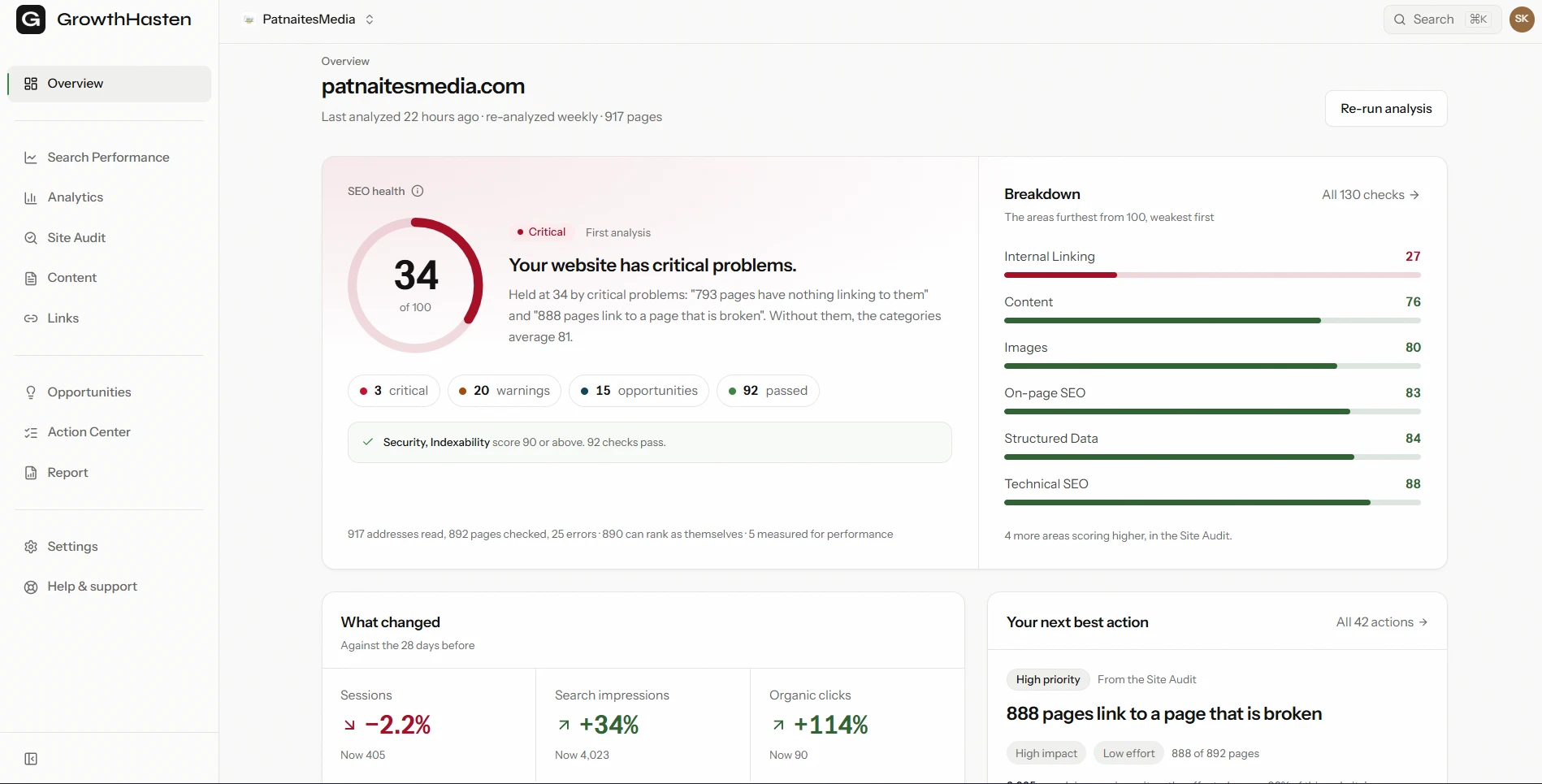
Brief any agency, consultant or hire from evidence. GrowthHasten crawls your website, joins it to your own Search Console and Analytics, and turns the result into one prioritized queue of fixes and opportunities. Free plan: one website of up to 900 pages, no card.
Analyze Your WebsiteQuestions
Frequently asked questions
Do early-stage startups really need an SEO agency?
Not always. If you have not found product-market fit or cannot commit budget for two to three quarters, SEO usually is not the priority yet. When organic search is a channel you intend to own long term, starting the technical and content foundations early pays off, but that can begin with a consultant or a productized service rather than a full agency retainer.
How much should a startup spend on SEO per month?
It varies with stage and scope, so decide what outcome you need this quarter and ask each provider to map its fee to specific deliverables and to reporting you can trace to signups. A few firms publish figures: productized tiers can start around $1,500 a month, while fuller programs run several thousand and up. Treat guaranteed rankings for a fixed fee as a red flag.
Should a startup hire an agency, a consultant, or an in-house SEO?
A consultant or fractional lead often fits pre-seed and seed, when you need direction more than execution volume. An agency fits when the work spans technical, content, links, and AI search at once and you need it faster than you can hire. An in-house hire fits once SEO is a permanent core channel with budget for a dedicated role, usually from Series A onward.
When is a startup too early for SEO?
Before product-market fit, or when your runway cannot support a two-to-three-quarter horizon, most SEO spend is premature because the channel compounds over quarters. The exception is low-cost foundational work, a crawlable, fast, well-structured site, which is cheap insurance for later. If you expect movement in weeks, you are too early to hire anyone for SEO.
What should a startup look for in an SEO agency in 2026?
Stage-appropriate experience, transparent reporting tied to signups, coverage of AI search (AEO and GEO), and honesty about timelines. Ask to speak to a client at a similar stage, and ask each firm to show the specific process it would run in the first 90 days. Google's own guidance warns against anyone who guarantees a number-one ranking or is secretive about methods.

Written by
GrowthHasten Team
Editorial Team, GrowthHasten
Articles from the GrowthHasten editorial team, grounded in primary research, our own testing, and what analyzing real websites shows, fact-checked in-house.
View profile