

Digital PR is the practice of earning coverage, brand mentions, and high-authority links by giving journalists and publications something genuinely worth writing about. This guide is for founders and marketing leads at B2B SaaS companies and venture-backed startups who are weighing whether to hire a digital PR agency, and which one fits. It compares nine agencies worth knowing, on a transparent scorecard, using only what each agency publicly states about itself. It also does the thing most agency lists skip: it helps you decide whether you need digital PR at all yet. If your priority is technical and content SEO rather than earned media, our SaaS SEO agency guide ranks partners built specifically around product-led growth and funnel work.
The short version
- Many early startups do not need a digital PR retainer yet. Content and targeted link building often deliver more until you have a story worth pitching.
- Digital PR earns authority and brand mentions. Link building chases links directly. Know which problem you are actually solving.
- Judge an agency on the quality of earned coverage and brand lift, not on raw link counts or vanity impressions.
- In 2026, PR that lands in sources AI models trust doubles as AI-search visibility, so earned media now feeds two channels at once.
How did we choose these agencies?
We selected on public evidence and fit, not on reputation or pay-to-play. No agency paid to appear here, and none of the entries repeat claims lifted from rival listicles.
Our method was deliberately narrow, because the alternative is inventing detail we cannot verify:
- Public information only: every fact about a third-party agency comes from that agency's own website. Where we could not verify pricing, client counts, or campaign results on a primary source, we left them out rather than guess.
- Relevance to SaaS and startups: we prioritized agencies that publicly position themselves around B2B technology, SaaS, or high-growth and early-stage companies.
- A real digital PR offering: each agency states earned media, media outreach, or link-earning work as a core service, not as an afterthought bolted onto something else.
- Transparent ordering: the list below is ordered roughly from the most SaaS-specific to the broadest digital PR generalist. It is not a quality ranking, and the position of any agency, including ours, is not a claim that it is better than the one beneath it.
Digital PR vs link building vs traditional PR: what does a SaaS startup actually need?
Usually one of the three, rarely all three at once, and the right answer depends on how much newsworthy substance you have right now. These three disciplines overlap, which is exactly why agencies blur them, and why buyers overpay for the wrong one. A wire-distributed press release is the clearest case of that overlap sold as something it is not; our guide to why a wire release rarely earns what it promises covers why the distribution product and the earned coverage it sometimes triggers are two different things bought as one.
The short definitions: traditional PR manages reputation and media relationships; digital PR earns online coverage and brand mentions that happen to produce links; link building targets links directly, often through outreach for placements. Our guide to what digital PR is and how it works goes deeper on the discipline itself, and our link building strategies guide covers the narrower tactic.
| Dimension | Digital PR | Link building | Traditional PR |
|---|---|---|---|
| What it targets | Coverage, brand mentions, and authority; links as a by-product | Backlinks to specific pages | Reputation and media relationships |
| Typical output | Earned articles, data stories, expert commentary | Guest posts, resource links, outreach placements | Press coverage, briefings, spokesperson interviews |
| Best startup stage | Once you have data, a launch, or a point of view worth pitching | Early, when you need a handful of relevant links to rank | Funding rounds, launches, crisis, or category creation |
| Main risk | Paying a retainer before you have anything newsworthy | Low-quality links that do nothing or invite penalties | Coverage that builds awareness but not search authority |
The decision, in one line: if you have a genuine story, data, or opinion worth amplifying, digital PR fits. If you mostly need a few relevant links to move rankings, start with link building. If neither is true yet, spend on content first and revisit PR when you have something to say.
What are the 9 best digital PR agencies for startups and SaaS in 2026?
Below are nine established agencies with a public focus on B2B technology, SaaS, or startups. Each entry states who it fits, what the agency says it does, its stated specialism, and one thing to check before you sign.
1. PANBlast (formerly BLAST Media)
Best for: B2B SaaS and AI companies that want a PR partner built around a single, deep vertical niche.
What they say they do: PANBlast, a division of PAN, describes itself as serving "emerging and high-growth brands spanning the B2B SaaS and native-AI technology sectors," with the stated position that "B2B SaaS and AI is our niche."
Notable public focus: named verticals including artificial intelligence, DevOps, HR tech, MarTech, climate tech, and retail and e-commerce.
What to check before hiring: ask how their vertical experience maps to your specific category, and how they measure outcomes beyond placement volume.
2. PRLab
Best for: startups and scale-ups that need B2B tech PR across both US and European markets.
What they say they do: PRLab positions itself as a "B2B Tech PR Agency" and a specialist tech PR partner for startups and scale-ups, with offices across Amsterdam, Austin, Stockholm, Munich, and Madrid.
Notable public focus: B2B technology across fintech, SaaS, AI, cybersecurity, and healthtech, with local media teams in each market.
What to check before hiring: confirm which office and media relationships would actually run your account, and whether coverage would land in the markets you care about.
3. Walker Sands
Best for: growth-stage to enterprise B2B technology companies that want PR integrated with demand generation.
What they say they do: Walker Sands describes itself as a "B2B Integrated Marketing and PR Agency" working across public relations, content, digital marketing, and demand generation under an outcome-based model.
Notable public focus: technology sub-sectors including AI, cloud, cybersecurity, fintech, and HR tech, aimed at "growth-stage and enterprise B2B companies."
What to check before hiring: as an integrated agency, clarify how much of the engagement is PR versus paid and demand gen, so you are buying the mix you need.
4. Firecracker PR
Best for: high-growth tech and SaaS brands that want fast awareness building from a tech-focused team.
What they say they do: Firecracker PR offers public relations, content marketing, social media, and SEO, and states a "singular focus: to rapidly scale your awareness as fast as possible."
Notable public focus: named sectors including SaaS, B2B technology, AI and generative AI, cybersecurity, and space and defense tech, with a stated sweet spot in "high growth brands."
What to check before hiring: ask what "awareness" translates to in measurable terms for your funnel, and how their process adapts to a longer B2B sales cycle.
5. NinjaPromo
Best for: SaaS companies and startups that want a flexible, subscription-style PR arrangement rather than a fixed retainer.
What they say they do: NinjaPromo offers "subscription-based PR" covering strategy, media outreach, press release writing, reputation management, and performance reporting.
Notable public focus: stated work across SaaS and software ("thought-leadership PR for complex tech"), startups ("launch-ready PR"), and regulated sectors including fintech and crypto.
What to check before hiring: understand what a subscription tier actually includes each month, and how outcomes are reported beyond placement counts.
6. Fractl
Best for: brands that have, or can build, a data story and want earned links from data-driven campaigns.
What they say they do: Fractl describes its work as "earned media, SEO and content for AI visibility," spanning digital PR, data journalism, content, and link building.
Notable public focus: data-driven content and earned media "that build authority, improve rankings, and drive conversions," with an emphasis on links from top-tier media and niche publishers.
What to check before hiring: data-led PR needs a genuine dataset or angle, so confirm what raw material they expect from you before a campaign can work.
7. Rise at Seven
Best for: teams that want digital PR wired into SEO and AI-search visibility rather than run as a standalone channel.
What they say they do: Rise at Seven describes itself as a "search-first content marketing agency" creating and distributing content "for SEO, social, PR, AI and LLM search."
Notable public focus: named services including digital PR, AI visibility and GEO, on-site SEO, and social, aimed at building category leaders across search platforms.
What to check before hiring: if you want pure media relations, confirm how much of the offering is PR rather than broader search and social content.
8. Propellernet
Best for: brands that want story-led digital PR joined up with SEO and paid media under one roof.
What they say they do: Propellernet describes itself as a digital PR and digital marketing agency building "authority and visibility through stories that earn coverage and links."
Notable public focus: digital PR alongside SEO and AI search, paid media, and content; the agency states it was "one of the first SEO agencies to employ PRs for link-building back in 2009."
What to check before hiring: ask for recent B2B or SaaS examples specifically, since a broad agency's strongest case studies may sit in other sectors.
9. JBH
Best for: brands with a strong data or creative hook that want links and brand mentions earned at scale.
What they say they do: JBH describes itself as an "outcome-focused digital PR agency" that increases "fame, building backlinks, and generating brand mentions" through data-led campaigns.
Notable public focus: digital PR combined with SEO and CRO, with a public portfolio that leans toward consumer sectors such as finance, beauty, healthcare, and e-commerce.
What to check before hiring: because the portfolio skews consumer, ask for B2B or SaaS work directly and confirm the approach translates to your audience.
How do you evaluate a digital PR agency?
Score every shortlisted agency against the same criteria, then compare, rather than reacting to whichever pitch was most polished. The scorecard below is the one we used to shape this list, and you can reuse it in a sales call.
| Criterion | What good looks like | Red flag |
|---|---|---|
| Relevance | Public work in your category or a close adjacent | Only unrelated consumer campaigns |
| Coverage quality | Named, relevant publications with real editorial value | Vague "top-tier media" with no examples |
| Measurement | Ties fees to earned placements and brand lift you can verify | Reports only link volume or impression estimates |
| Method | A repeatable process for finding and pitching stories | "We know journalists" with no system behind it |
| SEO alignment | Understands links, entities, and AI-search value | Treats coverage and search as unrelated |
| Transparency | Clear on scope, deliverables, and what you must supply | Guarantees specific placements or rankings |
The one rule that saves the most money: if an agency guarantees coverage in a named outlet or promises ranking gains, treat it as a warning. Earned media is earned, and no reputable agency controls an editor's decision.
What does digital PR cost, and what drives the price?
It depends on scope and cadence, and the honest answer is that public pricing is rare in this market. Rather than invent numbers, it helps to understand the models you will encounter and what pushes the fee up or down.
- Monthly retainer: the common model for ongoing coverage and relationship building. Cost scales with the volume of campaigns and the seniority of the team on your account.
- Per-campaign or project: a fixed fee for a defined push, such as a data study or a launch. Useful when you have one clear story rather than an always-on need.
- Subscription: a flexible tiered model, offered publicly by agencies such as NinjaPromo, where you scale hours up or down month to month.
What drives the price: the ambition of the target publications, whether original data or research is involved, the number of markets, and how much strategy versus pure execution you are buying. The buyer's move: ask any agency to tie its fee to deliverables and to outcomes you can verify, such as earned placements and brand-lift, not to a raw link count.
How is digital PR changing with AI search in 2026?
The biggest shift is that earned media now feeds two channels at once: traditional search and AI answer engines. When your brand and expertise appear in the sources that models such as ChatGPT, Gemini, and Google's AI Overviews draw from, you gain visibility in AI answers, not only in the blue links.
This raises the value of coverage in trusted, well-cited publications, and of consistent brand mentions across the web. It also connects digital PR to entity building, where the goal is for search engines and AI models to recognize your company as a distinct, notable entity. That is why authority tactics like entity and notability signals for SaaS and earned brand mentions on Reddit now sit close to PR strategy rather than apart from it.
The practical read: an agency that understands how earned coverage becomes AI-search visibility is worth more in 2026 than one measuring only referring domains, because the same placement now works twice.
When should you NOT hire a digital PR agency?
When you have nothing newsworthy to amplify yet, which is the situation most early startups are actually in. Digital PR pays off once there is a story, a dataset, or a point of view worth pitching, and it burns budget before that point.
Use this quick test:
- Too early: no launch, no data, no strong opinion, and no clear audience yet. Spend on foundational content and product instead, and revisit PR later.
- Link building first: you mostly need a handful of relevant links to move specific rankings, and hiring that specifically costs less than a full PR retainer.
- DIY is enough for now: a founder with a genuine point of view can win early coverage through journalist-request platforms and direct outreach before an agency makes sense.
- No capacity to feed it: PR needs raw material and fast responses from your team. If nobody can supply data, quotes, or approvals, even a strong agency will stall.
Hiring an agency does not create newsworthiness. It amplifies what already exists, so the honest first question is whether you have something worth amplifying. For that earlier stage, our SEO agencies for startups guide matches technical and content partners to your funding stage and budget instead.
How do you measure digital PR results?
Measure earned outcomes and authority signals, not activity. The metrics that matter are the quality of earned coverage, the number of relevant referring domains gained, movement in branded search and share of voice, and increasingly whether your brand shows up in AI answers for questions in your category.
Be wary of any agency that reports only link volume, unverifiable impression estimates, or a monthly count of "mentions" with no editorial value behind them. A single placement in a publication your buyers actually read, one that earns a link and gets cited by AI models, is worth more than fifty low-quality mentions. Agree on the two or three metrics that map to your goal before the engagement starts, and hold the reporting to them.
The habit worth building is simple: decide what you need before you shortlist who provides it. Draw the line between digital PR, link building, and doing nothing yet, then, if PR is genuinely the answer, shortlist two or three agencies whose public focus matches your category and run them through the scorecard above.
This week: write one honest paragraph answering "what do we have that a journalist would care about right now?" If the answer is thin, your budget belongs in content and product for now. If it is strong, you are ready to shortlist.
Make the Links You Earn Count
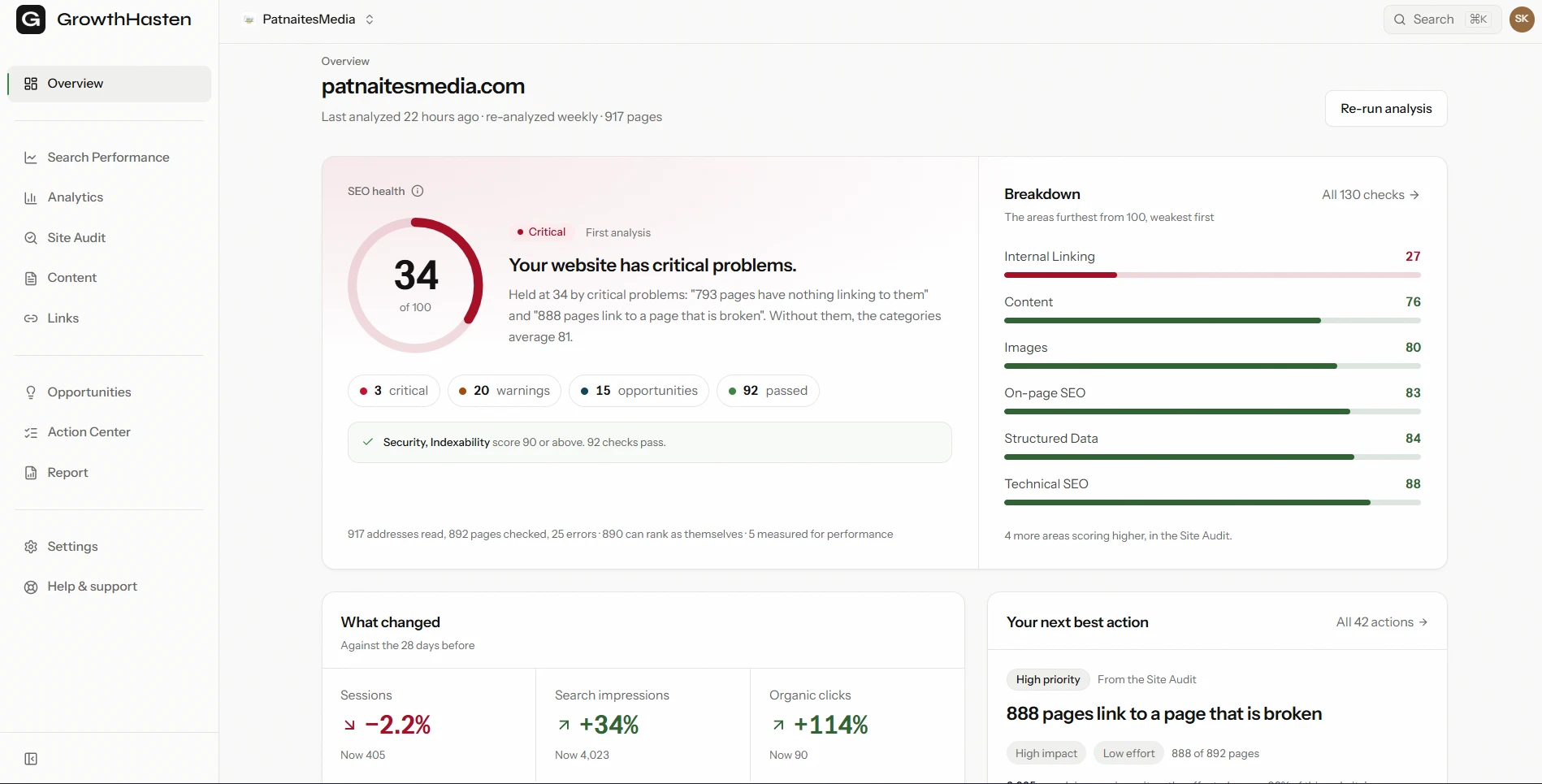
Earned links land on pages that pass authority on through your internal links. GrowthHasten's Links section maps that internal link graph, finds the pages nothing links to, and proposes specific internal links with the reasoning on every row. It does not build or buy backlinks.
Explore the Links SectionQuestions
Frequently asked questions
What does a digital PR agency do for a SaaS company?
It earns coverage, brand mentions, and high-authority backlinks by giving journalists and publications something worth writing about: data, expert commentary, or a strong point of view. For a SaaS company, the aim is authority and demand that compound over time, and increasingly a presence in the sources that AI answer engines cite when people ask questions in your category.
How is digital PR different from link building?
Link building targets links directly, often through outreach for specific placements. Digital PR earns links as a by-product of genuine coverage and brand mentions. The two overlap, but a startup that only needs a few relevant links to move rankings may not need a full PR program yet. Match the discipline to the problem you are actually trying to solve.
How much does a digital PR agency cost?
It depends on scope and campaign cadence, and models range from monthly retainers to per-campaign pricing and flexible subscriptions. Public pricing is rare in this market. Ask any agency to tie its fee to deliverables and to outcomes you can verify, such as earned placements and brand-lift, rather than to a raw link count or unverifiable impression estimates.
Do startups need digital PR?
Not always, and rarely first. Early startups often get more from content and targeted link building until they have a launch, a dataset, or a point of view worth pitching. Digital PR amplifies what already exists rather than creating newsworthiness, so it pays off once there is something genuinely worth amplifying to journalists and publications.
How do you measure digital PR results?
Look at the quality of earned coverage, the relevant referring domains gained, movement in branded search and share of voice, and increasingly whether your brand appears in AI answers for questions in your category. Be wary of agencies reporting only link volume or unverifiable impressions. Agree on two or three outcome metrics before the engagement starts and hold reporting to them.

Written by
GrowthHasten Team
Editorial Team, GrowthHasten
Articles from the GrowthHasten editorial team, grounded in primary research, our own testing, and what analyzing real websites shows, fact-checked in-house.
View profile