

SEO pricing is the set of fees providers charge for search work, and the reason two quotes for the same website can differ several times over is that the word "SEO" hides wildly different scopes. This is written for the founder or growth lead at a SaaS or B2B company who is holding a proposal and cannot tell whether the number on it is reasonable. It covers what the published price surveys actually measured, the six variables that move a quote, what each budget band genuinely buys a software company, and how to set two proposals side by side. It also covers the situation where the correct spend is zero, which no agency pricing page has any reason to tell you.
The short version
- The published averages disagree. Ahrefs' survey of 439 providers (2024) puts the average monthly retainer at $2,917, Clutch's directory guide (2026) at $3,199 with a typical range of $2,000 to $20,000, and their floors do not overlap.
- Price is a function of scope, and most quotes never state the scope precisely enough to compare. Two honest providers can quote several times apart for the same site and both be reasonable.
- The pricing model you are offered says more about the provider's business than about your website.
- Below a floor, a retainer cannot buy enough of anything to compound. Above a ceiling, you are paying for capacity your team has no time to absorb.
- For some companies at some stages the right spend is zero, and a retainer bought too early is one of the most common ways SEO budget is wasted.
How much does SEO cost?
Somewhere between a few hundred and several thousand dollars a month, and the width of that range is the real answer rather than a failure to answer. Two datasets get cited most often, and reading them next to each other is more useful than averaging them.
| Source | Population it measured | What it reports |
|---|---|---|
| Ahrefs' SEO pricing survey (article updated August 2024) | 439 SEO providers polled, self-reported, across agencies, consultancies and freelancers in all regions | Monthly retainers average $2,917. The single most common band is $501 to $1,000 per month (20.4% of respondents). Hourly rates average $111. |
| Clutch's SEO pricing guide (updated August 2026) | Firms listed in Clutch's own directory, plus first-party client reviews | Monthly fees typically $2,000 to $20,000. Average monthly cost $3,199. Most listed agencies bill $100 to $149 per hour. |
Look at the floors. Ahrefs' most common retainer band tops out at $1,000 per month. Clutch's typical range starts at $2,000. The two do not touch, and neither is wrong. A survey of self-selecting providers catches a long tail of solo operators and small local work; a directory of firms that market themselves to buyers catches the upper half of the market and almost nothing below it.
Provider type explains most of the spread. In the same Ahrefs survey, agencies reported an average of $3,209 per month, consultancies $3,250, and freelancers roughly $1,349. Among respondents in the US and Canada, 79.1% charge at least $1,001 per month. For one-off work, the most common per-project price in that survey was $2,501 to $5,000, reported by 21.2% of respondents.
Now the caveat that matters most for a software company. Both populations are providers, not SaaS buyers, and both skew toward local and small-business work. If your site has a few hundred pages, a JavaScript front end, a technical audience, and competitors with real content teams, the published averages read low. If you run a five-page brochure site, they read high. That is why the rest of this article talks about scope rather than about market rates.
What are the four SEO pricing models, and what does each one signal?
Four models cover almost every proposal you will see, and each one tells you something about the provider's business before it tells you anything about your site.
- Monthly retainer: a fixed fee for an agreed scope of ongoing work. It suits compounding work with no natural end, and it is the model most agencies prefer because it makes their revenue predictable. The risk runs both ways, so the scope has to be written down.
- Fixed-price project: a set fee for a defined deliverable such as an audit, a migration, or an information-architecture rebuild. Technical work is often better bought this way, because it finishes. Our guide to technical SEO explains why that work is usually scoped as an audit plus implementation rather than as an open retainer.
- Hourly rate: you pay for time logged. It is honest for advisory work and poor for program work, since it prices effort rather than output. In the Ahrefs survey the most common hourly band was $75 to $100, reported by 24% of respondents, with consultancies averaging well above agencies and freelancers.
- Performance-based: fees tied to rankings or traffic milestones. It sounds like aligned incentives and usually is not, because the fastest route to a ranking milestone is rarely the route that survives the next twelve months.
Choosing between the models is a provider-selection question rather than a pricing question, and our guide to what SEO services include covers that decision in full. For budgeting purposes, one thing is enough: the model changes what you can hold someone to, and only a retainer or a project fee tied to a written scope of work gives you anything to hold. The same four models price a content program too, and our guide to what a content marketing program costs works through how retainer, per-piece and in-house compare for that spend.
What should an SEO retainer actually include?
Five things. If a proposal is missing any of them, you are looking at a list of hours dressed as a scope, and you will not be able to compare it to anything.
They are a named strategy owner rather than a role, a monthly deliverable list with counts, either technical implementation or an explicit handoff spec for your developers, reporting against leading indicators agreed before the work starts, and a stated review point. What each of those five should actually contain, month by month, is what an SEO retainer should buy you.
A retainer is the wrong instrument when the work has an end. A one-off audit (see what an SEO audit costs), a replatform, or a redirect map is a project, and paying a monthly fee for it means paying past the point of delivery.
What actually drives an SEO quote up or down?
Six variables, and they are the reason two competent providers looking at the same site can arrive several times apart. Read a quote as a bet on these six rather than as a price for a product.
- Site size and page-type count: the number of distinct templates matters more than the number of URLs. A 5,000-page site built from four templates is cheaper to fix than a 300-page site built from nineteen. Ask which templates the work touches.
- Rendering complexity: a client-side rendered app costs more to diagnose and more to change than server-rendered HTML, because every finding needs verification in the rendered DOM rather than in
view-source. If your front end is a single-page app, expect that to appear in the number. - Content velocity required: the largest single line item in most SaaS engagements. Four researched, technically credible articles a month is a different business from twelve, and briefs, subject-matter interviews, and editing cost more than drafting.
- Competitive difficulty of the target set: the same article costs the same to write and a great deal more to rank when the incumbents are well-resourced publishers. A provider who quotes without looking at your target SERPs has not priced this at all.
- Whether dev capacity exists on your side: if your engineers can absorb a monthly queue of changes, the provider can recommend and hand off. If they cannot, the provider has to implement, and implementation is billed differently from advice.
- Whether link acquisition is in scope: the variable most often left ambiguous. Digital PR and editorial link work carry real outreach cost, so a quote that includes them and a quote that does not are not comparable at any price.
Two quotes differing several-fold on these six is legitimate. Two quotes differing several-fold with no stated position on any of them is a signal about the providers, not about your site.
What do SEO pricing packages include at each budget band?
Here is the part most pricing pages leave out: what a given number cannot buy. The bands below are scoping brackets we use for SaaS and B2B sites rather than market rates, and every row assumes a software company with a technical audience, not a local business. For reference, the sourced averages above land in the second band.
| Monthly band | What a competent scope contains | What it cannot contain at this number |
|---|---|---|
| Under $1,500 | One workstream done properly. Either a small content cadence with real briefs, or on-page and technical fixes on existing pages, or advisory time for an internal owner who executes. | Strategy, content, technical work, and links at once. A provider promising all four here is spreading a few hours across each, and nothing compounds. |
| $1,500 to $3,500 | A defined roadmap plus one primary engine: usually content production at a modest cadence with on-page work included, or a technical program with your developers implementing. | Meaningful link acquisition alongside content. Outreach has a floor cost, and buying a little of it produces the appearance of a link program rather than one. |
| $3,500 to $8,000 | Strategy, a real content cadence, on-page and technical work, reporting, and either implementation support or a genuine link workstream. The first band where a full program is plausible. | Both implementation and links at scale, and rarely enough for a competitive net-new content push in a category owned by established publishers. |
| Above $8,000 | Parallel workstreams: content at volume, technical implementation, digital PR or link acquisition, and senior strategic time with named specialists on each layer. | Results your organization cannot absorb. Above this line the binding constraint is usually your approval and deployment capacity, not the budget. |
Where the marginal dollar goes: the next increment of budget should not be spread evenly. In the lowest band, put it into whichever single workstream you can measure. In the second, put it into content quality rather than content volume, because one article that earns citations outperforms three that do not. In the third, put it into removing your own bottleneck, which is usually developer time. Above the fourth, put it into the constraint you have stopped talking about, which is almost always internal review capacity.
Two limits on reading this table. It assumes an engagement of at least six months, because a scope built for three does not compound. And it says nothing about quality: the same $4,000 buys senior judgment from one provider and junior execution behind a senior pitch from another, which is exactly what the next section is for.
How do you compare two SEO proposals?
Not by price, and not by reading them in the order they arrived. In my experience, the most effective approach is to rewrite both proposals into the same deliverable format before reading either one, because the formatting differences are doing most of the work of making one look better. Put monthly deliverables in identical rows, with counts, and the comparison usually resolves itself.
Then score both on these six dimensions.
| What to compare | The question to ask | What a good answer sounds like |
|---|---|---|
| Deliverables per dollar | What exactly ships each month, with counts? | Specific artifacts and quantities. Vague scope at a low price is the most expensive option on the table. |
| Who does the work | Is the person in this meeting the person doing it, and if not, who is? | Named people with their layer of the work. Discomfort with the question is itself the answer. |
| What happens in month six | What does the scope look like once the obvious fixes are done? | A shift from remediation to compounding work, described before you sign rather than renegotiated later. |
| What gets billed extra | What is explicitly outside this fee? | A written list. Content beyond a count, dev hours, link placements, and tool licenses are the usual four. |
| Reporting and access | What does the monthly report show, and can I see a real one? | A redacted example, with outcomes rather than activity, covering the metrics worth reporting on. |
| Exit | What stays mine if we stop? | Content, access, documentation, and data remain yours, with no ransom clause on the accounts. |
Google's own guidance on hiring a search provider is worth reading before either conversation. Its page on whether you need an SEO tells businesses to ask what results to expect and in what timeframe, how success will be measured, and whether every change made to the site will be shared with you. It also states plainly that no one can guarantee a number one ranking. A proposal that guarantees a position has answered the pricing question for you.
Is an in-house SEO hire cheaper than an agency?
It depends on how much work you have, and the comparison is usually run wrong. A salary is not the cost of an in-house hire. The honest comparison names every component on both sides.
- In-house: salary, employer taxes and benefits, recruitment cost, tool licenses (rank tracking, crawling, and analytics are billed per seat), ramp time before output starts, management overhead, and the coverage gap. One person cannot be strong at strategy, technical, content, and links at once.
- Agency: a higher effective rate per hour, a lower rate per capability, no recruitment risk, and a scope you can change quarterly. Against that, shallower context on your business and the standing risk of junior execution.
- Fractional: senior judgment for a fraction of the week, no benefits load, and no coverage of execution. It works when you have hands to do the work and no one to direct them.
Fill in your own market salary rather than borrowing one from an article, then add the other components before comparing anything. The pattern that usually emerges: agencies win on breadth, in-house wins once the volume is steady enough to keep one specialist fully occupied, and fractional wins when the missing ingredient is direction. Our guide to choosing between a consultant, agency, in-house, or fractional engagement works through that decision properly.
When should you not buy SEO yet?
Four situations, and in all four the right retainer is no retainer. What I've seen in practice is that the most expensive SEO engagement is not the overpriced one. It is the correctly priced one that produces a queue of sound recommendations nobody has the capacity to implement, month after month, while both sides stay polite about it.
- Before product-market fit: if who you sell to and what you sell are still moving, content built on today's positioning may be obsolete before it ranks.
- No content capacity on your side: SEO for a technical product needs subject-matter input. If no one internally can spend an hour a week being interviewed or reviewing drafts, the output will be generic regardless of the fee.
- No developer capacity: a technical roadmap nobody can ship is a document, not a change. Either buy implementation or wait until you have the engineering time.
- A site that needs building first: if the site itself has to be rebuilt or replatformed, spend the money on the build and start the retainer after it, so the work is not done twice. Our breakdown of scoping and pricing a website rebuild covers how to size that spend and price the organic traffic a rebuild puts at risk.
None of that means waiting forever. It means the first spend should go to the binding constraint.
How do you know whether the spend worked?
By separating leading signals from lagging ones, and by agreeing which is which before the first invoice. Leading signals move in weeks: pages crawled and indexed, impressions on target queries, average position on the tracked set, published output against the agreed count, technical issues closed. Lagging signals move in quarters: qualified organic sessions, pipeline sourced from organic, and eventually the effect on customer acquisition cost.
We will not tell you a payback period. Anyone who quotes one before seeing your traffic, conversion rate, deal size, and sales cycle is quoting a number they cannot know. What you can do is set the arithmetic up in advance: agree the leading indicators at the start, review them at the stated review point, and hold the lagging ones to a horizon long enough to be fair to a compounding channel. If a provider resists naming leading indicators, that resistance is your answer about the engagement.
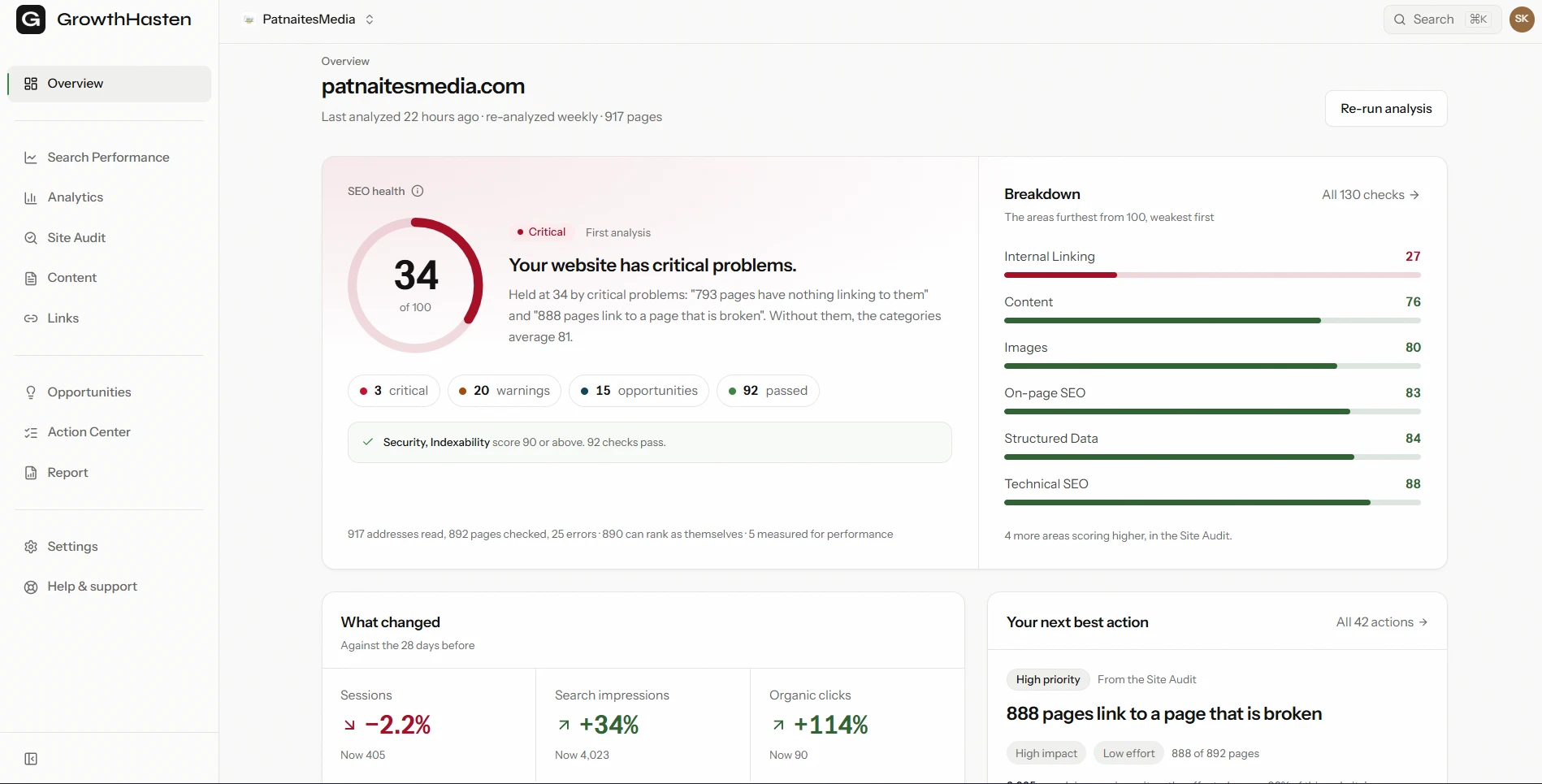
The habit worth building is narrower than a budget process: never evaluate a price without a written scope beside it. A number on its own is not information, and a scope on its own tells you almost everything. This week, take the two proposals on your desk and rewrite their monthly deliverables into the same format, with counts, before you look at either fee again. If you want to check the scope against your own site before you sign, a site audit shows which of the proposed fixes your site actually needs.
Know What Your Site Needs Before You Hire Anyone
Brief any agency, consultant or hire from evidence. GrowthHasten crawls your website, joins it to your own Search Console and Analytics, and turns the result into one prioritized queue of fixes and opportunities. Free plan: one website of up to 900 pages, no card.
Analyze Your WebsiteQuestions
Frequently asked questions
How much does SEO cost per month for a SaaS company?
Published surveys point at a wide band rather than a single number. Ahrefs' poll of 439 SEO providers, updated in August 2024, put average monthly retainers at $2,917, while its most common band was $501 to $1,000. Those populations skew toward local and small-business work rather than software. For a SaaS site the figure is driven by site complexity, how much content you need produced each month, and whether link acquisition is in scope. Get the scope in writing before comparing any two figures.
Why do SEO quotes vary so much for the same website?
Because SEO covers work ranging from a one-off audit to a full content and engineering program. Six variables move the number: template count rather than page count, rendering complexity, the content velocity required, competitive difficulty of the target keywords, whether your developers can absorb changes, and whether link acquisition sits inside the fee. Two quotes several times apart can both be reasonable if they take different positions on those six.
Is it cheaper to hire an in-house SEO or an agency?
It depends on volume. A fully loaded in-house hire costs more than salary alone once employer taxes, benefits, recruitment, per-seat tool licenses, ramp time, and management overhead are counted, and one person cannot cover strategy, technical, content, and links at once. Agencies cost more per hour and less per capability. Fractional support sits between the two and suits teams that have hands to execute but nobody to direct the work.
When is SEO not worth buying yet?
In four situations: before product-market fit, when nobody internally can give subject-matter input or review drafts, when you have no developer capacity to ship the changes, and when the site itself needs rebuilding first. Paying a retainer that produces sound recommendations nobody has the capacity to implement is one of the most common ways SEO budget is wasted. Spend on the binding constraint first, then start the retainer.

Written by
GrowthHasten Team
Editorial Team, GrowthHasten
Articles from the GrowthHasten editorial team, grounded in primary research, our own testing, and what analyzing real websites shows, fact-checked in-house.
View profile