

SEO services are the strategy, technical work, content, and off-site authority-building a business pays for to earn organic visibility in search engines and, increasingly, in AI answer engines like ChatGPT and Google's AI Overviews. This guide is for the person choosing a partner: a founder, a marketing lead, or an operator weighing an agency against a freelancer, a consultant, or an in-house hire. It covers what real SEO services include, the deliverables to expect, how providers price the work, and how to separate a sustainable partner from someone selling rankings. It also covers the red flags worth walking away from, and the cases where hiring anyone at all is the wrong move.
The short version
- No one can guarantee rankings. Any provider who promises a specific position is either misinformed or misleading you, and Google's own guidance says the same.
- "SEO services" is not one thing. It spans strategy, technical SEO, on-page, content, off-site authority, AI-search optimization, and reporting, and few providers do all of them equally well.
- The provider model matters less than fit. A strong freelancer can outperform a weak agency, and an in-house hire can beat both once your volume justifies the salary.
- Judge a partner by their process and reporting, not their promises. Transparency is the single best predictor of a good engagement.
- Sometimes the right answer is to wait. Before product-market fit, SEO spend rarely pays back.
What do SEO services actually include?
Seven distinct workstreams, though almost no engagement runs all seven at full intensity at once. When a provider says "SEO," ask which of these they mean, because the mix determines the price, the timeline, and whether the work fits your situation.
- Strategy and research. Keyword and intent research, competitor analysis, a prioritized roadmap. This is the layer that decides what gets worked on and why. Our complete guide to SEO walks through how the pieces connect.
- Technical SEO. Crawlability, indexing, site architecture, Core Web Vitals, structured data, and rendering. It rarely moves rankings on its own, but it removes the ceiling everything else hits. See our technical SEO guide for the full sequence.
- On-page optimization. Titles, headings, internal links, metadata, and the on-page signals that map a page to the query it should answer.
- Content. Briefs, writing, and optimization built to satisfy search intent and earn citations. Most sustainable growth lives here. Our content marketing for SEO guide covers the approach.
- Off-page and digital PR. Earning links and mentions from credible sites, the authority signals search engines still weigh heavily.
- AI search optimization (AEO and GEO). Making pages quotable by AI assistants and eligible for AI Overviews. Newer, but no longer optional. Our AI SEO guide explains what changes, and if you're vetting a specialist for this layer specifically, our guide to choosing an AI SEO agency covers the evaluation criteria.
- Reporting and analysis. Search Console and analytics reviews that tie the work to outcomes rather than activity.
Google's own Search Central documentation is the reference standard for most of this, and a good provider will point to it rather than to secret methods of their own.
Which type of SEO provider fits your situation?
It depends on your scope, budget, and how much you can manage internally. There are four common models, in-house, agency, freelancer, and consultant, and the honest answer is that fit beats category. Here is how the three most common providers compare.
| Factor | In-house hire | Agency | Freelancer |
|---|---|---|---|
| Best when | SEO is a core, ongoing channel with steady volume | You need multiple specialisms and execution capacity | Scope is focused and you can direct the work |
| Breadth of skills | Narrow to one or two people | Broad across a team | Usually one or two strengths |
| Context on your business | Deepest over time | Shared across clients | Varies with involvement |
| Main risk | Single point of failure; slow to hire | Junior execution behind a senior pitch | Capacity limits and continuity |
A consultant sits apart from this table. They rarely do the hands-on execution; they set direction, audit, and coach your team or your other providers. That fits companies with capacity but no senior SEO judgment in the room, and our guide to what an SEO consultant does and when to hire one covers that model in full if you're still weighing it against an agency or an in-house hire. If your product is SaaS specifically, our ranked guide to SaaS SEO agencies scores nine specialist firms against the same fit-over-rank standard this section describes.
What deliverables should you expect from an engagement?
Artifacts you can point to, not activity summaries. "We optimized 40 pages" is activity. A prioritized roadmap, a shipped set of fixes, and a report that ties both to search performance are deliverables. Expect to receive, over the first quarter of most engagements:
- A technical and content audit with issues ranked by impact.
- A keyword and topic map tied to your funnel stages.
- A prioritized roadmap with owners and timelines.
- Optimized or newly published pages, not just recommendations.
- Direct access to the accounts where work happens, Search Console, analytics, the CMS.
- A regular report that connects the work to impressions, clicks, and rankings.
If a provider keeps you out of your own Search Console or CMS, treat that as a warning, not a convenience.
How do SEO providers price the work?
SEO is sold four ways: a monthly retainer, a fixed-price project, an hourly rate, and performance-based deals. Which one you are offered says more about the provider's business model than about your site. For what each model actually costs, what a given budget buys, and how to compare two quotes side by side, see SEO pricing for SaaS and B2B companies. For the first of the four, our month-by-month account of what an SEO retainer should deliver sets out what each month of the engagement is supposed to produce.
How do you choose an SEO partner?
Interview their process, not their promises. The best signal is how a provider thinks about your business before they've won it, whether they ask about your margins, your sales cycle, and your best customers, or just recite deliverables. Use this checklist in the first conversation.
Questions to ask before you sign.
- What will you work on in the first 90 days, and why that order?
- How do you decide what to prioritize when everything looks important?
- Who actually does the work, the person pitching, or someone I haven't met?
- How do you build links, specifically, and can you name the type of sites?
- What does your monthly report show, and can I see a real example?
- What access will you need, and what stays in my accounts if we part ways?
- What happens to the work, content, links, fixes, if the contract ends?
- When have you told a client something they didn't want to hear?
The answers matter less than the shape of them. A partner who explains trade-offs and admits uncertainty is worth more than one with a confident answer for everything. For a fuller set of questions to ask an SEO agency, with what a good answer looks like, see our dedicated guide.
What are the red flags that should end the conversation?
A handful of claims that reliably signal risk. None of these guarantees a bad provider on its own, but each is common enough among low-quality ones that we treat them as reasons to slow down.
- Guaranteed rankings. Search results depend on factors no agency controls. Google's Search Essentials make clear that no one can promise a position, and reputable providers say so plainly.
- Secret or proprietary methods. Sustainable SEO is not a secret. Vagueness usually hides tactics that violate search guidelines.
- Private blog networks or cheap link packages. Bulk links from networks are a spam signal, and they put your site at risk rather than growing it.
- No reporting or account access. If you can't see the work or the data, you can't verify either.
- Long lock-in contracts with early exit penalties. Good work earns renewal. Contracts that trap you tend to protect the provider from accountability.
- No questions about your business. A provider who doesn't ask what a customer is worth to you can't prioritize the work that pays back.
When should you not hire an SEO agency?
More often than most agencies will admit. SEO is a compounding channel, and a few situations make it the wrong first investment:
- Before product-market fit. If you're still changing who you sell to and what you sell, SEO built around today's positioning may be obsolete before it ranks.
- When you need revenue this quarter. Organic search usually takes months, not weeks, to move. If the runway is short, paid channels answer faster.
- When the scope is small and well-defined. A single audit (the price of a one-off audit) or a local business with a handful of pages is often better served by a freelancer or a one-off project than a full retainer.
- When you can't feed the engine. SEO needs content approvals and development time from your side. Without them, even a strong agency stalls.
Naming these situations honestly is part of the job. We'd rather tell a founder to wait six months than take a retainer that can't pay back.
What does a good SEO engagement look like?
Structured onboarding, a visible roadmap, and a steady cadence you can audit. In the first weeks, a good partner learns your business and your data before recommending anything. Then they publish a prioritized plan you can see, ship work against it on a predictable rhythm, and report in terms of outcomes, impressions, clicks, rankings, and the pages driving them.
The relationship should feel like a team extension, not a black box. You keep access to your accounts. You understand what shipped and why. And when something doesn't work, the partner says so and adjusts, because building a durable system beats defending a forecast.
The one habit worth building: judge every SEO conversation by its transparency, not its confidence. Providers who show their process, share their data, and name their trade-offs are the ones who compound value over years. This week, take one proposal or provider you're considering and run it through the eight questions above, the gaps in the answers will tell you most of what you need to know.
Know What Your Site Needs Before You Hire Anyone
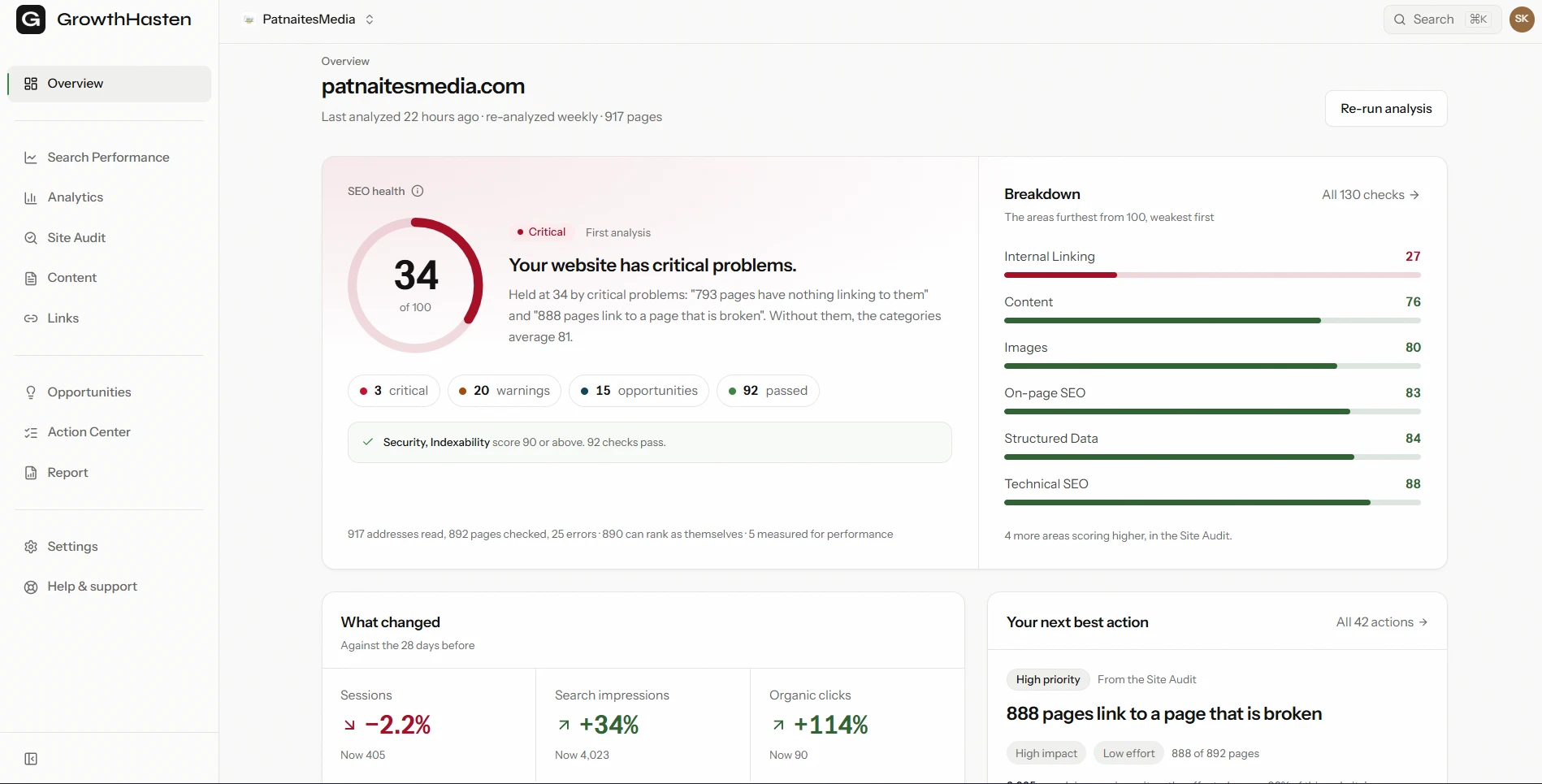
Brief any agency, consultant or hire from evidence. GrowthHasten crawls your website, joins it to your own Search Console and Analytics, and turns the result into one prioritized queue of fixes and opportunities. Free plan: one website of up to 900 pages, no card.
Analyze Your WebsiteQuestions
Frequently asked questions
What is the difference between an SEO agency and an SEO consultant?
An agency executes the work with a team across technical SEO, content, and links, usually on a retainer. A consultant sets strategy, audits, and coaches your team or existing providers, but rarely does the hands-on work. Agencies suit companies that need execution capacity; consultants suit those with capacity but no senior SEO judgment in the room.
How long do SEO services take to show results?
Usually months, not weeks, and the range is wide enough that an average is misleading. Technical fixes can move within weeks; competitive content usually takes two to three quarters. What actually sets your timeline is your site's starting state, not a benchmark. Our guide to how long SEO takes for B2B and SaaS companies breaks the timeline down by stage and by starting condition.
Can SEO rankings be guaranteed?
No. Search rankings depend on factors no provider controls, including competitors, algorithm updates, and searcher behavior. Google's own guidance states that no one can guarantee a specific position, and any provider who promises one is either misinformed or misleading you. A trustworthy partner commits to a process and reporting, not to a ranking number.
What should an SEO monthly report include?
It should tie work to outcomes, not list activity. Expect impressions, clicks, and average position from Search Console, ranking movement for tracked keywords, the pages driving traffic, and a summary of what shipped that month and why. Good reports also flag what didn't work and what changes next, so you can audit the engagement rather than trust it.
Is it better to do SEO in-house or hire an agency?
It depends on volume and breadth. In-house works once SEO is a steady, core channel that justifies a salary and benefits from deep business context. An agency fits when you need multiple specialisms and execution capacity without hiring for each. Many companies blend the two: an internal owner directing an agency or consultant for depth.
How much do SEO services cost?
There is no universal rate, because pricing depends on scope, seniority, and geography. Providers typically charge hourly, on a monthly retainer, per project, or on a performance basis. Retainers and project fees tied to a clear scope tend to align incentives best. Be cautious with performance pricing, which can push providers toward short-term tactics and risky link sources.

Written by
GrowthHasten Team
Editorial Team, GrowthHasten
Articles from the GrowthHasten editorial team, grounded in primary research, our own testing, and what analyzing real websites shows, fact-checked in-house.
View profile