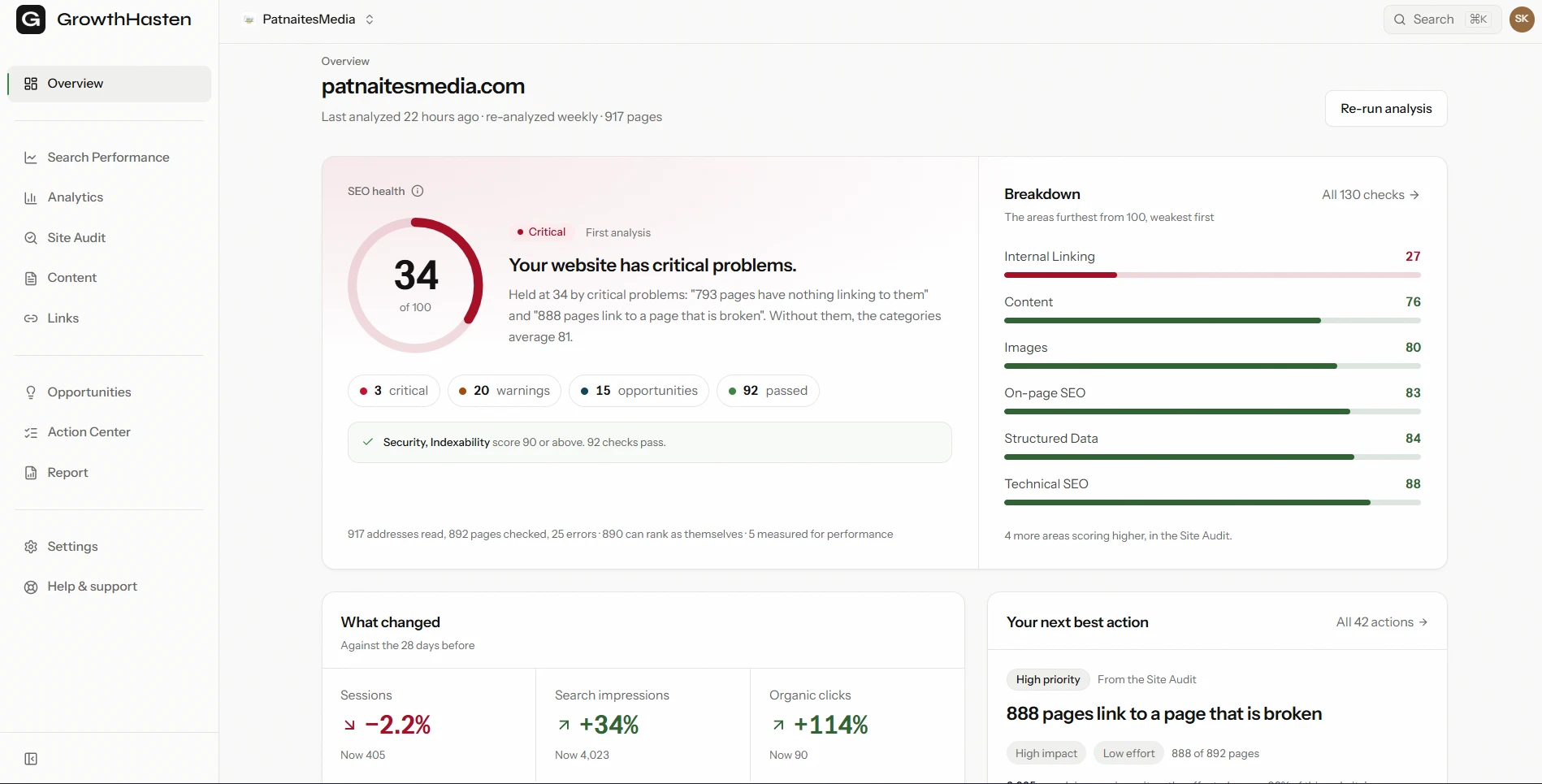


An SEO audit is a paid review of why a website underperforms in search, delivered as a prioritized list of what to fix and in what order. The quotes for that same review routinely disagree by ten times, so it speaks to the operator weighing two proposals that both look reasonable and cannot both be right. It explains what actually drives the number, what each price tier genuinely buys, and how to check any quote against the hours of work behind it. We run audits and we built a free tool that runs the automated layer of one, so this piece says plainly where the honest floor is and when paying for a manual audit is the wrong move.
The short version
- Run the free, automated tier before you pay anyone. It costs nothing, takes minutes, and often answers enough of the question that a paid audit can wait.
- The price is hours multiplied by an hourly rate. The ten-times spread between quotes is scope, not quality or secret knowledge.
- Under a few hundred dollars almost always means an automated report with no human judgment attached, whatever the label on it says.
- A $500 audit you act on this quarter beats a $5,000 audit that becomes a PDF nobody opens.
What drives the cost of an SEO audit?
Scope and site complexity, almost entirely. Two competent auditors looking at the same website can arrive at numbers ten times apart because they are pricing different amounts of human time, not charging different rates for the same work. Read any quote as a bet on these variables:
- Site size and template count: the number of distinct page templates matters more than the raw URL count. A site built from four templates is quicker to audit than one built from nineteen, regardless of how many pages each produces.
- Depth of the review: a technical-only crawl is a fraction of the work of a full audit that also covers a content audit, a backlink audit, and a competitive gap read.
- How the site renders: when a page builds its content in the browser with JavaScript, the auditor cannot trust
view-sourceand has to inspect the DOM the browser actually produces for each check, which adds hours a server-rendered page never costs. - Log-file analysis: reading server logs to see what Googlebot actually crawls is specialist, time-consuming work that only appears on larger engagements.
- Migration or replatform prep: auditing a site that is about to move is a different job from auditing a stable one, because the redirect map and the risk assessment are added on top.
- Provider type: a freelancer, an agency, and an in-house hire price the same hours differently, and they bring different amounts of them.
When I scope an audit, the factor that swings the estimate most is rarely the page count. It is the template count and whether the site renders its content with JavaScript. A 5,000-page catalog built from four clean templates can be faster to audit than a 400-page single-page app, because on the app every issue has to be confirmed in the rendered output before it can be trusted. Ask any provider which templates their audit will actually touch; a quote that does not know is a quote that has not been scoped.
How do hours translate into the price of an audit?
Directly, and once you see the arithmetic the ten-times spread stops being mysterious. An audit is hours of skilled time, and the published rate for that time sits in a known band. Ahrefs' survey of 439 SEO providers found the most common hourly rate was $75 to $100, with 90% of respondents charging $150 an hour or less and the average landing at $111. An audit is usually bought as a one-off project rather than a retainer, and in the same survey the most common per-project fee was $2,501 to $5,000, with 60.6% of providers charging $1,001 or more for a project.
The table below turns scope into hours, then hours into a price at a representative $75 to $150 an hour. The hours are our scoping judgment from running audits; the rate is the sourced band above; the price is simply the two multiplied. Treat it as a way to sanity-check a quote, not as a rate card.
| Audit scope | What the work covers | Rough hours | Price at $75 to $150/hr |
|---|---|---|---|
| Automated only (the $0 tier) | Deterministic crawl checks of markup and structure. No human judgment. | 0 human hours | $0, or a month of a tool subscription |
| Basic health check | Small, server-rendered site. Technical and on-page skim, top issues flagged. | 6 to 12 hours | about $450 to $1,800 |
| Comprehensive audit | Mid-market site. Technical, content and backlink review, competitive gap, prioritized plan. | 20 to 40 hours | about $1,500 to $6,000 |
| Enterprise or complex | Large or JavaScript-heavy site. Log-file analysis, international, migration prep. | 60 to 120+ hours | $5,000 to $15,000 and up |
The floor is the useful number here. If a quote comes in under a few hundred dollars for anything called comprehensive, the math says there are almost no human hours in it. You are being sold an automated export at a human price, which is where most wasted audit spend goes.
What does each price tier actually buy?
A ladder, with human judgment entering higher up each rung. Knowing where a quote sits on it tells you more than the number does.
- The $0 automated tier: free tools run deterministic checks and tell you what is technically broken: missing titles, broken links, slow pages, orphaned URLs. Our roundup of free SEO audit tools covers what this layer reaches. What it cannot do is weigh any of it against your goals or your competitors.
- The freelancer: one experienced person's judgment applied to a focused scope, usually a technical SEO audit or a content audit rather than everything at once. Good value when the question is narrow and you can brief it precisely.
- The agency: a team with breadth across technical, content, links and competitive analysis, more hours, and a higher blended rate. This is the tier where a full audit with a prioritized roadmap becomes realistic.
- The enterprise engagement: named specialists per layer, log-file analysis, international and migration work. You are paying for capacity and depth that only matter once the site is large or complex enough to need them.
The automated tier is where our own product sits, and it is worth running before you brief anyone, so that your conversation with a provider starts from evidence rather than a blank page.
See What Your Site Needs Fixed First.
GrowthHasten runs the automated layer of an audit: over 130 deterministic checks across twelve scored categories, joined to 16 months of your own Search Console and your GA4 data. The free plan covers one website of up to 900 pages, with no card.
Start FreeFreelancer, agency, or in-house: how do the costs compare?
They price the same hours very differently, and the honest comparison counts more than the headline rate. This is a cost framing only; which one actually fits your situation is a separate decision.
| Source of the audit | How the cost works | Where it makes sense on cost |
|---|---|---|
| Freelancer | Lower hourly rate, fewer hours available, one area of depth. | A focused, well-defined audit where you know which question to ask. |
| Agency | Higher blended rate, more hours, breadth across specialisms. | A full audit covering technical, content and links at once. |
| In-house | No per-audit fee, but loaded salary, tools and ramp time make the first audit the most expensive one. | Only once audits are frequent enough to keep a specialist busy. |
For a one-off audit, an in-house hire is almost never the cheaper route, because the salary, the per-seat tool licenses and the ramp time all land before the first finding does. The in-house case is about ongoing work, not a single review. If you are weighing the ongoing version of this spend, our breakdown of ongoing SEO pricing works through the retainer decision that sits next to the one-off audit.
Is a free SEO audit worth anything?
Yes, as a floor and a filter, and no as a substitute for judgment. A free automated audit runs deterministic checks and returns the same answer on the same input every time, which is genuinely useful: it tells you what is broken before you pay anyone to look. For many sites that is enough to decide whether a paid, strategic audit is even needed yet.
What the automated tier cannot do is the part you are actually paying a human for. It will not weigh a finding against your specific goals, read your competitive landscape, or tell you which of 300 warnings to fix first and which to ignore. The honest use of a free audit is to clear the mechanical problems and arrive at a paid conversation already knowing the state of your site, which makes every hour you then buy more valuable.
Treat a free audit as the first step, not a smaller version of the paid one. They answer different questions.
What should a paid SEO audit deliver for the money?
Prioritized findings with severity and an owner, not a raw dump of warnings. The difference between an audit worth paying for and an automated export dressed up as strategy is the order of operations: a real audit tells you what to do first, why, and what it is likely to be worth. Expect, at minimum:
- Coverage across the layers you paid for: technical, on-page and content, and, if it was in scope, a backlink audit and a competitive gap read.
- Prioritization you can act on: findings ranked by impact and effort, with the first few weeks of work made obvious.
- Owners and severity: each finding assigned to the person who would fix it, not left as an undifferentiated list.
- Realistic estimates, not guarantees: an honest read of the likely improvement and the work involved.
Our SEO audit checklist sets out the full scope a thorough audit should cover, which is a useful way to check a proposal against what you are actually being charged for. Google's own guidance on hiring an SEO puts it plainly: an audit should give you realistic estimates of improvement and an estimate of the work involved, you should grant read-only Search Console access at this stage rather than write access, and any provider guaranteeing a number one ranking should be ruled out on the spot.
How do you sanity-check an audit quote?
Convert it to hours before you compare it to anything. Divide the fee by a plausible hourly rate from the band above, and ask whether that many hours of skilled work can credibly produce what the proposal promises. A $400 "comprehensive" audit implies three or four hours of human time, which is not comprehensive; a $9,000 audit of a tidy 50-page site implies sixty hours that site cannot absorb. The number should match the work, in both directions.
The audits I have seen deliver the least value were not the cheapest ones. They were mid-priced reports that reran a crawler the client already owned and shipped a few hundred undifferentiated warnings with no order of operations attached. Watch for these signals that you are paying a human price for machine output:
- No stated scope: the quote names a price but not which templates, layers or page counts the work covers.
- Automated output sold as strategy: the sample report is a tool export with the logo changed and no prioritization.
- No prioritization promised: you are told what is wrong but not what to do first.
- Guarantees: a promised ranking or a fixed traffic lift, which no honest provider offers.
If a provider can map the fee to hours, name the scope, and show a redacted report that prioritizes, the price is probably fair whatever the headline number. If they cannot, the lowest number on the quote will end up costing you the most.
So the rule is simple: never judge an audit by its price, judge it by the hours and the deliverable behind the price, and always run the free automated tier before you pay for the manual one. Take whatever quote is on your desk, divide it by $100 an hour, and ask the provider to account for the hours that produces, then decide your route. If the answer is to run the first pass yourself, start with the free tools above and our guide to hiring an SEO partner for when it is time to hand it over. If you would rather have the work scoped and run for you, we can help.
Ready to Grow Your Organic Traffic?
If you want better rankings, more qualified traffic, and long-term organic growth, GrowthHasten can help.
Talk to an SEO ExpertQuestions
Frequently asked questions
How much should an SEO audit cost?
Scope and site size decide almost everything. Priced at a typical $75 to $150 an hour, a small-site health check runs a few hundred dollars to about $1,800, a comprehensive mid-market audit lands in the low thousands, and enterprise audits with log-file and international work cost more. Ahrefs' survey of 439 providers put the most common one-off project fee at $2,501 to $5,000. Convert any quote to hours before judging it, and run the free automated tools first.
Why do SEO audit quotes vary so much?
The same website can be quoted at very different prices depending on what the auditor is asked to produce: a crawl and a summary, or a deep technical, content, link and competitive review with a prioritized plan. The variable is hours of human judgment, not a fixed market rate. Two numbers that sit ten times apart can each be fair when they cover genuinely different scope.
Is a free SEO audit worth anything?
Yes, as a floor and a filter. Free automated tools run deterministic checks and tell you what is broken, which is often enough to decide whether you need a paid, strategic audit at all. What they cannot do is weigh findings against your specific goals and competitors, or tell you which problems to fix first. Use the free pass to clear mechanical issues, then pay for judgment.
What should a paid SEO audit deliver?
Prioritized findings with severity and an owner, not a raw list of warnings. Expect coverage of technical, on-page, content and link issues, a competitive gap read, and a plan you can act on in order. Google's guidance on hiring an SEO says an audit should give realistic estimates of improvement and of the work involved. If the deliverable is an automated export with no prioritization, you are paying agency rates for tool output.
How long does an SEO audit take?
Roughly a day for a small site to several weeks for a large or complex one. Timeline tracks hours, hours track scope, and that makes the timeline a better honesty check on a quote than the headline price. If a provider promises a comprehensive audit of a large, JavaScript-heavy site in a single afternoon, the scope and the schedule do not match.

Written by
Anshuman Sinha
AI SEO Specialist, GrowthHasten
Anshuman Sinha is an AI SEO Specialist and Computer Science Engineer with over three years of experience in SEO and five years in web development. He specializes in Technical SEO, AI Search Optimization (AEO and GEO), SaaS SEO, and building high-performance websites with modern technologies.
View profile