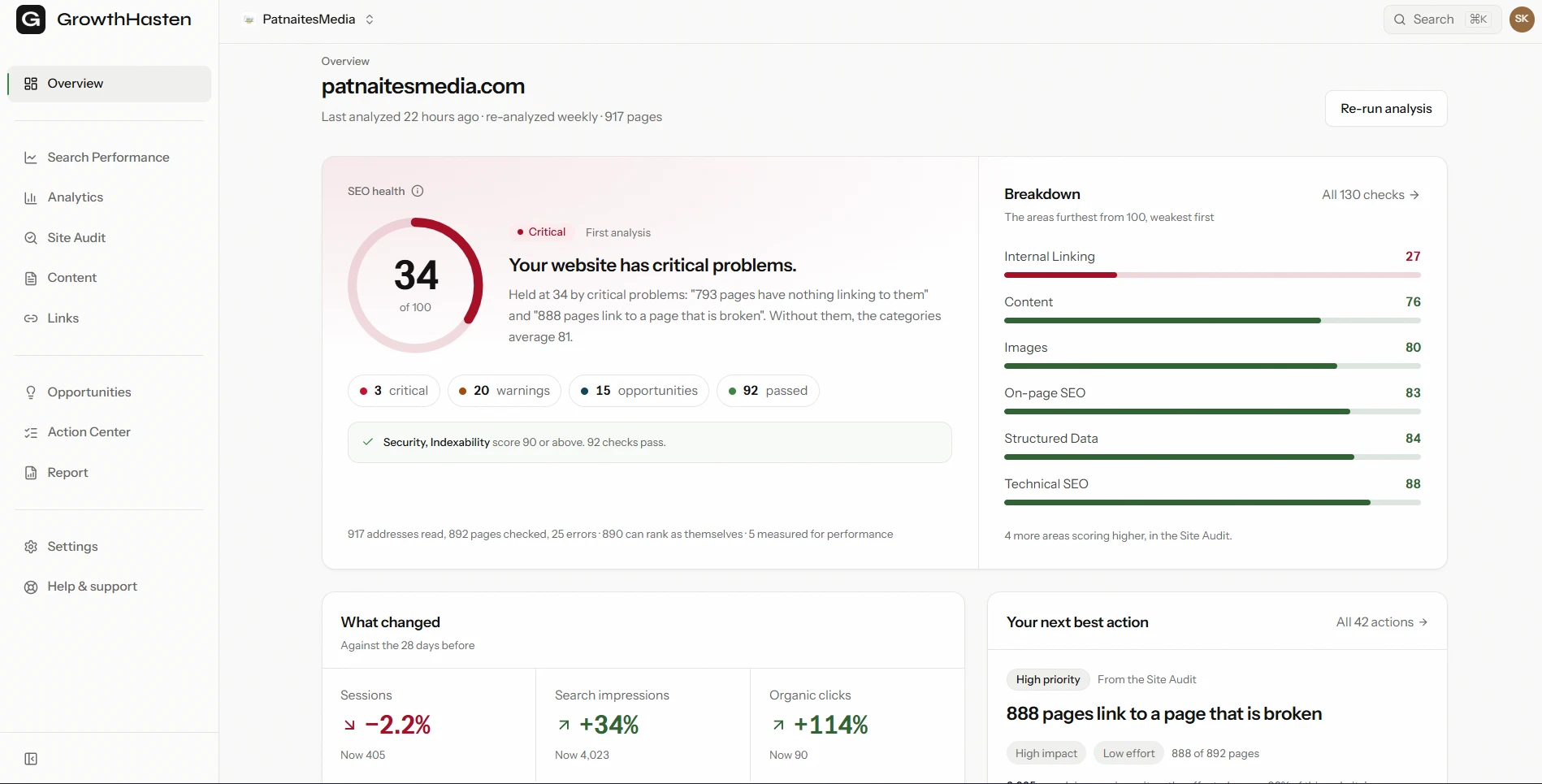


Technical SEO services are the specialist work of making a website easy for search engines to crawl, render, index, and trust: audits, indexing fixes, site architecture, performance, structured data, JavaScript rendering, and migration support. This guide is for the person deciding whether to hire that help, whether you bring in an agency, a freelancer, or build the capability in-house. It covers what these services include, the signals that mean you actually need them, how they differ from general SEO or content work, what to expect for the money, and when hiring would be a waste. Technical work removes ceilings on your organic growth. It does not create demand that was never there.
The short version
- Technical SEO fixes the reasons good content fails to rank. It rarely creates rankings on its own, so if your real gap is authority or content depth, hiring for technical work first is money in the wrong place.
- The clearest buying signal is a measurable break: traffic drops after a migration, pages stop getting indexed, or a JavaScript rebuild coincides with a ranking slide.
- Deliverables you should expect: a prioritized audit, the fixes implemented or specced for your developers, and a monitoring setup so problems surface early.
- Pricing follows three models (project, retainer, hourly), and each suits a different situation. None is inherently better value.
- The best providers show their process and their reporting before you sign. Vague promises of "first page" rankings are the reliable red flag.
What do technical SEO services actually include?
They include every layer that sits between your content and a search engine's ability to use it, delivered as a diagnosis followed by fixes. The scope varies by provider, but a complete offering covers a recognizable set of areas.
- Technical audits. A full crawl compared against what Google has indexed, surfacing the gaps between what exists, what is crawlable, and what ranks.
- Crawl and indexing fixes. Resolving "crawled, not indexed" clusters, cleaning up
robots.txt, correcting straynoindextags, and fixing canonical logic. - Site architecture and internal linking. Flattening deep pages and repairing orphans so important content is a few clicks from the homepage.
- Core Web Vitals and performance. Diagnosing slow loads, layout shift, and poor interactivity using real-user field data.
- Structured data. Adding valid JSON-LD schema so pages are eligible for rich results and easier for AI answer engines to parse.
- JavaScript SEO and rendering. Making sure content, links, and metadata survive rendering rather than arriving late or not at all.
- Site migrations. Redirect mapping, pre-launch checks, and post-launch monitoring so a replatform does not shed traffic.
- Log analysis and monitoring. On larger sites, watching what bots request and catching regressions before they cost rankings.
Our technical SEO guide explains the mechanics of each of these in depth if you want to understand the work before you buy it, and if the platform itself is still an open question, our guide to choosing a CMS built to rank covers that decision on its own terms.
What signals mean you need technical SEO help?
You need help when the evidence points to a mechanical failure rather than a content or authority gap. The strongest signal is a measurable event you can tie to a cause. Run down this checklist, and if two or more items match, technical SEO services are likely worth the spend.
Break signals (something changed). Organic traffic dropped noticeably after a site migration, replatform, or a website redesign that broke on-page signals without anyone noticing. A JavaScript framework rebuild lined up with a ranking slide. A deployment went out and impressions fell within days.
Indexing signals (pages are missing). Important pages are not in the index at all. Search Console shows growing "discovered, currently not indexed" or "crawled, currently not indexed" counts. Pages you deleted still appear in results.
Performance signals (the site is slow). Core Web Vitals sit in the "poor" range in field data. Mobile users bounce faster than desktop. Pages take several seconds to become usable.
Plateau signals (nothing is working). You publish genuinely good content and it never gains traction. Rankings have flatlined despite steady effort. Competitors with weaker content consistently outrank you.
That last group is the trickiest, because a plateau can be technical or it can be authority. A provider worth hiring will tell you which, honestly, before selling you a fix.
How are technical SEO services different from general SEO or content services?
They target a different layer of the same problem: technical work makes pages reachable and understandable, content work makes them worth ranking, and general SEO ties strategy across both. Buying the wrong one for your situation is the most common and most expensive mistake here.
| Service type | What it fixes | Signal you need it |
|---|---|---|
| Technical SEO | Crawling, indexing, rendering, speed, architecture, migrations | Pages not indexing, traffic dropped after a change, slow site, plateau despite strong content |
| Content SEO | Relevance, depth, topical coverage, on-page optimization | Pages indexed and loading fine but ranking on page two or three |
| General SEO / consulting | Strategy, keyword targeting, prioritization across technical, content, and links | You need a roadmap and do not know where the real bottleneck is |
The overlap is real. A technical audit often surfaces content problems, and a content strategy often exposes architecture debt. If you are not sure which layer is your bottleneck, a diagnostic-led engagement can name it before you commit to a build.
What deliverables and outcomes should you expect?
Expect a prioritized audit, the fixes either implemented or documented clearly enough for your developers to ship, and a monitoring setup that catches the next regression. Anything less than a prioritized, actionable output is a report you paid for and cannot use.
A good engagement produces three things: a diagnosis that ranks what is broken by impact, resolution (the fixes implemented, or exact specs handed to your developers with the reasoning attached), and a way to see the effect over time in indexing coverage, rankings, and organic traffic.
Now the honest limit. Technical SEO removes constraints so pages can compete, but it does not manufacture search demand, write the content that earns the ranking, or build the authority that wins competitive terms. If you fix every technical issue and still do not rank, the ceiling was never technical, and a provider who promises rankings from technical work alone is selling you a story. The SEO audit guide shows how a proper diagnosis separates these causes.
How much do technical SEO services cost?
Technical SEO is more often scoped as a fixed-price audit plus an implementation phase than as an open-ended retainer, because the work has an end. For the wider picture of retainers, bands, and what drives a quote, see SEO pricing for SaaS and B2B companies.
In-house, agency, or freelancer: which model fits?
It depends on how continuous the work is and how much implementation you need done for you rather than advised. Each model has a situation it fits and a situation where it fails.
| Model | Best for | Main limitation |
|---|---|---|
| In-house hire | Large sites with constant technical work and developers to coordinate daily | Expensive and slow to hire; a single person has blind spots |
| Agency | Teams wanting breadth (audit, implementation, monitoring) without hiring | Higher cost; you need to confirm senior people do the actual work |
| Freelancer | Defined projects, audits, and advisory work on a tighter budget | Limited capacity; may lack developer resources to implement fixes |
Most growing companies do not need a full-time technical SEO. They need a strong diagnosis, the important fixes implemented, and a lighter ongoing check. That maps to a project or a modest retainer more often than a headcount.
How do you choose a provider, and what are the red flags?
Choose on process, transparency, and reporting, not on promises. A provider who can show you how they diagnose and what they report is telling you something a rankings guarantee never can. Ask these questions before you sign.
- What does your audit process actually look like? You want a repeatable sequence (crawl, index comparison, rendering checks, performance), not a tool export with a logo on it.
- Will you implement the fixes or hand them to our developers? Both are valid. What matters is that the answer is clear and priced accordingly.
- How will I see the impact? Look for reporting tied to indexing coverage, rankings, and organic traffic, with plain explanations of what changed and why.
- Can you show similar work? Examples, case studies, or a walkthrough of their reasoning matter more than a client logo wall.
- What will you tell me if the problem turns out not to be technical? The best answer is that they will say so and point you to the real gap.
The red flags are consistent: guaranteed rankings or a promised "number one" spot, pricing with no defined deliverable, reports that list problems but never prioritize or fix them, reluctance to explain the reasoning, and any pitch that leans on attacking a previous provider instead of showing its own method. If you want a diagnosis before you talk to any provider, GrowthHasten's Site Audit runs 130+ deterministic checks and ranks the fixes, which gives you something concrete to brief against.
When should you NOT hire technical SEO services?
Do not hire when your real gap is content or authority, or when your business is too early to know what to rank for yet. Technical SEO is a ceiling-remover, and there is no point removing a ceiling you are nowhere near.
Skip it, for now, if your pages are indexed and loading fine but simply ranking on page two or three. That is almost always a relevance, depth, or backlink problem, and a technical audit will return a clean bill of health while your traffic stays flat. Spend the budget on content and authority instead.
Skip it if you are pre-product-market-fit or pre-content. A brand-new site with a handful of pages and no clear demand does not need structured data or crawl-budget tuning. It needs a product people search for and content that answers those searches. Come back to technical work once there is something worth indexing at scale.
And skip a full engagement if the issue is genuinely small: a single broken redirect or a slow image can often be fixed in an afternoon by your own team. Hire specialists for systemic problems, not one-off tickets. If you are unsure whether your issue is systemic, our Core Web Vitals guide helps you gauge whether performance is actually your problem.
Where should you start this week?
The habit worth building is a monthly reconciliation between what you think is indexed and what Google actually indexes, because technical problems appear quietly, one deployment at a time, and only show up when you go looking. That single check tells you whether you have a technical problem worth hiring for at all.
This week, open Search Console and check three things: your index coverage report for rising "not indexed" counts, your Core Web Vitals report for pages in the "poor" range, and URL Inspection on your five most important pages. If those come back clean, your growth ceiling is probably not technical, and you have just saved yourself a misdirected budget. If they do not, you now know exactly what to brief a provider on. Google's Search Essentials and its wider Search Central documentation are the baseline any competent provider checks against, and a useful yardstick for judging one.
Know What Your Site Needs Before You Hire Anyone
Brief any agency, consultant or hire from evidence. GrowthHasten crawls your website, joins it to your own Search Console and Analytics, and turns the result into one prioritized queue of fixes and opportunities. Free plan: one website of up to 900 pages, no card.
Analyze Your WebsiteQuestions
Frequently asked questions
What is included in technical SEO services?
Technical SEO services cover the layers between your content and a search engine's ability to use it. That means technical audits, crawl and indexing fixes, site architecture and internal linking, Core Web Vitals and performance work, structured data, JavaScript rendering, site migrations, and ongoing monitoring. Providers vary in scope, so confirm which of these are in the engagement before you sign, and whether fixes are implemented for you or handed to your developers to ship.
How do I know if I need technical SEO or content SEO?
Look at where your pages sit. If important pages are not indexed, the site is slow, or traffic dropped after a change, that is a technical problem. If pages are indexed and loading fine but ranking on page two or three, that is almost always a content or authority gap, not a technical one. When you cannot tell, a diagnostic audit will separate the two before you commit budget to either.
Do technical SEO services guarantee higher rankings?
No, and any provider guaranteeing a specific ranking is a red flag. Technical SEO removes constraints so pages can compete: it gets them crawled, indexed, rendered, and fast. It does not create search demand or write the content and authority that win competitive terms. If you fix every technical issue and still do not rank, the ceiling was never technical, and the honest next step is content and links, not more technical work.
How are technical SEO services priced?
Usually through one of three models. Project or fixed-scope pricing suits a defined job like an audit or a migration. A monthly retainer suits large or fast-changing sites with continuous work. Hourly or consulting suits advisory input and spot checks. None is inherently better value; the right one depends on how continuous the work is. Whatever the model, tie payment to defined deliverables and reporting so you can see what you paid for.
When should a business not hire technical SEO services?
Skip it when your real gap is content or authority rather than mechanics, when pages already index and load fine but rank poorly, or when you are pre-product-market-fit with few pages and no clear demand. Also skip a full engagement for a single small issue like one broken redirect, which your own team can fix in an afternoon. Hire specialists for systemic problems, not one-off tickets or gaps that content work would close faster.
In-house, agency, or freelancer for technical SEO?
It depends on how continuous the work is and how much you need implemented for you. An in-house hire suits large sites with constant technical work and developers to coordinate. An agency suits teams wanting audit, implementation, and monitoring without hiring. A freelancer suits defined projects on a tighter budget. Most growing companies need a strong diagnosis and the key fixes shipped, which maps to a project or a modest retainer rather than a full-time headcount.
Tags

Written by
GrowthHasten Team
Editorial Team, GrowthHasten
Articles from the GrowthHasten editorial team, grounded in primary research, our own testing, and what analyzing real websites shows, fact-checked in-house.
View profile