

An external link is a link on your page pointing at somebody else's site. That is the opposite of a backlink, and the confusion between the two is why this topic is served so badly: almost every article about links is really about acquiring them. This guide covers the other direction. What linking out does and does not do for SEO, which attribute belongs on which kind of link since the 2019 change, how many is too many, whether to link to competitors, and the part nobody schedules, which is that outbound links quietly stop working after you publish.
The short version
- Linking out does not drain your rankings. The instinct to hoard link equity costs more in credibility than it ever saves.
- The attribute matters more than the count.
nofollow,sponsoredandugcare not synonyms, and Google has treated all three as hints rather than directives since 2019.- Reflexively applying
nofollowto every external link is a real mistake, not a safe default. It wastes the only signal the attribute carries.- Outbound links rot. The link you verified on publication day is not the link on the page two years later, and nothing in a normal content workflow re-checks it.
What is an external link, and how is it different from a backlink?
Direction, and that is the entire distinction. An external link points from your page out to another site. A backlink points from another site in to yours. Same object, opposite ends, completely different work.
The terms get used interchangeably because both involve a link and a second domain, and the result is that people searching for advice on what to link out to find advice on how to earn links instead. Our guide to link building covers the inbound side. Everything below is about what your own pages point at.
One more distinction worth keeping straight: external links leave your domain, internal links stay on it. They behave differently and are managed differently. Our internal linking guide covers the inside of the site, including how equity moves between your own pages. The third question, which words go inside the link in either direction, is covered in our guide to anchor text.
Do outbound links help or hurt SEO?
Neither, directly, and the honest answer is more useful than either of the confident ones. Google has never confirmed a ranking benefit for linking out, and the studies that claim one are correlational. What outbound links reliably do is make a page more credible and more useful, because a claim with a source behind it is easier to trust than one without.
The fear pointing the other way is worse than the thing it fears. "Link equity leak" is the idea that linking out passes value away from your page, so you should avoid it. Taken seriously, it produces unsourced pages that assert things without evidence, and that is a real cost against a theoretical saving. A page nobody trusts does not rank well either.
When not to link out: there are cases. Do not link to a source you have not read. Do not link to a competitor's commercial page in a section where a reader is deciding between you. Do not link to low-quality sites because you need a citation and that was the first result. And do not link out purely to hit some notion of a healthy ratio, which is not a thing.
What do nofollow, sponsored and ugc actually mean?
They mark three different relationships between you and the thing you linked to. Google introduced sponsored and ugc in 2019 and, at the same time, changed how all three are handled: they became hints rather than directives, which means Google may still use the linked page for crawling and indexing decisions rather than ignoring it outright.
| Attribute | What it says | Typical use |
|---|---|---|
rel="sponsored" | This link was paid for | Advertising, sponsorships, affiliate links |
rel="ugc" | A user put this here, not the publisher | Comments, forum posts, user profiles |
rel="nofollow" | I am not vouching for this | Untrusted sources, links you must reference but cannot endorse |
| No attribute | I stand behind this link | Editorial citations, sources, references |
Google's documentation on qualifying outbound links is the reference here, and it also notes that you can combine values, for example rel="sponsored nofollow", when more than one applies. "Dofollow" is not an attribute and never was. It is just what people call a normal link.
Which attribute does each kind of link need?
The definitions are easy. Mapping them onto the cases you actually hit is where most pages stop, so here is the mapping.
| The case | Attribute | Why, and the risk of getting it wrong |
|---|---|---|
| Citing a source in an article | None | You are endorsing it. Adding nofollow here signals doubt you do not have. |
| Paid placement or sponsorship | sponsored | Undisclosed paid links fall under Google's link spam policies. |
| Affiliate link | sponsored | Same category. This is the most commonly missed one. |
| Blog comment or forum post | ugc | You did not write it and cannot vouch for it. |
| Link inside a customer testimonial | ugc | Attribution is to the person, not to you. |
| Link to a competitor | None | If it is a genuine reference, treat it like any citation. |
| Link in a press release | nofollow | Distributed links are a known spam pattern. See below. |
| Link to your own other property | None | It is yours. There is nothing to disclose. |
Two rows deserve a note. The affiliate row is the one most sites get wrong, usually by inertia rather than intent, and it sits squarely inside Google's spam policies. The press release row has its own reasoning, which our guide to press release SEO covers in full, along with why the wire distribution package is usually being sold on a promise it cannot keep.
How many external links should a page have?
There is no number, and the question is usually standing in for a different one. Link out wherever a specific claim needs a source and wherever a reader would genuinely want the original. A short guide might carry three. A research piece might carry twenty. Neither is a problem.
What people are usually worried about when they ask is one of two real things. Either the page reads like a link farm, in which case the issue is that the links are not earned by the sentences around them, or the links are pulling readers away before they reach the point of the page, which is a placement problem rather than a count problem.
The useful test is per link, not per page: does this specific link support this specific sentence? A page where every link passes that test does not have too many, whatever the total.
Should you link to competitors?
Sometimes, and the trade-off is real enough to be worth stating rather than resolved with a slogan. The case for it is that refusing to reference the obvious authority on a subject makes a page look either uninformed or evasive, and readers notice both. Comparison content in particular is not credible if it will not name what it is comparing against.
The case against is narrower than people assume. It is not about equity. It is about the point in the reader's journey: linking a competitor's pricing page from inside a section where someone is choosing between you is a decision you are making on their behalf, and there is no reason to.
The working rule: link to a competitor when they are the correct source for a factual claim, and do not link to their commercial pages from your own commercial pages. That resolves most cases without ceremony. Where you cite them as evidence but genuinely do not want to endorse them, nofollow is what it is for.
Why do outbound links stop working, and how do you catch it?
Because the web on the other end keeps moving and nothing tells you. A page you cited two years ago has since been deleted, moved behind a redirect, merged into something broader, or quietly rewritten into a different argument. Your page still links to it, still looks fine, and is now sending readers somewhere that does not support the sentence it sits under.
This is the maintenance job nobody owns. Site crawlers and audit tools mostly report on internal links, so outbound rot does not show up in the reports people already read. It surfaces when a reader clicks and hits a 404, which is the worst possible moment to find out.
The two failure modes need different responses, and treating them the same is the common error:
- A break: the URL returns 404 or 410. The source is gone. Replace it with an equivalent source or remove the claim it was supporting. Do not leave a dead citation in place. If you are finding dead pages on someone else's site rather than your own, our guide to telling a real 404 from a redirect or a soft 404 covers the outreach version of this same check.
- A redirect: the URL still resolves, through a 301 or 302, to somewhere else. The link works, so nothing looks wrong, but you are pointing at a stale address and the destination may no longer say what you cited it for. Update the link to the final URL and check the content still supports your sentence. Our guide to 301 and 302 redirects covers why the two redirect types mean different things about permanence.
The check itself is quick if you do it per page rather than per site: open the page, test every outbound link, and look at where each one actually lands. Do it once when you publish and again at every content refresh, and you will catch nearly all of it. Sources that are already well maintained, like official documentation, rot far more slowly than blog posts and news articles, which is one more argument for citing primary sources in the first place. Keeping citations accurate is also a plain E-E-A-T question: a page whose evidence points at nothing is less trustworthy than one whose evidence holds up.
See Every Broken Link Where It Sits
Hasten LinkLens colours the links on any page you are viewing: green for working, yellow for redirected, red for broken, with dofollow separated from nofollow. Free Chrome extension, one click from the Web Store.
Get Hasten LinkLensWhat are the most common external linking mistakes?
Five, and the first two are the ones that show up on almost every site that has never looked at this.
- Blanket nofollow: applying
nofollowto every external link by default. It signals that you endorse nothing you cite, which is both untrue and useless, and it means the attribute carries no information when you genuinely need it. - Never re-checking: treating a link as verified forever because it was verified once.
- Missing the affiliate disclosure: affiliate links without
sponsored, usually because nobody revisited the template after 2019. - Citing the article instead of the source: linking to a blog post that quotes the documentation, rather than to the documentation. The blog post will rot first and was never the authority.
- Decorative linking: links added because a paragraph felt like it needed one. If the sentence does not need support, it does not need a link.
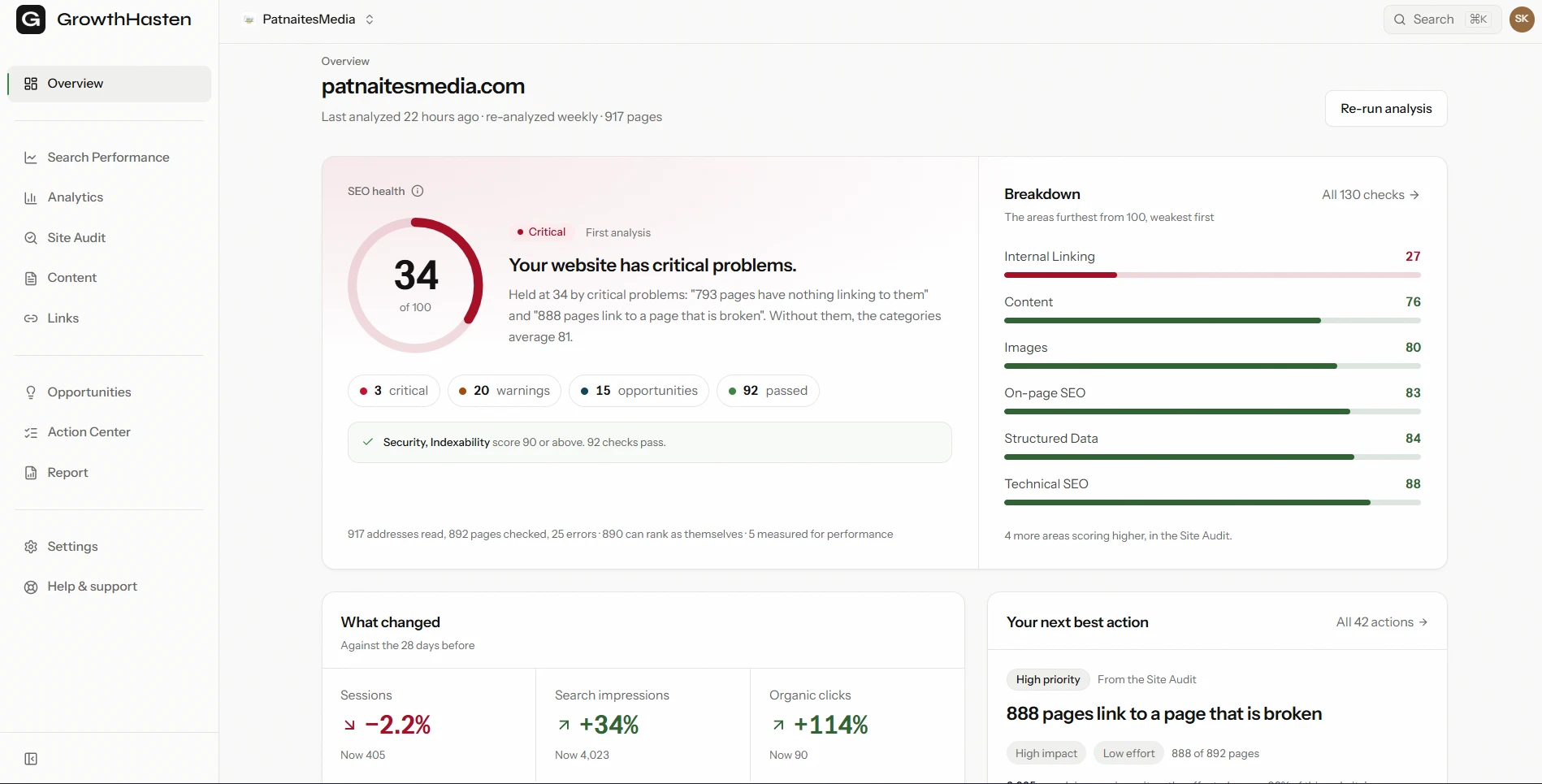
Underneath all five is one habit: linking is treated as a formatting decision made while writing, rather than an editorial one with consequences afterwards. Getting the outbound side right is a small part of the technical picture. GrowthHasten's Links section lists which other websites you link to, from how many pages, and whether those links still work.
The habit worth building is to check what a page links out to before you call it finished, and again whenever you refresh it. It takes a couple of minutes and it is the only thing standing between a well-sourced article and a well-sourced article full of dead citations. This week, open your three most-trafficked posts and check every outbound link on each one, separating the breaks from the redirects as you go.
Check Every Outbound Link on the Site
GrowthHasten's Links section lists which other websites you link to, from how many pages, and whether those links still work, alongside a map of your internal link graph. Nothing is written to your website.
Explore the Links SectionQuestions
Frequently asked questions
Do outbound links help SEO?
Not directly, or at least not in a way Google has confirmed. What they do reliably is make a page more useful and more credible, because a claim with a source behind it is easier to trust than one without. The stronger argument runs the other way: refusing to link out in order to avoid leaking link equity produces thin, unsourced pages, and that costs more than any theoretical saving.
Should external links be nofollow or dofollow?
Editorial links you genuinely endorse should be normal links with no attribute. Reserve rel=sponsored for paid and affiliate links, and rel=ugc for anything a user submitted, such as a comment or a forum post. Use rel=nofollow when you need to reference a source without endorsing it. Applying nofollow to every external link by reflex is a common mistake, and it wastes the only signal the attribute carries.
What is the difference between nofollow, sponsored and ugc?
They mark three different relationships. Sponsored says the link was paid for or is an affiliate link. Ugc says a user rather than the publisher put it there. Nofollow is the general marker for a link you are not vouching for. Since 2019 Google treats all three as hints rather than directives, which means it may still use them for crawling and indexing decisions rather than ignoring the target outright.
How many external links should a page have?
There is no threshold, and the question usually stands in for a different one. Link out wherever a specific claim needs a source and wherever a reader would genuinely want the original. A short guide might carry three; a research piece might carry twenty. What matters is that each link is earned by the sentence it sits in, not that the total lands under some number.
How do you find broken outbound links on a page?
Check the links themselves rather than trusting a site crawl, because many audit tools only report on internal links. Separate the two failure modes: a link returning 404 is broken and needs replacing or removing, while a link that redirects still works but points at a stale URL and should be updated to its destination. A page-level check when you publish, and again at each refresh, catches almost all of it.

Written by
GrowthHasten Team
Editorial Team, GrowthHasten
Articles from the GrowthHasten editorial team, grounded in primary research, our own testing, and what analyzing real websites shows, fact-checked in-house.
View profile