

Free SEO tools are the software you can use at no cost to research keywords, audit pages, monitor indexing, and measure organic performance. For a founder or in-house marketer running a business blog, the honest position is that the free stack covers almost everything a young blog needs, and paid tools buy speed and scale rather than access to ranking itself. This guide is written for people building a company blog on a SaaS or B2B product, not for hobby writers, and it groups tools by the job you are actually doing rather than dumping a list of twenty-four options on you. Every free-tier limit below was checked live, because caps and pricing drift constantly. What you get is a job-based decision matrix, a minimum starter stack in the order to adopt it, and the one area almost no other roundup covers: checking whether AI search engines cite you.
The short version
- Google's own tools (Search Console, Keyword Planner, Trends, PageSpeed Insights) are the non-negotiable base, and none of them cost anything.
- Paid tools mostly sell speed, scale, and competitor data. The free tier of each is usually enough until your blog genuinely outgrows it.
- You need five jobs covered, not twenty-four tools installed. Coverage beats collection.
- The newest free frontier is AI-search visibility: checking whether ChatGPT, Perplexity, and Google's AI Overviews quote your pages. No paywall gates it yet.
Do you really need paid SEO tools to rank a blog?
No, not for most blogs. The parts of SEO that decide whether you rank, understanding what people search, publishing pages that answer it, getting those pages indexed, and reading how they perform, are all covered by free tools. Google gives away the ones that matter most, because it wants site owners feeding it clean, crawlable content.
Paid tools are not a scam, though. They compress time and add scale. A subscription buys exact search volumes, historical rank tracking, large-scale crawls, and competitor keyword data you cannot pull for free. For a SaaS blog publishing two or three posts a week, none of that is load-bearing yet.
The useful way to think about it: free tools tell you what is true about your own site, and paid tools tell you what is true about everyone else's. Early on, your own site is the only thing you can act on.
What is the minimum free SEO stack, and which tool do you install first?
Five tools, adopted in order, cover a new blog end to end. Install them one at a time rather than all at once, because each one only becomes useful when you have work for it to do.
- Google Search Console, day one: verify your domain before you publish anything serious. It reports the real queries, clicks, impressions, and indexing status Google records for your site, and no third-party tool can replace it. Our Google Search Console guide walks through setup and the reports that matter.
- PageSpeed Insights, once your templates exist: run your homepage and one blog-post template through it to catch layout and loading problems before they scale across every post. No login, no cost.
- A free keyword tool, before you plan content: Google Keyword Planner and Google Trends together give you demand and seasonality for free. Add Ahrefs Webmaster Tools if you want difficulty and keyword ideas for your verified domain. Our guide on how to do keyword research shows how to turn those into a plan.
- A WordPress SEO plugin, if you are on WordPress: Rank Math or Yoast in their free versions handle titles, meta descriptions, and schema so every post ships with the basics correct.
- Screaming Frog free, once you pass twenty posts: crawl your own site to find broken links, missing titles, and orphaned pages. Below a few hundred URLs the free version is all you need.
If you install only one thing this week, make it Search Console. Everything else is easier to justify once you can see what Google already thinks of your pages.
Which free tool covers each SEO job? The decision matrix
SEO is not one task, it is five, and each has a free tool that does the job well enough to start. The matrix below is the working version: the job on the left, the free tool that covers it, what the free tier actually gives you, and the point where free stops being enough. Every limit here was verified against the tool's live pricing, not quoted from memory, because these numbers change.
| Job to be done | Free tool(s) | What the free tier gives you | Where free stops |
|---|---|---|---|
| Keyword research | Google Keyword Planner, Google Trends, Ahrefs Webmaster Tools, Ubersuggest | Keyword ideas, relative demand, and seasonality. Keyword Planner shows volume in ranges (for example 1K to 10K) without an active ad campaign. Ahrefs Webmaster Tools shows keyword data for your verified domain, up to 1,000 rows per view. | Exact monthly volumes, large exports, and deep difficulty scoring across competitor domains. |
| On-page optimization | Rank Math free, Yoast free, Google Rich Results Test | Title and meta editing, readability and keyword checks, and schema markup on every post. Rich Results Test confirms your structured data is valid before you publish. | Bulk content scoring, internal-link suggestions at scale, and multi-keyword tracking per page. |
| Technical and crawl | Screaming Frog free, Ahrefs Webmaster Tools Site Audit, PageSpeed Insights | Screaming Frog free crawls up to 500 URLs per crawl and PageSpeed Insights scores Core Web Vitals with no cap. For what each free audit tool reads before it stops, including Ahrefs Site Audit's monthly crawl allowance, see our comparison of free SEO audit tools. | Sites over 500 URLs in one pass, saved and scheduled crawls, JavaScript rendering, and API connections. |
| Analytics and Search Console | Google Search Console, Google Analytics 4, Bing Webmaster Tools | Real query, click, impression, and index-coverage data at no cost. GA4 adds traffic and engagement. Bing Webmaster Tools covers the same for Bing, and our guide to whether Bing SEO is worth the extra setup for a blog this size covers whether it's worth installing at all, and, indirectly, some AI engines. | GSC caps reports at 1,000 rows and 16 months of history. Longer retention and custom joins need a paid pipeline. |
| AI-search visibility | Manual checks in ChatGPT, Perplexity, and AI Overviews, plus GSC impressions | Query each engine for the questions your posts answer and see whether you are cited. Perplexity lists its sources inline, so it is the easiest to audit. GSC impressions flag pages already earning question-query visibility. | Automated tracking of AI citations across engines over time, which is where paid brand-monitoring tools begin. |
Read the matrix as a coverage check, not a shopping list. If all five jobs have a tool against them, you have a complete free stack. Adding a sixth keyword tool does not cover a new job, it just gives you a second opinion on one you already handle. Once the pages exist, our on-page SEO checklist covers turning those tool outputs into pages that actually satisfy the query.
Where does the free stack stop being enough?
At scale, competition, and speed, in that order. The free stack is built to tell you the truth about one site of modest size. It starts to strain when your blog crosses a few hundred URLs, when you need to see exactly which keywords a competitor ranks for, or when manual work that took ten minutes now needs to run across two hundred pages.
Three specific ceilings are worth naming. Screaming Frog's free crawl stops at 500 URLs, so a large content library needs the paid licence, a cloud crawler, or a free crawler with a higher page cap. Free keyword tools give ranges and ideas, not the exact volumes and full difficulty data a paid subscription provides. And no free tool tracks competitor rankings historically, which is the single most common reason a growing blog upgrades. Which one to reach for instead depends on how much of your site each free audit tool reads, which our comparison of free SEO audit tools sets out in full.
None of those ceilings block a young blog. The mistake is buying tools to solve problems you do not have yet. Upgrade when a specific limit is costing you real time each week, not before. The same goes for tools sold as AI-powered: which of their figures a model produced tells you more than the label does.
How do you check, for free, whether AI search cites your blog?
By asking the engines directly and reading Search Console, both at no cost. This is the row almost every other roundup skips, and it matters because AI Overviews, ChatGPT, and Perplexity now answer a growing share of the questions your posts target. There is no paywall on checking whether they use you.
Run a simple manual audit on a schedule:
- Query the engines with your target questions: type the exact questions your posts answer into ChatGPT, Perplexity, Gemini, and Google, then watch whether your domain appears in the answer or its sources. Perplexity is the most transparent because it lists sources beside every response.
- Read the AI Overview on Google: for question-shaped queries, Google often shows an AI Overview with sitelinks. If competitors are cited there and you are not, that is a concrete gap to close.
- Use Search Console to find candidates: pages already earning impressions on question queries are the ones closest to being quoted. Structure those first.
- Make the page quotable: lead each section with a direct answer, define terms plainly, and use tables. Engines lift self-contained, well-structured passages. Our guide on how to get cited by ChatGPT, Gemini and Perplexity covers the full method.
One honest addition to this section: if you draft with AI, the readability pass matters, because mechanical phrasing reads as generic to both people and engines. GrowthHasten's free AI Humanizer is a content tool, not a ranking tool, and it does exactly that pass. It rewrites AI-generated text to sound natural while keeping your meaning, links, and formatting intact, with no signup and a 12,000-character limit. It will not move your rankings on its own, but it makes an AI-assisted draft read like something a person wrote, which is the version worth publishing.
Writing With AI? Make It Sound Human.
Paste your draft into GrowthHasten's free AI Humanizer to strip the mechanical phrasing while keeping your meaning, links, and formatting. No signup, no cost.
Try the AI HumanizerWhich free SEO plugins should WordPress bloggers use?
Rank Math or Yoast, and for a new blog on the free tier, Rank Math gives you more. Both handle the on-page basics competently: editable titles and meta descriptions, XML sitemaps, and readability feedback. The gap shows in what each includes for free, and it is not close.
| Capability (free version) | Yoast SEO free | Rank Math free |
|---|---|---|
| Focus keywords per post | 1 | Up to 5 |
| Redirect manager | Not included | Included |
| 404 monitor | Not included | Included |
| Schema types | Core types | Broader set built in |
| Title and meta editing | Included | Included |
Rank Math ships redirect management, multiple focus keywords, and more schema at no cost, which is why it wins on the free tier for most new blogs. Yoast's counterargument is stability and a longer track record, and it is a genuinely safe default that many large sites still run. The honest read: if you are starting fresh, install Rank Math free; if you already run Yoast and it works, there is no urgent reason to switch. Whichever you pick, validate the output with Google's Rich Results Test before trusting the schema.
Which free SEO tools can you safely skip?
Anything that duplicates a job you already cover, and anything whose free tier is too thin to rely on. The point of the stack is coverage, so a second tool for the same job is a distraction, not an upgrade. A few honest trims for a new business blog:
- A second keyword tool: once Keyword Planner, Trends, and Ahrefs Webmaster Tools are in place, adding Ubersuggest changes little. Its free allowance has tightened over the years, so treat it as an occasional bonus rather than a foundation.
- Standalone rank trackers on the free tier: Search Console already shows your real average positions for free. A separate free tracker with a tiny keyword cap rarely adds enough to bother with.
- Question-idea generators, past the first pass: tools like AnswerThePublic are useful once to map question phrases, but their free tier allows only a limited number of daily searches, and Search Console plus the People Also Ask box cover the same ground for free.
- Anything you would check once a quarter: if a tool solves a problem you meet rarely, use it in a browser when the moment comes rather than adding it to your weekly routine.
Skipping tools is a feature, not a compromise. A stack of five you run weekly beats a folder of fifteen you opened once. A free report is also only as useful as the order you act on it in, which is what our list of common SEO mistakes, ranked by what each one costs sets out.
The habit worth building is a light, regular pass, not a one-time setup. Check Search Console weekly for new queries and coverage issues, run PageSpeed Insights and a Screaming Frog crawl monthly, and audit your AI-search citations once a month by querying the engines directly. That rhythm keeps a free stack working long after the novelty of installing it wears off. This week, verify your domain in Google Search Console and run URL Inspection on your three most important posts, then use what you learn to plan the next one with a clear head about how to write content that ranks.
See What Your Site Needs Fixed First
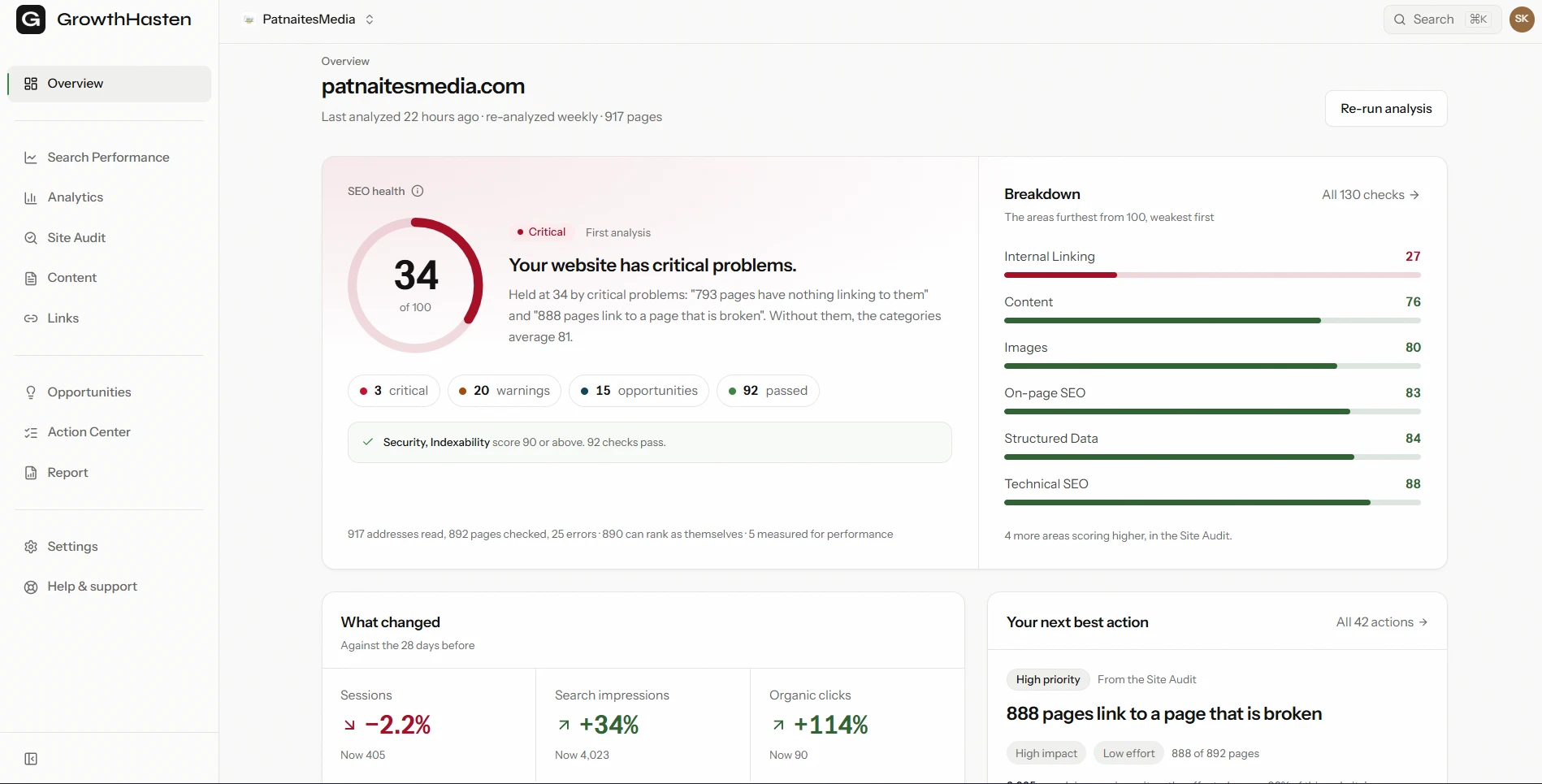
GrowthHasten is AI-native SEO software. It crawls your website, runs 130+ deterministic checks across 12 categories, and orders what it finds so the work worth doing first sits at the top. The free plan covers one website of up to 900 pages, with no card.
Analyze Your WebsiteQuestions
Frequently asked questions
Can you do SEO for free?
Yes, for most blogs. Google Search Console, Keyword Planner, Trends, and PageSpeed Insights cover discovery, keywords, and performance at no cost, and free tiers of tools like Ahrefs Webmaster Tools and Screaming Frog handle audits. Paid tools mainly buy speed, scale, and competitor data, not access to ranking itself. A young blog can run a complete program on free tools alone.
What is the best free SEO tool for bloggers?
Google Search Console, because it shows the real queries, clicks, and indexing status Google records for your site. No third-party tool can replace it, since the data comes straight from Google. Pair it with a free keyword tool such as Keyword Planner and with PageSpeed Insights, and you have a working base that covers discovery, demand, and performance without spending anything.
Which free tool is best for keyword research?
For a starting blog, Google Keyword Planner and Google Trends are free and reliable for demand and seasonality, while the free tier of Ahrefs Webmaster Tools adds keyword ideas and difficulty for your verified domain. Keyword Planner shows volume in ranges rather than exact numbers without an active ad campaign. Each free tool caps lookups, which is the main reason people eventually upgrade.
Are free SEO tools good enough for a small blog?
For a blog publishing a few posts a week, yes. The free stack covers keyword research, on-page checks, technical audits, and analytics. You outgrow it when you need large-scale crawls above 500 URLs, historical rank tracking, or competitor gap analysis. Until then, buying tools mostly solves problems a small blog does not have yet, so upgrade only when a specific limit costs you real time.
What free tools help you show up in AI search?
There is no paid gate here. You can check ChatGPT, Perplexity, and Google AI Overviews manually for your target questions, use Search Console to see which pages already earn impressions, and structure content to be quotable with clear answers and tables. The visibility comes from well-structured, self-contained answers more than from any tool, so the work is editorial rather than a purchase.

Written by
GrowthHasten Team
Editorial Team, GrowthHasten
Articles from the GrowthHasten editorial team, grounded in primary research, our own testing, and what analyzing real websites shows, fact-checked in-house.
View profile