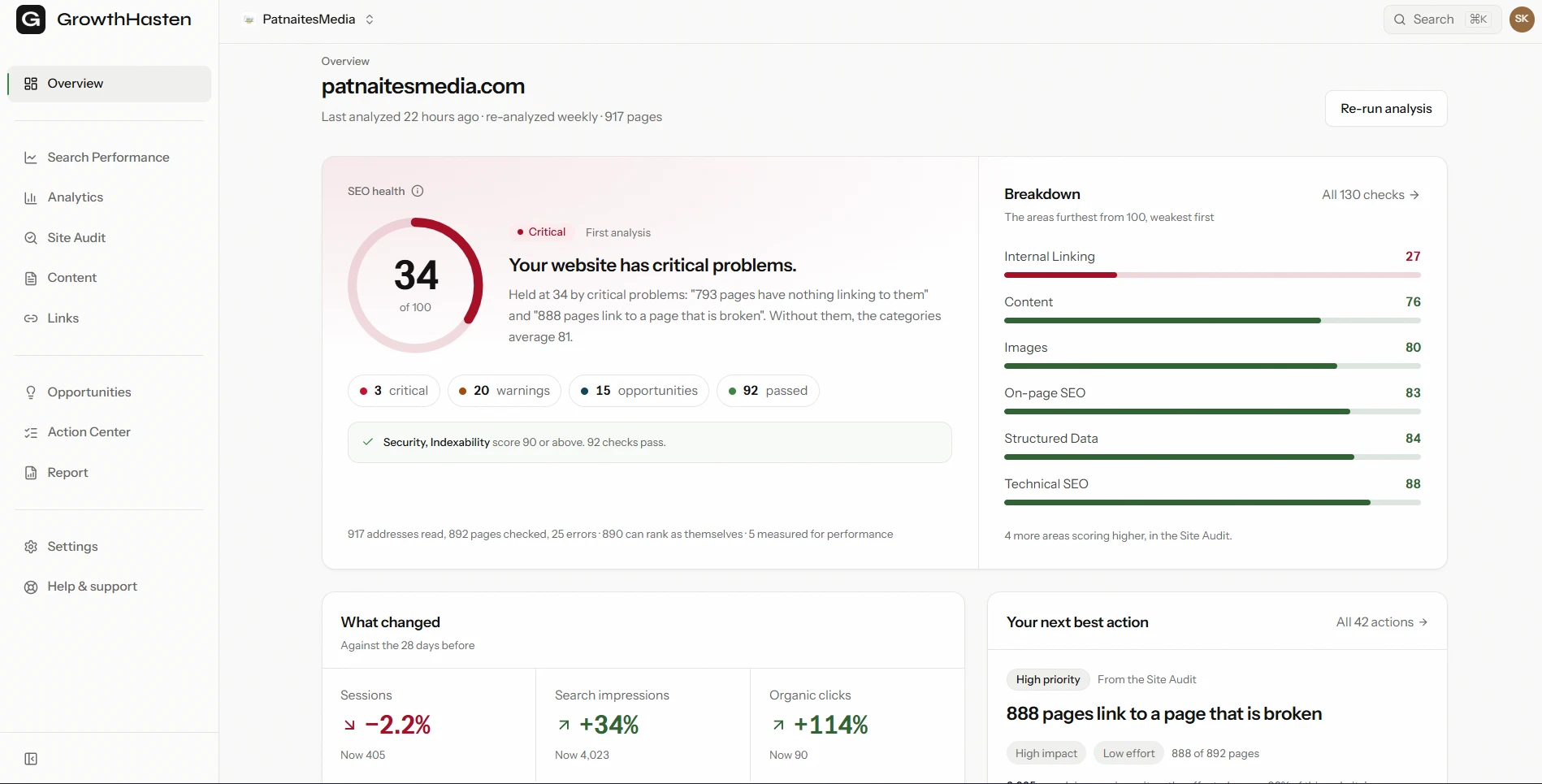


An SEO audit checklist is the reference list of checks you work through to find what is limiting a site's organic performance, grouped by layer and ordered by consequence. It is a different object from the audit itself: the audit is a process you learn once, the checklist is a document you reopen every quarter and hand to someone else. This one is written for the person who owns organic outcomes at a SaaS or B2B company and has more findings available than engineering hours to spend on them. It covers six layers, three time budgets, and the checks most sites should deliberately not run.
The short version
- A checklist you cannot finish is not a checklist. Pick a time budget before you pick checks, because the tier decides the list, not the other way around.
- Most findings never touch rankings. The order is the product; the list of checks is raw material anyone can copy.
- Six layers, always in this order: crawling and indexing, on-page, content, links, competitors, AI readiness. Work spent on a layer above a broken one is wasted.
- The skip list matters as much as the check list.
hreflang, crawl-budget tuning and disavow work are wrong for most sites under a few thousand URLs.- Every check needs a named owner. A checklist nobody is assigned to is a document, not a job.
What is an SEO audit checklist, and how is it different from an audit?
The audit is the process, the checklist is the artifact. An SEO audit is a structured investigation with a goal, a scope and a report at the end, and our guide to how to run the audit itself walks through that sequence. A checklist is what you work from once you have decided to do the work: a flat set of verifiable questions, each with a yes or no answer and a tool that produces it. You read an audit guide once. You reopen a checklist every quarter and hand the untickable items to a developer.
Six layers cover everything worth checking, and the order is fixed:
- Crawling and indexing: can search engines reach the page and store it?
- On-page: does the page match the query it targets?
- Content: does the page still deserve to exist, and is anything else on the site competing with it?
- Links: does anything point at it, internally and externally?
- Competitors: what do the pages that outrank it have that it does not?
- AI readiness: can an answer engine lift a clean answer out of it?
Each layer assumes the one above it works. Rewriting a title tag on a page carrying an accidental noindex is effort spent on a page that cannot rank at any quality level, which is why every tier below starts at layer one and stops the moment it finds something broken there.
How much time do you have? Pick the tier first.
Decide the time budget before you open a tool, then take the tier that fits it. In my experience, the audits that get finished are the ones that were scoped to a time budget before anyone opened a crawler, and the ones that die are the ones that started with an intention to check everything.
| Tier | Time and scope | What it catches |
|---|---|---|
| The 30-minute pass | About 12 checks, on your five to ten most commercially important pages | Disasters. Deindexing, broken canonicals, blocked crawling, content that never renders, mobile parity failures |
| The half-day pass | About 40 checks, site-wide, with a crawler plus Search Console | The above, plus intent mismatches, content decay, cannibalization, internal link gaps and real-user performance |
| The full audit | All six layers, no page-count limit, a week or more on a large site | The above, plus backlink health, competitor gaps, structured data coverage and AI extractability |
Be honest about what each tier cannot see. The 30-minute pass will happily return all-clear on a site that is technically perfect and commercially invisible. The half-day pass misses the off-site picture, so it cannot explain why a competitor with a worse page outranks you. The full audit sees everything and costs the most, which is why running it monthly is a mistake; what an SEO audit costs when you buy one shows how steeply scope drives the price. Free tools add a cap of their own on top of the tier, and our comparison of free SEO audit tools lists how many pages each one reads before it stops.
The 30-minute pass: the twelve checks that catch most disasters
Twelve checks, all inside the first two layers, run on your most important pages rather than site-wide. This tier answers one question: is anything catastrophically broken right now?
- Is the page actually indexed: run URL Inspection in Search Console on each priority URL. Google reports its own verdict and the reason for any exclusion, which no third-party tool can do. Owner: marketer.
- Does the canonical point where you expect: compare the declared canonical against the Google-selected canonical in URL Inspection. A mismatch means Google is ranking a different URL than the one you are optimizing. Owner: marketer.
- Is there a stray
noindex: check the renderedmeta robotstag and theX-Robots-Tagheader, not just the source. Staging directives that survive a deploy are the most expensive one-line bug in SEO. Owner: either. - Does
robots.txtblock anything you need crawled: read the file and test priority paths. Blocking a path also stops Google seeing anynoindexthere, so the two directives interact badly. Owner: either. - Do priority pages return
200: request each URL and follow the chain. A page that quietly became a302to the homepage still looks fine in a browser. Owner: either. - Does the primary content render without JavaScript: view the rendered HTML in URL Inspection and confirm your main copy and links are present. Content that appears only after a client-side fetch is at risk. Owner: developer.
- Does the mobile version match desktop: compare the two directly, since Google indexes mobile-first. Collapsed sections are fine; content absent from the mobile DOM is not. Owner: either.
- Does
sitemap.xmllist only canonical, indexable URLs: open it and spot-check. A sitemap full of redirects and noindexed URLs degrades a discovery signal you control. Owner: either. - Is the sitemap referenced and submitted: confirm it is declared in
robots.txtand submitted in Search Console. URL Inspection reports whether a URL is referenced by a sitemap at all. Owner: marketer. - Does HTTPS serve everywhere: confirm a valid certificate and a
301fromHTTP. Mixed-protocol internal links quietly add a redirect hop to every crawl. Owner: developer. - Has any priority page lost impressions in 28 days: compare the period against the previous one in the Search Console performance report. Impressions fall before clicks do, so this is the earliest warning you get. Owner: marketer.
- Do titles match the query they target: read the title against the current SERP. If every result is a comparison and your title promises a sales page, the mismatch is upstream of anything technical. Owner: marketer.
Anything that fails here stops the pass. Fix it, confirm with a live test, then continue. Google's Search Essentials sets the baseline these checks measure against, and its documentation on the URL Inspection tool explains what each indexing verdict means.
Want the First Tier Run for You?
GrowthHasten's Site Audit crawls your site and returns a prioritized fix list across technical SEO, indexability, on-page, links, structured data, performance and AI crawler access. It runs this tier in one pass. Free plan, no card.
Explore the Site AuditThe half-day pass: what to add when the basics are clean
Four groups, added on top of the twelve and run site-wide. This is the tier most teams should default to quarterly, and it is where a checklist starts finding problems you did not already suspect.
Indexing at scale: compare crawled pages against indexed pages and account for the gap. Read the Search Console Pages report for the largest exclusion reasons. Find pages indexed that should not be: tag archives, filtered URLs, internal search results, paginated duplicates. Confirm no important section is orphaned. Check for redirect chains longer than one hop, soft 404s, and parameter URLs multiplying without canonical control.
On-page at scale: pull every indexable URL's title, meta description, H1 and word count from a crawl. Flag duplicate titles, duplicate H1s, missing meta descriptions and pages carrying more than one H1. Check that headings describe the content under them. Verify each page targets one intent and that the intent matches what currently ranks. Confirm images on commercial pages carry alt text. Our on-page SEO checklist is the per-page version of this group.
Content decay and duplication: list pages that ranked and slipped, using a period-over-period comparison in Search Console. Flag pages below your thin-content threshold. Find queries where two or more of your URLs both appear, which is how keyword cannibalization surfaces before it costs you anything. Identify pages whose facts, screenshots or tool references have gone stale. A structured content audit is the deeper version when the inventory is large.
Performance on real users: check Core Web Vitals field data rather than lab scores, because field data is what Google uses. The documented thresholds are 2.5s or less for LCP, 200ms or less for INP, and 0.1 or less for CLS, assessed at the 75th percentile of page loads segmented across mobile and desktop. Group failing URLs by template, not by page, since one template fix usually clears many URLs. Our Core Web Vitals guide covers diagnosing each metric.
The full audit: the complete checklist, layer by layer
The full tier adds three layers the shorter passes leave out and completes the three they cover partially. Each layer has a deeper node on this site, so the checks are listed and the mechanics linked rather than re-explained.
Layer 1: Crawling and indexing
Decides whether anything else matters. Beyond the half-day items, add log file analysis, an hreflang validation pass if you serve multiple markets, a review of how faceted URLs are controlled, a check that 410 is used for permanently removed content, and confirmation that the CDN is not rate-limiting Googlebot. Our technical SEO checklist is the complete version of this layer.
Layer 2: On-page and intent match
Decides whether each page earns the query it targets. Add a template-level review of heading structure, internal anchor text judged on descriptiveness rather than volume, URL structure checked for consistency, and a pass on whether commercial pages sit deeper from the homepage than they should.
Layer 3: Content quality and inventory
Sorts every URL into keep, improve, consolidate or remove. Add a gap analysis against the questions your buyers actually ask, a consolidation plan for cannibalizing pairs with the 301 direction already decided, and a decision on every thin page rather than a flag. The decision is the deliverable here, not the list.
Layer 4: Backlinks and profile health
Tells you whether external authority is a constraint or a distraction. Check referring domains rather than raw counts, look for lost links from pages that used to send equity, find broken inbound links pointing at 404s that could be redirected, and confirm there is no manual action in Search Console.
Layer 5: Competitor benchmarking
Converts an internal review into a relative one. Identify keywords competitors rank for and you do not, compare depth and structure on the pages that outrank you, and check update dates on the results holding position one. A structured competitor analysis for SEO covers the method. The output is a short list of specific gaps, not a spreadsheet.
Layer 6: AI-search readiness
Asks whether an answer engine can extract a clean answer and attribute it to you. Confirm crawlers such as OAI-SearchBot and Google-Extended are not blocked in robots.txt, that each section answers its heading in the first sentence, that key answers ship in the server-rendered HTML, and that JSON-LD follows the Schema.org vocabulary and matches visible content. Our AI SEO audit runs the full check. Ranking and extraction are separate jobs, and a page can do the first well and the second badly.
Which checks should you deliberately skip?
Six of them, for most sites under a few thousand URLs. During our technical audits, the checks that most often turn out to be wasted effort are the ones borrowed from enterprise checklists by sites that are nothing like enterprises. Each skip names the site profile it applies to and the point at which it stops being true, because "skip it" without a threshold is just a different kind of bad advice.
- Skip
hreflangunless you serve different content by language or region: a single-market site has nothing for it to disambiguate, and a partial implementation creates errors where none existed. It becomes real the moment you publish a second language version or a country-specific variant. - Skip crawl-budget tuning below a few thousand URLs: Google will find and recrawl a small site without help, and these levers cost developer time to move a number that is not constraining you. It becomes real when your crawled-versus-indexed gap is large and growing, or when new pages take weeks to appear.
- Skip faceted-navigation controls if you have no facets: content sites and most B2B SaaS marketing sites generate no filter combinations at all. This check belongs to e-commerce and large directories, and it is among the most commonly copied items in checklists where it has no referent.
- Skip disavow work without a manual action or a clear paid-link pattern: Google says it can usually assess which links to trust without extra guidance, so disavowing rarely changes anything on its own. It becomes real when there is an actual manual action, or when you inherited a documented link-buying history, and our guide to deciding whether disavowing is worth doing at all covers how to tell.
- Skip micro-optimizing Core Web Vitals already inside the good range: moving LCP from
2.1sto1.8swhen the documented threshold is2.5sbuys nothing in ranking terms and costs a sprint. Spend that time on templates failing outright. It becomes real when a metric sits close to the threshold and your traffic is mobile-heavy on slow connections. - Skip full log file analysis until crawl behavior is genuinely a question: it needs server access, a parser and someone who can read the output, and on a small site it mostly confirms what Search Console already told you. It becomes real above roughly ten thousand URLs, or wherever whole sections are not being crawled and nobody knows why.
A seventh item is less a skip than a warning. Chasing on-page scores from content-optimization tools, the ones that grade a page out of a hundred, is easy to mistake for auditing. Those scores measure similarity to pages that already rank, not whether your page is correct, and a checklist that treats them as findings produces work with no ceiling. The headline number at the top of a site audit report has a different flaw: what a site-level SEO score really counts is the tool's own checklist, not the site's health.
Who runs which check: marketer, developer, or either?
A marketer can run most of this alone. The split matters because an unassigned checklist stalls at the first item that needs someone else, and that delay is usually procedural rather than technical.
| Check group | Owner | Why it lands there |
|---|---|---|
| Indexing status, canonicals, sitemap contents, Search Console reports | Marketer | All of it runs in a browser against tools the marketer already has |
| Titles, headings, intent match, content decay, cannibalization, competitor gaps | Marketer | Editorial judgments, not implementation questions |
| Backlink profile, manual actions, link opportunities | Marketer | Read-only analysis in a backlink tool and Search Console |
Rendering, server response time, redirect logic, robots.txt, X-Robots-Tag | Developer | Each needs repository or server access, and a wrong edit is site-wide |
Core Web Vitals fixes, template changes, JSON-LD implementation | Developer | Diagnosis is shared; the fix is always a code change |
| Mobile parity, HTTPS coverage, status codes, alt text | Either | A marketer can detect all four; only some of the fixes need a developer |
Diagnosis and repair have different owners more often than checklists admit. A marketer can prove a page does not render without JavaScript in two minutes; only a developer can change that. Write the owner next to the finding rather than next to the check, and the handover stops being a negotiation. Where the team is too small for the split to be obvious, decide it explicitly before the first audit runs.
How do you turn a finished checklist into a plan?
Score each finding on impact and effort, then sequence; the scoring model for ranking audit fixes walks through the arithmetic. A completed checklist is an inventory of problems, and an inventory is not a plan until somebody has decided what not to do this quarter.
The severity framework, meaning the four tiers and the timeframe each deserves, is set out in the SEO audit guide rather than repeated here. What the checklist stage adds is a discipline about grouping: fixes sharing a template, a redirect rule or a content decision should ship together, because review and deploy overhead is usually larger than the fix. Ten title rewrites on one template is one ticket, not ten.
How often should you run it?
Monthly, quarterly and twice a year, in that order by tier. Cadence turns an audit from a rescue operation into maintenance, and the reason to schedule it is that the failures this checklist catches stay silent until they are expensive.
| Tier | Cadence | Also run it after |
|---|---|---|
| The 30-minute pass | Monthly | Any deploy touching templates, routing or robots.txt |
| The half-day pass | Quarterly | A migration, a redesign, or a confirmed ranking drop |
| The full audit | Once or twice a year | Inheriting a site, a replatform, or a change of SEO ownership |
Migrations and redesigns are the highest-risk events here and the most often skipped, because the team that shipped them has already moved on. Accidental noindex tags, dropped canonicals and lost internal links appear at exactly those moments. When the audit needs to run as an ongoing program rather than an occasional project, GrowthHasten's Site Audit keeps every analysis and compares each one with the last, rule by rule.
The habit worth building is scheduling the 30-minute pass rather than waiting for a traffic drop to trigger it. Every check in that tier answers a question you would otherwise only ask after something had already gone wrong. This week, run those twelve checks on your five most commercially important pages, write the owner next to anything that fails, and do nothing else until those are clear.
Turn the Checklist Into a Queue
GrowthHasten runs 130+ deterministic checks across your website and puts every recommendation in one queue, ordered by priority. Mark a fix done and the next analysis re-reads the page to check it. Free plan, no card.
Analyze Your WebsiteQuestions
Frequently asked questions
What is included in an SEO audit?
A complete SEO audit covers six layers: crawling and indexing, on-page elements, content quality and decay, backlink profile health, competitor benchmarking, and AI-search readiness. The order matters more than the coverage, because a page search engines cannot reach or store will not rank regardless of how good its content is. Work down from access to experience, and stop to fix anything that blocks crawling before continuing.
How long should an SEO audit take?
It depends entirely on the tier you are running. A focused pass over crawling, indexing and your most important pages takes about thirty minutes. A half-day pass adds on-page checks, content decay and Core Web Vitals field data. A full audit across all six layers on a large site is a week of work or more. Set the tier before you start, or the audit expands until nobody finishes it.
Which SEO audit checks can a small site skip?
Most sites under a few thousand URLs should skip hreflang entirely unless they genuinely publish different content by language or region, skip crawl-budget tuning, skip faceted-navigation controls if they have no facets, and skip disavow work unless there is a manual action or a clear paid-link pattern. Also skip micro-optimizing Core Web Vitals that already sit inside Google's good range. Each of these costs real time and returns nothing at that scale.
Do I need a developer to run an SEO audit?
Not for the whole thing. A marketer can run the majority of the checklist alone using Search Console, PageSpeed Insights and a crawler: indexing status, canonicals, titles, content decay, internal links and competitor gaps. A developer is needed for rendering problems, server response time, redirect logic, structured-data implementation and anything touching build configuration. Assigning an owner per check is what stops the audit stalling.
How often should you run an SEO audit checklist?
Run the thirty-minute pass monthly, a half-day pass quarterly, and a full audit once or twice a year. Beyond that schedule, re-run the short pass after any migration, redesign or template change, because those are when accidental noindex tags, broken canonicals and lost internal links appear. A scheduled audit finds problems before a traffic drop forces the issue.

Written by
GrowthHasten Team
Editorial Team, GrowthHasten
Articles from the GrowthHasten editorial team, grounded in primary research, our own testing, and what analyzing real websites shows, fact-checked in-house.
View profile