
An AI SEO audit is a readiness check for AI answer engines: it tells you whether ChatGPT, Google AI Overviews, Perplexity, Gemini, and Claude can crawl, parse, trust, and extract your page, rather than where that page ranks in blue links. If your team keeps hearing "ChatGPT never mentions us" or watching Gemini recommend a competitor, the cause is almost always one of a handful of boring, fixable problems on your own pages. This guide gives you a 7-point audit you can run by hand, the reason each check matters to a language model, and the specific fix. It also shows where an automated audit picks up the same signals, so you can shortcut the manual pass when you want to.
The short version
- An AI SEO audit checks whether engines can crawl, parse, trust, and extract your page, not where you rank. A page can rank on page one of Google and still be unreadable to an answer engine.
- Most failures are dull, not exotic: blocked AI crawlers, answers buried under setup, weak entity signals, and missing or invalid structured data.
- You can run the audit by hand with the 7 checks below, or automate the scoring with a free tool.
- Readiness is upstream of visibility. Fix the page first, then track whether mentions actually appear.
What is an AI SEO audit, and how is it different from a normal SEO audit?
A normal SEO audit optimizes for ranking. An AI SEO audit optimizes for extraction. They share a foundation, and then they diverge on what "good" means.
A classic audit asks whether Google can crawl and index the page, whether the title and headings target the query, whether the page is fast, and whether links pass authority to it. An AI audit keeps all of that and adds a second question: once the content is retrieved, can a language model lift a clean, correct answer out of it and attribute that answer to you? Ranking is about being found. Extraction is about being usable once found.
The mental model I use is four verbs in order: crawl, parse, trust, extract. An answer engine has to fetch the page, read the structure, decide the source is credible, and then pull a self-contained passage it can quote. A normal audit lives mostly in the first verb. An AI audit is graded on all four.
| Dimension | Normal SEO audit | AI SEO audit |
|---|---|---|
| Goal | Rank in the blue links | Get parsed, trusted, and quoted by answer engines |
| Crawl check | Googlebot access | Googlebot plus AI user agents like OAI-SearchBot and Google-Extended |
| Content check | Keyword coverage, depth, uniqueness | Answer-first passages, question coverage, extractable size |
| Structure check | Headings for readability and keywords | Headings as retrieval anchors that name the answer |
| Trust check | Backlinks, E-E-A-T signals | Entity clarity plus valid structured data |
| Outcome | Position and traffic | Whether an engine can cite you accurately |
Why do AI engines ignore pages that rank fine in Google?
Because ranking and extraction are different jobs, and a page can pass one while failing the other. Answer engines built on retrieval do not read your page the way a human scrolls it. They fetch it, split it into passages, and pull the chunk that most cleanly matches the question. If your best answer is three paragraphs of context followed by the actual point, a human forgives you and a retrieval system skips you.
This is the extractability gap, and it is where most "invisible in AI search" complaints actually live. The page ranks because it is comprehensive and well-linked. It gets ignored by the engine because the answer is buried, the headings describe nothing, the brand entity is fuzzy, or the whole thing renders client-side and the crawler saw an empty shell. None of those hurt a Google ranking much. All of them break extraction.
There is also a plain access problem hiding underneath. Google's own documentation on AI features notes that snippet controls such as nosnippet, max-snippet, and noindex limit how your content can appear in AI experiences, and third-party engines respect a separate set of crawler rules entirely. A robots line written years ago can quietly keep you out of ChatGPT search today.
What does the 7-point AI Search Readiness Audit check?
Seven signals, each with a plain pass or fail test, the reason it matters to a language model, and the fix. Run them top to bottom, because the order is also the dependency order: a page the crawler cannot reach makes every check below it irrelevant.
In the AI-search audits we run, the first failure is almost always access, not content. Teams assume their writing is the problem and start rewriting, when the real issue is a robots.txt rule or a rendering choice that stopped the engine at the door.
| # | Signal | The pass/fail test | Why it matters to an LLM | The fix |
|---|---|---|---|---|
| 1 | AI crawl access | Can AI bots fetch the page? Check robots.txt for OAI-SearchBot, GPTBot, PerplexityBot, and Google-Extended, and confirm the page returns 200 with no stray noindex. | If the crawler is blocked, nothing else matters. The engine never sees the page. | Allow the AI user agents you want; remove leftover noindex and nosnippet tags. |
| 2 | Answerability | Does the opening answer the question in the first two sentences, before backstory and setup? | Retrieval rewards passages that state the answer plainly. A buried answer gets skipped. | Move the direct answer to the top of each section. Lead, do not warm up. |
| 3 | Heading clarity | Do headings describe the content ("How to allow AI crawlers") instead of labeling it ("Overview")? | Engines use headings to locate the passage that answers a question. Vague headings hide it. | Rewrite headings as the questions readers actually ask. |
| 4 | Question coverage | Does the page address the specific questions a buyer would ask, each in a self-contained block? | Models assemble answers from passages that match a question closely, so uncovered questions default to a competitor. | Add the real questions from People Also Ask and answer each in 40 to 90 words. |
| 5 | Entity clarity | Is it obvious who you are and what the subject is, without the reader inferring it? Consistent naming, defined terms. | Engines attribute content to entities they recognize. A fuzzy entity is hard to credit or cite. | Define terms on first use, keep brand naming consistent, and strengthen your entity signals. |
| 6 | Extractability | Are passages a quotable size, in plain HTML, not hidden behind tabs, images, or client-side rendering? | If the answer appears only after JavaScript runs, or lives inside an image, the parser can miss it. | Serve key content in the initial HTML, keep passages self-contained, and use lists and tables. |
| 7 | Structured-data validity | Does the page carry valid, relevant JSON-LD that passes a structured-data test? | Schema helps machines read the page precisely and reinforces which entity the page is about. | Add accurate Article, FAQ, or Organization schema, then validate and clear every error. |
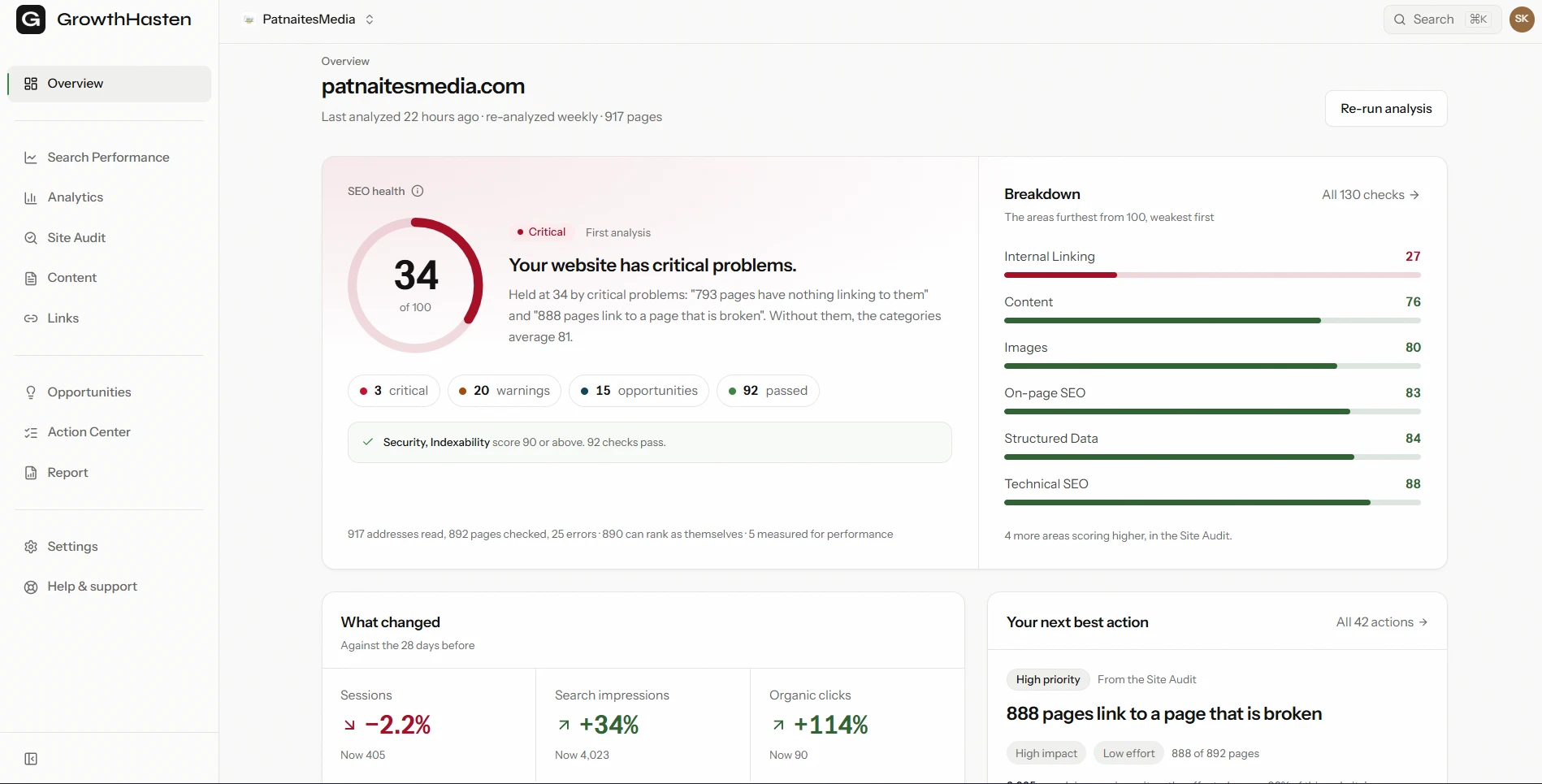
An automated crawler can score part of the same ground. GrowthHasten's Site Audit, for example, checks crawl access in its AI Accessibility category, which tests whether robots.txt lets the crawlers behind ChatGPT, Claude, Perplexity and Google's AI answers fetch your pages, and JSON-LD validity in its structured-data checks. The middle five signals (answerability, heading clarity, question coverage, entity clarity, and extractability) still need a person reading the page. Manual or automated, the seven questions are the same.
Want the Crawl Checks Run for You?
GrowthHasten's Site Audit runs the crawl-access and structured-data checks on this list across every page, with an AI Accessibility category for the crawlers behind ChatGPT, Claude, Perplexity and Google's AI answers. The answerability signals still need a person reading the page.
Explore the Site AuditHow do you run the 7 checks by hand, without a paid tool?
Every check has a free method, and most take a browser tab and a minute. Here is the self-serve version of each.
- AI crawl access: open
yoursite.com/robots.txtin a browser and search it forOAI-SearchBot,GPTBot,ChatGPT-User,PerplexityBot, andGoogle-Extended. Then view the page source and look fornoindexornosnippetin the meta robots tag. A blocked agent or a straynoindexis your first fail. - Answerability: read the first two sentences after each heading out loud. If they introduce the topic instead of answering it, mark the section down.
- Heading clarity: collapse the page to its headings only. If a stranger could not guess the answers from the headings alone, they are labels, not anchors.
- Question coverage: write the ten questions your buyer asks before purchase, then check that each has a passage that answers it directly.
- Entity clarity: ask an engine "what is [your brand]" and "what does [your brand] do." If it hedges or invents, your entity is thin.
- Extractability: view the page source, or disable JavaScript, and confirm your key answers are still in the raw HTML rather than injected after load.
- Structured-data validity: paste the URL into Google's Rich Results Test and read the errors and warnings.
Score each check pass or fail and write the fails in priority order. That list is your remediation plan, and it is the same output an automated tool hands you, minus the crawl of every page at once. If the tool folds the seven results into one percentage instead, read how to interpret a single audit percentage before comparing it with a rival tool's figure.
How do you fix the failures the audit surfaces?
Fix in dependency order: access first, then answers and structure, then entities and schema. Polishing extractability on a page the crawler cannot reach is wasted effort.
Step 1. Restore access: unblock the AI user agents you want in robots.txt, remove any leftover noindex or nosnippet, and confirm the important content ships in the server-rendered HTML rather than appearing only after JavaScript runs, which can leave the crawler looking at an empty shell.
Step 2. Fix answers and structure: rewrite each section so the first sentence answers its heading, turn vague headings into the questions people ask, and add self-contained passages for the questions you currently skip. This is the highest-leverage work, because it improves both extraction and human readability at once.
Step 3. Strengthen entities and schema: define your terms, keep brand naming consistent across the site, and add valid JSON-LD. Our guide to building a clear brand entity and our walkthrough of structured data with JSON-LD cover the two halves of this step, and your off-site brand mention footprint is worth auditing alongside them, since engines read a mention exactly as well as a link when they judge whether an entity is real. Then validate the markup and clear the errors, because invalid schema helps nothing.
One limit worth stating: not every fix is worth doing on every page. Reserve the full seven-check pass for pages with real commercial intent. A thin utility page does not need entity work or FAQ schema, and forcing it there is over-optimization, not readiness.
Does schema markup actually help with AI search?
It helps machines read your page precisely, but it is not a ranking or citation switch. Valid, relevant JSON-LD makes your entities and relationships explicit, which supports extraction and attribution. It does not buy you a mention on its own.
Be careful with the myth that AI search needs special files. Google states plainly that you do not need to create new machine-readable files, AI-specific text files, or extra markup to appear in its AI features, and that standard SEO fundamentals are enough. That includes the llms.txt proposal you may have seen promoted: it is unofficial, unproven, and not something Google asks for. Treat schema as a way to be read accurately, not as a lever that forces engines to quote you.
Where schema earns its place is precision. Article and FAQ schema map your content to a structure engines already understand, and Organization schema ties a page back to a defined entity. That is a readiness signal, and it is exactly why check 7 asks only that your schema be valid and relevant, not that you bury the page in every type you can find.
How is auditing readiness different from tracking AI visibility?
Readiness is the on-page diagnosis. Visibility is the outside measurement. This audit tells you whether your page can be parsed, trusted, and quoted. It does not tell you whether an engine actually mentions you, and the two answer different questions at different moments.
Run the readiness audit before you optimize and before you hire, because it is the cheapest way to find the boring blockers first. Once the fixes ship, the job shifts to measurement: are the mentions appearing, for which prompts, and against which competitors. That is a monitoring exercise, and our guide to tracking your AI search visibility covers how to watch it over time. For the strategy that connects the two, our pillar on how to get cited by ChatGPT, Gemini and Perplexity sets out the full method, and if Google's answer surfaces are your priority, see our piece on how to rank in Google AI Overviews.
One nuance that trips teams up: blocking GPTBot keeps your content out of model training, but it does not remove you from ChatGPT search, which uses the separate OAI-SearchBot agent. OpenAI's crawler documentation lists each agent and what it controls. Decide training and search access on purpose, not by accident, which our guide to getting cited in ChatGPT works through in detail.
Which page should you audit first, and how do you know it worked?
Start with your single highest-intent page, not your homepage. The page that answers a buying question is the one an engine is most likely to be asked about, so it is where readiness pays back first. Run the seven checks, fix the fails in order, and ship.
You know the readiness work landed when the page passes all seven checks and the fixes hold in the rendered HTML, not just the draft. You know the visibility worked when mentions start appearing for your target prompts, which is a slower, external signal you track rather than audit. Keep the two apart in your reporting so you can tell a readiness problem from an authority problem. If you want the crawl-level checks run across the whole site, GrowthHasten's Site Audit includes an AI Accessibility category that checks whether robots.txt lets the main AI crawlers fetch your pages.
The habit worth building is simple: audit readiness before you chase mentions. Most teams do it backwards, spending months on visibility tracking while their best page quietly fails the crawl-access check. This week, run the 7 checks on your one highest-intent page and fix whatever fails first. It is an hour of work, and it is usually the hour that unblocks everything downstream.
See What Your Site Needs Fixed First
GrowthHasten is AI-native SEO software. It crawls your website, runs 130+ deterministic checks across 12 categories, and orders what it finds so the work worth doing first sits at the top. The free plan covers one website of up to 900 pages, with no card.
Analyze Your WebsiteQuestions
Frequently asked questions
What is an AI SEO audit?
An AI SEO audit checks whether AI answer engines can crawl, parse, trust, and extract your content, rather than where you rank in blue links. It scores signals like AI-crawler access, answer clarity, heading structure, entity signals, and structured-data validity, then tells you what to fix so engines like ChatGPT and Google AI Overviews can quote you accurately.
How is an AI SEO audit different from a regular SEO audit?
A regular audit optimizes for ranking; an AI audit optimizes for extraction. They share fundamentals like crawlability and structured data, but the AI audit adds checks specific to how language models retrieve and summarize content: answer-first passages, question coverage, entity clarity, and machine-readable formatting that a parser can lift cleanly.
Why doesn't ChatGPT mention my brand?
Usually because AI crawlers are blocked, your answer is buried below setup and preamble, your brand entity is weak, or your schema is missing or invalid. An AI SEO audit surfaces which of these applies so you fix the cause rather than the symptom. Access problems are the most common, and the easiest to miss.
Does schema markup help with AI search?
It helps machines read your page precisely, which supports extraction and entity understanding, but it is not a ranking or citation switch. Google states you do not need special AI markup to appear in its AI features. Treat valid, relevant JSON-LD as a readiness signal, not a guarantee that an engine will quote you.
Can I audit my site for AI search for free?
Yes. You can run the 7-point checklist in this guide by hand using your browser, robots.txt, page source, and Google's Rich Results Test. GrowthHasten's Site Audit automates the crawl-access and structured-data checks across a whole site on a free plan, though the answerability signals still need a person reading the page.

Written by
GrowthHasten Team
Editorial Team, GrowthHasten
Articles from the GrowthHasten editorial team, grounded in primary research, our own testing, and what analyzing real websites shows, fact-checked in-house.
View profile