

Indexed means Google has stored your page in its index and can show it in search results. It is not the same as crawled, which only means Googlebot fetched the page, and it is not the same as ranking, which means Google places the page for a query someone actually types. If you just published a page and want to confirm Google truly has it, this guide walks through four reliable checks, what each one proves, and what it quietly cannot. I learned to keep these three states separate the hard way: in July 2026, every publish check on this blog passed on 17 posts that Google had never crawled.
The short version
- A page sitting in your CMS as "published" is not proof Google has it. We had 17 posts pass every publish check while Google had never crawled a single one of them.
- URL Inspection in Google Search Console is the only method that returns Google's own verdict for one specific URL.
- The
site:operator is fast but approximate: it can miss pages that are indexed and keep showing pages that have since dropped out.- Indexed and ranking are different questions. Appearing in a
site:result tells you nothing about whether you rank for anything.
What does "indexed" actually mean?
Three separate states, and keeping them apart saves hours of guesswork. A page moves through a pipeline before it can earn traffic, and a check that answers one stage says nothing about the next.
- Crawled: Googlebot requested the URL and received the HTML. Crawling is permission to read, not a promise to store.
- Indexed: Google processed the page, decided it was worth keeping, and added it to the index. Only an indexed page is eligible to appear in results.
- Ranking: for a given query, Google places the indexed page somewhere in the results. Relevance and competition decide this, not indexing.
A page can be crawled and never indexed. It can be indexed and rank for nothing. The point of checking indexation is to confirm the middle stage, so you do not waste a month optimizing a page Google has not even stored.
Method 1: URL Inspection in Search Console (the authoritative check)
URL Inspection is the definitive answer, because it reads Google's own index record for the exact URL you paste. No other method sees what Google sees for a single page. Open the full Search Console guide if you have not set the property up yet; once you have, the check takes seconds.
- Step 1. Paste the full URL: drop the complete address into the inspection bar at the top of Search Console. Use the exact URL, including
https://and any trailing path. - Step 2. Read the headline verdict: "URL is on Google" means the page is indexed. "URL is not on Google" means it is not, and the panel below usually names the reason, from a
noindexdirective to "Crawled, currently not indexed." - Step 3. Understand the live test caveat: the headline reflects Google's stored verdict from the last crawl, not the page as it exists this second. "Test Live URL" checks whether the current page could be indexed, which is a different question from whether it is.
That distinction matters when you have just fixed something. A live test can report that the page is now eligible while the headline still says "not on Google," because Google has not recrawled yet. For the mechanics of the tool itself, Google's URL Inspection tool documentation is the primary reference.
When not to rely on it alone: URL Inspection answers one URL at a time. For a site with hundreds of pages, inspecting each one by hand is the wrong tool, and Method 3 is built for that job.
Method 2: The site: search operator (fast but approximate)
Fast, free, and never authoritative. Type site:example.com/your-page into Google and it returns indexed URLs that match. It is the quickest gut check, and the one most people overtrust.
The operator under-reports and over-reports at the same time. It can omit pages that are genuinely indexed, because the operator's coverage is incomplete and not guaranteed to surface every stored URL. It can also keep showing a page for a while after the page has dropped from the index, so a hit is not fresh proof. Treat site: as a cross-check that raises a flag, never as the verdict.
A useful pattern: run site:example.com with no path to get a rough count of how much of your domain Google holds, then confirm any specific page with URL Inspection. If site: shows the page and URL Inspection disagrees, believe URL Inspection.
Method 3: The Page Indexing report (bulk, with reasons)
This is how you check the whole site at once and learn why pages are missing. The Page Indexing report in Search Console groups every known URL by status, splitting them into indexed pages and pages that are not indexed, each bucket labeled with a reason.
The reasons are the valuable part. Common not-indexed statuses include:
- Crawled, currently not indexed: Googlebot read the page and declined to add it, typically a thin-content or duplication call. We go deep on this one in crawled, currently not indexed.
- Discovered, currently not indexed: Google has logged the URL but not yet fetched it, usually a crawl-budget or weak internal-linking symptom on larger sites.
- Excluded by "noindex" tag: a meta robots or header directive is telling Google to leave the page out, which is correct only if you intended it.
- Alternate page with proper canonical tag: Google is indexing a different URL you nominated as canonical, which is usually correct behavior.
For the full list of statuses and what each one means, Google's Page Indexing report documentation is the source to keep open. The report updates on Google's own schedule, so a fix you shipped today will not clear the report for days.
Method 4: Organic impressions (an indirect signal)
Impressions prove indexing; zero impressions prove nothing. If a page has recorded even one impression in the Search Performance report, Google indexed it, because an unindexed page cannot be shown for any query. That makes a single impression a reliable positive signal.
The reverse does not hold. A page with zero impressions might be indexed and simply never surfaced, because it ranks too low to be seen or targets queries nobody searches. So use impressions to confirm indexing quickly when the data is there, and fall back to URL Inspection when it is not. This is the softest of the four methods, and it belongs as corroboration rather than a primary test.
How do the four methods compare?
Each method answers a slightly different question and updates on a different clock. Pick by what you need to prove.
| Method | What it proves | What it cannot prove | How fast it updates |
|---|---|---|---|
| URL Inspection | Google's own index verdict for one URL, with the reason | Whether the page ranks; status of other pages | Reflects the last crawl; live test is on demand |
site: operator | That a URL is probably in the index right now | Reliable absence (misses indexed pages); ranking; freshness | Roughly real time, but approximate |
| Page Indexing report | Index status of every known URL, grouped by reason | The live state of a single URL this second | On Google's schedule, often days behind |
| Organic impressions | That a page is indexed (one impression is enough) | That a page is not indexed; its exact status | Updates daily, with a short processing lag |
In practice, URL Inspection settles any single page, the Page Indexing report covers the whole site, and site: plus impressions are fast corroboration you already have on hand.
Is the page indexed, ranking, or just discoverable?
These are three different questions, and most "my page is not indexed" panics are actually one of the other two. Walk the pipeline in order, and the right fix becomes obvious.
- Can Google discover it? Check that the page is linked from pages Google already indexes and appears in your XML sitemap. An orphaned page with no inbound internal links can sit undiscovered indefinitely. If discovery is the gap, add links from indexed pages first.
- Has Google indexed it? Run URL Inspection. If it comes back "Crawled, currently not indexed," the problem is perceived value or duplication, not discovery. If it is excluded by a directive, check for a stray noindex directive or a
robots.txtblock. - Does it rank? If the page is indexed but gets no impressions for its target terms, this is a relevance and competition problem. Indexing is done; the work is now on-page relevance and authority, not crawling.
Diagnosing the wrong stage is the most common waste of time here. A page that is indexed but ranking nowhere does not need a sitemap fix; it needs a better match to the query.
What should you do if the page is not indexed?
Work from the cheapest fix to the most expensive, and recheck after each. Most not-indexed pages fall to one of these, in this order.
- Indexability signals first: confirm the page does not carry a
noindexmeta tag or header, is not blocked inrobots.txt, and has a canonical tag that points to itself rather than another URL. A single wrong canonical hands your indexing to a different page. - Discovery second: add internal links from pages that are already indexed, and make sure the URL is in your sitemap. Internal links from indexed pages are the most reliable way to speed up discovery, more dependable than resubmitting a sitemap.
- Quality third: if the status is "Crawled, currently not indexed," Google saw the page and passed. Thin content, near-duplicate pages, and low perceived value all trigger this. Strengthening the page is the only real fix.
- Then request indexing: use "Request Indexing" in URL Inspection once the page is genuinely ready. It prompts a recrawl rather than forcing one, and firing it repeatedly at a weak page changes nothing.
If you want the full technical sweep rather than a single-page fix, you can run a full SEO audit to catch the indexability issues that repeat across a site.
How do you check the whole site at once?
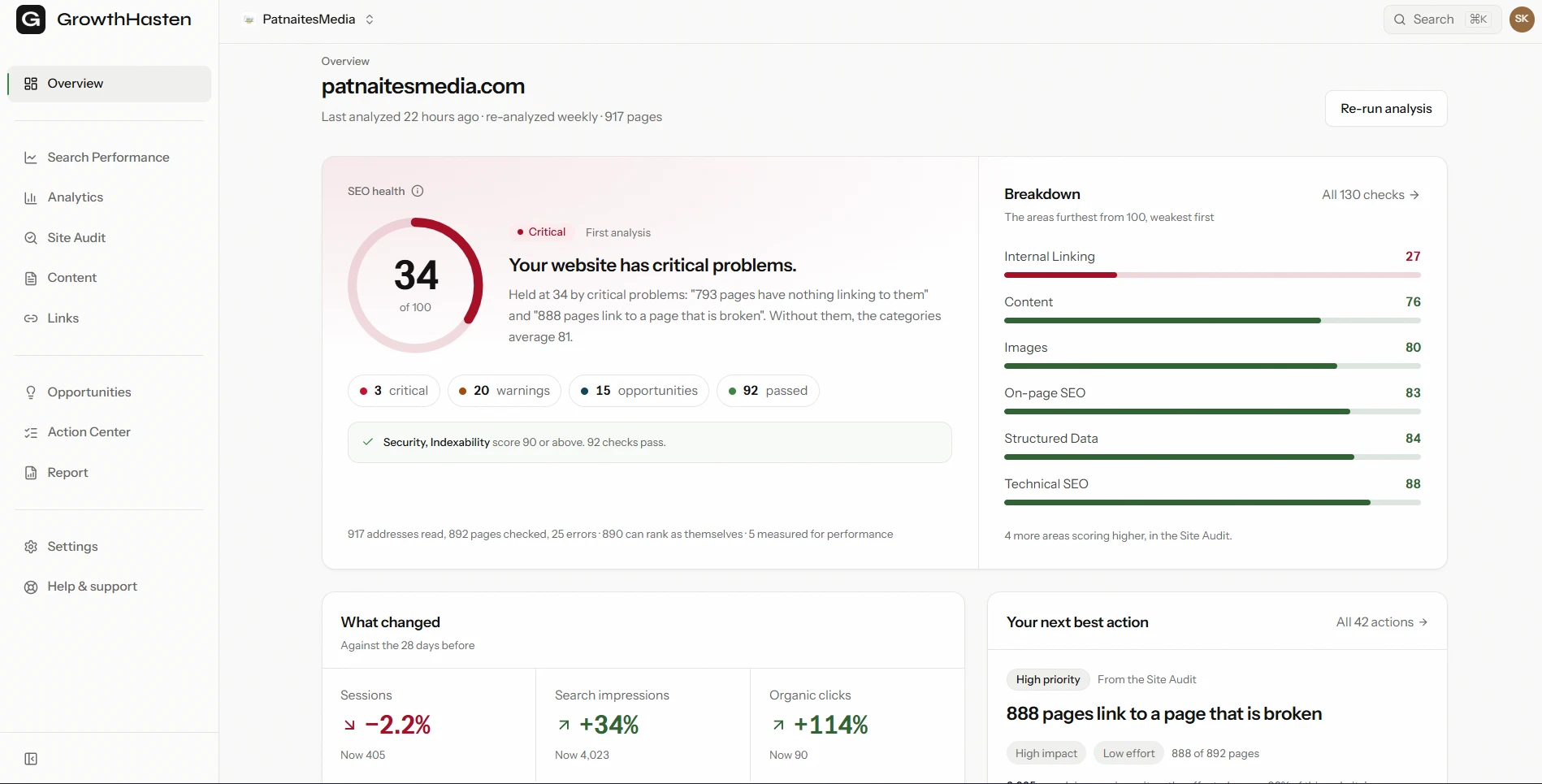
Inspecting pages one at a time does not scale past a handful of URLs, which is exactly the gap that caught us with those 17 posts. Confirming a single page is Google's job through URL Inspection, and nothing can do that part for you, because that verdict lives only in Search Console. What you can automate is the layer underneath it: the indexability signals that decide whether a page ever gets indexed in the first place.
That is where GrowthHasten fits. It is free SEO and content software that crawls your site and runs more than 130 deterministic checks across twelve categories, including the indexability signals this guide covers: stray noindex tags, robots.txt blocks, and canonicals pointing at the wrong URL. It also joins 16 months of your own Search Console data to the pages it finds, so you can see which of your URLs Google actually reports on, rather than guessing. The free plan covers one website of up to 900 pages and asks for an account but no card.
Treat publishing and indexing as two separate events, and verify the second on a schedule instead of assuming it followed the first. The cadence I use on this blog is a check at day 3, day 7, and day 14 after a page goes live, because that window is where silent indexing failures hide. This week, open URL Inspection and run your five newest URLs through it; if any come back "not indexed," you will know before it costs you a month of invisibility.
See What Your Site Needs Fixed First.
GrowthHasten is free SEO and content software. Point it at your domain and it checks indexability and more than 130 signals across every page, ranked by what to fix first. The free plan covers one website and asks for an account, no card.
Start FreeQuestions
Frequently asked questions
How do I check if my page is indexed by Google?
The most reliable way is the URL Inspection tool in Google Search Console: paste the full URL and it returns Google's own verdict, either "URL is on Google" or "URL is not on Google." A faster but approximate cross-check is the site: operator, for example site:example.com/your-page. When the two disagree, trust URL Inspection, because it reads Google's actual index record for that page.
Does appearing in a site: search mean my page ranks?
No. The site: operator only shows whether a URL is in Google's index. Ranking for a real query is a separate question, decided by relevance and competition. A page can be fully indexed and still rank nowhere for the terms you care about, which is why indexing and ranking should always be diagnosed as two different problems.
Why is my page crawled but not indexed?
Google crawled the page but chose not to store it, usually because of thin or duplicate content, a canonical tag pointing to another URL, or low perceived value. This shows as "Crawled, currently not indexed" in the Page Indexing report. The fix is almost always to strengthen the page itself, not to resubmit it or request indexing repeatedly.
How long does it take Google to index a new page?
It varies from a few hours to several weeks, and there is no guaranteed timeline. Internal links from pages that are already indexed are the most reliable way to speed up discovery. Do not assume a page is indexed just because your CMS shows it as published: those are two separate events, and the gap between them is where pages go missing.
Can I check indexing for my whole site at once?
Yes. The Page Indexing report in Search Console groups every known URL by status and names the reason each one is or is not indexed. For a wider sweep, a site crawler or GrowthHasten's free Site Audit checks indexability signals across every page in one pass, so you can catch stray noindex tags and misconfigured canonicals at scale rather than one URL at a time.

Written by
Anshuman Sinha
AI SEO Specialist, GrowthHasten
Anshuman Sinha is an AI SEO Specialist and Computer Science Engineer with over three years of experience in SEO and five years in web development. He specializes in Technical SEO, AI Search Optimization (AEO and GEO), SaaS SEO, and building high-performance websites with modern technologies.
View profile