

Conversion rate optimization for SEO is the practice of turning the organic visitors a page already ranks for into the actions your business cares about. It is for founders, marketers, and SEOs who have earned traffic and then watch most of it leave without doing anything. This guide covers why ranking and converting are two separate jobs, micro versus macro conversions, how search intent decides what a conversion can be, the on-page levers you control, a way to prioritize the work, and how to measure it. Ranking brings the visitor; conversion earns the outcome, and it is the half most SEO programs quietly neglect.
The short version
- More traffic is rarely the fastest route to more leads. Converting the traffic you already have usually is.
- SEO and CRO are one system: rankings decide who arrives, CRO decides what they do next. Doing one without the other wastes it.
- A conversion has to match intent. A page answering an informational query should ask for a small next step, not push a hard demo.
- Micro conversions (a newsletter signup, a guide download) predict macro conversions (a demo request, a purchase). Track both, in that order.
- You cannot A/B test a page that gets a handful of visits a week. Without traffic, use qualitative tools and fix the obvious first.
What is conversion rate optimization for SEO?
It is the discipline of improving the share of organic visitors who take a wanted action, without harming the search intent that ranked the page. Conversion rate is a simple ratio: visitors who complete an action divided by visitors who arrived. CRO raises it by making the action clearer, easier, and better matched to why the visitor came.
CRO on organic pages is not the same as CRO on a paid landing page. A paid page can be rebuilt around a single offer, but an organic page carries a ranking you worked for, so the content that earned the position has to stay. The job is to sharpen the path to conversion around that content, not to strip it out and trade a ranking for a short-term lift that vanishes when the page falls out of results.
Why do SEO and CRO belong together?
Because ranking and converting are two separate jobs, and doing one without the other wastes it. Ranking brings the visitor to the page; CRO earns the outcome once they are there. A page can rank first and still send almost nobody into your pipeline, which looks like success in a rankings report and failure in a revenue one.
Organic traffic is worth this attention because it tends to be high intent. Someone typed a query that describes a problem you solve, a warmer starting point than an interruptive ad. That intent is an advantage you already paid for with content and links, and leaving it unconverted is an expensive habit.
The honest limit: not all organic traffic is commercial. Informational visitors convert slowly, if at all, on a first visit, so the point is not to force a sale but to offer each visitor the next step that fits where they are.
What is the difference between micro and macro conversions?
A macro conversion is the outcome that pays the bills; a micro conversion is a smaller step that signals progress toward it. Treating only macro conversions as real means ignoring the pages that do the early work of a long sales cycle.
Macro conversions are the actions tied directly to revenue: a demo request, a qualified lead form, a trial start, a purchase. These are what a founder means by SEO working.
Micro conversions are the steps that lead there: a newsletter signup, a template download, an account creation, a pricing page view. They give lower-intent pages a realistic job to do, and they act as leading indicators, so you can see a page improving weeks before a macro conversion confirms it. Track both, and read the micro numbers to explain the macro ones.
How does search intent decide what conversion is possible?
The intent behind the query sets a ceiling on what you can reasonably ask a visitor to do. A page ranking for a top-of-funnel informational query attracts people who are learning, not buying, so the right conversion is a soft next step: a related guide, a subscribe, a free tool. A commercial or transactional query can ask for the demo or signup directly, because the visitor is closer to a decision.
Here is a rule that gets broken constantly: do not optimize conversions at the expense of intent match. Dropping a hard demo push onto an informational article usually lowers conversions and can hurt engagement, because it answers a question nobody on the page was asking yet.
The better move on informational pages is to earn the next click, not the sale. Offer the logical next resource and let internal links carry the visitor deeper, the mechanism our guide to content marketing for SEO uses to move readers through a cluster.
Which page types should target which conversion goals?
Different page types serve different intents, so each deserves a conversion goal it can realistically hit. Assigning one site-wide goal to every page judges informational articles by a demo-request rate they were never going to hit. Comparison and alternatives pages sit closest to a buying decision, and our template for comparison and alternative pages that convert covers the on-page structure built for that ask. Use the map below to set a fair goal per page type.
| Page type | Dominant intent | Realistic conversion goal |
|---|---|---|
| Blog / guide | Informational (top of funnel) | Newsletter signup, next-guide click, free tool trial |
| Comparison ("best X", "X vs Y") | Commercial investigation (middle) | Email capture, trial start, demo request |
| Solution or use-case page | Commercial (middle to bottom) | Demo request, contact, trial start |
| Pricing page | Transactional (bottom of funnel) | Signup, contact, checkout |
| Service or product page | Transactional | Contact, purchase, booking |
| Homepage | Mixed and navigational | Route the visitor to the right next page |
The pattern to notice: as intent warms from informational to transactional, the ask you can make grows heavier. Push harder than the intent supports and conversion falls. A pricing page sits at the transactional end of that scale, which is exactly why its own crawlability and markup deserve separate treatment.
What on-page levers actually lift conversions?
A short set of levers you control directly, most of them about clarity and friction rather than persuasion. The visitor needs to understand the offer, trust it, and reach the action without effort.
Value proposition. State what the page offers and who it is for, in plain language, near the top. If a visitor cannot tell within seconds whether they are in the right place, they leave before any other lever can work.
Above the fold. The first screen should confirm the visitor's query and show the primary action, without hiding the content that ranked. Ready visitors should not have to scroll to act.
Trust signals. Real evidence lowers hesitation: a named author with genuine credentials, specific examples, and honest limits. Never invent numbers or testimonials, because a claim a visitor can verify beats a statistic they cannot.
Page speed and Core Web Vitals. A slow or unstable page loses visitors before they read a word. Google's thresholds are worth hitting: Largest Contentful Paint under 2.5s, Interaction to Next Paint under 200ms, and Cumulative Layout Shift under 0.1, as defined in web.dev's Core Web Vitals reference. Our Core Web Vitals guide covers how to fix each one, and a page slow because of how it was built is a job for web development, not a settings change.
CTA clarity. One primary action per page, described by what it does ("Get the template", "Book a demo") rather than a vague "Submit". Competing calls to action split attention and lower the response to all of them.
Form friction. Every field you ask for costs completions. Request only what you need to act on the lead, and defer the rest to a later step.
Internal links to the next step. Give the visitor who is not ready to convert somewhere useful to go. A well-placed link to the logical next page keeps them on the site, and the wider set of on-page elements this touches is covered in our on-page SEO checklist.
How should you prioritize CRO work on organic pages?
Start where traffic, intent, and gap overlap, not where the page looks worst to you. The framework below screens candidates on three factors so you work the highest-value pages first.
| Factor | What a high score looks like | Where to read it |
|---|---|---|
| Traffic | Enough organic visits to matter now and to learn from | GA4 landing pages, Search Console clicks by page |
| Intent proximity | The query sits close to a buying decision | The keyword and SERP the page ranks for |
| Conversion gap | Behavior is far below what the page could achieve | Exit rate, CTA clicks, form starts vs completions |
Score each factor from 1 to 3 and work the pages that score high on all three first. A high-traffic, high-intent page with an obvious conversion gap is the best use of your time, while a low-traffic informational page can wait, however broken it looks, because fixing it moves almost nothing.
One caution: a high-traffic, low-intent page like a popular informational guide is worth a soft micro-conversion goal, not a redesign aimed at demos it will never produce.
How do you measure CRO without chasing vanity metrics?
By defining conversions as GA4 key events tied to real actions, then reading them against the traffic that produced them, the same GA4 fundamentals our GA4 for SEO guide walks through for organic traffic specifically. A conversion you have not configured is one you cannot measure.
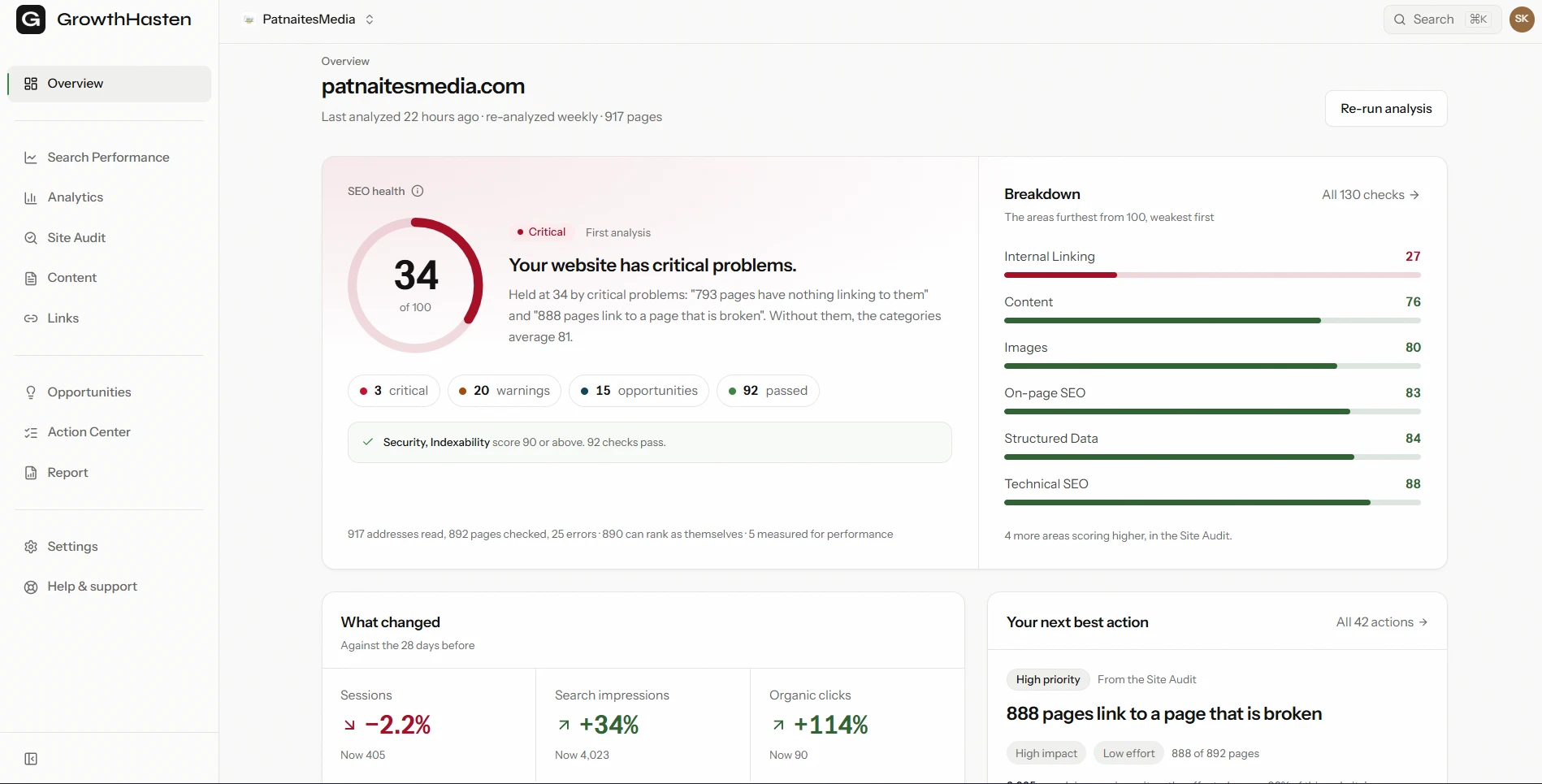
Set up a key event for each action that matters, such as generate_lead for a qualified form or sign_up for an account, and mark it as a key event in GA4 so it counts as an outcome rather than a generic event. This setup has to come before any reporting. As a live example, GrowthHasten's own contact form does not yet have a key event configured, so no conversion count for it exists to report until that event is created. If your forms are in the same state, configuring the event is step one.
Avoid vanity metrics that flatter the work without informing a decision: raw sessions, pageviews, and bounce rate on their own say nothing about whether visitors acted. Read conversions against the traffic that drove them, and fold the result into reporting that ends in a decision. Our SEO reporting guide lays out the leading-versus-lagging structure that CRO data slots into, and Google's Search Central documentation explains what the search-side metrics mean.
How do you test responsibly, and when should you not test?
Only A/B test when a page has enough traffic and conversions for the result to mean something; otherwise you are reading noise and calling it insight. A test needs a sample large enough that the gap between two versions is unlikely to be chance, and low-traffic pages rarely reach that bar in a reasonable timeframe. A "winner" declared on a dozen conversions usually reverses the next month.
So the clearest rule of when not to test: do not run A/B tests on pages without enough traffic, because a thin page produces confident-looking conclusions built on random variation.
When traffic is low, lean on qualitative tools instead. Session recordings and heatmaps show where visitors hesitate, and short on-page surveys tell you why. Often the honest move is to skip testing and fix the obvious problems: the unclear headline, the buried CTA, the form asking for six fields. Save controlled experiments for the pages that can feed them.
How does CRO connect to your SEO reporting?
CRO closes the loop that reporting opens: rankings and traffic are leading signals, and conversions are the lagging business result they are meant to produce. A report that stops at traffic proves only that the visitor arrived; adding conversions proves the visit was worth something. Without that second half, an SEO program can look healthy for months while adding nothing to revenue. When the sales cycle runs for months rather than days, that gap widens further, and our guide to the lag between an organic conversion and the revenue it eventually produces shows how to calculate a return that accounts for it.
Report conversions the way you report traffic, segmented by page type and intent, so a healthy total cannot hide a weak bottom of the funnel. When organic sessions rise but conversions stay flat, the split usually shows the growth landing on informational pages. Tie each conversion trend to the CRO change you made, and a scoreboard becomes an explanation of what to do next.
What are the most common CRO-for-SEO mistakes?
Most failures repeat the same handful of errors, nearly all of them a mismatch between what the page is for and what you asked it to do.
Optimizing before matching intent. Pushing a bottom-of-funnel ask onto a top-of-funnel page lowers conversions and can dent engagement. Fix the goal-to-intent fit first.
Copying paid-landing tactics onto ranked content. Stripping an article down to a single offer often removes the content that earned the ranking, so you lose the traffic worth converting.
Testing without traffic. Declaring winners on tiny samples produces decisions built on noise. Use qualitative tools on low-traffic pages instead.
Chasing micro conversions that never lead anywhere. A rising signup count means little if none of those signups progress. Check that your micro conversions actually predict macro ones.
Ignoring speed and hiding the next step. A slow page loses visitors before the offer loads, and a page with no visible next action leaves ready visitors with nowhere to go.
The habit worth building is to treat every ranked page as having two jobs, and to check the second one on purpose: once a page earns steady organic traffic, ask what the visitor should do next and whether the page makes that obvious. This week, open your top three organic landing pages in GA4, confirm a key event is configured for the action each one should drive, and for any page missing it, set the event up before you touch the design. You cannot improve a conversion you are not measuring.
See What Organic Visitors Do After the Click
Connect GA4 and GrowthHasten separates organic from every other channel, lists the landing pages that receive it, and shows key events with an honest state when none has been configured yet. Free plan, no card.
Explore AnalyticsQuestions
Frequently asked questions
What is conversion rate optimization in SEO?
Conversion rate optimization in SEO is the practice of turning organic visitors into wanted actions without harming the search intent that ranked the page. It raises the share of visitors who convert by making the offer clearer, the path easier, and the ask better matched to why the visitor came. Unlike paid landing pages, organic pages must keep the content that earned the ranking while sharpening the route to conversion around it.
Do SEO and CRO work together or compete?
They work together as one system. SEO decides who arrives on the page, and CRO decides what those visitors do next, so optimizing one without the other wastes its effort. A page can rank first and still send almost nobody into your pipeline. Because organic traffic is usually high intent, converting the visitors you already earn is often a faster route to leads than chasing more traffic.
What is the difference between micro and macro conversions?
A macro conversion is the outcome tied to revenue, such as a demo request, a qualified lead, or a purchase. A micro conversion is a smaller step toward it, such as a newsletter signup, a template download, or a pricing page view. Micro conversions give lower-intent pages a realistic job and act as leading indicators, so track both and read the micro numbers to explain and forecast the macro ones.
How much traffic do you need to run an A/B test?
Enough that the difference between two versions is unlikely to be chance, which most low-traffic pages never reach in a reasonable timeframe. A winner declared on a handful of conversions usually reverses the next month, so testing thin pages produces confident conclusions built on noise. When traffic is low, use qualitative tools like session recordings, heatmaps, and short surveys, and simply fix the obvious problems instead of testing.
How do you measure conversions from organic traffic?
Define each meaningful action as a GA4 key event, such as a lead form or a signup, and mark it as a key event so it counts as an outcome rather than a generic event. A conversion you have not configured cannot be measured, so this setup comes before any reporting. Then read conversions against the traffic that produced them, segmented by page type and intent, rather than celebrating raw sessions or pageviews.
Tags

Written by
GrowthHasten Team
Editorial Team, GrowthHasten
Articles from the GrowthHasten editorial team, grounded in primary research, our own testing, and what analyzing real websites shows, fact-checked in-house.
View profile