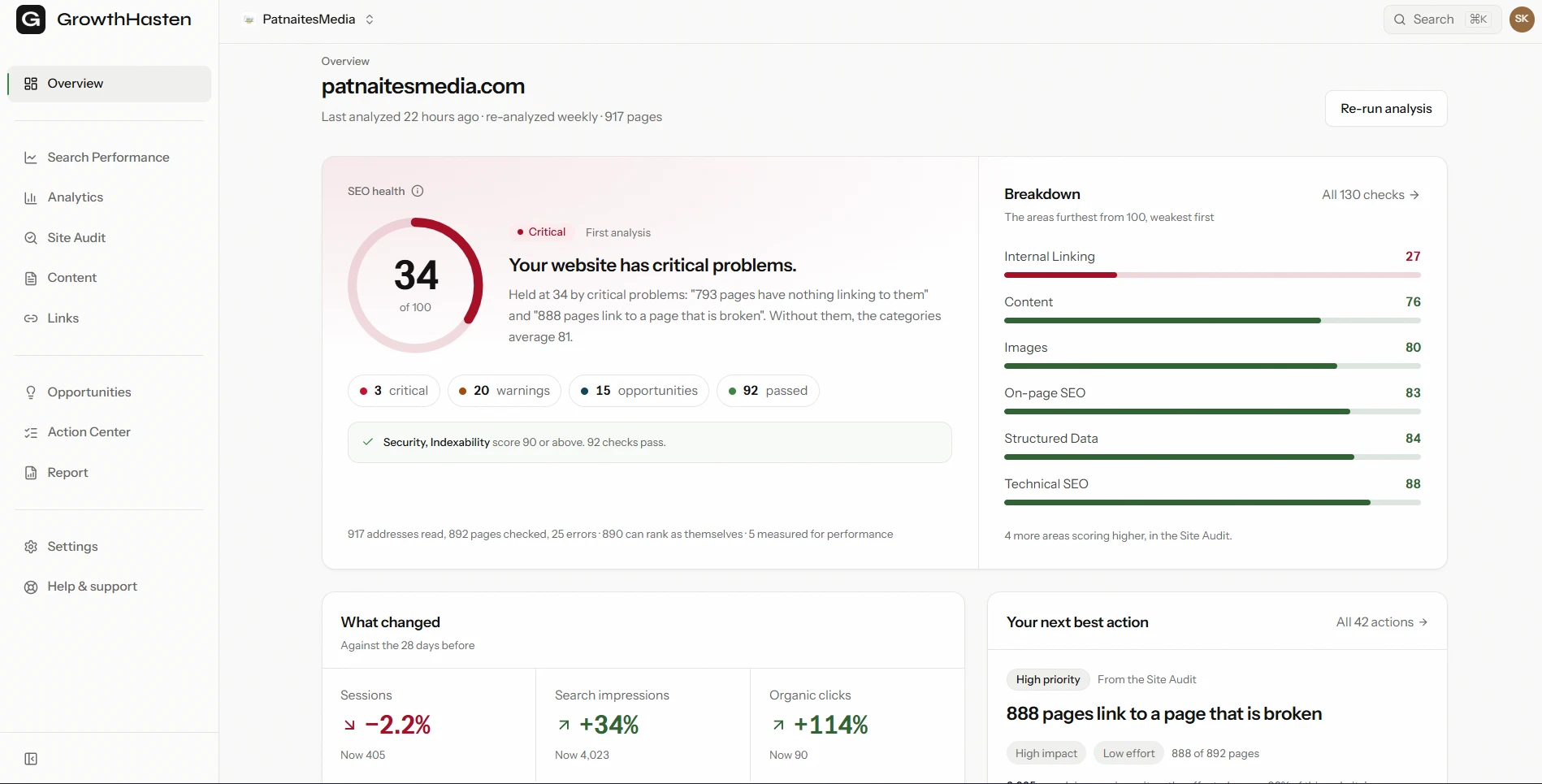


SEO reporting is the practice of turning search data into a short, honest account of what your organic work changed and what to do next. It is for founders, marketers, and in-house SEOs who have to explain organic performance to someone who does not live inside a dashboard. This guide covers what a good report is for, the difference between leading and lagging metrics, the core data sources, how to structure a monthly report, and the reporting habits that quietly waste everyone's time. The goal is a report that ends in decisions, not one that ends in a pile of charts.
The short version
- A report that only shows numbers going up is a highlight reel, not a report. The value is in tying organic work to business outcomes and naming the next action.
- Leading metrics (impressions, average position, indexed pages) move first and predict. Lagging metrics (organic sessions, conversions, assisted revenue) confirm the business result. You need both, read in that order.
- No single tool sees everything. Search Console owns search data, GA4 owns behavior and conversions, a rank tracker owns position over time, and a dashboard tool stitches them together.
- Rankings reported in isolation are the most common way to mislead a stakeholder. A number without a trend, a segment, and an action item is decoration.
What does good SEO reporting actually do?
It connects the work you did to a result someone cares about, and tells them what happens next. A report exists to support a decision: keep investing, change direction, fix something, or leave it alone. If a stakeholder cannot make one of those decisions after reading it, the report failed regardless of how polished the charts look.
Good reporting does three things at once. It records what changed over the period, explains why in plain language, and recommends a specific next action with an owner. Everything else is context that supports those three jobs.
The trap is treating volume as value. A twenty-tab spreadsheet feels thorough and gets read by nobody. A one-page summary that names the two wins, the one problem, and the three fixes for next month gets acted on.
What is the difference between leading and lagging SEO metrics?
Leading metrics move first and hint at where results are heading; lagging metrics confirm the business outcome after the fact. SEO is slow, so you need the leading set to know whether the work is landing long before revenue reflects it. This split is the backbone of a report that survives a skeptical question.
Think of it as two tiers stacked in causal order.
Tier 1: leading indicators (the early signal). These respond within days or weeks and tell you the direction of travel. Impressions show whether Google is surfacing you for more queries. Average position shows whether you are climbing. Indexed pages show whether new work is even eligible to rank. Click-through rate shows whether your titles and descriptions earn the click once you appear.
Tier 2: lagging indicators (the business result). These take weeks or months and prove the work mattered commercially. Organic sessions show the traffic you actually earned. Conversions and conversion rate show whether that traffic did anything useful. Assisted conversions and revenue show organic's role in journeys that closed elsewhere. Turning those lagging numbers into a single return figure is where most reports go wrong, and our guide to why the standard SEO ROI formula understates B2B programs covers the lag that causes it and what to report instead.
Read Tier 1 to explain Tier 2. When sessions rise, impressions and position usually rose first, and pointing to that chain is what turns a report from a claim into evidence. When sessions stall while impressions climb, you have a click-through or intent-match problem, and the leading metrics told you before the lagging ones did. Our guide to how AI Overviews change what a CTR curve predicts covers the further cause worth ruling out: an AI Overview or another SERP feature absorbing the click at the position you hold.
Which metrics belong in an SEO report?
A small set, each earning its place by informing a decision. Report the metric a stakeholder can act on, and cut the ones that only make the deck longer. Here is the working set and where each one comes from.
| Metric | What it tells you | Where to find it |
|---|---|---|
| Impressions | How often you appear in search, a leading signal of growing visibility | Google Search Console, Performance report |
| Clicks | The traffic search is actually sending you | Google Search Console, Performance report |
| Average position | Where you sit for tracked queries, read as a trend not a single number | Search Console for reality, a rank tracker for daily granularity |
| Click-through rate | Whether your title and description earn the click once you rank | Google Search Console, by query and by page |
| Indexed pages | How much of your site is eligible to rank at all | Search Console, Pages (indexing) report |
| Organic sessions | The lagging measure of traffic earned from search | GA4, Traffic acquisition, organic channel |
| Conversions | Whether organic traffic completes actions that matter | GA4, key events and conversions |
| Assisted conversions | Organic's role in journeys that convert on another channel | GA4 attribution and path reports |
Notice the split: the first five are leading, the last three are lagging. A report that shows only the first five looks busy but never proves value; one that shows only the last three cannot explain why anything moved. Google's Search Central documentation describes what the Search Console metrics mean and how they are counted, which matters when a stakeholder asks why your session count and click count never match exactly.
That set is the reporting layer. Choosing which of those numbers your company should actually be judged on, and what a realistic target looks like at your stage, is a separate question, covered in our guide to SEO KPIs.
Where does the reporting data come from?
Four sources, each answering a question the others cannot. Trying to run reporting from one tool is how blind spots become surprises.
Google Search Console. The source of truth for search-side data: impressions, clicks, position, click-through rate, and indexing status, straight from Google rather than a third-party estimate. Start here, because it shows what Google actually did with your pages.
GA4. Owns behavior and conversions after the click: sessions, engagement, key events, and revenue by channel. It answers what visitors did once they arrived, which Search Console cannot see, and our GA4 for SEO guide covers setting it up specifically for organic measurement.
A rank tracker: Records position for a defined keyword set on a daily cadence, with location and device control. Search Console averages position across everything and lags by a couple of days, so a dedicated tracker gives you the cleaner trend line for priority terms. That trend line depends on how the tracker reaches the results page in the first place, and Google's new passthrough redirect on search result links is a reason to ask a vendor how it collects that data before you trust the line.
Looker Studio (or a similar dashboard). Connects those sources into one view so you are not rebuilding the same charts by hand every month, and our guide to what belongs on an SEO dashboard covers which tiles earn a place on it. Your written summary handles the judgment a dashboard cannot supply.
How should you structure a monthly SEO report?
As a decision document with four parts, in a fixed order, so the reader gets the point before the detail. The structure below is the template we reach for, and keeping it identical month to month is what makes the trend readable.
1. Summary. Three to five sentences at the very top. What changed this month, the single most important reason, and the headline recommendation. A busy stakeholder should be able to stop reading here and still know what matters.
2. Wins. The two or three results worth celebrating, each tied to a metric and, where possible, to a specific action you took. "Sessions to the pricing cluster rose after we fixed the internal links" beats "traffic is up."
3. Issues. What slipped or stalled, stated without spin. A lost featured snippet, a page that dropped out of the index, a cluster losing position to a competitor. Naming problems plainly is what makes the wins credible.
4. Next actions. A short, ordered list of what you will do about the issues and where you will push next, each with an owner and a rough timeframe. This is the part that turns a report into a plan.
Put the recurring numbers in a linked dashboard and keep the written report to the judgment: the summary, the why, and the actions. The numbers show what happened; the words explain what it means and what you will do.
Why should you segment by page type and intent?
Because a site-wide average hides every story worth telling. Blended totals move slowly and blur the signal, so a 4% lift looks dull until you split it and find the blog up 30% while product pages slid. Segmentation is where a report stops being a scoreboard and starts being an explanation.
By page type. Group blog, product, category, and landing pages separately. Each serves a different job and moves for different reasons, and a founder cares far more about product-page organic traffic than about a total that averages it away.
By intent. Separate informational queries from commercial and transactional ones. Traffic that converts behaves differently from traffic that researches, and reporting them together lets a healthy-looking total hide a weak bottom of the funnel. Our keyword research guide covers how to read the four search intents, which is the same lens you use to segment a report.
How do you report on AI-search visibility?
Qualitatively and honestly, because the tooling is young and precise numbers here are mostly guesses. AI answer engines like ChatGPT, Gemini, Perplexity, and Google's AI Overviews do not hand you clean, universal metrics the way Search Console does, so resist the urge to invent a chart that looks authoritative.
Report what you can actually observe. Whether your brand or pages get cited when you test the queries that matter to your business. Which pages the citations point to. Whether AI Overviews appear for your priority terms and whether you are inside them. Track the direction of travel and log example prompts and screenshots as evidence, rather than reporting a single made-up "AI visibility score."
Frame it as an emerging signal you are watching, not a settled KPI. That honesty is worth more to a stakeholder than false precision, and it matches how the underlying systems still work: AI answers are built on the same crawled, indexed web, so the fundamentals you already report on still drive most of the outcome.
What are the most common SEO reporting mistakes?
Most bad reports fail the same handful of ways, and all of them are avoidable. The pattern is the same: data presented without the context or the action that would make it useful.
Rankings in isolation. A position number with no traffic, conversion, or trend beside it tells a stakeholder nothing about whether the business is better off. Ranking first for a term nobody searches is not a win.
No context. A number with no comparison is noise. Always show the trend and the prior period, and flag anything that skews it, such as a seasonal dip or an algorithm update, so a normal fluctuation does not read as a crisis.
No action items. A report that ends at the charts leaves the reader to guess what to do. Every report should close with what you recommend and why.
Cherry-picking. Showing only the metrics that went up destroys trust the first time someone checks. Report the losses too; a credible report is one a stakeholder can act on without double-checking.
When should you not report a metric?
Whenever it flatters the work without informing a decision. The discipline in reporting is as much about what you leave out as what you include, and vanity metrics are the first thing to cut.
Do not report keyword rankings on their own. A ranking only matters through the traffic and conversions it produces, so pair it with those or leave it out. Do not report raw impressions as a success metric; impressions can climb while clicks and revenue stay flat, and celebrating them alone is how a report drifts from reality. Do not report totals that average away the segment that matters, and do not add a metric just because a tool offers it. If you cannot name the decision a number supports, it does not belong in the report. Google's Search Essentials is a useful sanity check here: report against the outcomes Google actually rewards, not against a dashboard's default vanity tiles.
How do you turn a report into action?
By ending every report the way an audit should end, with a prioritized list of what to do next. A report and an audit share the same failure mode: a long document that names problems but never orders them. Our SEO audit guide lays out the impact-versus-effort scoring that works just as well for turning reporting findings into a plan.
Give each next action an owner, a rough timeframe, and the metric you expect it to move, then check that metric in next month's report. That closing loop, action to result and back again, is what compounds. It also connects reporting to the wider system: reporting sits at the end of the loop that our complete SEO guide maps in full, and understanding how Google Search works is what lets you explain in the report why a change took weeks to show up rather than days.
The habit worth building is a fixed monthly report you never redesign, so the trend stays legible and the writing goes into judgment rather than formatting. This week, open Search Console and GA4, and draft a one-page summary for last month with exactly three parts: the biggest change, the most likely reason, and one action you will take because of it. If you want the figures behind that report assembled for you, GrowthHasten's Reports tag every figure with where it came from, but the one-page draft is the part worth doing on your own first.
Reports Where Every Figure Shows Its Source
GrowthHasten builds one document from your crawl, Search Console and Analytics, with what passed beside what failed and every section tagged Measured, Computed, AI-written or Not measured. Print it or save it as a PDF.
Explore ReportsQuestions
Frequently asked questions
What metrics should be in an SEO report?
Report a small set tied to decisions: impressions, clicks, average position, click-through rate, and indexed pages as leading signals, plus organic sessions, conversions, and assisted conversions as lagging business results. Read the leading metrics to explain the lagging ones. Skip any number you cannot connect to an action a stakeholder can take, because a longer report is not a better one.
What is the difference between leading and lagging SEO metrics?
Leading metrics move first and predict where results are heading, so impressions, average position, and indexed pages respond within days or weeks. Lagging metrics confirm the business outcome later, so organic sessions, conversions, and revenue take weeks or months. You need both. Read the leading set to explain and forecast the lagging set, which is what turns a report from a claim into evidence.
How often should you send an SEO report?
Monthly works for most sites, because SEO moves slowly and weekly reports mostly show noise that invites over-reaction. Keep a live dashboard for anyone who wants numbers between reports, and reserve the written monthly report for judgment: the summary, the reasons, and the next actions. Add a lighter check after a migration or a major algorithm update, when things can change fast enough to matter.
Should you report keyword rankings to clients or stakeholders?
Only alongside traffic and conversions, never on their own. A ranking matters through the clicks and revenue it produces, so a position number in isolation tells a stakeholder nothing about whether the business is better off. Ranking first for a term nobody searches is not a win. Pair rankings with the traffic and outcomes they drive, or leave them out of the report entirely.
How do you report on AI-search visibility?
Report it qualitatively, because the tooling is young and precise numbers are mostly guesses. Track whether your brand or pages get cited when you test priority queries in ChatGPT, Gemini, Perplexity, and Google AI Overviews, note which pages the citations point to, and log example prompts and screenshots as evidence. Frame it as an emerging signal you are watching, not a settled KPI, and avoid inventing an authoritative-looking score.
Tags

Written by
GrowthHasten Team
Editorial Team, GrowthHasten
Articles from the GrowthHasten editorial team, grounded in primary research, our own testing, and what analyzing real websites shows, fact-checked in-house.
View profile