

Content distribution is the deliberate work of getting a published piece in front of readers through channels you own, earn, and pay for, so it gets discovered, engaged with, and linked to. This guide is for marketers, founders, and SEO leads who keep publishing solid content and wondering why it never ranks. It covers why creation is only half the job, how distribution feeds the signals search engines actually reward, the owned, earned, and paid channels available to you, the specific tactics that work, a repeatable workflow tied to your editorial calendar, how to measure it without chasing vanity numbers, and when distribution is the wrong move. The short answer up front: great content still needs a path to discovery, and distribution builds that path.
The short version
- Distribution does not change rankings directly. It drives the signals that do: early engagement, referral traffic, and earned links.
- Publish-and-pray is the most common way good content dies. A page nobody sees earns nothing to rank on.
- Internal linking is distribution you fully control, and it is the one channel most teams underuse.
- One asset should become many formats. Repurposing multiplies reach without multiplying research time.
- Measure referral traffic, engagement, and links earned, not impressions and follower counts.
What is content distribution?
Content distribution is the set of channels and tactics you use to promote a piece of content after it is published, so the right people find it. Creation answers the question of what to say. Distribution answers a harder one: how anyone will ever see it. The two are separate disciplines, and treating them as one step is why so much good work goes unread.
Distribution splits into three types of channel: owned, earned, and paid. Owned channels are the ones you control outright, like your email list, your website, and your social profiles. Earned channels are placements other people give you, from a mention in someone's newsletter to a link from a journalist. Paid channels are the ones you buy, such as social ads or sponsored placements. A healthy program uses all three, weighted toward the ones that fit your resources.
Why is creating content only half the job?
Because a page that nobody visits generates none of the signals search engines use to decide what ranks. Google reads the web, but it also reads behavior around a page: whether people click it, stay on it, link to it, and search for more from you afterward. A brilliant article with zero distribution produces none of that, so it sits unread and unranked.
There is a discovery problem underneath this. New pages on a young or mid-authority site are not crawled and ranked the moment they publish. They need signals that tell search engines the page exists and matters. Distribution supplies those signals early, when a page is most vulnerable to being ignored. Our guide to content marketing for SEO covers how creation and promotion fit together across a whole program rather than one post at a time.
The honest version: distribution does not rescue weak content. It amplifies whatever you already have. Promote a thin, derivative post hard enough and you simply help more people bounce off it. Good distribution starts with content that deserves the attention.
How does content distribution actually affect SEO?
Indirectly, through the behavioral and link signals it generates, not by any direct ranking lever you can pull. This distinction matters, because it changes what you measure and what you expect. Sharing a post on social media does not tell Google to rank it higher. What it can do is put the post in front of people who then read it, link to it from their own sites, cite it, and search for your brand later.
Three chains connect distribution to rankings. First, early engagement: distribution brings the initial readers whose behavior helps a page establish relevance. Second, referral traffic: visits from newsletters, communities, and other sites signal that the page is useful and worth reaching. Third, and most durable, earned links: when the right people see strong content, some of them link to it, and links remain one of the signals Google's Search Central documentation describes as central to how it evaluates and ranks pages.
Earned links are where distribution and off-site SEO meet. You cannot buy your way to durable authority safely, but you can put linkable content in front of people who publish. That overlap is why our digital PR guide and our link building guide both belong in a serious distribution plan: they are the earned side of getting content seen by people who can link to it. A wire-distributed press release is not a shortcut into that earned side, and our guide to what a press release actually buys you covers why the distribution product and the coverage it can sometimes trigger are not the same purchase.
What are owned, earned, and paid channels?
They are the three buckets every distribution tactic falls into, and knowing which is which keeps your plan balanced. Owned channels cost you nothing per use but are capped by the size of the audience you have built. Earned channels reach further and carry more trust, but you do not control whether they happen. Paid channels are instant and scalable, but the reach stops the moment the budget does.
- Owned. Your email list and newsletter, your own website and its internal links, your social profiles, any video channel you publish to, and any community you host. These are the foundation, because you can use them on every piece without asking permission. Video is often the most neglected of these, and our guide to YouTube SEO for B2B and SaaS teams covers how a demo or explainer earns discovery there instead of collecting a few dozen views. A podcast is the same kind of owned asset with the same failure mode: our guide to getting B2B podcast episodes found in search covers turning a show into indexed pages instead of a feed nobody outside your existing audience finds. LinkedIn is the same kind of owned asset with the same trap: our guide to how B2B teams should split their time across LinkedIn's surfaces covers which of its four surfaces leave something durable and which just feed the feed.
- Earned. Mentions, shares, syndication, guest placements, journalist coverage, and inbound links, none of which you control and all of which carry more trust than anything you publish yourself. Our guide to what earned media is and why AI answers run on it covers the category in full.
- Paid. Social ads, search ads, sponsored newsletter slots, and content discovery networks. Useful for a launch push or to seed a new asset, but they rent attention rather than build it.
Most teams should lead with owned, invest patiently in earned, and use paid selectively. Pouring budget into paid promotion for a post that your own audience has not validated is a fast way to spend money learning the content was not ready. Choosing which channels to build in the first place is a different decision from promoting any single piece, and it runs on different criteria: our guide to website traffic sources and which channels actually compound covers that choice, including a test for telling a durable channel from rented attention.
Which distribution tactics move the needle?
The ones that match your audience and your capacity, not the ones with the biggest theoretical reach. A niche community where your buyers actually gather beats a broadcast to a huge, indifferent audience. Use the matrix below to weigh each channel by what it is best for and what it costs you in effort.
| Channel | Best for | Effort |
|---|---|---|
| Email and newsletter | Reaching an audience that already trusts you and driving reliable early traffic | Low once the list exists |
| Internal linking | Passing authority to new pages and guiding both readers and crawlers | Low, and fully in your control |
| Organic social | Early visibility, conversation, and putting an asset in front of people who might link | Medium and ongoing |
| Communities and forums | Reaching a specific, engaged niche where your buyers already gather | Medium, and only where you genuinely participate |
| Syndication | Extending reach to a partner's audience without recreating the piece | Medium, and only with a canonical tag |
| Digital PR and outreach | Earning links and coverage from credible publications | High, and project-based |
| Paid promotion | Fast reach for a launch or to seed a new, proven asset | Low effort, direct cost |
Two tactics deserve a closer look, because they are the most misused. Communities and forums reward genuine participation and punish drive-by link drops: share a resource only where it answers a real question and where you were already a member. Syndication has enough moving parts to need its own page, and one real downside if you get it wrong: our guide to content syndication covers choosing partners, the canonical rules, and how to tell an organic republishing arrangement from a paid lead-generation programme sold under the same name.
How do you turn one asset into many formats?
By treating the original piece as a source, then extracting smaller assets from it for each channel where your audience lives. Repurposing is the highest-leverage move in distribution, because the expensive part, the research and the thinking, is already done. A single well-built guide can supply weeks of channel-specific content.
A five-step repurposing workflow
- Publish the anchor. Start with the full, canonical piece on your own site. This is the home everything else points back to.
- Extract the pull-quotes. Pull the three or four sharpest, most quotable points. Each becomes a standalone social post or short-form update.
- Rebuild one section as a visual. Turn a table, a framework, or a step list into a simple graphic or carousel. Visual formats travel where plain links do not.
- Summarize for the newsletter. Write a short, value-first summary that links back to the anchor. Your list is the most reliable early traffic you have.
- Answer the question elsewhere. Where you already participate in a community, answer a relevant question in full and link the anchor as further reading, not as bait.
Run this loop for every substantial piece and one publish becomes five to seven touchpoints. The limit is judgment: repurpose only what is genuinely useful in each format. Cross-posting the same link everywhere with no adaptation reads as noise and trains people to ignore you.
Is internal linking really distribution?
Yes, and it is the channel you have the most control over and the one teams most often forget. Every time you link from an existing, indexed page to a new one, you hand the new page two things: a path for readers to discover it, and a path for search engines to crawl and understand it. On a site without much external authority yet, internal links are often the primary way new content gets found at all.
The mechanics are simple. Point links from your strongest, most-visited pages toward the new piece, using descriptive anchor text that tells both readers and crawlers what sits on the other side. Group related content so a topic reinforces itself rather than scattering. This is distribution that costs nothing per use, never expires, and compounds as your library grows. Our topical authority guide explains how those internal connections build a subject cluster that ranks as a whole.
One caution: internal linking helps only when the linking pages are themselves discoverable. A link from a page that search engines have never crawled passes nothing. Anchor new content to pages that already attract traffic, not to other brand-new posts.
How do you build a repeatable distribution workflow?
By attaching distribution to your editorial calendar as a defined stage, not a burst of activity you improvise on publish day. If distribution is left to whoever remembers, it does not happen consistently. Build it into the process so every piece gets the same promotion by default.
A workable default looks like this. On publish day, add internal links from three relevant existing pages, send the newsletter summary, and post the first social extracts. Over the following week, work through the repurposing loop and share in any communities where the piece genuinely fits. For pieces built to earn links, run outreach as its own project on its own timeline. Plan content and its distribution together, not creation followed by hope.
Write the steps down and make them part of the definition of done. A piece is not finished when it is published; it is finished when it has been distributed. That single rule prevents most publish-and-pray failures.
How should you measure content distribution?
By tracking reach that turns into outcomes, not the vanity metrics that feel productive and prove nothing. Impressions and follower counts move easily and mean little. The numbers that reflect real influence are harder to game and worth more attention.
| Metric | What it tells you | Where to find it |
|---|---|---|
| Referral traffic | Which channels actually send readers to the piece | Your analytics platform, segmented by source |
| Engagement quality | Whether arrivals read and stay, not just land and leave | Analytics engagement and scroll or time-on-page signals |
| Links earned | Whether the right people saw the content and cited it | A backlink tool or Search Console links report |
| Assisted conversions | Whether distributed content contributed to demand over time | Analytics attribution and path reports |
Assisted conversions matter because distribution rarely drives a sale on the first touch. A reader arrives from a community post, returns weeks later through search, and converts then. Judge distribution on its contribution to that path, not on last-click alone. Do not invent benchmarks for what a channel should deliver; measure your own baseline and improve against it.
How does distribution compound topical authority?
By turning individual posts into a body of work that earns links and recognition as a set, which is how authority on a subject actually accrues. One well-distributed article earns a few links and some referral traffic. Ten well-distributed articles on the same theme, linked to each other and each promoted, form a cluster that search engines and readers recognize as expertise.
The compounding is real and slow. Each earned link and each internal connection strengthens the whole cluster, so later pieces rank more easily than earlier ones did. Distribution is what keeps that flywheel turning, because a piece nobody sees adds nothing to the cluster. This is the long game the brand is built for: sustainable authority, not a single viral spike.
When should you not distribute?
More often than the advice to promote everything suggests. Distribution amplifies, and amplifying the wrong thing costs you reach, reputation, and trust. A few situations call for restraint:
- Before the content is genuinely good. If a piece would not survive a critical read, fix it first. Distributing weak content just helps more people confirm it is weak, and burns the audience you spent effort building.
- By spamming every channel at once. Blasting the same unadapted link into every community and inbox reads as noise and trains people to tune you out. Share where the piece fits and where you already participate.
- Into communities you have never contributed to. Dropping a link in a forum on day one, with no history there, is the fastest way to get removed and remembered for the wrong reason.
- When the foundation is broken. If the page cannot be crawled, loads poorly, or has no clear path back into your site, sending traffic to it wastes the promotion. Fix discovery and structure first.
Restraint is part of the discipline. Google's guidance on creating helpful, people-first content is the standard worth meeting before you promote anything: distribution rewards content that already earns its attention.
The one habit worth building: treat a piece as unfinished until it has been distributed. Publishing is a milestone, not the finish line. This week, take your last three published posts and add internal links to each from three existing pages that already get traffic, then send one of them to your list with a short, value-first summary. That single pass will move more than another unread post ever would.
See Which Pages to Write, Refresh or Leave Alone
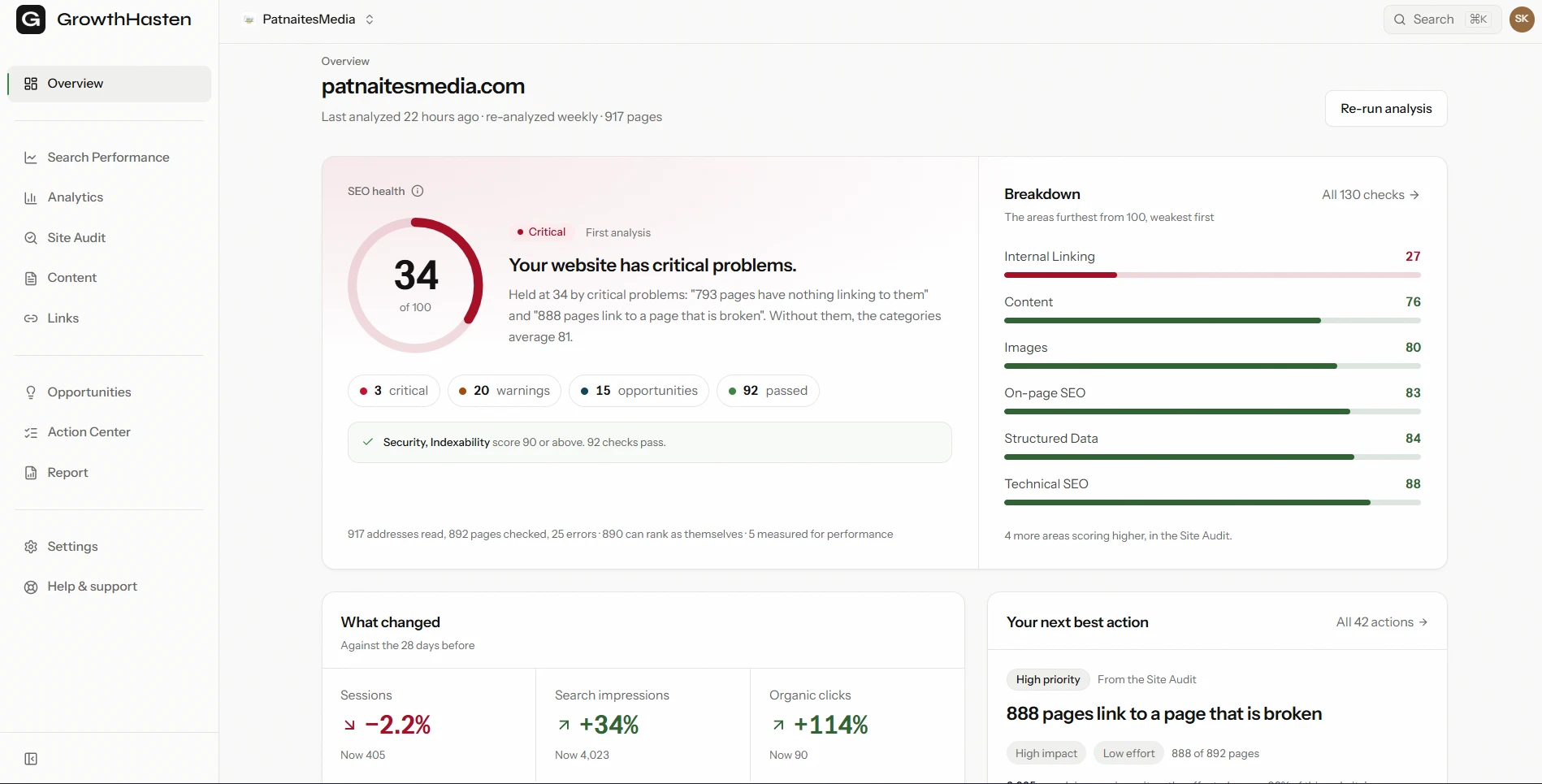
Connect Search Console and GrowthHasten's Content section puts every page's word count beside its clicks, flags the pages losing traffic and the pages competing for the same search, and groups topics as covered, partial or missing against what you already publish.
Explore the Content SectionQuestions
Frequently asked questions
What is content distribution in SEO?
Content distribution is the work of promoting a published piece through owned, earned, and paid channels so the right people discover, read, and link to it. In SEO terms, it does not change rankings directly. Instead it drives the signals that do: early engagement, referral traffic, and earned links from credible sites. Creation decides what you say; distribution decides whether anyone ever sees it.
Does content distribution directly improve search rankings?
No, not directly. Sharing a post does not send Google a signal to rank it higher. What distribution does is generate the things that influence rankings: it brings early readers whose engagement helps establish relevance, sends referral traffic that shows a page is useful, and puts strong content in front of people who may link to it. Those earned links and behavioral signals are the real ranking levers.
What are owned, earned, and paid distribution channels?
Owned channels are ones you control, like your email list, website, internal links, and social profiles. Earned channels are placements others give you, such as mentions, shares, syndication, and journalist coverage with links. Paid channels are ones you buy, like social ads or sponsored newsletter slots. A balanced program leads with owned channels, invests patiently in earned ones, and uses paid selectively to seed proven assets.
How do you repurpose one piece of content into many?
Start with the full anchor piece on your own site, then extract smaller assets from it. Pull the sharpest points into standalone social posts, rebuild a table or framework as a simple visual, write a short newsletter summary that links back, and answer relevant questions in communities where you already participate. One substantial guide can become five to seven channel-specific touchpoints, since the research is already done.
How do you measure content distribution without vanity metrics?
Track reach that turns into outcomes rather than impressions and follower counts. The metrics that matter are referral traffic by source, engagement quality such as time on page, links earned from other sites, and assisted conversions that show content contributed to demand over time. Distribution rarely drives a sale on the first touch, so judge it on its contribution to the full path, not last-click alone.

Written by
GrowthHasten Team
Editorial Team, GrowthHasten
Articles from the GrowthHasten editorial team, grounded in primary research, our own testing, and what analyzing real websites shows, fact-checked in-house.
View profile