
YouTube SEO is the work of making a video findable through search and recommendation, both on YouTube itself and in Google's video results. This guide is for growth and content leads at B2B and SaaS companies who already publish demos, explainers and feature walkthroughs, then watch each one collect a few dozen views. Almost every guide on this topic is written for creators whose income depends on view count, which makes their advice quietly wrong for you. It covers how YouTube decides what to rank, which videos are worth making, why YouTube search and Google video results are separate systems, what retention means for a walkthrough, and when the channel is not worth your time. The short answer up front: optimize for the right viewer, not the most viewers.
The short version
- A demo watched by the right 400 people is a success. Nearly every number YouTube puts in front of you was designed for someone who needs the other 40,000.
- Ranking in YouTube search and appearing in Google's video results are two different systems with different requirements. Winning one does not hand you the other.
- YouTube's own documentation says tags play a minimal role. Titles, descriptions, thumbnails and what you actually say on camera do the work.
- Retention advice built for entertainment content will make a product walkthrough worse. Add chapters instead of cutting substance.
- For most B2B teams, three videos aimed at real buyer questions beat thirty published on a schedule.
What is YouTube SEO, and how does YouTube decide what to rank?
By matching a query to a video, then ordering the matches by engagement. YouTube's documentation on search and discovery names two inputs: "How well the title, description, and video content match the viewer's search" and "What videos drive the most engagement for a search." It also rules out the assumption most people start with, stating that search results "are not a list of the most-viewed videos for a given search."
Based on our research across YouTube's published guidance, the documented signals fall into two groups. Relevance signals are the text and content you control directly: title, description, and what is actually said and shown. Engagement signals are what viewers do next, and watch time is the one YouTube describes most concretely: "Our discovery system uses absolute and relative watch time as signals when deciding audience engagement."
Two honest limits. YouTube publishes no signal weights, so any article assigning percentages to ranking factors is guessing. And click-through rate is not named as a ranking signal there: it appears in YouTube Studio as a performance metric, and practitioners treat it as a signal, which is inference rather than documented platform behavior.
Why does standard YouTube SEO advice fail B2B teams?
Because it optimizes for a number you do not get paid on. A creator's model converts views into revenue almost directly, so maximizing views is correct, and everything downstream follows: broaden the topic, sharpen the hook, cut anything costing a point of retention. That is not bad advice. It is advice for a different business.
Your video sits inside a buying process. It exists to help a specific person judge whether your product solves their specific problem, and the population capable of doing that is small by definition.
| Signal | Why creators chase it | What it is worth to a B2B team |
|---|---|---|
| Total views | Views convert to ad revenue and sponsorship rates, so volume is the product | Almost nothing alone. A broad topic can inflate this while attracting zero buyers |
| Subscribers | A durable audience that lifts every future upload | Marginal. Your buyer subscribes to peers and publications, rarely to vendors |
| Average view duration | Feeds the watch time that drives recommendation | Genuinely useful, but read it per section rather than as a channel average |
| Traffic source | Shows which recommendation surface is working | The most useful number here. Search traffic means people arrived with a question |
The consequence is a different definition of failure. A creator fails when a video underperforms the channel average. A B2B team fails when a video reaches plenty of people and none were buyers, which is the outcome that looks most like success on the dashboard.
Which kinds of video should a B2B or SaaS company actually publish?
Fewer than most content calendars assume, and not all of them belong on YouTube. Our recommendation is to decide what each video is for before deciding whether to publish it, because the same footage can be an excellent onboarding asset and a pointless upload. The map below is our synthesis of how video types map to search intent, not a documented platform rule.
| Video type | The question it answers | Where it belongs |
|---|---|---|
| Developer tutorial | "How do I do this specific thing?" | YouTube first. Highest search demand of any type, and it reaches people before they have a shortlist |
| Explainer | "What is this category and why would I need it?" | YouTube. Real volume, broad audience, weakest buying signal |
| Comparison or alternative-to | "Is this better than the tool I already use?" | YouTube and your own site. Strong commercial intent, often your highest-value video |
| Product demo | "What does this look like in practice?" | Both, in different cuts. Short public version on YouTube, full version on a landing page |
| Feature walkthrough | "How does this capability work?" | Your site and docs, embedded beside the relevant text. Little search demand outside your user base |
| Onboarding and docs video | "How do I get this working?" | Your product and help center. Public only if non-customers search that setup problem too |
| Customer story | "Has this worked for someone like me?" | Your own site. Near-zero search demand, high value once a buyer is evaluating |
| Conference talk | "Do these people know what they are talking about?" | YouTube. Rarely found through search, valuable as proof when someone checks you out |
Success means something different for each group, and collapsing them into one channel-wide report is how teams cancel video that was working.
- Discovery videos: Tutorials, explainers, comparisons. Judge them on impressions, share of traffic arriving from search, and whether new viewers return. The only types where growth in raw reach is a fair measure.
- Consideration videos: Demos and comparisons. Judge them on whether the right viewers finish the sections that matter, and whether pages carrying the video convert better than pages without it.
- Enablement videos: Feature walkthroughs, onboarding, docs. Judge them on completion by existing users and on support tickets that stop arriving. Public view count is noise, and several of these should never sit on a public search surface.
How do you do keyword research for YouTube?
Start from the questions you already know your buyers ask, then check whether anyone has answered them on video. That reverses the usual sequence, and it suits a B2B team because you already hold demand data creators have to go find.
- Mine your existing Google keyword set: Pull queries where your blog already earns impressions and separate the ones with a procedural or visual answer. "How to configure X" and "X vs Y" translate to video. "What is X" usually does not need to.
- Test YouTube autosuggest: Type your seed term into YouTube's search box and record the completions. These are real queries from YouTube's own users, a different population from Google's, and the closest thing to first-party demand data the platform gives away.
- Read scarcity as a signal: Search your target query on YouTube. If the top results are five years old, in another language, or aimed at a different audience, that is a gap rather than a dead end. Weak competition on a low-volume query beats strong competition on a high one.
Our guide to reading search intent covers the classification work that makes step one useful, since the point is separating queries that want a video from queries that want a page.
One caution on tooling. YouTube does not publish search volume, so every YouTube keyword figure you have seen is modeled by a third party from indirect signals. Use them to rank options against each other, not to forecast.
What belongs in the title, description, thumbnail, and tags?
The title and thumbnail decide whether anyone clicks. The description and what you say on camera help YouTube work out what the video is. The conventional priority order here is close to backwards.
- Title: Lead with the query, not your brand. "Setting up SSO with Okta" beats "Acme Platform Tutorial 4". YouTube asks for titles that "accurately represent the content" and warns against anything "Deceiving, misleading, clickbaity or sensational".
- Description: Write the first two lines for a human deciding whether to watch, since that is all most people see. Use the rest for a summary, chapter timestamps with a label on each line, and a link to the relevant page on your site. YouTube's chapter requirements are strict: the first timestamp has to be
00:00, you need at least three listed in ascending order, and each chapter has to run at least 10 seconds. This is your only reliable path from a video to your product. - Thumbnail: For B2B, legible beats striking. A clear frame of the actual interface with three or four words of text beats a surprised face: your viewer is scanning for whether this is the right tool.
- Tags: Nearly skippable. YouTube's documentation on video tags states that "tags play a minimal role in your video's discovery" and that the "title, thumbnail, and description are more important pieces of metadata". Tags help mainly when your topic is commonly misspelled. Add three, move on.
Captions deserve a more careful answer than they usually get. YouTube's captions documentation describes them as a way to reach a larger audience, including viewers who are deaf or hard of hearing and viewers who speak another language. It does not claim a ranking benefit. What is documented is that "video content" is matched against the search, so the words you say do matter. Add captions for accessibility, and put the transcript on your own site, where it becomes crawlable text.
How do you get a video into Google's results as well as YouTube's?
By treating a page on your own site as the video's home rather than relying on the YouTube URL. These are separate systems, and Google's requirements are specific enough that most B2B video fails them by accident.
| Surface | What decides whether you appear | What you control |
|---|---|---|
| YouTube search | Query match against title, description and video content, then engagement for that query | Metadata, spoken content, chapters, thumbnail |
| YouTube suggested videos | Viewer history and session behavior, largely outside your influence per upload | Playlists, topical consistency, end screens |
| Google video results | Whether Google can find, index and render the video on a crawlable watch page | Page structure, structured data, thumbnail accessibility |
Google's video SEO documentation sets out the requirements, and one line explains most failures: "Just because the watch page is indexed doesn't mean that the video will also be indexed." Indexing the video is a separate outcome from indexing the page it sits on.
The Google video results checklist: Give the video a dedicated watch page where viewing that single video is the primary purpose. Google states the watch page "must be performing well in Search before its video can be considered for indexing," so that page has to earn its own rankings first. Embed with a standard <video>, <iframe>, <embed> or <object> element, not a URL fragment, which Google does not generally support. Keep it visible rather than hidden behind tabs. Serve a valid thumbnail at a stable URL Googlebot can reach.
Then add VideoObject structured data. Google requires three properties, name, thumbnailUrl and uploadDate, and supports Clip markup for key moments so searchers jump straight to a segment. Our guide to schema markup covers implementation and validation.
Why this matters for B2B specifically: a video embedded beside relevant text on your own domain earns you the page, the video result, and the transcript. A video that lives only on YouTube earns YouTube the page.
How much does retention matter for a product demo?
Less than creator advice implies, and differently than the percentage suggests. This is where standard guidance does real damage, because the instinct it trains is to cut, and cutting is usually wrong for a walkthrough.
The mechanism sits in YouTube's own wording. Relative watch time, the average share of a video that people watch, carries more weight for short videos. Absolute watch time, the raw minutes, carries more weight for longer ones. A twelve-minute walkthrough that holds people for six minutes has a retention figure that looks poor and an absolute watch time that is strong, and it may well have answered the viewer's question at minute five.
Cutting that video to eight minutes to protect a percentage removes the detail a buyer arrived for. The technical evaluator watching your pipeline demo wants the error-handling section. Trim it and the video scores better while doing its job worse.
What to do instead: Add chapters so viewers skip rather than abandon, which for anything longer than a few minutes is the formatting change we would make first. State in the first fifteen seconds what the video shows and who it is for, so the wrong viewer leaves early and the right one stays. Put substance before context. Then cut only genuine filler: the intro animation, the subscribe request, the throat-clearing before the demo starts.
The limit on this reasoning: it follows from the absolute-versus-relative distinction YouTube documents, but YouTube does not publish how it trades the two off, and no public benchmark exists for what retention a B2B walkthrough should expect. Sound direction, not a tuned formula.
Do AI answer engines surface or cite YouTube videos?
Sometimes, and how they choose is not documented. This section is deliberately short, because the honest answer runs out faster than the demand for one.
What is documented sits on the Google side. Google's guidance on AI features and your website states there are "no additional requirements to appear in AI Overviews or AI Mode, nor other special optimizations necessary", and that to be eligible "a page must be indexed and eligible to be shown in Google Search with a snippet".
Read together, that points somewhere useful and unglamorous. The lever for AI visibility is the same lever as for Search: a crawlable, indexed page eligible for a snippet. For video, that is the watch page on your own site, with the transcript on it. Text is quotable in a way video is not, so the transcript does most of the work in any AI answer drawing on your video.
Where the evidence ends: Google does not document whether or how video is selected for inclusion in AI responses, and the other major assistants publish nothing comparable. Anyone selling a tactic for ranking video inside AI answers is describing an untested theory. Our guide to how AI answer engines choose what to cite covers the mechanics that are established.
How do you measure whether B2B video is working?
By counting the right viewers rather than the total. YouTube Studio reports on an audience it assumes you are monetizing, so the work is picking the few numbers that map to your goal and ignoring the prominent ones that do not.
- Traffic source and impressions: The share of views arriving from YouTube search tells you whether people came with a question or were served your video between two others. For a demo, a search-sourced view is worth several homepage-sourced ones.
- View duration on the sections that matter: Read the retention graph against your chapters, not as one average. A cliff at the pricing section is information. A gentle decline across twelve minutes is not.
- Downstream behavior on your own site: Whether pages carrying an embedded video convert better than the same pages without it. Measurable, yours, and more useful than anything on the YouTube dashboard.
- Branded search movement: Whether searches for your product name grow after a video reaches a real audience. Slow, noisy, and one of the few honest signals that video created demand rather than captured it.
Leave out subscriber count, channel-wide total views, and any comparison against a published benchmark for "good" retention, since none exists for this content type. Our guide to which metrics end in a decision applies here without modification. The genuine limitation is attribution: YouTube does not tell you which company a viewer works for, so the link between a video and a deal is usually inference. Say so in the report rather than manufacturing a number.
When is YouTube the wrong channel for you?
More often than the volume of YouTube advice suggests. Video is the most expensive content format per unit of output, and these are the cases where the spend goes nowhere.
- No sustained production capacity: A channel with four videos from eighteen months ago is worse than no channel. If video depends on one enthusiastic person with no process behind them, wait until it does not.
- A product that does not demo well: Infrastructure, data-quality tooling, anything whose value appears over weeks rather than in a session. A walkthrough of a mostly empty dashboard undersells you.
- A buyer who does not watch video: Some roles read documentation and nothing else. Before committing a quarter, check whether the videos ranking for your buyer's questions have any real engagement.
- Content that should not be public: Detailed onboarding, customer-specific configuration, and anything under an NDA belong in your product or help center.
- No plan beyond publishing: A video with no home on your site, no embed, and no distribution is an upload rather than a strategy.
If two or more describe your situation, another channel will return more for the same budget. Our guide to which channels are worth your time works through the alternatives, and our look at what X's own crawler rules allow applies the same crawlability question to a narrower channel.
The one habit worth building: decide what a video is for before you publish it, and write that purpose where the person measuring it can see. Almost every wasted B2B video was made because the calendar said video, then judged against a metric nobody chose on purpose. This week, pick the three highest-intent questions your buyers ask in sales calls and search each one on YouTube. If nobody has answered them properly, you have found your next three uploads, and you already know the demand is real.
See Which Pages to Write, Refresh or Leave Alone
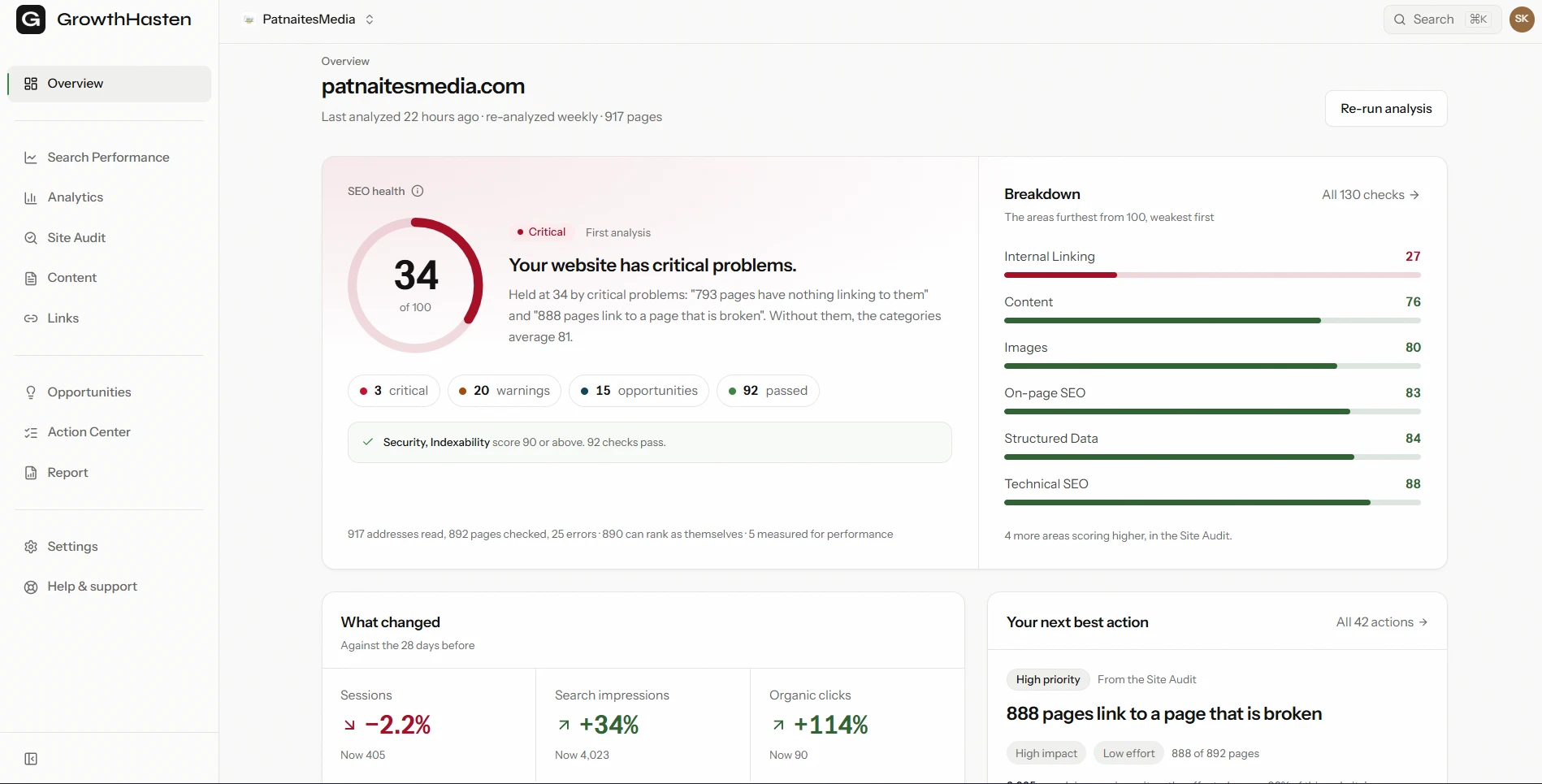
Connect Search Console and GrowthHasten's Content section puts every page's word count beside its clicks, flags the pages losing traffic and the pages competing for the same search, and groups topics as covered, partial or missing against what you already publish.
Explore the Content SectionQuestions
Frequently asked questions
What is YouTube SEO?
YouTube SEO is the work of optimizing a video and its channel so YouTube's search and recommendation systems surface it to the right viewers. YouTube's documentation describes search results as ranked on how well the title, description and video content match the query, together with which videos drive the most engagement for that search. It is closer to Google SEO than most people expect, though YouTube does not publish how the two groups of signals are weighted.
Do tags still affect YouTube rankings?
Barely. YouTube's own documentation states that tags play a minimal role in a video's discovery, and that the title, thumbnail and description are the more important pieces of metadata. Tags are useful mainly when the content of your video is commonly misspelled. Spending time building long tag lists at the expense of your title, thumbnail, or the first thirty seconds of the video is a poor trade.
How do you get a video to rank in Google and not just YouTube?
Appearing in Google's video results is a separate outcome with its own requirements. The video needs to sit on a crawlable watch page where viewing that single video is the primary purpose, that page has to be indexed and performing in Search, and the video should carry VideoObject structured data with a thumbnail Googlebot can reach. Google states plainly that an indexed watch page does not mean the video itself is indexed.
How long should a B2B product demo be?
Long enough to answer the question the viewer arrived with, and no longer. Retention advice built for entertainment content pushes creators to cut aggressively, which can strip a walkthrough of the exact detail that made it worth watching. YouTube notes that absolute watch time matters more for longer videos, so a twelve-minute demo holding viewers for six minutes is not failing. Add chapters so people can skip rather than trimming the substance.
Does YouTube SEO still matter in 2026?
Yes, for discovery. YouTube ranks search results on how well a video matches the query and on engagement, which is exactly the situation a B2B team is in: reaching someone who does not yet know your video exists. What has changed is that search is only one surface among several, alongside the homepage, feeds and suggested videos. YouTube does not publish how those surfaces compare in volume, so measure your own traffic sources rather than assuming.

Written by
GrowthHasten Team
Editorial Team, GrowthHasten
Articles from the GrowthHasten editorial team, grounded in primary research, our own testing, and what analyzing real websites shows, fact-checked in-house.
View profile