
Podcast SEO is the work of making an audio show findable through search engines and AI answer engines rather than only through podcast apps. The phrase is muddy in practice, since a good share of the results for it are podcasts about SEO, so start with the distinction: this is search optimization for a show you produce. It is written for a B2B software company running a podcast as a demand asset rather than as a media business, because almost every guide on the subject is written for a creator whose success metric is downloads. Search will not move that metric much. What it will do is put long-form indexed text on a domain you own, across three surfaces that behave nothing alike.
The short version
- Podcast SEO is three separate problems on three separate surfaces. Advice that mixes them is why so much of it contradicts itself.
- Search will not grow your listener count. It grows the number of long-tail queries your own domain answers.
- The transcript is the asset. It is the only part of a podcast a search engine or an AI answer engine can actually read.
- The surface you control is your own episode pages. Apple Podcasts, Spotify and YouTube are platforms you rent.
- Your show notes will exist in five places at once, and you can set a canonical tag on exactly one of them. Plan for that asymmetry before you publish, not after.
What is podcast SEO, and what is it actually for?
Getting the text around your show indexed. Not the audio. A search engine cannot listen to a 40-minute conversation, so everything it ranks about your podcast is text you wrote or text you transcribed: the episode page title, the show notes, the transcript, and the metadata in your RSS feed.
That mechanical fact is where creator advice and B2B advice split. A creator optimizes for discovery inside podcast apps, because a new subscriber is the win. A B2B company already has a list, a newsletter and a sales team, so the show's job is different: it produces expert conversation at volume, and that conversation is raw material for pages that answer buyer questions.
The arithmetic is straightforward. A 40-minute conversation transcribes to roughly 5,000 words at normal speaking pace, so forty episodes puts something on the order of 200,000 words of on-topic text on your domain, in the vocabulary practitioners use rather than the vocabulary marketers use. Some of it will rank for long-tail questions nobody at your company would have thought to target. Some of it will get quoted by an AI answer engine. Almost none of it will produce a new listener from Google, and a guide that promises otherwise is selling the wrong outcome.
Where can a podcast actually be found?
On three surfaces, and they share almost nothing. Google web search ranks your episode pages. In-app search inside Apple Podcasts and Spotify ranks records built from your RSS feed, using signals neither company documents. AI answer engines quote text, which in practice means your transcript. Nearly every tip worth following applies to exactly one of these three, which is why generic tip lists contradict themselves.
| Surface | What actually gets ranked | What you control | What you do not |
|---|---|---|---|
| Google web search | The episode page on your own domain. Never the audio file. | URL, page title, headings, transcript, internal links, structured data, page speed | Whether Google prefers a platform page over yours for queries on your show's own name |
| In-app search (Apple Podcasts, Spotify) | The show and episode records the apps build from your RSS feed | Feed metadata: show title, episode titles, descriptions, categories, artwork, transcript tag | The ranking logic, which is undocumented, and whatever weight subscriber and completion behavior carries |
| AI answer engines | Passages of text a model can retrieve and quote | Whether a full transcript exists in crawlable HTML on a page you own | Which passage gets selected, and whether the answer credits you with a link |
One move per surface is worth more than a checklist of twenty.
Google web search: Publish the full transcript in crawlable HTML on your own episode page, with real headings rather than bolded lines.
In-app search: Write episode titles as plain descriptions of the subject. Feed metadata is close to the only signal these apps have for matching a typed query against your show.
AI answer engines: Break the transcript with question-shaped subheadings, so every retrievable passage has an obvious question attached to it. Our guide to how AI answer engines choose what to quote covers the retrieval mechanics behind that.
What does the RSS feed control, and what does it not?
It controls everything the apps know about your show, and nothing about how they rank it. Apple Podcasts, Spotify and every other directory build their own copy of your show from a feed you publish, which makes the feed the only lever on that surface. Three things in it matter.
- Stable identifiers: Every episode needs a globally unique
<guid>that never changes, and the feed has to stay publicly reachable without a password. Change a GUID and apps read the episode as a brand new one. - Descriptive episode titles: "Pricing models for usage-based SaaS" is matchable. "Episode 47: Dave's back" is not. In-app search has your title, your description and your categories to work with, and very little else.
- A transcript tag: Apple Podcasts generates a transcript automatically for every new episode, and ingests your own from the feed's RSS transcript tag when you supply one. Listeners can then read the episode text, search it for a phrase, and tap a line to play from that point.
What the feed does not give you is reporting. You cannot see which in-app queries surfaced your show, and neither platform publishes how its search ranks. Treat the feed as hygiene you get right once, not a channel you tune.
Why is the transcript the whole asset?
Because it is the only part of a podcast that exists as text. An episode page without one is a title, two paragraphs of show notes and an embed, which is thin content with a player on it. That page will rank for your show's name and not much else.
A transcript changes that completely. It turns a conversation into several thousand words of subject-matter text in the phrasing your buyers actually use, including the long-tail formulations a keyword tool would never surface because nobody searches them often enough to register a volume.
Full transcript versus summary: Full, in almost every case. A summary is a paraphrase written by a marketer; a transcript is what a practitioner actually said, which is both more specific and more quotable. The honest exceptions are an episode where the conversation wandered badly, audio too poor to transcribe accurately, or a guest saying something your legal team would rather not host in text. A lightly cleaned transcript is still a transcript. A 200-word recap is not.
Structure it or it stays unread: Five thousand unbroken words serve nobody. Break the transcript at the natural topic changes and write each subheading as the question that section answers. Those subheadings are what a retrieval system matches against, and what a human scans before deciding to read.
Speaker labels, timestamps that jump the player, and a short takeaways block above the transcript all help. What does not help is leaving the only transcript on a platform. Spotify expects transcripts uploaded through its own creator tools as VTT or SRT files rather than read from your feed, and an uploaded one is replaced if auto-generated transcripts are switched on. A copy that lives on a platform is a copy you do not own.
What does a B2B episode page need?
Nine things, and a creator-growth checklist gets about half of them wrong. This is the anatomy when the goal is pipeline rather than downloads.
- A URL on your own domain: Something like
/podcast/episode-slug, at a path rather than a subdomain, and not a host-provided page atyourshow.hostingcompany.com. - A page title that describes the subject: The feed title and the page
<title>do not have to match. The feed title serves in-app browsing; the page title serves search. - The full transcript in HTML: Present in the rendered page, not hidden behind a click or injected by a widget a crawler may never execute.
- Question-shaped subheadings: Real
<h2>and<h3>elements at the topic changes, written as questions rather than as timestamps. - An embedded player: Embedded, so the page is the destination. A page that links out to Spotify has already sent its reader away.
- A guest block with entity markup: Name, role, company, and a link to their profile. This is how an episode page connects to people search engines already recognize.
- One internal link to the page the episode discusses: If the conversation was about migration tooling, link the migration solution page. One relevant link beats six generic ones.
- A takeaways list above the transcript: Four or five specific claims from the conversation, as complete sentences. This is the block most likely to be quoted.
- A link to a related episode or cluster page: Episode pages orphan themselves easily. Something other than the archive index has to point at them.
What to leave out: Subscribe buttons for eleven platforms, a review request, a keyword-stuffed tag cloud, and an auto-generated "key moments" list that reads like machine output. None of them earn their space on a page whose job is answering a question.
Where should episode pages live, and which copy is canonical?
On your own domain, and the canonical question has an uncomfortable answer: you can only set it on the copy you own. Publish one episode and your show notes exist in five places within a day, on your site, on Apple, on Spotify, on YouTube and on your host's player page. Exactly one of those is a page whose <head> you control.
| Copy of the episode | Can you set a canonical? | The practical move |
|---|---|---|
| Your own episode page | Yes | Self-canonical. This is the master copy, and it is the one that carries the full transcript. |
| Your podcast host's player page | Sometimes. A few hosts expose a canonical field or a noindex toggle. | Point it at your page if the setting exists. If it does not, ask, and weigh the answer at renewal. |
| Apple Podcasts and Spotify | No | Accept it. Keep the platform description short so your page holds the depth. |
| YouTube | No, and it is a separate index anyway | Treat it as its own surface rather than as a duplicate to suppress. |
This is not the classic duplicate content problem, because platform copies rarely outrank you for anything except your show's own name. It is a dilution problem. If an identical full transcript sits on five domains, the version that gets ranked or quoted is as likely to be the one on a high-authority platform as the one on yours, and you have no lever to argue otherwise.
The rule that works is asymmetry: the copy on your domain gets the full transcript, the takeaways, the internal links and the guest markup. The syndicated copies get two paragraphs and a link back. You cannot win a canonical argument you are not allowed to have, so the better play is not creating the duplicate at all. Our guide to choosing which URL is the master copy covers the mechanism for the pages where you do control the head.
Not Sure If Your Episode Pages Are Even Indexable?
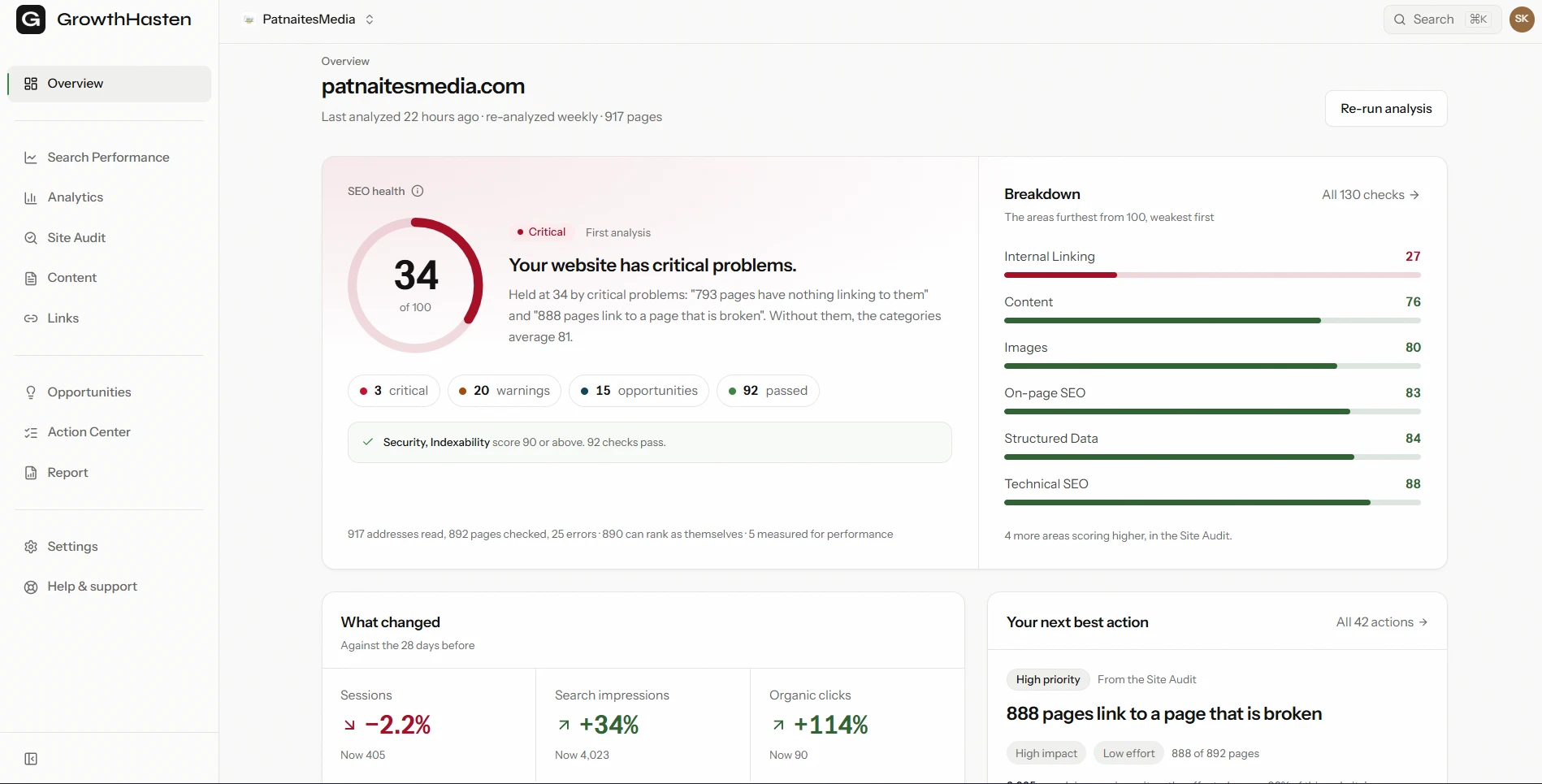
GrowthHasten's Site Audit crawls your site the way a search engine would and reports on indexability, canonical tags and structured data, page by page. Free plan, no card.
Explore the Site AuditDoes podcast schema markup still do anything?
Less than most guides imply, and the honest answer has changed. Checked against Google's gallery of structured data types that Search supports on 20 August 2026, there is no podcast entry at all. Article, Video, Recipe, Q&A, Event and roughly twenty others are listed. Podcast, PodcastSeries and PodcastEpisode are not. Any advice promising a podcast rich result or an audio player in the search results should be treated as out of date until you can find it in that gallery yourself.
The vocabulary itself is real and current. Schema.org defines PodcastEpisode as a subtype of Episode, with partOfSeries pointing at a PodcastSeries, associatedMedia for the audio file, and timeRequired for duration in ISO 8601 form. Marking up episode pages with it is still worth the hour, for a reason that has nothing to do with rich results: it states, in machine-readable form, that this page is one episode of a named series, published on a date, featuring a named person. That is exactly the disambiguation an entity-driven index and a retrieval system both benefit from.
What to actually ship: PodcastEpisode for the episode, Person for the guest, Organization for your company, every property consistent with what a human sees on the page. Our guide to structured data in JSON-LD covers the format, so this page will not repeat it. What not to do is add markup for a search feature you have not verified exists, because Google's handling of podcast content has changed more than once and the check takes two minutes.
What if the show is video-first?
Then this is the wrong guide for the main event. A show recorded for video, published to YouTube first and distributed as audio second is a video property with a podcast feed attached, and its discovery problem belongs to YouTube's ranking system rather than Google's web index. Video-first shows belong on YouTube, and that guide treats the surface properly.
The episode page advice above still applies to the audio side. Publish the transcript on your own domain either way, because a YouTube caption file is text on YouTube's domain, not yours.
How do you know if any of it worked?
Through the pages, never through the show. Podcast platforms report very little back to a publisher, and what they do report is about listening rather than about discovery. Measure what your own analytics can genuinely see.
What you can measure: Organic sessions to /podcast/* pages. The set of queries those pages appear for in Search Console, and how it grows as the transcript library grows. Impressions on long-tail questions your marketing pages never targeted. Assisted conversions where an episode page was an early touch. Whether the pages are indexed at all, which is worth confirming before diagnosing anything else.
What you cannot measure: Which in-app searches surfaced your show. Whether a download came from search, a newsletter or a guest's own audience. Whether an AI answer engine used your transcript without citing it. Attribution from a podcast app through to a pipeline record does not exist, and a tool promising it is modeling rather than measuring.
The one number worth watching: unique queries per episode page, tracked over six months. If it climbs, the transcripts are working. If it sits flat at three or four branded variants, the pages are not carrying enough distinct subject matter, and the fix is better episode subject selection rather than more markup.
When is podcast SEO not worth it?
More often than the vendor blogs on this query suggest. Three cases where the work does not pay for itself.
- Fewer than about ten episodes: The value compounds with the size of the transcript library, and the setup cost of a page template, a schema block and a transcription workflow is roughly the same whether you have ten episodes or a hundred.
- No transcription budget and no owner: Without transcripts there is no asset, and the SEO layer collapses to metadata. If transcription is neither funded nor assigned to a named person, the honest decision is to skip this work and run the podcast as a relationship channel, which is a perfectly good reason to have one.
- An audience that does not search for the subject: Some shows exist to build affinity with people who already know you, on topics that are cultural rather than problem-shaped. There are no queries sitting underneath "conversations with interesting founders," and no amount of markup creates them.
There is a sequencing point too. If your solution pages, comparison pages and core cluster articles are not built yet, episode pages are the wrong place to spend content effort, because they sit further from a buying decision than almost anything else you could publish. Podcast SEO belongs inside the wider distribution model, not ahead of it.
The habit worth building is small and unglamorous: publish the transcript with the episode, every time, on a page you own, before the episode reaches the platforms. Everything else here is downstream of that one behavior.
This week, pick your three best episodes and check two things. Is the full transcript on your own domain in readable HTML, and is the page in Google's index? If either answer is no, that is your entire backlog for the quarter, and turning it into a repeatable publishing routine is what a content marketing system is for.
See Which Pages to Write, Refresh or Leave Alone
Connect Search Console and GrowthHasten's Content section puts every page's word count beside its clicks, flags the pages losing traffic and the pages competing for the same search, and groups topics as covered, partial or missing against what you already publish.
Explore the Content SectionQuestions
Frequently asked questions
What is podcast SEO?
Podcast SEO is the work of making a podcast findable through search rather than only through podcast apps: episode pages and transcripts a search engine can index, feed metadata that in-app search can read, and text an AI answer engine can quote. For a business podcast, most of the return comes from the indexable text you publish on your own domain, not from the audio file itself.
Do podcast transcripts help SEO?
They are the main mechanism. Audio is not indexable text, so without a transcript there is almost nothing on an episode page for a search engine or an AI answer engine to read. A full transcript on a page you own turns a 40-minute conversation into several thousand words of long-tail-relevant text, in the vocabulary practitioners actually use. Transcripts are the precondition for ranking, not a guarantee of it.
Where should podcast episode pages live?
On your own domain, at a path rather than a subdomain, with the player embedded rather than linked. Platform pages on Apple Podcasts or Spotify build those platforms' authority; a page you own builds yours, and it is the only copy where you control the internal links, the structured data and the canonical tag.
How do I avoid duplicate content across Apple, Spotify and my own site?
Publish the authoritative version, including the full transcript, on your own site first, and keep the syndicated copies short. You cannot set a canonical tag on a platform you do not own, so the practical lever is asymmetry: give your own page the transcript, takeaways, internal links and guest markup that the platform copies do not have.
Does PodcastEpisode schema markup earn a rich result in Google?
Not according to Google's own documentation. Checked on 20 August 2026, Google's gallery of supported structured data types lists no podcast entry. Schema.org still defines PodcastEpisode and PodcastSeries, and the markup remains useful for machine-readability and entity clarity, but treat any claim of a podcast rich result or an in-search player as out of date until you verify it in that gallery.
How do you measure whether podcast SEO worked?
Through the episode pages, not the show. Organic sessions to episode pages, the long-tail queries those pages start appearing for in Search Console, and assisted conversions are all measurable. Download counts and in-app discovery largely are not, because podcast platforms report very little back and no attribution path runs from a podcast app to a pipeline record.
Tags

Written by
GrowthHasten Team
Editorial Team, GrowthHasten
Articles from the GrowthHasten editorial team, grounded in primary research, our own testing, and what analyzing real websites shows, fact-checked in-house.
View profile