

SEO and AI search are not two competing disciplines. They are two surfaces built on the same web index, the same crawlers, and the same signals of quality and authority. This guide is for marketers, founders, and content leads who keep hearing that "SEO is dead" and want an honest read on what actually changed when AI Overviews, ChatGPT, Gemini, Claude, and Perplexity started answering questions directly. It covers how ranking links differs from generating answers, what shifts for your team, what stays the same, and how to make your pages quotable without abandoning the fundamentals that still do most of the work.
The short version
- AI search runs on the same crawl-index-rank pipeline as classic search. It is a new way to present answers, not a new way to find them.
- The things that ranked you in Google (useful content, technical health, authority, and a match to intent) are the same things that get you cited by an AI answer engine.
- What is genuinely new: zero-click answers, citations and brand mentions as a form of currency, and how cleanly a single passage can be lifted and quoted.
- Schema markup helps machines parse your page. It does not buy you a citation. Nothing does.
- Chasing AI visibility before your content can rank in ordinary search is usually premature.
Is AI search replacing traditional SEO?
No. It is adding a layer on top of it. AI answer engines still need to find, read, and trust web pages before they can summarize them, and they find those pages the same way Google always has: by crawling the web and building an index.
Think of it as a change in the shop window, not the warehouse. The warehouse (the crawled, indexed, quality-assessed web) is shared. AI Overviews and chat assistants are one more way of arranging what is already on the shelves. A page that no crawler can reach and no index contains cannot be ranked and cannot be quoted. Both outcomes start from the same requirement.
Our AI SEO guide goes deeper on optimizing specifically for answer engines, and our complete SEO guide covers the foundation both surfaces sit on.
How do Google Search and AI answer engines retrieve and present answers differently?
The retrieval is similar; the presentation is where they split. Google returns an ordered list of links and lets the person choose. An AI engine retrieves candidate passages, then a model selects and rewrites them into a single answer, sometimes with citations and sometimes without. The table below maps the real differences against the parts that stay shared.
| In classic search (ranking links) | In AI answers (generated responses) | The shared foundation |
|---|---|---|
| Retrieval. Google crawls the web and builds an index of pages it can reach and render. | Engines pull passages from an index (their own, or a search partner's) at the moment you ask. | Your page must be crawlable, indexed, and free of blocking directives before either can use it. |
| Ranking. Algorithms order results by relevance, quality, and authority. | A model chooses the passages it judges most relevant and trustworthy, then synthesizes them. | Relevance to intent and demonstrated authority decide who gets surfaced. |
| Presentation. A list of links the reader scans and clicks. | One written answer, occasionally with a handful of cited sources. | Clear, well-structured content is easier to rank and easier to quote. |
| What success looks like. A click through to your page. | A citation or brand mention that may never produce a click. | Being the source an answer is built from still means being the best source. |
| What you optimize. Titles, intent match, internal links, page experience. | Self-contained passages a model can lift without distortion. | Accurate, genuinely useful content underneath all of it. |
Google's documentation on how Search works describes the crawling, indexing, and ranking stages in detail, and our explainer on how Google Search works translates them into plain language.
What actually changes for marketers?
Four things change, and none of them replace your existing work. They sit alongside it.
- Zero-click answers. When an AI Overview or assistant answers a question outright, the informational click you used to earn may not happen. Top-of-funnel "what is" queries are the most exposed.
- Citations become a currency. Being named as a source in an answer builds awareness and trust even without a visit. It is closer to earned media than to a ranking, and Reddit is one of the clearest examples: a deliberate Reddit marketing strategy can earn exactly that kind of citation.
- Brand mentions matter more. Answer engines surface brands they encounter often and in credible contexts. Being talked about across the web starts to influence whether you show up.
- Extractability becomes a skill. A page can rank well and still be hard to quote. Writing passages that stand on their own is now part of the job.
Based on our experience, the teams that adapt fastest treat these as additions to a working SEO program, not as a reason to tear one down. They also spend very little time on the vocabulary: our guide to what the difference between AEO and GEO actually changes covers why those labels are a convention rather than a specification, and which of the two halves of the work is worth checking first.
What stays exactly the same?
Most of it. The levers that mattered before still carry the load, because AI engines are drawing from the same web and rewarding the same signals.
- Quality content that satisfies intent. Answer the real question completely. This is what earns both rankings and citations.
- Technical health. Crawlability, indexability, and rendering decide whether your content exists as far as any engine is concerned.
- Authority and trust. Recognized expertise and credible links still separate the sources an engine reaches for from the ones it ignores.
- Search intent. Matching the format and depth a query calls for has not changed at all.
Google's Search Essentials still describe the baseline for being eligible to appear, and none of it has been retired for AI.
Which myths about AI search should you drop?
Four come up constantly, and each one leads teams to waste effort.
"SEO is dead." It is not. The channel is broadening, not closing. Search behavior is spreading across Google, AI Overviews, and assistants, and every one of those still depends on indexed, trustworthy pages. Declaring SEO dead and stopping the work is how you disappear from all of them at once.
"Add schema and you will get cited." Structured data helps machines understand what a page contains, and it supports rich results. It is not a citation lever. We have observed no reliable path from "added markup" to "quoted by an assistant." Schema earns you nothing if the content underneath is not the best answer available.
"Keywords do not matter anymore." They matter differently. You are no longer stuffing an exact phrase; you are covering a topic and its related entities thoroughly enough that a model recognizes your page as being about that thing. Language and intent still anchor everything: the tactic changed, not the principle.
"Watermarked AI content will be demoted." Model providers now embed machine-readable marks in their output, and the assumption that Google will use those marks to filter results has spread faster than any evidence for it. No published Google documentation connects watermark detection to ranking. Our guide to AI content watermarking covers what a detected mark actually proves and where the real obligations sit.
How do you make a page quotable by AI engines?
Write passages that survive being lifted out of the page. An assistant quoting you will rarely take the whole article; it takes a sentence or a short block, so each block has to make sense alone. Our full guide runs a pass/fail test for a quotable passage against six checks, not just the four covered here.
- Answer first, then expand. Put the direct answer in the first sentence under each heading. This is the same instinct that wins featured snippets.
- Use question-shaped headings. They match how people ask assistants and make each section a self-contained unit.
- Define terms in place. Do not assume the reader arrived from your introduction. A quoted passage carries no context but its own.
- State facts cleanly and attribute them. A sentence with a clear, checkable claim is easier to trust and reuse than a vague one.
- Structure with tables and lists. Comparisons and steps are easy for a model to parse and repeat accurately.
Our guide to content marketing for SEO shows how to build this into an editorial process rather than bolting it on afterward.
A framework: what to keep, what to add, what to stop worrying about
Use this to sort your effort as AI search grows. It keeps you from over-rotating toward a new surface while your foundation quietly erodes.
| Keep doing | Add | Stop worrying about |
|---|---|---|
|
|
|
The pattern is deliberate. Almost everything in the "add" column is an extension of something in the "keep" column, not a replacement for it.
When is chasing AI visibility premature?
When you cannot yet rank in ordinary search. AI engines draw heavily from pages that already perform, so if your content is not indexed, is not trusted, or does not answer the query well, optimizing it for citations is optimizing a page nothing will surface anyway.
Hold off on a dedicated AI-visibility push when any of these are true:
- Your important pages have crawl, index, or rendering problems. Fix the foundation first.
- Your site has little topical authority yet. Assistants reach for sources they already treat as credible.
- Your audience is not using AI search for your topic. Some commercial and local queries still happen almost entirely on classic search.
Our recommendation is simple: earn ordinary rankings first, then make the winning pages more quotable. The order rarely reverses successfully.
How do you measure AI visibility?
Imperfectly, and that is worth admitting up front. There is no equivalent of Search Console for AI answers yet, so measurement leans on a mix of methods rather than one clean dashboard.
The practical approaches available today:
- Prompt testing. Ask the assistants the questions your audience asks and record whether you appear, and how you are described. Repeat it on a schedule. Answers vary between runs, so a fixed, repeatable prompt set matters more than any single check; our vendor-neutral framework for measuring AI search visibility covers how to build and run one.
- Brand-mention and AI-visibility tools. Several SEO platforms now track how often a brand surfaces in AI answers. Treat the numbers as directional, not precise, because the underlying systems change often.
- Referral traffic from AI sources. Some assistants pass a referrer, so a slice of AI-driven visits shows up in analytics. It undercounts, but a rising trend is still a signal.
Track the direction over months, not the exact figure on any given day. The measurement layer is young, and anyone quoting you a precise "AI market share" is guessing.
The one habit worth building: keep the foundation strong, then make your best pages easier to quote, in that order, every time. This week, take your three highest-value pages, read the first sentence under each heading, and rewrite any that do not answer the heading on their own. That single edit improves both your snippet chances and your odds of being cited, and it costs you an afternoon. If you'd rather bring in a specialist for this work, our guide to hiring an AI SEO agency sets out how to vet one.
Can AI Crawlers Reach Your Pages?
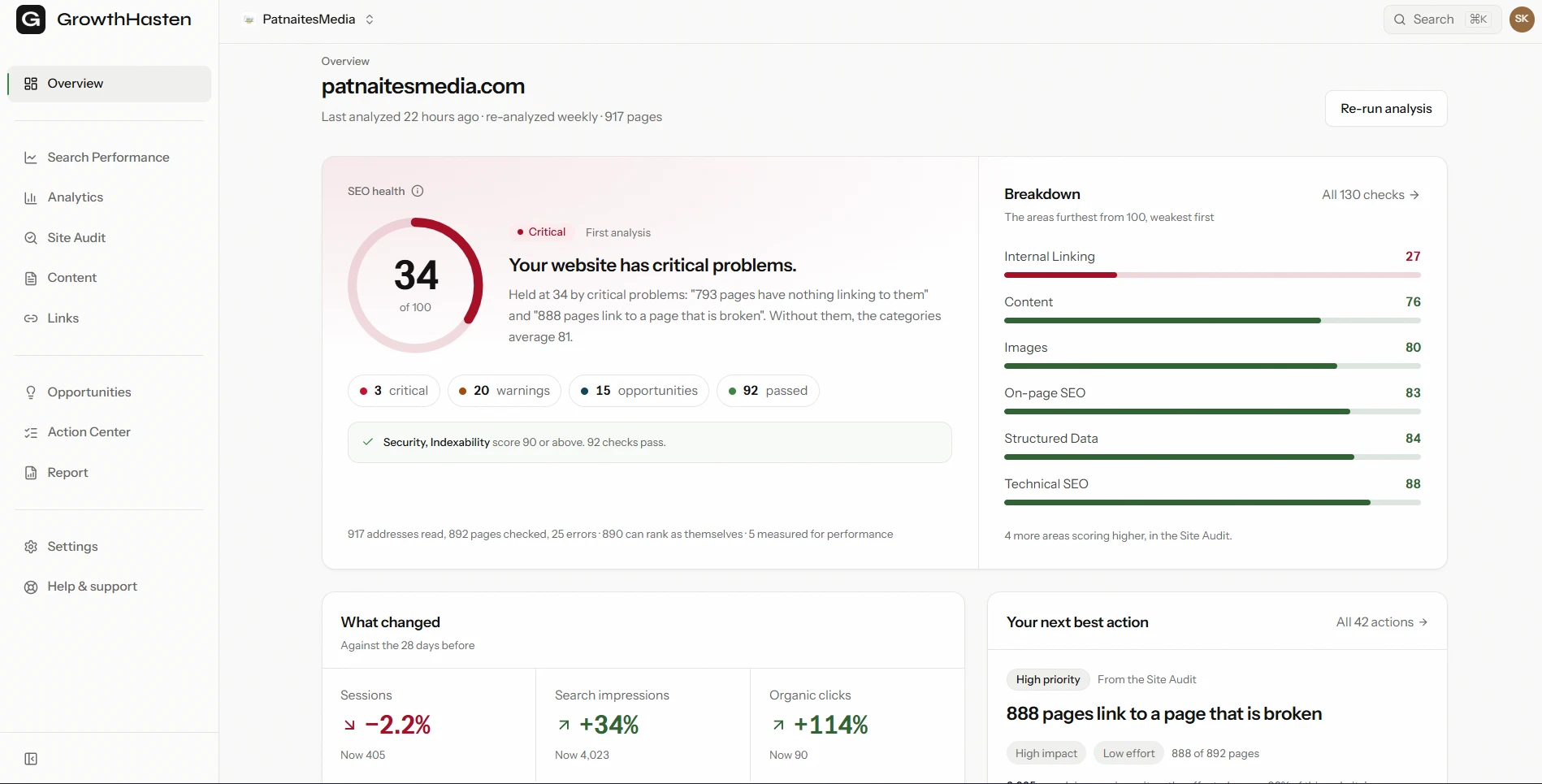
GrowthHasten's Site Audit includes an AI Accessibility category that checks whether robots.txt lets the crawlers behind ChatGPT, Claude, Perplexity and Google's AI answers fetch your pages, alongside 130+ other deterministic checks. Free plan: one website of up to 900 pages, no card.
Analyze Your WebsiteQuestions
Frequently asked questions
Is SEO dead because of AI search?
No. AI search depends on the same crawled, indexed web that traditional SEO serves, so the fundamentals still decide who gets surfaced. What is changing is where answers appear: alongside Google results, you now have AI Overviews and assistants like ChatGPT, Gemini, Claude, and Perplexity. Each one still needs trustworthy, indexed pages to draw from. Stopping SEO work removes you from all of those surfaces at once.
Does adding schema markup guarantee I will be cited by AI?
No. Schema markup helps machines understand what a page contains and supports rich results in Google, but it is not a citation lever for AI answers. We have seen no reliable path from adding markup to being quoted by an assistant. Citations follow from being the clearest, most trustworthy answer to a question. Markup can support that, but it cannot substitute for content that genuinely deserves to be the source.
Do keywords still matter for AI search?
Yes, but the tactic has shifted. You are no longer repeating an exact phrase to hit a density target. You are covering a topic and its related entities thoroughly enough that a model recognizes your page as authoritative on that subject. Language, search intent, and how people phrase questions still anchor everything. Think in terms of complete topic coverage and clear terminology rather than keyword counts.
Does AI search change what I should work on first?
Rarely. The order stays the same: make pages crawlable and indexed, make them genuinely answer the query, then earn the authority that makes an engine reach for you. AI answers draw on the same index and reward the same signals, so a page that cannot rank in ordinary search is not a page an assistant will quote. What changes is the finishing layer, not the sequence.
How can I tell if AI tools are citing my content?
There is no single dashboard yet, so combine methods. Ask the assistants the questions your audience asks and note whether you appear and how you are described, repeating it on a schedule because answers vary. Use brand-mention and AI-visibility tools for directional trends, and watch analytics for referral traffic from AI sources. Track the direction over months rather than trusting any precise figure, since the measurement layer is still young.

Written by
GrowthHasten Team
Editorial Team, GrowthHasten
Articles from the GrowthHasten editorial team, grounded in primary research, our own testing, and what analyzing real websites shows, fact-checked in-house.
View profile