

AI content watermarking is a hidden signal embedded in generated text or files that lets a detector check whether a model produced them. Anthropic began adding one to Claude's output in August 2026, and much of the SEO industry read the news as though Google had just been handed a penalty switch. It was not. This guide covers what the mark is, what a detection actually proves, what Google's published guidance says about AI content, and the small number of places where watermarking genuinely changes how you should work.
The short version
- A detected mark shows content may have been processed by Claude, not that a machine wrote it. Pasting your own draft in for an edit can leave a mark too.
- Google's published guidance judges content on quality and value, not on how it was produced. No Google documentation ties watermark detection to ranking.
- Absence of a mark proves nothing. Only some providers mark their output, only newer models carry it, and editing or translation degrades the signal.
- The genuine obligations here are regulatory and contractual, not algorithmic.
- Nothing in the announcement changes what actually decides rankings: whether the page is worth reading.
What did Anthropic actually announce?
A transparency measure, not a quality rating. According to Anthropic's documentation on how Claude marks AI-generated content, Claude models launched on or after 2 August 2026 support machine-readable marking at launch, and the company is working to add support to earlier models.
Two different mechanisms are involved, and conflating them causes most of the confusion:
- Text: an imperceptible watermark embedded directly into the text itself. Anthropic states it does not change the meaning, quality, or readability of the output.
- Files: signed provenance metadata attached to supported file types (
.svg,.png,.jpg), following the Coalition for Content Provenance and Authenticity (C2PA) open standard.
The marking applies across Claude Platform (API), Claude, Claude Code, Claude Cowork, and Claude Tag, including deployments on AWS, Google Cloud, and Microsoft Foundry. It applies worldwide rather than only in Europe.
Why is this happening now?
Regulation, specifically Article 50 of the EU AI Act. Article 50(2) requires providers of generative AI systems to ensure outputs are marked in a machine-readable format and detectable as artificially generated or manipulated, using solutions that are effective, interoperable, robust and reliable as far as is technically feasible. That obligation applies from 2 August 2026, the same date Anthropic used for its model cutoff.
Anthropic is not alone in this direction. Google DeepMind has run SynthID across Gemini text, images, audio, and video for some time, using the same broad approach for text. The useful read is that watermarking is becoming a compliance baseline for model providers, not a competitive move aimed at publishers.
How does an invisible text watermark work?
By biasing word choice in a pattern a detector can recognize, without changing what the text says. A language model assigns a probability to each possible next word. Watermarking nudges those probabilities so the finished text carries a faint statistical fingerprint, spread across the whole passage rather than hidden in any single word. DeepMind describes SynthID in precisely these terms: it adjusts the probability scores assigned to each generated word.
Two consequences follow directly from that design, and they explain nearly every limitation below. The signal is statistical, so it needs a reasonable volume of text to register. And it lives in the specific word sequence, so anything that rewrites the sequence weakens it.
What does a detected watermark actually prove?
Considerably less than the headlines suggested.
| The common claim | What the mark supports |
|---|---|
| "This proves a machine wrote it" | No. Anthropic's wording is that detection tells you content may have been processed by Claude, and is not fully conclusive about original authorship. Editing your own writing in Claude can leave a mark on work you wrote. |
| "No mark means a human wrote it" | No. Anthropic states explicitly that the absence of a detectable mark does not mean content was not AI-generated. |
| "It identifies who generated it" | No. The documentation describes no mechanism for identifying a specific user or account. |
| "It is permanent" | No. Heavy editing, paraphrasing, translation, or mixing into other writing can degrade it, and very short passages may carry too little signal. File metadata can be lost through format conversion, re-saving, or screenshots. |
That first row is the one worth sitting with. The mark records processing, not authorship. A researcher who writes an article herself and asks Claude to tighten the prose may end up with marked text, while a fully generated article that has been through a translation pass may not. Any policy that treats a detection as proof of machine authorship will produce false accusations in both directions.
Does Google penalize AI-generated content?
No, and its published guidance has been consistent on this point. Google's documentation on generative AI content directs creators to the Search Essentials and the spam policies rather than to any AI-specific rule. What it does warn about is scale without value: using generative tools to produce many pages without adding value for users may violate the spam policy on scaled content abuse.
Google also recommends, rather than requires, disclosure. Its guidance suggests that sharing information about how a piece of content was created can give readers useful context. That is an editorial recommendation, not a ranking condition.
The distinction that matters: Google's systems are asking whether a page is useful, original, and trustworthy. A watermark answers a different question entirely, which is where the text came from. Our guide to using AI content without hurting rankings covers the workflow side of that in depth.
Could Google use a watermark as a ranking signal?
It could read one. Building ranking on it would be a poor system, for reasons that have nothing to do with policy statements.
- Coverage is partial by design: only participating providers mark output, and only their newer models. A demotion tied to detection would fall hardest on the users of providers that complied with transparency rules early, and miss everyone using an unmarked model entirely.
- False negatives are the normal case: a light rewrite, a translation, or a mix of sources weakens the signal. Such a system would not separate good pages from bad ones. It would separate lightly edited AI text from heavily edited AI text, which is not a quality distinction.
- Google already has stronger signals: it sees the full page, the site around it, the link graph, and how people behave in results. A single provenance bit adds very little to that picture.
- It would contradict its published guidance: Google has repeatedly framed its position as being about content quality rather than production method.
Being honest about the limits of that reasoning: Google has not ruled out using provenance signals in writing either. What can be said with confidence is narrower, and it is what you should tell a nervous stakeholder. No published Google documentation connects watermark detection to ranking, and anyone claiming a confirmed watermark penalty is speculating rather than citing.
Where does watermarking actually create risk?
Away from search, mostly. The exposure is real but it sits in contracts and compliance rather than in rankings.
| Context | What changes | Sensible response |
|---|---|---|
| EU-facing products and services | AI Act transparency duties are now live for providers, with related disclosure duties on deployers | Get legal advice on your specific obligations. This is not an SEO decision. |
| Client and agency contracts | A "no AI-generated content" clause becomes something a client can plausibly test | Renegotiate the clause to describe what you actually do, rather than quietly breaching it |
| Publisher, academic, and journalistic submissions | Provenance checks become routine at intake | Disclose your process up front instead of waiting to be asked |
| Marketplaces and UGC platforms | Platform policies may start enforcing against undisclosed AI content | Read the policy for each platform you publish on |
| Google Search rankings | No published change | No action |
Should you stop drafting with Claude?
Not on SEO grounds. Four questions settle it in the order that matters:
- Are you bound by a disclosure rule, platform policy, or client contract? If yes, comply with it. That is a legal and commercial question, and it outranks every other consideration here.
- Does the page carry genuine information gain? If it repeats what ten other pages already say, the watermark is not your problem. The page was always going to struggle.
- Would you put your name on it? Our guide to E-E-A-T for SEO covers why the byline is a claim about where knowledge came from, not decoration.
- Has a human verified every factual claim? This is where AI drafts fail in practice, and no watermark policy affects it either way.
If the answers are no, yes, yes, yes, then nothing about the announcement requires you to change your process.
What should change in your workflow?
Less than the discourse implies, but not nothing.
Worth doing this quarter: Write down your actual AI usage policy, covering which stages use models and which require a human. Check whether any live client contract contains an AI clause you are now at odds with. Decide your disclosure position and apply it consistently rather than case by case.
Worth doing anyway: Keep the editorial gate that catches unverified claims, because that gate was always the one doing the work. Keep human review of every factual statement. Keep asking what each piece adds that competitors do not already cover.
Not worth doing: Rewriting your archive. Buying an AI-detection subscription to police your own writers. Adding an "AI-free" badge you cannot substantiate, which is a trust claim you would have to defend.
If your drafts read mechanically, the fix is an editing pass that adds specificity and cuts hedging, which is the same work described in our guide to humanizing AI content.
Writing With AI? Make It Sound Human.
Paste your draft into GrowthHasten's free AI Humanizer to strip the mechanical phrasing while keeping your meaning, links, and formatting.
Try the AI HumanizerWhat about images and C2PA metadata?
Images work differently, and the difference is practical. Text carries a statistical watermark inside the words. Supported image files carry signed provenance metadata attached to the file, built on the C2PA standard, which records that the file was produced or edited by an AI system.
Metadata is more fragile than a text watermark in one specific way: it survives only as long as the file does. Convert the format, re-save through an editor, or screenshot the image, and the provenance record is typically gone. It is also more visible than a text watermark, because provenance metadata is the kind of thing image platforms can surface to users directly.
For most publishers this changes nothing about image SEO. Alt text, filenames, compression, and licensing remain the things that matter.
What are the common mistakes?
- Treating a detection as proof of authorship: it indicates processing, and the difference will matter the first time someone is accused wrongly.
- Paraphrasing purely to strip the mark: it degrades the signal and usually the prose, and it addresses nothing Google evaluates. If a disclosure obligation applies to you, evasion does not satisfy it.
- Assuming unmarked means safe: a thin, unhelpful page is a ranking problem regardless of what produced it.
- Rewriting an archive on speculation: there is no documented penalty to remediate, and the effort would fund several genuinely useful new pages.
- Ignoring a real contractual obligation because "Google doesn't care": Google is not the party that can terminate your contract.
When does this stop being a non-issue?
Watch for one specific thing: a change in Google's own published documentation, or an announced feature that surfaces provenance labels in results. Provenance labeling in the interface, which affects click behavior, is a far more plausible near-term development than a ranking demotion, and it would be announced rather than inferred. Our guide to ranking in Google AI Overviews covers how interface changes reshape clicks without touching the ranking systems underneath.
The same caution applies to how AI crawlers read your site, which we cover in our guide to AI crawlers and llms.txt. Provenance and crawl control are separate systems, and conflating them leads to fixes aimed at the wrong problem.
Until one of those things happens, the honest position is that a watermark records where text came from, and search engines rank pages on whether they are worth reading. Those remain two different questions.
The habit worth keeping through all of this is the unglamorous one: a human who verifies the claims and adds something the sources did not have. This week, take the last article you published and mark every factual sentence you could not defend with a source. That count tells you more about your ranking risk than any detector will.
See Which Pages to Write, Refresh or Leave Alone
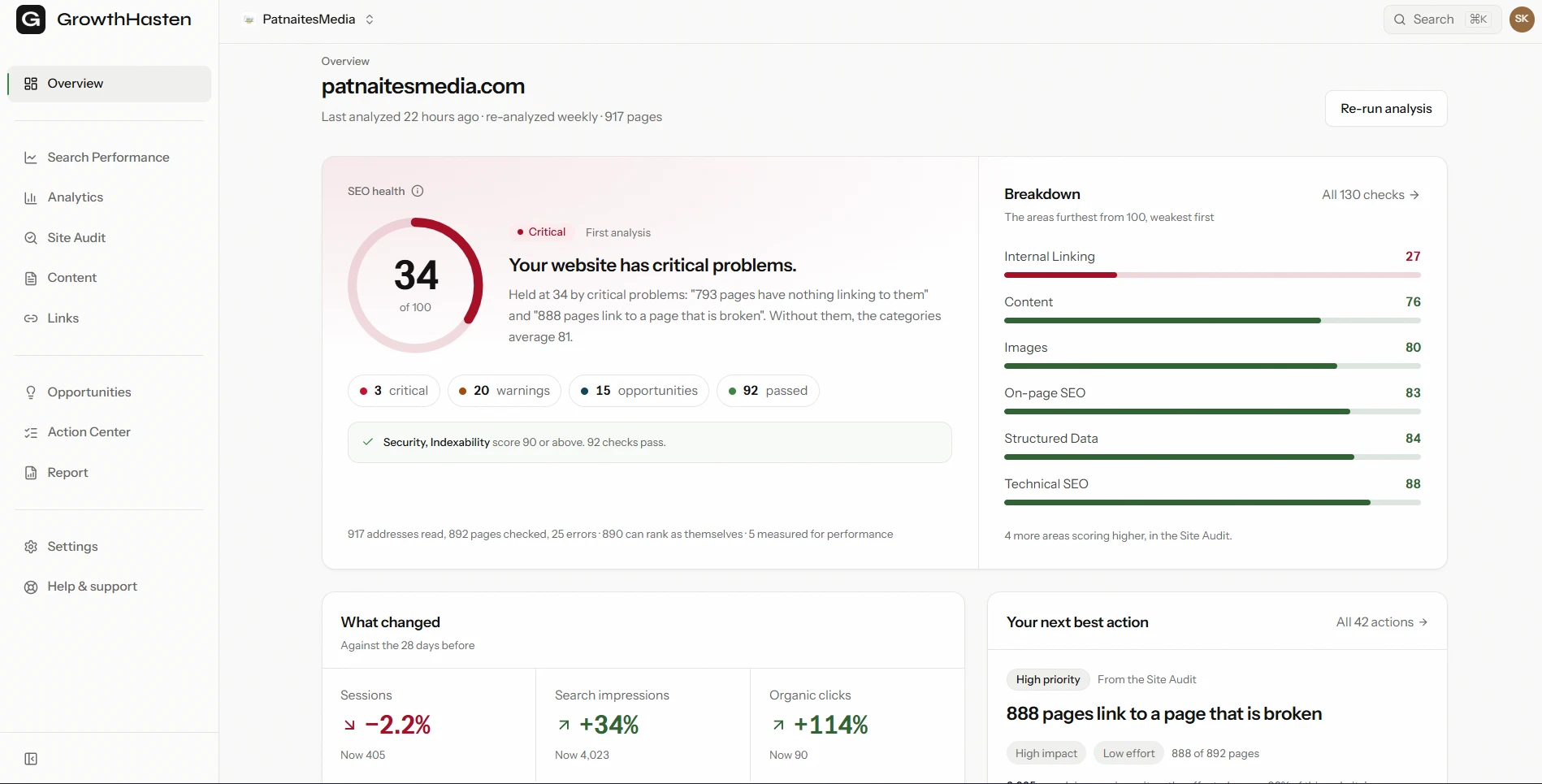
Connect Search Console and GrowthHasten's Content section puts every page's word count beside its clicks, flags the pages losing traffic and the pages competing for the same search, and groups topics as covered, partial or missing against what you already publish.
Explore the Content SectionQuestions
Frequently asked questions
Does Google penalize AI content that has a watermark?
There is no published Google guidance connecting watermark detection to ranking. Google's documented position on generative AI content is that it evaluates quality and value rather than how content was produced, and that using automation to generate many pages without adding value may violate its scaled content abuse policy. A watermark describes origin, not quality, so it does not answer the question Google's systems are actually asking.
Can Google even detect Claude's watermark?
Anthropic has said it will publish details of detection mechanisms in forthcoming technical documentation, so detection is not broadly available yet. Even once it is, coverage would be partial. Only participating providers mark their output, only newer models carry the mark, and editing degrades it. Any system built on that signal would misclassify a large share of the web.
Does editing my AI draft remove the watermark?
It can. Anthropic states the mark may degrade when text is heavily edited, paraphrased, translated, or mixed into other writing, and that very short passages may not carry enough signal for reliable detection. That said, editing to strip a mark is not a content strategy. It changes nothing about whether the page deserves to rank, and it does not satisfy a disclosure obligation you are genuinely bound by.
Does the watermark identify me or my company?
Anthropic's documentation describes the mark as identifying that content may have been processed by Claude. It does not describe any mechanism that identifies a specific user, account, or organization. A detection tells someone which model family was likely involved, not who prompted it. Treat claims that watermarks expose individual authorship as speculation rather than documented behavior.
Should we stop using Claude to draft content?
Not on SEO grounds alone. The decision turns on whether a contract, platform policy, or regulation you are subject to requires disclosure or restricts AI use. If one does, comply with it, because that is a legal question rather than a ranking question. If none does, the thing that determines performance is unchanged: whether the page offers genuine information gain and is accurate enough to trust.

Written by
GrowthHasten Team
Editorial Team, GrowthHasten
Articles from the GrowthHasten editorial team, grounded in primary research, our own testing, and what analyzing real websites shows, fact-checked in-house.
View profile