

Answer engine optimization (AEO) is the practice of writing and structuring a page so an answer engine can lift a complete, accurate answer straight out of it. The acronym is shared with a clothing retailer's stock ticker, so this guide spells the term out. It is written for content, growth and SEO leads who have watched ChatGPT, Gemini, Claude or Perplexity answer their category's questions without once naming their brand. It covers what the term means, why answer engines quote passages instead of whole pages, a six-check test for whether a specific paragraph is liftable, and where Google's own guidance stops applying. Where something here is an observed working model rather than documented behavior, I say so.
The short version
- Answer engines quote passages, not pages. Your best argument can be unquotable for reasons that have nothing to do with how good it is.
- AEO is on-page work with a testable outcome: can this paragraph be lifted out and still answer something specific?
- Nobody has a consensus definition separating AEO from GEO. Anyone selling you a hard boundary between them is selling you a taxonomy.
- Google's own guidance says optimizing for its generative features is still SEO. That statement covers Google's surfaces and nobody else's.
- Structured data is not required for generative AI search, and Google Search ignores
llms.txt. Both are in Google's documentation now.
What is answer engine optimization?
Answer engine optimization is the work of making a passage on your page directly liftable by a system that answers a question in writing instead of returning links. It is on-page work, and its outcome is testable. Take any paragraph out of the page, read it cold, and see whether it still answers something specific. That test is the whole discipline in one move.
AEO does not replace SEO and it does not compete with it. It is a clarity and formatting layer sitting on top of a page that is already crawlable, indexed and topically relevant. Skip the foundation and there is nothing to optimize.
What is an answer engine, and which ones matter?
An answer engine is any system that reads sources and writes the answer for the user: Google's AI Overviews, ChatGPT, Gemini, Claude, Perplexity, and the assistants built on top of them. They differ in which index they draw from and how readily they cite, but they share a two-stage shape: retrieval gathers candidate passages, then a language model reads them and writes an answer, attributing the parts it used.
Which ones matter depends on where your buyers actually ask questions, and most teams do not know yet. Start with the two you can observe: ranking in Google AI Overviews, because it sits on the index you already work with, and whichever assistant your own team reaches for. Our guide to how AI answer engines retrieve and cite sources covers that mechanism in depth, and this article assumes it rather than rebuilding it.
No engine has published its citation formula, so everything mechanical below is a working model checked against behavior, not a specification.
What is AEO vs SEO?
SEO gets a page into the running; AEO decides whether the passage on it can be used once it gets there. The two share almost all of their inputs and differ in what counts as a win. SEO wins a position and a click. AEO wins a quotation, and the click is optional.
| Question | SEO answers this | AEO answers this |
|---|---|---|
| What competes? | The page | The passage |
| What does winning look like? | A position in the results | Your wording inside the answer |
| What breaks it? | Thin content, weak authority, crawl problems | A paragraph that only makes sense in sequence |
The useful reframe is that AEO adds a second reader. The first is a person scanning your page for the answer. The second is a model handed one chunk of that page, without the rest of it, deciding whether the chunk answers the question.
Serve the first reader well and you usually serve the second. Serve only the second and you get a page nobody wants to link to. A passage built to win featured snippets is usually the passage an answer engine quotes, which is why snippet work transfers here almost directly.
Does Google treat this as a separate discipline?
No, at least not on its own surfaces. Google's guide to optimizing for generative AI features states its position directly: "From Google Search's perspective, optimizing for generative AI search is optimizing for the search experience, and thus still SEO."
Read that quote precisely, because its scope is the part people drop. It is Google's position on Google's surfaces. ChatGPT, Claude and Perplexity are not built on Google's index, and Google does not speak for how they select their sources. Our guide to what actually follows from that for Perplexity picks up exactly where this sentence stops.
Which leaves the naming question, and it is a genuine one: this work gets sold as AEO, as GEO, as AI SEO, and as several other acronyms, with no consensus definition separating them. That argument is worth having once and then dropping, so we gave it its own page: our guide to what the difference between AEO and GEO actually changes covers where each term came from, including the KDD 2024 paper that gave GEO a traceable origin, and a two-question test for which half of the work is your constraint. Everything below this point is the on-page half.
Why do answer engines quote passages instead of pages?
Because the unit of retrieval is a passage, not a document. Your article is rarely what reaches the model. What reaches it is one fragment, chosen by a selection step you never see, often stripped of the heading above it.
That has an uncomfortable consequence, and it is where most of the ground sits: quality and quotability are different properties. A page whose argument only resolves in its final paragraph offers an engine nothing to lift, however well made. The page is not the unit you are optimizing here. Each block is.
Worth separating from a myth, though. Google's guidance is explicit that there is "no requirement to break your content into tiny pieces for AI to better understand it," and that you "don't need to write in a specific way just for generative AI search." Neither statement contradicts anything above. Fragmenting a page into stubs is a different act from making each paragraph state what it is about. The first makes the page worse for everyone. The second is ordinary clear writing that happens to survive chunking.
Is your passage liftable? The six-check test
Six checks, each answered pass or fail, run on every block that is meant to answer something. The first four are the quotable test already published in our guide to getting cited by AI search. Checks five and six are the additions, and they are the ones that actually fail.
- Self-contained: the passage answers the question without needing the paragraph before it. Fails: "This is the part most teams get wrong." Fix: name what "this" is, then say what they get wrong.
- Answer-first: the first sentence carries the answer, not the setup. Fails: "There are several factors to consider here." Fix: lead with the conclusion and put the factors underneath it.
- Attributable: the claim is concrete enough to be worth repeating, and any fact in it carries its source in the same sentence. Fails: "Studies show most searches now end without a click." Fix: name the study and link it, or cut the sentence.
- Right-sized: roughly 40 to 90 words. Below that it reads as a fragment; above it, the engine has to edit you before quoting. Fails: a 200-word paragraph carrying three separate answers. Fix: split it at the second answer.
- Reference-independent: every pronoun, and every "this", "that" and "the above", resolves inside the passage. Fails: "As covered above, it depends on which of those you prioritize." Fix: name the thing, then name the options.
- Heading-independent: the passage still states its subject when the
<h2>above it is deleted. Fails: a heading reading "Crawl budget" followed by "It only matters above a certain size." Fix: "Crawl budget only starts to matter above roughly 10,000 URLs."
What I've seen in practice is that checks five and six are the ones that fail in otherwise well-edited drafts. The first four are about the answer, so editors catch them. The last two are about the language wrapped around the answer, and fluent prose hides them. Pronouns and back-references are what makes writing flow, and what breaks when a chunk travels alone.
We run these six as a drafting gate rather than a post-publish audit, because the fix costs thirty seconds while you are writing and a rewrite afterwards. The same logic is encoded in the free tools we ship.
Find the Questions Your Pages Do Not Cover Yet
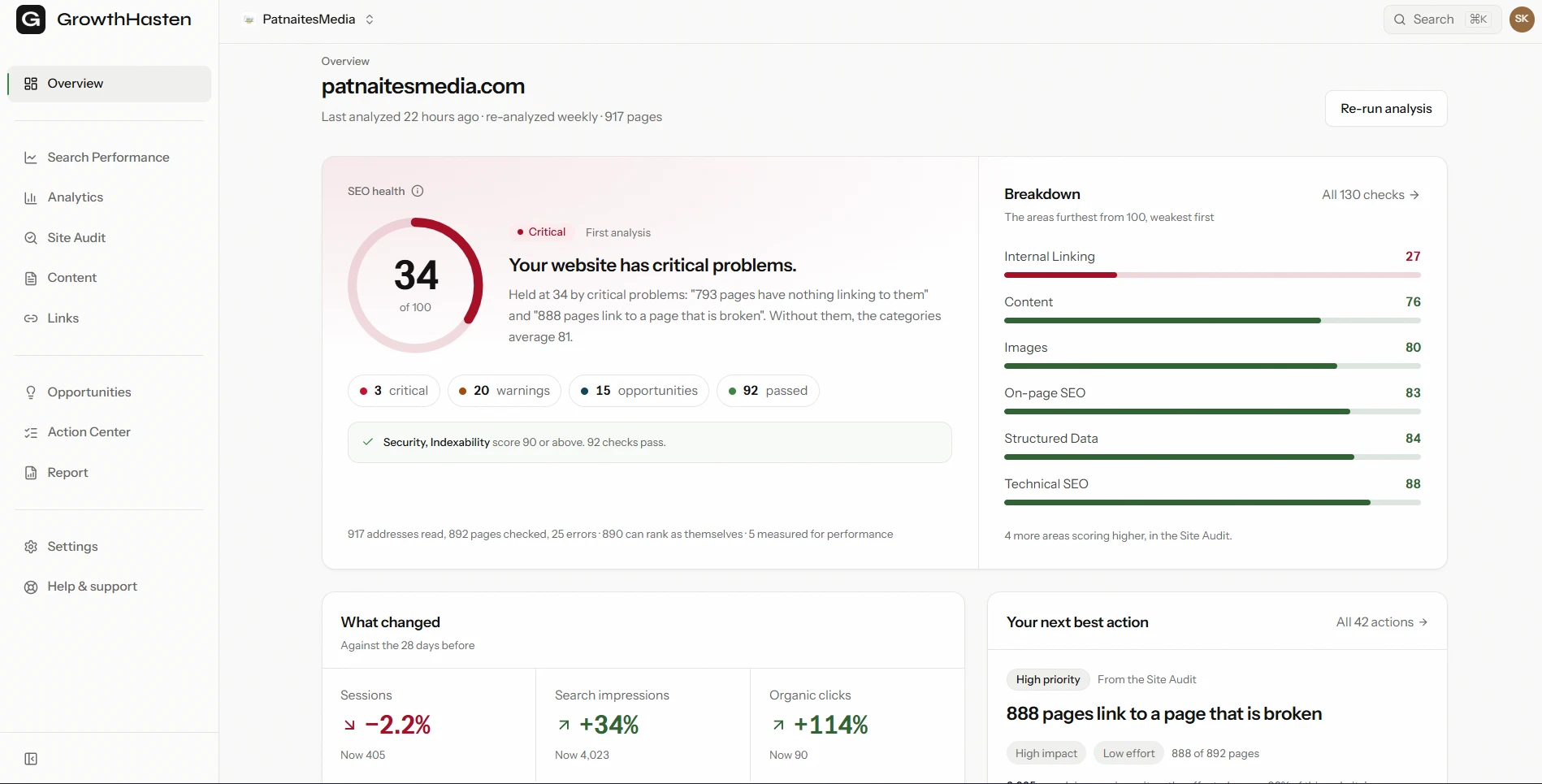
GrowthHasten's Content section can research a subject and group every part of it as covered, partial or missing against the pages you already have, with the matched pages shown as evidence.
Explore the Content SectionWhat is an example of AEO?
Here is one paragraph, before and after, run through the six checks. The subject is deliberately factual, so you can watch attribution working rather than just formatting.
Before: "As covered above, this is a common question and the answer isn't as simple as people think. There's a lot of debate about it in the industry, and it really depends on your setup. We'll get into the specifics further down."
That fails five checks out of six. No answer, no stated subject, nothing attributable, three unresolved references, and it collapses without its heading. It is also the most common shape of paragraph on the internet.
After: "Structured data does not get you cited by generative AI search. Google's documentation states that structured data is not required for generative AI search, and that no special schema.org markup is needed to appear. Schema still earns its place, because it clarifies what a passage is for classic search features, but it is not a citation lever. If you are choosing between adding FAQ markup and rewriting the first sentence under each heading, rewrite the sentence."
Seventy-six words. The answer is in sentence one, the source in sentence two, the limitation in sentence three, and a decision in sentence four. Delete the heading above it and you still know what it is about. That is the entire target.
How do you do answer engine optimization on a page?
Work through the page in one pass, in this order. The order matters, because fixing the headings first makes most of the rest obvious.
Step 1. Make every heading a question: Phrase each <h2> the way a person would ask it out loud. A heading reading "Crawl budget considerations" tells a retrieval system nothing about which question the passage below answers.
Step 2. Put the answer in the first sentence: Move the conclusion up and let the reasoning follow it. If the first sentence under a heading is context, cut it.
Step 3. Define terms where they first appear: A model cannot quote an explanation it has to reconstruct from three paragraphs away. Expand the acronym, then use it.
Step 4. Put one comparison in a table: Any "X vs Y" or multi-option decision extracts more reliably as a table than as prose. Three columns is usually the limit before it stops being readable.
Step 5. Confirm the answer exists in the HTML: The passage has to be in server-rendered HTML, not injected by JavaScript after load. This is the most common reason a good page never gets quoted, and it is invisible unless you look at the raw source.
Then run the six checks on every answer block before you publish. That is the sequence, and it is short on purpose.
Does schema markup or an llms.txt file help with AEO?
No, and Google now documents both answers. Its guide to optimizing for generative AI features says structured data "isn't required for generative AI search," and that there is no special schema.org markup you need to add. On llms.txt and files like it, the same guide says maintaining one will neither help nor harm your visibility in Google Search, because "Google Search ignores them."
Two caveats, and neither rescues the tactic. Google's statement governs Google's surfaces, so it says nothing about what an assistant on a different index does with an llms.txt file. And schema still earns its place for classic search features, where it drives rich results and clarifies entities. Google's structured data documentation lists the supported types, and our guide to structured data for SEO covers implementation and validation.
When is AEO not worth doing?
When the page is not indexed, when your audience does not ask assistants about your topic, or when the hour would come out of work that lifts ten pages instead of one. AEO is additive. It is rarely the first thing to fix.
The page is not indexed: an unindexed page cannot be retrieved, so no amount of formatting reaches an answer engine. Check coverage in Google Search Console before touching the copy. This is the cheapest item on the list and the most often skipped.
Your buyers do not ask machines: relationship-led and offline sales cycles produce few assistant queries. Run your own core questions through two assistants and see whether the category is being answered at all before committing a quarter to it.
The off-site work is the real bottleneck: if an engine has no reason to trust your brand, a perfectly formatted passage still goes uncited. Whether you are trusted enough to be quoted is the off-page half of this job (our guide to how brands earn AI citations covers it), and rewriting paragraphs does not solve it.
From my experience working on pages that already earn citations, the most common misallocation in this work is reformatting one of them. It feels productive, because the checklist gets ticked. The page was already winning, and the hour would have done more on a page that is trusted but unreadable in chunks.
There is an over-optimization limit too. The six checks apply to answer blocks, not to every sentence you write. A page where every paragraph has been flattened into a standalone answer stops reading like an argument, and an argument is what people cite you for. Keep the narrative sections, the worked examples and the transitions.
The one habit worth building is smaller than any of this. After drafting a section, copy its first paragraph into an empty document and read it cold. If it still answers something specific, it is ready for both readers. If not, rewrite it before moving on.
This week, take your single highest-value page, run the six checks on every answer block, and fix the two that fail hardest.
Can AI Crawlers Reach Your Pages?
GrowthHasten's Site Audit includes an AI Accessibility category that checks whether robots.txt lets the crawlers behind ChatGPT, Claude, Perplexity and Google's AI answers fetch your pages, alongside 130+ other deterministic checks. Free plan: one website of up to 900 pages, no card.
Analyze Your WebsiteQuestions
Frequently asked questions
What is AEO vs SEO?
SEO gets a page into the running; AEO decides whether the passage on it can be used once it gets there. The two share almost all of their inputs and differ in what counts as a win. SEO wins a ranking position and a click. AEO wins a quotation inside an answer, where the click is optional. AEO is a clarity layer on top of SEO, not a replacement for it.
Do you need to write differently for AI search?
No, and Google's guidance says so directly: there is no requirement to break content into tiny pieces for AI to understand it, and no need to write in a specific way just for generative AI search. What extraction rewards is ordinary clear writing that happens to survive being chunked, which means each paragraph states its own subject and answers something specific. Fragmenting a page into stubs makes it worse for every reader.
What is an example of AEO?
Rewriting a vague paragraph into a self-contained answer is the clearest example. A paragraph opening with “as covered above, this depends on your setup” answers nothing on its own, and it collapses if a retrieval system hands it to a model without the heading. The AEO version states the answer in the first sentence, names its source in the second, gives the limitation in the third, and stays under ninety words.
How do you do answer engine optimization?
Work through the page in one pass. Turn every heading into the question it answers, put the answer in the first sentence below it, define terms where they first appear, move one comparison into a table, and confirm the answer exists in server-rendered HTML rather than being injected by JavaScript after load. Then test each answer block on its own, before publishing, by reading it with the rest of the page removed.
Is there a free course on answer engine optimization?
No single authoritative free course exists, and anyone claiming an official one is overstating it. Google publishes free documentation on optimizing for generative AI features in Search, which is the closest thing to a primary source. Beyond that, the free explainers ranking for the term cover the basics reasonably well, though they disagree with each other on definitions. Read Google's guidance first and treat the rest as commentary.
How do you know if a passage is extractable?
Copy the paragraph into an empty document, delete the heading that sat above it, and read it cold. If it still answers something specific, it is extractable. Six checks make that judgment repeatable: the passage should be self-contained, answer-first, attributable, roughly forty to ninety words, free of references pointing outside itself, and clear about its subject without the heading above it.

Written by
GrowthHasten Team
Editorial Team, GrowthHasten
Articles from the GrowthHasten editorial team, grounded in primary research, our own testing, and what analyzing real websites shows, fact-checked in-house.
View profile