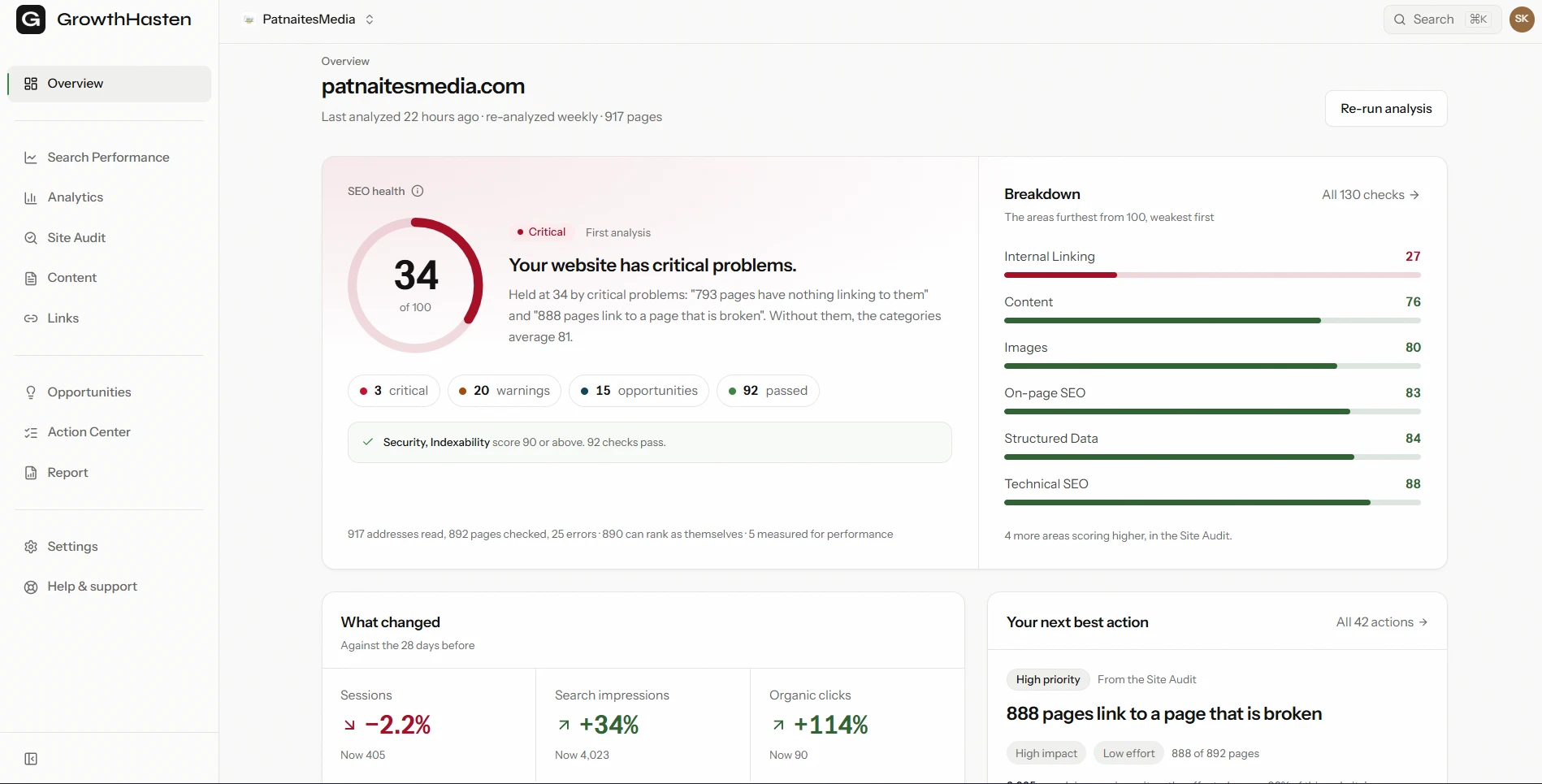


Internal linking is the practice of connecting the pages on your own site with links, so search engines can discover them and readers can move between related ideas. This guide is for founders, marketers, and content owners who publish regularly but suspect their pages aren't connected in a way that helps them rank. It covers how link equity flows, the hub-and-spoke model, orphan pages, and how internal linking changes on large sites. Internal links are the one ranking lever you control completely: no outreach, no approval, no waiting. Most sites treat them as an afterthought, which is exactly why fixing them pays.
The short version
- Internal linking is the ranking factor you own outright. Backlinks depend on other people. Every internal link is a decision you make yourself.
- Links do three jobs at once: they help crawlers discover pages, they pass relevance through anchor text and context, and they distribute equity to the pages you want to rank.
- Descriptive anchor text beats
click hereevery time, but forcing the same exact-match phrase into every link looks manipulative and can backfire.- An orphan page (no internal links pointing to it) is nearly invisible to Google, no matter how good the content is.
- More links is not better. Placement, relevance, and restraint matter more than volume.
What is internal linking, and why does it matter for SEO?
Internal linking is any link from one page on your domain to another page on the same domain, and it matters because it is how both crawlers and readers understand how your site fits together. Search engines follow these links to find new pages and to judge how important each one is. Readers follow them to go deeper without leaving.
Three mechanisms are working at the same time, and it helps to keep them separate:
- Discovery. Googlebot finds most pages by following links. A page nobody links to internally may sit uncrawled for a long time. Google's own explanation of how Search works describes crawling as link-following at its core.
- Relevance. The anchor text and surrounding context tell Google what the linked page is about. A link from an article about keyword research to one about search intent, using the words "search intent" as the anchor, reinforces that topic.
- Equity. Authority earned by one page flows along its links to others. Point that flow at the pages you most want to rank.
External backlinks get the attention because they are hard to earn. Internal links get neglected for the opposite reason: they are easy, so they feel unimportant. In our experience that is backwards. The internal graph is where a lot of quiet ranking gains hide.
How does link equity actually flow through internal links?
Equity flows from pages that have authority to the pages they link to, and internal links decide where that authority lands. When an external site links to your best article, that page gains authority. The internal links leaving that article then pass a share of it onward. A page with no outbound internal links is a dead end that hoards the value it receives.
The original model for this is PageRank: each link passes a portion of a page's value, split across all the links on that page. The modern reality is more nuanced than the 1998 formula, but the intuition holds. A link from a strong, well-linked page carries more weight than one from a weak, buried page, and the more links a page has, the thinner each link's share becomes.
Two consequences follow. Links from your highest-authority pages (usually the homepage and your most-linked articles) are worth placing deliberately. And a page buried five clicks deep receives very little internal equity, which is why site architecture and crawl depth are part of the same conversation. Keep the pages that matter shallow and well-connected, and remember that equity only flows within one host: carving out a blog or docs section onto its own subdomain, a common move covered in our guide to subdomain versus subdirectory structure for SaaS sites, moves it outside this graph entirely unless you deliberately link back in.
What makes an internal anchor work, and what breaks it?
Descriptive anchor text works because it tells both Google and the reader what to expect on the other side of the link. The anchor is one of the clearest relevance signals you control. A link that reads "our guide to search intent" says far more than "click here" or "read more," which say nothing at all.
The rules we follow:
- Be descriptive. The anchor should make sense read on its own, out of context. Avoid
click here,this post, and bare URLs. - Vary it. Don't use the identical exact-match phrase for every link to a given page. Natural variation ("search intent," "how intent shapes keywords," "matching content to intent") reads better and looks less engineered.
- Keep it honest. The anchor should match the destination. Mismatched anchors frustrate readers and confuse relevance signals.
- Put it in context. An anchor inside a sentence carries the surrounding words as extra context. A link stranded in a "related posts" box carries almost none.
Over-optimization is the trap: the same keyword-rich anchor stuffed into dozens of internal links, especially from low-value pages. Write anchors for humans first and the relevance signal takes care of itself. Internal anchors carry less risk than the ones pointing at you from other sites, and our guide to anchor text covers both directions.
What is the hub-and-spoke model, and how do you build one?
The hub-and-spoke model (also called pillar-and-cluster) is a structure where one broad pillar page links out to several focused articles, and each of those articles links back to the pillar and to its siblings. It works because it groups related content into a tight, self-reinforcing cluster that signals topical depth to Google and gives readers an obvious path through a subject.
The pillar covers the topic broadly ("content marketing for SEO"). Each spoke covers one slice in depth ("how to do keyword research," "writing for search intent," "content refresh workflow"). The links between them do the structural work. This is the backbone of building topical authority: a well-wired cluster tells search engines you cover a subject thoroughly rather than in scattered one-off posts.
A hub-and-spoke build sequence
This is the order we build clusters in. Doing it in sequence prevents the two failure modes: a pillar with nothing to link to, and spokes that never connect back.
- Define the pillar topic and confirm it maps to something your business actually does. A cluster with no commercial relevance is an expensive hobby.
- List the spokes: the sub-questions and subtopics a reader working through the pillar would ask next.
- Publish the pillar first, even in a lean form, so every spoke has a parent to link to on day one.
- Publish each spoke with a contextual link back to the pillar, placed in the body where it reads naturally.
- Link the pillar down to each spoke as you publish it, so the pillar grows into a genuine table of contents for the topic.
- Cross-link sibling spokes where they genuinely relate, but only where they relate. Not every spoke needs to link to every other one.
- Revisit older posts and wire them into the new cluster where the topic overlaps.
Our approach to content marketing for SEO treats this clustering as part of the editorial process, not a cleanup task done months later. Deciding which spokes are worth building in the first place, and which topics should update an existing page instead of becoming a new one, is covered in our guide to content planning.
What are orphan pages, and how do you find and fix them?
An orphan page is a page with no internal links pointing to it, which makes it nearly invisible to search engines and unreachable to readers browsing your site. Google may still find it through your sitemap, but a page with zero internal links reads as unimportant, so it gets crawled rarely and ranks poorly, if at all.
The fix is usually worth doing: add two or three contextual links from relevant, already-indexed pages that are topically related, so the orphan inherits both relevance and a little equity. For the full four-source method, and how to decide whether a given orphan should be linked, redirected, noindexed or deleted, see our guide to orphan pages. To pick software for the job, our comparison of internal link checker tools says which of them can find an orphan at all.
How should internal linking change on large sites?
On large sites the priority shifts from passing equity to controlling crawl budget, because Google will only spend so much effort fetching pages before it moves on. Under roughly ten thousand URLs, crawl budget is rarely your problem and you can focus on relevance and equity. Past that, and especially on e-commerce or listing sites, structure becomes a resource-management problem.
Three issues dominate at scale:
| Challenge | What goes wrong | What to do |
|---|---|---|
| Faceted navigation | Filter and sort parameters generate near-infinite URL combinations that eat crawl budget and create duplicates | Decide which facet combinations deserve indexing; use rel="canonical", noindex, or crawl controls on the rest |
| Pagination | Deep paginated series bury products and articles many clicks from the homepage | Keep important items shallow; link to key pages from hubs rather than relying on page 14 of a list |
| Flat vs deep depth | Important pages sit too many clicks from the homepage and get crawled rarely | Use hub pages and contextual links to pull priority URLs closer to the surface |
The governing idea is that every internal link is a vote for spending crawl budget on that URL, so at scale you are constantly deciding which pages deserve the vote and which to consolidate or hold back. Google's Search Essentials is the baseline these decisions check against. At scale, internal linking is as much about restraint as reach, which is why GrowthHasten's Links section proposes specific links with the reasoning on every row rather than linking everything to everything.
How many internal links should a page have, and where do they go?
There is no magic number, but a useful frame is: enough to connect the page to its cluster, and no more than a reader would find helpful. A long pillar page might carry a dozen or more contextual links naturally; a short post might carry three. The right count is the one that serves the reader, not a quota.
Placement matters more than count. A distinction worth keeping clear:
- Contextual links sit inside your body copy, surrounded by relevant text. These carry the most relevance signal and the most reader value, because they appear exactly where the related idea comes up.
- Navigational links live in menus, footers, and "related posts" widgets. They help site structure and discovery, but each one carries far less topical weight because it is repeated site-wide with no surrounding context.
Favor contextual links for the pages you actually want to rank. Add the link where the topic is genuinely mentioned, high enough in the content that a crawler and a reader both reach it. A relevant link in the first half of an article is worth more than the same link buried at the bottom.
Can AI help with internal linking?
Yes, for finding candidate links and surfacing orphans quickly, but not for deciding what actually ships. AI tools are good at scanning a large content library and proposing pages that mention a topic without linking to the relevant page, which is tedious to do by hand. That is a real time-saver on a site with hundreds of posts.
The limits are just as real. A tool can suggest a link based on surface word matching and miss that the two pages serve different intents, or propose an anchor that reads awkwardly, or over-link a single target because the keyword appears everywhere. We treat AI suggestions as a shortlist, not a decision: a human confirms each link is genuinely relevant, the anchor reads naturally, and the destination is the page a reader would actually want next. A wrong internal link is worse than a missing one, because it actively misleads both readers and search engines.
What are the most common internal linking mistakes?
The most common mistake is simply not doing it: publishing posts that never get wired into the rest of the site. After that, a familiar set of errors shows up again and again.
- Generic anchors. "Click here," "read more," and bare URLs waste the clearest relevance signal you have.
- Orphan pages. New posts published without a single inbound internal link, left to fend for themselves.
- Over-linking. Cramming a paragraph with links until none of them stands out and the text is hard to read.
- Exact-match repetition. The same keyword-stuffed anchor forced into every link to one page.
- Linking only from the footer or a widget. Relying on navigational links while ignoring the contextual links that carry real weight.
- Ignoring old content. Publishing new clusters but never revisiting older, higher-authority posts to link forward into them.
Most of these come from treating internal linking as a one-time task rather than a habit built into publishing. A short manual review at publish time catches nearly all of them.
When should you not add an internal link?
Don't add a link when it doesn't genuinely help the reader, because a forced link costs more than the missing one. The goal is a useful graph, not the maximum number of connections. Restraint is part of the craft.
Specifically, skip the link when:
- The pages aren't really related. Linking two posts because they share a keyword, not a purpose, dilutes relevance rather than building it.
- The paragraph is already dense with links. Adding one more helps nothing and makes every link weaker.
- You'd be forcing exact-match anchor text into a sentence where it reads unnaturally. If the anchor is awkward, the link is probably forced.
- The target is a thin or low-value page you wouldn't want a reader to land on. Fix or consolidate the page first.
A good test: if you removed the link, would the reader lose something useful? If not, it probably shouldn't be there.
What does a practical internal linking checklist look like?
Run this at two moments: when you publish a new post, and as a periodic audit of the whole site. It turns internal linking from a vague intention into a repeatable step.
At publish time, for every new post. Add two to four contextual links out to relevant existing pages. Add at least two inbound links from older, related posts pointing to the new one. Link back to the cluster's pillar page. Check that every anchor is descriptive and reads naturally in its sentence. Confirm the most important link sits in the first half of the article.
In a periodic site audit. Crawl the site and list orphan pages, then connect each one with two or three contextual links. Find your highest-authority pages and confirm they link out to priority targets. Check for broken internal links and fix or redirect them, then do the same for the links pointing off your domain, which most crawlers do not report on and which our guide to external links and when to nofollow covers. Look for over-optimized anchors (the same exact-match phrase repeated) and vary them. Verify that important pages sit within a few clicks of the homepage.
For large sites, add. Review faceted navigation and pagination for crawl waste. Confirm canonical and noindex decisions are consistent across parameterized URLs. Where you have them, analyze your server logs to see which pages bots actually request. The broader sequence sits inside our complete SEO guide, which places internal linking alongside the rest of the strategy. Google's Search Central documentation is the reference for the crawl and index behavior behind all of it.
Where should you start this week?
The one habit worth building is treating internal linking as the final step of publishing, not a separate project you'll get to later. Every time a post goes live, spend ten minutes wiring it into the site: links out to relevant pages, links in from older ones, and a check that each anchor earns its place. Done consistently, this compounds quietly the way few other SEO tasks do.
This week, run one crawl of your site and pull the list of orphan pages. Pick the three that already earn traffic or matter most to the business, and give each of them two contextual inbound links from relevant, established posts. It is the fastest internal linking win available, because the content is already there and only needs to be connected.
See Your Internal Link Graph
GrowthHasten's Links section shows crawl depth, orphan pages and anchor text across your site, and proposes specific internal links with the reasoning shown on every row. Nothing is written to your website.
Explore the Links SectionQuestions
Frequently asked questions
What is internal linking in SEO?
Internal linking is the practice of linking from one page on your website to another page on the same site. It helps search engines discover and crawl your pages, signals which pages are most important, and passes authority (link equity) between them. For readers, internal links create a path to related content. Unlike backlinks, internal links are fully within your control, which makes them one of the most reliable levers for improving how your site is understood and ranked.
How many internal links should a page have?
There is no fixed number. The right count is enough to connect the page to its related content and no more than a reader finds genuinely helpful. A long pillar page may carry a dozen or more contextual links naturally, while a short post might carry three. Focus on placement and relevance rather than volume: contextual links inside the body copy, pointing to genuinely related pages, matter far more than hitting an arbitrary quota.
What is an orphan page and why does it hurt SEO?
An orphan page is a page with no internal links pointing to it from anywhere else on your site. It hurts SEO because search engines rely on links to discover pages and judge their importance, so an orphan gets crawled rarely and ranks poorly even when the content is strong. Readers browsing your site also can't reach it. Our guide to orphan pages covers how to find yours and how to decide whether each one needs a link, a redirect, a noindex or deletion.
What is the hub-and-spoke or pillar-cluster model?
It is a content structure where one broad pillar page links out to several focused articles (spokes), and each spoke links back to the pillar and to related siblings. This grouping signals topical depth to search engines and gives readers a clear path through a subject. Build it by publishing the pillar first so every spoke has a parent to link to, then wiring each new spoke both up to the pillar and across to genuinely related siblings.
Does anchor text matter for internal links?
Yes. Anchor text tells both search engines and readers what the linked page is about, so descriptive anchors carry real relevance signal while generic ones like click here waste it. Use anchors that make sense read on their own and match the destination. Vary the wording rather than repeating the same exact-match phrase for every link to a page, since forced repetition looks manipulative. Write anchors for humans first, and the relevance signal follows.

Written by
GrowthHasten Team
Editorial Team, GrowthHasten
Articles from the GrowthHasten editorial team, grounded in primary research, our own testing, and what analyzing real websites shows, fact-checked in-house.
View profile