

How long SEO takes is set by where your site is starting from, not by an industry average. This guide is for founders, CMOs, and heads of growth at B2B and SaaS companies who have to give a board a date, and who have been handed the same "three to six months" answer by every provider they have spoken to. It covers the four starting conditions that decide your timeline, a five-stage model with the signal that proves each stage actually finished, why the revenue clock runs behind the traffic clock in B2B, and the three cases where the honest answer is to not start this quarter. The range is wide for a reason, and the reason is more useful than the number.
The short version
- The honest answer is a range. Anyone who gives you a single number is describing an average rather than describing your site, and the two have very little to do with each other.
- Four starting conditions set the timeline: index coverage, existing authority, existing content inventory, and technical debt. Two companies buying identical work on identical retainers get different curves.
- Rankings, qualified traffic, and pipeline are three separate clocks. In B2B they can run two quarters apart, which is why founders conclude organic search failed when it was running on schedule.
- Technical fixes can move within weeks. Competitive content usually takes two to three quarters. Averaging the two produces a number that describes neither.
- Sometimes the correct answer is to not start this quarter, and the three conditions that make it true have nothing to do with your budget.
How long does it take for SEO to work?
For most B2B and SaaS sites, the first meaningful ranking movement shows up somewhere between three and six months, and traffic large enough to affect pipeline between six and twelve. Those are ranges, not forecasts. The spread exists because identical work lands differently depending on the state of the site it lands on, and the starting state is what sets the clock.
Google describes the same thing in less commercial language. Its SEO starter guide says some changes might take effect in a few hours while others could take several months, and suggests waiting a few weeks before assessing whether a change had a beneficial effect in Search at all. That is the closest thing to an official timeline that exists, and it is a range because Google is describing a process rather than a schedule.
So a single number is not a shorter version of the same answer. It is an answer to a different question: what happened on average across a group of sites that probably does not include yours.
The useful version of the question is narrower. Not "how long does SEO take," but "how long does this site, in this competitive set, with this much technical debt and this much existing authority, take to reach each stage." That question has an answer you can plan against.
Why does SEO take months instead of weeks?
Four things have to happen in sequence, and none of them is instant. This is mechanism rather than mystique, and understanding it is what lets you tell a slow program apart from a stalled one.
1. Google has to crawl the change, then decide to index it: Nothing you publish exists to Search until it has been fetched and processed. Google's documentation on how Search works states that Googlebot uses an algorithmic process to determine which sites to crawl, how often, and how many pages to fetch from each one, and that indexing is not guaranteed because not every page Google processes will be indexed. You control neither decision. On a small or low-authority site, the gap between publishing and being indexed is frequently the longest single delay in the whole timeline.
2. Links have to be found before they count: A link earned this week is a link Google has not seen yet. It has to crawl the linking page, process it, and attribute the signal, and that chain runs on the same crawl schedule as everything else. Coverage that lands in March is often still being counted in May.
3. Query and engagement data accumulate slowly at low volume: Positions on competitive commercial queries firm up as Google gathers evidence about how a page performs for them. A page with a handful of impressions a week is producing very little evidence. This is why months two and three feel flat even when the work is correct.
4. Your competitors did not stop: Every other site in your result set is publishing, earning links, and fixing its own problems over the same period. You are not climbing a static ladder. Part of the first two quarters is spent matching the rate at which the target set improves, before any net movement shows up in position. Matching that rate is not the same as out-publishing it: weekly posting volume set beside weekly clicks over nine weeks on our own site shows clicks staying between zero and five a week while output swung ninefold.
Technical fixes short-circuit parts of this chain, which is exactly why they land faster. New content on a new domain has to run the whole sequence.
What four conditions actually set your timeline?
Four, and each one has a test you can run yourself in about ten minutes. Run all four before you accept anyone's estimate, because an estimate made without them is a guess wearing a suit.
Most of these tests live in Search Console, which is free and where every one of these conditions is visible.
| Starting condition | The ten-minute test | What it does to your timeline |
|---|---|---|
| Index coverage | Open the Pages report in Search Console. Compare the number of indexed pages against the number of pages you believe you have published. | A large gap means your first stage is indexation, not ranking. Nothing else can start until Google is reliably indexing what you ship. |
| Existing authority | Check how many distinct domains link to you today, and whether any of them are in your industry. Any backlink tool will tell you, and the direction matters more than the exact count. | Sites with existing, relevant links compete for mid-difficulty queries within a quarter or two. Sites near zero spend the first two quarters on long-tail queries and on earning the links themselves. |
| Existing content inventory | Count the pages that already target a commercial query and already receive impressions. Not total pages. Pages with impressions. | Improving a page that already sits on page two is the fastest movement available in organic search. A site with twenty such pages has a materially shorter timeline than one with none. |
| Technical debt | Look for the blockers: pages excluded by noindex, content that renders only in JavaScript, duplicate or missing canonicals, a sitemap that does not match reality. | Real blockers add weeks at the front, then produce the fastest visible wins once cleared. A clean site has no such wins available, so its early months look slower even though nothing is wrong. |
The fourth row is the one that surprises people. A site carrying serious technical debt often shows faster early results than a clean one, because clearing a blocker releases value that was already built and merely trapped. That does not make debt a good thing. It means "our results came quickly" and "this program is well run" are different statements.
Not Sure Which Stage You Are In?
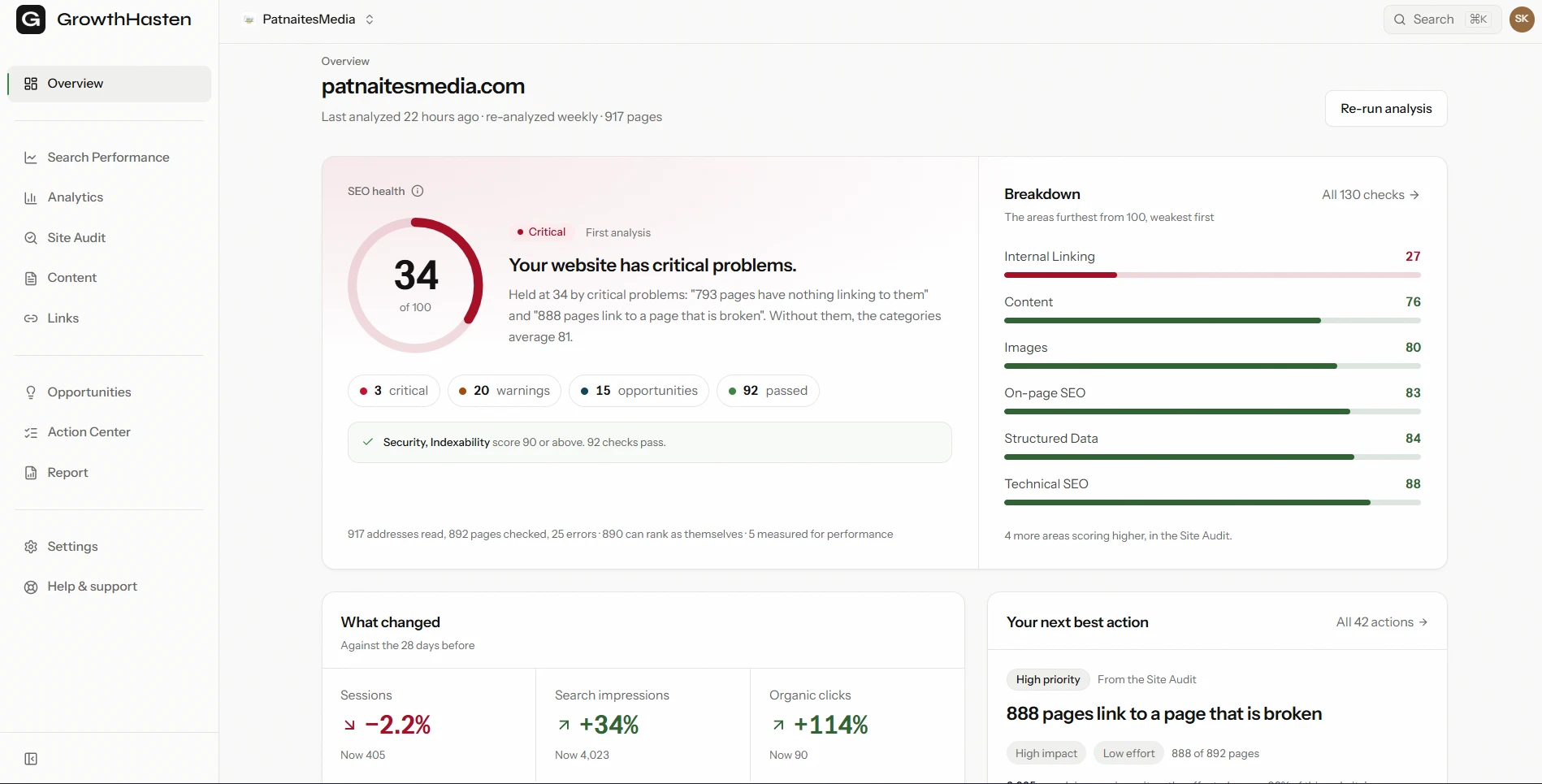
Run GrowthHasten's Site Audit to see your site's current indexability, technical debt and AI crawler access. That starting state is what sets your timeline.
Explore the Site AuditWhat are the five stages, and how do you know a stage is done?
Five, and each completes when a specific signal appears rather than when a month ends. This is the part a calendar cannot give you, because a calendar tells you where you should be and a signal tells you where you are.
The order does not change: Google indexes what you publish, pages start appearing for relevant queries, those appearances turn into visits from people who could plausibly buy, those visits produce pipeline, and the system starts feeding itself.
| Stage | Typical range | The signal that proves this stage finished |
|---|---|---|
| 1. Indexation | Days to several weeks, longer on a new domain | New pages appear as indexed in Search Console within a predictable window, without you requesting each one by hand. |
| 2. First ranking movement | Roughly one to two quarters | Impressions climb on non-brand queries and average position improves, while clicks stay near zero. Impressions move before clicks, always. |
| 3. First qualified traffic | Roughly two to three quarters | Clicks arrive on commercial-intent queries rather than definitional ones, and land on pages that can convert rather than only on top-of-funnel posts. |
| 4. First pipeline | One sales cycle after stage three | Records in your CRM carry an organic first touch and reach a qualified stage. Not form fills. Qualified records. |
| 5. Compounding | Usually after the first year | New pages rank faster than comparable pages you published six months earlier did. That acceleration is the return on all the earlier work. |
From my experience, the stage people misread most often is the second one. Impressions climbing while clicks stay flat looks like failure to anyone reading a traffic dashboard, and it is the clearest early evidence available that the program is working, because it means Google has started showing your pages for queries it did not show them for before. Reporting that collapses stage two into a single traffic number will describe a working program as a failing one, every time.
The mistakes attached to each stage are worth naming, because each one causes a different bad decision.
- Stage 1: Treating a page as live because the CMS says published. Published and indexed are different states, and only one of them can rank.
- Stage 2: Judging progress on clicks. Watch impressions and average position on non-brand queries instead.
- Stage 3: Counting all traffic as progress. Traffic to a glossary post is not the same asset as traffic to a comparison page, even at identical volume.
- Stage 4: Blaming the channel for a conversion problem. If qualified traffic arrives and nothing converts, the timeline is fine and the page is not.
- Stage 5: Cutting the retainer in the month compounding starts, because the early months looked expensive. This is the costliest mistake on the list.
Do technical fixes work faster than content?
Usually yes, and the gap is often the difference between weeks and quarters. The reason is structural rather than a matter of effort.
A technical fix changes how Google treats pages that already exist. Remove a stray noindex, repair a broken canonical, serve content without requiring JavaScript execution, and the value on those pages was already built. You are releasing it, not creating it. Once the affected pages are recrawled, the change can show up quickly.
New content starts from nothing. It has to be discovered, indexed, gather enough query evidence to be trusted for competitive terms, and in most cases earn links before it holds a position worth having. That is the full sequence from the section above, run end to end, and our guide to technical SEO work covers the diagnosis side of the fast half.
When this does not apply: On a technically clean site there is no trapped value to release, so the quick technical win simply is not available. Selling one anyway is a familiar way to make a first quarter look productive. Ask which specific blocker is being cleared and what it currently costs, and if nobody can name one, the honest plan starts with content and authority and takes longer.
The other limit: Technical fixes raise a ceiling. They do not create demand. A perfectly crawlable site with no content targeting commercial queries will be perfectly crawlable and invisible.
How does a six-month sales cycle change the answer?
It changes the revenue timeline, not the traffic timeline. Organic traffic arrives on its own schedule regardless of how you sell, but if your average cycle runs six months, the first closed deal attributable to organic search lands roughly two quarters after the first qualified visit.
Those are two separate curves, and conflating them is the most common reason a founder concludes the channel failed. The traffic curve started moving in month five. The revenue curve had not started by month eleven, because the leads from month five were still in evaluation. Both facts are consistent with a program running exactly to plan.
The practical consequence is a reporting one. Judge the channel on the leading curve until the lagging curve has had time to complete once, and agree that out loud at the start of the engagement rather than during the first uncomfortable quarterly review. Our guide to how to calculate SEO ROI on a six-month sales cycle works through the arithmetic of counting cost and revenue inside the same window.
What to give a board instead of a date: A stage, the signal that will prove that stage finished, and the approximate window you expect it in. "We are in stage two, we expect non-brand impressions to keep climbing before clicks move, and we will report that split monthly" survives scrutiny. "Results in six months" does not survive month seven.
How long before you can tell an agency is failing?
About 90 days, and you judge leading indicators rather than rankings. Positions at 90 days tell you almost nothing. What was shipped, and whether the site changed measurably as a result, tells you nearly everything.
By day 30: A documented audit with named, prioritized problems. A keyword and page map showing which pages target which queries. Search Console and analytics access confirmed working. Any crawl or index blocker identified and either fixed or scheduled with a date.
By day 60: The first technical fixes shipped and verifiable in the live HTML rather than only in a status report. Published work appearing on the site at whatever rate the plan promised. Index coverage moving in the right direction on the pages that matter.
By day 90: Non-brand impressions rising on target queries. Named technical debt closed rather than restated in a new deck. Reporting that separates brand from non-brand and says which stage the program is in.
Then comes the distinction that actually matters, because both cases look like "no rankings yet" from the outside.
Slow because organic search is slow: The leading indicators are all present. Work shipped, blockers cleared, impressions rising, coverage improving, positions still outside the top ten. This is normal, and it is stage two. Cutting here wastes everything already spent.
Slow because nothing is happening: Reports arrive on time but describe activity rather than change. The same technical issues appear in month three that appeared in month one. Nothing new is indexed. Impressions are flat on every non-brand query. That is not a slow channel, it is an absent one, and the timeline is not the explanation. If you are not sure which of the two you are looking at, our month-by-month account of what a retainer should produce in each of the first six months gives you something to hold it against.
If you are still choosing a provider rather than reviewing one, what SEO costs for SaaS and B2B companies covers what different budget bands can realistically deliver in the first two quarters. If there is already an agreement on the table, what to check in the agreement before you sign covers how to set the term against this same checkpoint. And if you are the agency fielding these same questions from your own client because the delivery is subcontracted, white label SEO arrangements change what you can promise on a timeline you do not control.
When should you not start SEO this quarter?
Three conditions, and none of them is about money. In my experience, the most effective approach with a founder in one of these situations is to say so plainly rather than start a retainer that cannot succeed inside the horizon they are actually planning against, because a program cancelled in month four costs more than the one that never started.
1. You need revenue inside this quarter: If the business needs pipeline in the next 90 days to survive or to hold a board commitment, organic search cannot supply it. Nothing in the five stages moves that fast. Paid search, outbound, and partnerships can. Start organic alongside them, funded as a long-term investment, or start it next quarter.
2. Your positioning or your product is still moving: Content built around a value proposition that changes in two months has to be rewritten in two months, and the authority it accumulated does not transfer cleanly to the new message. If you are still finding product-market fit, the same budget spent on learning faster is worth more than the same budget spent on pages you will replace.
3. Nobody internally can supply subject-matter input: Content in technical B2B and SaaS categories needs someone inside the business who can explain how the product actually works and where the market is wrong. Without that, you get competent, generic pages that rank for nothing competitive. This is a scheduling problem more than a budget problem, and it is usually solved by waiting a quarter until the right person has time.
None of these is permanent. They are reasons to sequence organic search after something else, not reasons to skip it. If you are weighing the decision itself, what SEO services actually include sets out what different provider types deliver and which ones suit which stage of company.
The habit worth building is reviewing the leading indicators monthly and the lagging ones quarterly. Non-brand impressions, index coverage, published volume, and technical debt closed are all visible long before revenue is, and a program judged only on revenue will be judged on the one number certain to be missing for the longest.
This week, run the four-condition assessment on your own site. Open Search Console, compare indexed pages against published pages, count the pages already earning impressions on commercial queries, and write down which of the five stages you are actually in. That one sentence is worth more than any benchmark, because it describes your site rather than an average.
Know What Your Site Needs Before You Hire Anyone
Brief any agency, consultant or hire from evidence. GrowthHasten crawls your website, joins it to your own Search Console and Analytics, and turns the result into one prioritized queue of fixes and opportunities. Free plan: one website of up to 900 pages, no card.
Analyze Your WebsiteQuestions
Frequently asked questions
How long does SEO take to show results?
Usually three to six months for the first meaningful ranking movement and six to twelve for traffic that affects pipeline, but the range is wide because it is set by your starting state rather than by an average. A site with existing authority and a clean technical base moves in weeks. A new domain with no links and no indexed content takes longer at every stage. Assess your own four starting conditions before accepting anyone's number.
Why does SEO take months instead of weeks?
Four things have to happen in sequence and none of them is instant. Google has to crawl and index the changes, links pointing at them have to be discovered and counted, engagement data has to accumulate before the pages are trusted for competitive queries, and your competitors are working the whole time. Technical fixes short-circuit some of this, which is why they land faster than new content.
How long does SEO take for a brand-new website?
Longer than for an established one, and the gap is mostly about trust rather than content. A new domain typically spends the first weeks getting indexed at all, then several months earning enough authority signals to compete for anything other than long-tail queries. Expect the first stage to be indexation rather than ranking, and judge early progress on index coverage and publishing velocity, not on positions.
How long before I can tell whether an SEO agency is failing?
About 90 days, but you judge leading indicators rather than rankings. By then you should see index coverage improving, a measurable volume of work shipped, and named technical debt closed. If those are absent at 90 days the engagement is not slow, it is not happening. If they are present and rankings still have not moved, that is normal and you are in the stage before ranking movement.
Does a long B2B sales cycle change the SEO timeline?
It changes the revenue timeline, not the traffic timeline. Organic traffic arrives on its own schedule, but if your sales cycle runs six months then the first closed deal attributable to organic lands roughly two quarters after the first qualified visit. Plan the two curves separately, and do not judge the channel on revenue before the sales cycle has had time to complete once.

Written by
GrowthHasten Team
Editorial Team, GrowthHasten
Articles from the GrowthHasten editorial team, grounded in primary research, our own testing, and what analyzing real websites shows, fact-checked in-house.
View profile