
A Google traffic drop is a sudden or gradual fall in the organic clicks and impressions your site earns from Search, and it always has a cause you can name if you look in the right order. This guide is for founders, marketers, and site owners who watch organic traffic slide and feel the urge to change everything at once. It covers how to confirm the drop, read its shape, tell the common causes apart, and choose the recovery that fits each one. The theme throughout: diagnose before you touch anything, because the wrong fix on the wrong cause can bury you deeper.
The short version
- The shape of the drop tells you the cause. Sudden and sitewide points at a technical fault or penalty; slow and broad points at an algorithm update.
- Confirm the drop in Google Search Console first. Analytics can fall for reasons that have nothing to do with rankings, like broken tracking.
- Most panic changes make recovery slower, not faster. You cannot fix what you have not yet diagnosed.
- Recovery is rarely instant. After a core update, meaningful recovery often waits for the next update, which can be weeks or months away.
- Check the cheap, reversible causes first: a bad deploy, an accidental
noindex, a manual action. Rule those out before you assume it was the algorithm.
What should you do first when traffic drops?
Nothing to the site yet. The first move is to diagnose, not to fix, because every recovery path branches from the cause, and acting before you know it usually adds a second problem on top of the first.
Resist the reflex to rewrite pages, rebuild links, or roll back changes the moment a graph turns red. Rewriting a page that lost traffic to a technical fault wastes days and fixes nothing. Roll back a deploy that had no effect and you have hidden the real cause under a change of your own.
Give yourself one disciplined hour before any edit: confirm the drop, mark the date it started, and read its pattern. That hour decides whether the next week is targeted or wasted.
How do you confirm the drop is real?
Open Google Search Console before you open anything else, because it reports what Google actually served, not what a third-party script happened to record. Analytics can fall for reasons that never touched your rankings: a broken tag after a deploy, a consent banner change, a bot filter, a tracking migration. Confirm the loss in Search Console first, then cross-check analytics.
In the Search Console Performance report, set the date range wide enough to see before and after, and compare periods rather than eyeballing a single line. Look at clicks and impressions together; the gap between them is a clue you will use later.
Annotate the exact date. Find the day the decline began and write it down. That single date is the most useful fact you own. You will line it up against your own deploy log, against known Google update dates, and against your seasonal history. A drop that starts on the day you shipped a template change is a different investigation from one that starts on the day a core update began rolling out.
To understand why the report shows what it shows, Google's Search Central documentation explains how impressions and clicks are counted.
What actually causes Google traffic to drop?
A short list of causes covers almost every case, and they leave different fingerprints. Knowing the list is what turns a vague panic into a checklist you can work through.
- A core or algorithm update. Google reassesses quality and relevance across the web, and your relative position shifts even though your pages did not change. A spam update, like the September 2026 spam update, is a related but distinct cause: it targets a specific, nameable spam-policy pattern rather than a broad reassessment.
- A manual action. A human reviewer at Google penalized the site for violating spam policies, and the penalty shows in the Manual Actions report.
- A technical fault. A bad deploy, an accidental
noindex, a brokenrobots.txtrule, a canonical pointing the wrong way, or pages returning errors instead of content. - A SERP or intent shift. AI Overviews, new features, or a change in what searchers want pushed your result down or reduced the clicks it earns even at the same position.
- Seasonality. Demand for your topic fell on schedule, the way it does every year, and nothing is actually wrong.
- Lost backlinks. Links that supported a key page disappeared, and its authority fell with them.
- Cannibalization. A new page you published now competes with an old one for the same query, and they split the signals between them.
How do you read the drop pattern?
The shape of the fall narrows the cause faster than any tool. Before you investigate anything specific, ask three questions of the graph: was it sudden or gradual, sitewide or confined to one section, and did it hit one query or many? The answers point you straight at the likely cause and tell you where to look.
| Drop pattern | Likely cause | Where to look |
|---|---|---|
| Sudden, sitewide, overnight | Technical fault or manual action | Manual Actions report, then the Pages report and your deploy log for that date |
| Sudden, one section or template | Bad deploy or broken template rule | URL Inspection on affected pages; check noindex, canonical, and status codes |
| Gradual, broad, over one to two weeks | Core or algorithm update | Known update dates against your annotated date; Search Status Dashboard |
| Impressions steady, clicks down | SERP layout, AI Overviews, or CTR loss | Performance report: position held but CTR fell; inspect the live SERP |
| Gradual on a few pages only | Content decay, lost links, or cannibalization | Page-level Performance data; backlink history; internal search for competing pages |
| Smooth annual dip, recovers later | Seasonality | Year-over-year comparison in Performance |
One pattern deserves special attention. If impressions hold steady while clicks fall, your rankings did not move. Something changed in the results page, not in your position, and the fix is completely different.
Was it a core or algorithm update?
Compare your annotated date against the dates Google confirmed an update. If your gradual, broad decline lines up with a core update window, that is your strongest lead, and Google publishes ranking-update history on its Search Status Dashboard so you can check.
Core updates rarely cause an overnight cliff. They roll out over days or weeks, so a genuine update signature is a slope, not a wall, and the loss usually spreads across many pages rather than hitting one template. Our guide to Google algorithm updates covers the main update types and how a rollout actually behaves. It reflects a relative judgment: your pages did not get worse, but Google decided other results serve the query better.
Google is clear that there is no single fix for a core-update drop and no penalty to lift. The guidance is to improve overall quality and relevance, then wait for a later update to reassess. That patience is the correct move when the cause is a broad reassessment rather than a specific fault. Our SEO audit guide gives you a structured way to find the quality gaps worth closing.
Do you have a manual action?
Check the Manual Actions report in Search Console, and check it early, because it is the fastest cause to confirm or rule out. If a human reviewer penalized your site, the report names the reason and the scope. If it says no issues, you can cross a whole category off your list in thirty seconds.
A manual action differs from an algorithmic drop in one important way: it has a defined path back. You fix the specific action Google's Manual actions report names, then submit a reconsideration request. Recovery is not instant, since a human has to review the request, but the route is explicit. A manual action for unnatural links is also the one situation where a disavow file is the right response, and our guide to when disavowing actually helps, and when it makes a drop worse covers why lost links and toxic links call for opposite fixes.
Google's Search Essentials defines the policies a manual action enforces, so it is the reference for understanding what you were flagged for and what compliant looks like.
Could it be a technical problem?
Often, and this is the cause you most want to catch, because it is usually the cheapest to reverse. A sudden sitewide or section-wide drop right after a release points at your own site first.
Run URL Inspection on affected pages and check the obvious culprits in order. Did a template change ship an accidental noindex tag? Did a new robots.txt rule block a whole directory, or a canonical start pointing every page at the homepage? Are pages returning a 404 or 500 where content used to live, or did a migration drop redirects and orphan the old URLs?
The Pages report in Search Console shows indexing status at scale, so a wave of pages moving from indexed to excluded on your annotated date is a strong signal. Work through the specifics with our technical SEO guide, and to understand why an indexing fault erases rankings entirely, Google's explanation of how Google Search works shows where crawling and indexing sit in the pipeline.
Did the SERP change under you?
Look here when impressions held but clicks fell, because that gap means your position survived and the results page changed around you. An AI Overview now answers the query above the links, or a bigger set of ads and rich results pushed your listing down the page. Or searcher intent shifted, and Google now favors a format your page does not offer.
Open the live SERP for your key queries and see it with your own eyes. If an AI Overview or a features block sits where your clicks used to come from, no on-page edit restores the old click rate, because the loss is structural. The realistic response is to compete for the space that remains: earn the citation inside the overview, sharpen the title and description, or pursue queries where the layout still rewards a blue link.
Is it seasonality, lost links, or cannibalization?
Rule these out with a few targeted checks, because each leaves a distinct trace. They are easy to confuse with a real problem and easy to confirm once you know the signature.
Seasonality. Compare this period against the same weeks last year, not against last month. If the dip repeats every year and recovers on schedule, demand fell, not your rankings, and the fix is patience plus a plan for the off-season.
Lost backlinks. If a single important page slipped, check whether links pointing to it disappeared. A site that linked to you removed the page, redesigned, or went offline, and the authority it passed went with it. Rebuilding or replacing those links is the recovery.
Cannibalization. If traffic fell after you published something new, you may have two pages fighting over one query. They split clicks and signals between them. Consolidate into one stronger page and redirect the weaker URL. Our content audit guide covers how to find and resolve competing pages.
What is the recovery approach for each cause?
Match the fix to the diagnosis, because a recovery that ignores the cause is just motion. Once you have named the cause, the response is usually clear.
Use this diagnostic order as your decision path. It runs cheapest and most reversible first, so you rule out the quick wins before assuming the slow, uncertain one.
- Manual action present? Fix the named violation, then submit a reconsideration request. Defined path, human review.
- Indexing or technical fault? Reverse the bad change: remove the stray
noindex, fix therobots.txtrule, correct the canonical, restore the redirects. Then request indexing on the key pages. - Clicks down but position held? Treat it as a SERP change. Improve titles and snippets, pursue AI Overview citation, and diversify toward queries the new layout still rewards.
- Lines up with a core update? Improve genuine quality and relevance across affected pages, then wait for the next update to reassess. No shortcut, no penalty to lift.
- Seasonality? Do nothing structural. Confirm the year-over-year pattern and plan content for when demand returns.
- Lost links or cannibalization? Rebuild or replace the lost links; consolidate competing pages and redirect the weaker one.
Only two of these paths involve rewriting content, and both come after you have ruled out the faster causes. That order is the whole discipline.
How long does recovery actually take?
It depends entirely on the cause. A technical fix can recover within days once Google recrawls the affected pages. A manual action recovers when your reconsideration request is reviewed and approved.
A core-update drop is the slow one. Google has said that even after you improve a site, meaningful recovery may not show until a later broad update runs, and those arrive weeks or months apart. There is no button that brings it back sooner, and any tool or service promising instant core-update recovery is describing something Google does not offer.
Set expectations by cause, not by hope. If the diagnosis is a core update, the honest timeline is measured in months, and the work in between is real quality improvement. Recovering lost rankings is still faster than earning them the first time.
When should you rebuild instead of wait, and when should you do neither?
Rebuild only when the diagnosis says the content genuinely no longer serves the query, not because a graph looks alarming. If the SERP now wants a comparison and your page is a thin overview, or the topic moved on and your page is stale, a real rewrite is justified. If the page still answers the query well and the loss came from a broad update, rewriting risks throwing away signals that are still working.
Here is the explicit warning, because it is the single most common mistake: do not panic-change everything before you diagnose. Rewriting pages, disavowing links, rolling back deploys, and adding schema all at once does two damaging things. It can introduce new faults on top of the original one, and it destroys your ability to learn what moved the needle, because you changed six variables at once.
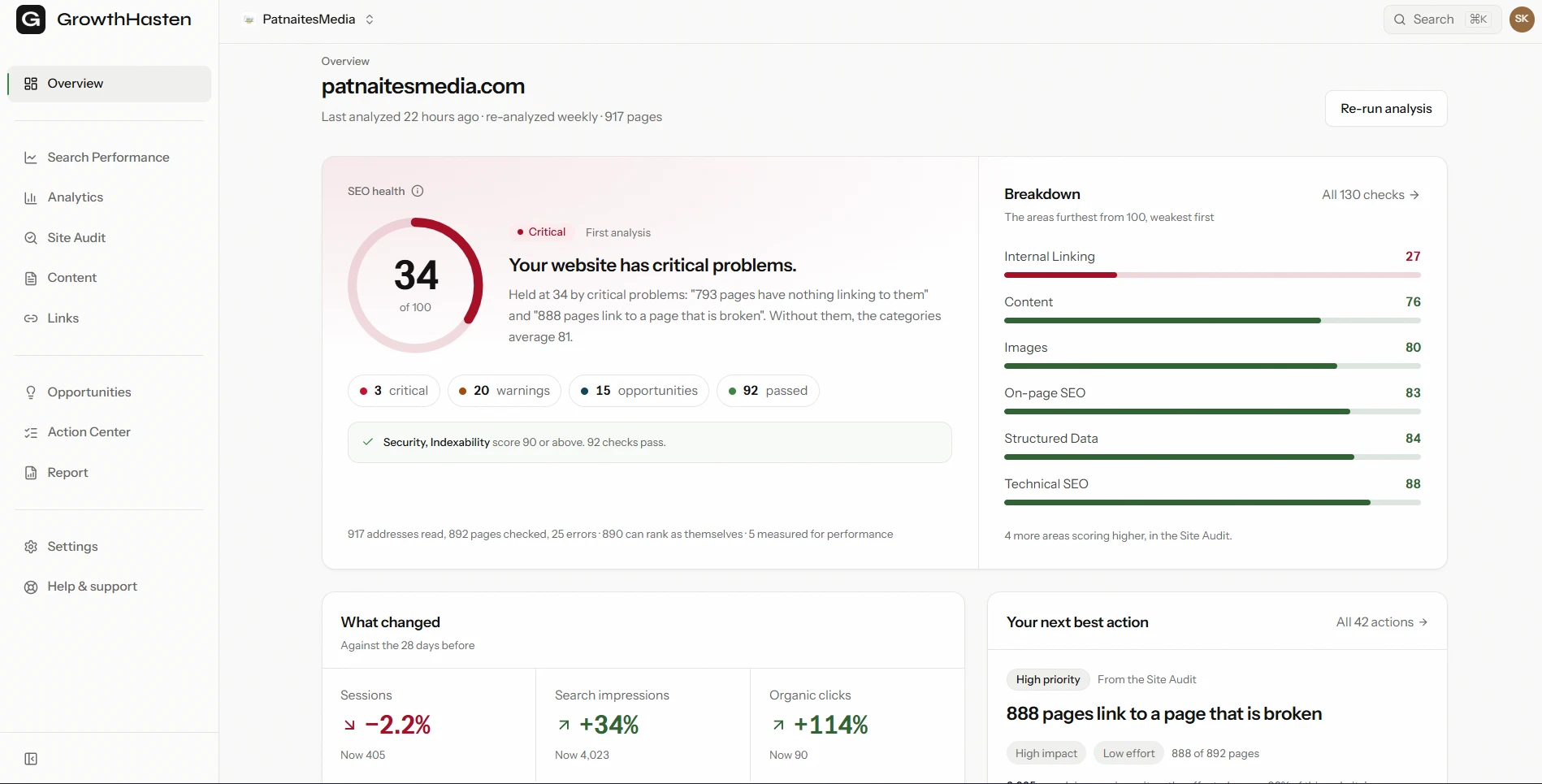
Change one diagnosed thing at a time, give Google time to recrawl, and measure against your annotated baseline before the next move. When the cause is unclear and the fixes are getting expensive, GrowthHasten's Opportunities view joins your crawl to Search Console and Analytics to show which technical issues sit on the pages that carry your traffic, which is cheaper than months of guessing.
The habit worth building is annotation: keep a running log of every deploy, migration, and major content change with its date, so the next time traffic moves you can line the graph up against your own history in minutes instead of guessing. This week, open Search Console, find the exact date your last drop began, and check it against your deploy log and Google's confirmed update dates. If the date matches a change you shipped, you have likely found your cause. If it matches an update, you know the work ahead is patience and quality, not panic.
Find What Changed, and Where It Hurts
GrowthHasten joins your crawl to your own Search Console and Analytics, shows which queries and pages fell between periods, and ranks the technical issues sitting on the pages that carry your traffic. Free plan, no card.
Analyze Your WebsiteQuestions
Frequently asked questions
Why did my website traffic suddenly drop?
A sudden, overnight drop usually points at a technical fault or a manual action rather than an algorithm update, which tends to roll out gradually. Check the Manual Actions report in Search Console first, then look at whether a recent deploy shipped an accidental noindex tag, a broken robots.txt rule, or a wrong canonical. Line up the exact date the drop began against your deploy log. A sudden sitewide fall almost always traces back to a change on your own site.
How do I know if a Google update caused my traffic drop?
Compare the exact date your decline began against Google's confirmed update dates on the Search Status Dashboard. A core update signature is a gradual slope over days or weeks, spread across many pages, not an overnight cliff on one section. If your annotated date lines up with a core update window and the loss is broad, that is your strongest lead. If the drop is sudden and confined to one template, look at technical causes before blaming an update.
How long does it take to recover from a Google traffic drop?
It depends on the cause. A technical fix can recover within days once Google recrawls the affected pages. A manual action recovers after your reconsideration request is reviewed and approved. A core-update drop is the slowest: Google has said meaningful recovery may not appear until a later broad update runs, and those arrive weeks or months apart. There is no way to force core-update recovery to happen faster.
Should I check Google Analytics or Search Console for a traffic drop?
Start with Google Search Console, because it reports what Google actually served in search results, while Analytics can fall for reasons unrelated to rankings, such as broken tracking after a deploy or a consent banner change. Confirm the loss of clicks and impressions in the Search Console Performance report first, then cross-check Analytics. If Search Console is stable but Analytics dropped, your problem is likely tracking, not search visibility.
My impressions are steady but clicks dropped. What happened?
That gap means your ranking position held but the results page changed around you. An AI Overview may now answer the query above the links, or new features and ads pushed your listing down, lowering your click-through rate at the same position. Open the live SERP for your key queries to see it directly. No on-page rewrite restores the old click rate, so the fix is competing for the space that remains, through snippet improvements and AI Overview citation.

Written by
GrowthHasten Team
Editorial Team, GrowthHasten
Articles from the GrowthHasten editorial team, grounded in primary research, our own testing, and what analyzing real websites shows, fact-checked in-house.
View profile