

An SEO-friendly website is one engineered so search engines and AI answer engines can crawl its pages, render its content, understand its structure, and trust its quality, by design rather than by patch. This guide is for founders, growth leads, and product owners who are about to budget and commission a website and want it to rank, along with the developers and designers who will build it. It covers what SEO-friendly means at the build level, the spec to hand your team before a line of code is written, the platform and rendering decisions that decide whether pages can rank at all, and the launch checklist that keeps SEO from quietly breaking on go-live day. The thesis is simple: SEO belongs in the build spec, not bolted on after launch. The cheapest place to fix a crawl or rendering problem is a design document; the most expensive is a live site with traffic you never earned.
The short version
- Most sites ship un-optimized not from ignorance but because no single person owned SEO on the build. It falls through the gap between the developer, the designer, and the marketer.
- The platform matters less than whether it renders real HTML and lets you control titles, metadata, URLs, redirects, and structured data. WordPress, Webflow, a headless CMS, and a custom build can all rank.
- The cheapest time to engineer SEO is before the build; the most expensive is after launch, once URLs are live and content has settled.
- An SEO-friendly site rests on four foundations: a crawlable structure, fast rendering, clear semantics, and trustworthy content. Keywords and plugins sit on top of those; they do not replace them.
What does an "SEO-friendly website" actually mean?
It means a site built so a search engine can complete four jobs without friction: crawl it, render it, understand it, and trust it. Miss any one of the four and the pages either never enter the index or enter it weakly, no matter how good the content reads to a human.
- Crawlable: a bot can reach every page that matters through links and a clean sitemap, without hitting dead ends, login walls, or paths blocked by mistake.
- Renderable: the content, links, and metadata exist in HTML the crawler can build, not only after heavy client-side JavaScript runs.
- Understandable: semantic markup, a clear heading hierarchy, descriptive URLs, and structured data tell the engine what each page is about.
- Trustworthy: the content genuinely answers the query, loads fast on a phone, runs on HTTPS, and links sensibly to related pages.
What it is not: an SEO-friendly website is not a keyword density target, and it is not a plugin you install the week before launch. Those are surface tactics. The foundations above are architecture, and architecture is decided when you design the build, which is exactly why the timing question comes next.
Should you plan SEO before or after you build?
Before. Always before. Routing, rendering strategy, URL structure, and redirects are close to free to set right in a spec and painful to retrofit once a site is live and indexed.
Think about what changes after launch. Rename a URL and you inherit a redirect map and lost link equity. Discover your framework ships an empty shell to crawlers and you are rebuilding the rendering layer, not tweaking it. Realize no analytics fired for the first month and that data is simply gone. None of these are content problems, and none of them are fixable with a plugin, and each one lands directly in what it costs to keep the site running after handover.
The mental shift that prevents most of this is small: treat SEO as an acceptance criterion of the build, in the same bucket as accessibility and performance, rather than a marketing phase that starts after handoff. A page that a crawler cannot render is as broken as a button that does not click, and it should fail the same review.
What goes in an SEO build spec?
An SEO build spec is a short, concrete requirements document a founder or product owner hands to a developer or agency before the build starts, so the ranking foundations are engineered in rather than discovered later. In my experience, the most effective approach is to write it as an acceptance document: each row is something the team must be able to demonstrate at launch, not a vague aspiration. Here is the spec I use as a starting point.
| Spec area | What to require | Why it matters |
|---|---|---|
| URL and routing | Lowercase, readable, keyword-first URLs; no session IDs or deep parameter chains; a documented rule for trailing slashes and casing | URLs are permanent contracts; changing them later costs redirects and equity |
| Rendering strategy | Server-side rendering or static generation for all content that must rank; client-side JavaScript reserved for enhancement | Content that only appears after client scripts run can be indexed late or thin |
| Metadata system | Per-page control of title, meta description, canonical, and Open Graph tags, editable without a developer | Marketers need to change titles and canonicals without a deploy |
| Structured data | A plan for JSON-LD types the site will use (Article, Breadcrumb, FAQ, Organization, Product) generated from real page data | Drives rich results and helps AI engines parse the page accurately |
| Performance budget | Explicit Core Web Vitals targets as pass/fail gates: LCP under 2.5s, INP under 200ms, CLS under 0.1, measured on mobile | Turns speed from a vague goal into a testable build requirement |
| Image pipeline | Automatic modern formats (WebP or AVIF), responsive sizing, lazy-loading below the fold, and required alt text | Images are the most common cause of a failing LCP and wasted bandwidth |
| Internal linking | A navigation and content-link model that reaches every important page within a few clicks; no orphan pages | Internal links drive both discovery and how authority flows through the site |
| Analytics and Search Console | Analytics, a verified Search Console property, and an XML sitemap wired up and firing on day one | Data you do not capture at launch is lost permanently; you cannot backfill it |
The spec does not tell your developers how to build the site. It tells them what the finished site must be able to do, and it gives everyone a shared definition of done. Two of those rows, rendering and platform control, deserve their own decision, because they are the ones that quietly decide whether pages can rank at all.
Which platform and rendering strategy can actually rank?
Any platform that outputs real HTML, lets you control titles, metadata, URLs, redirects, and structured data, and loads fast can rank. The platform brand matters far less than those capabilities, so the practical question is not "WordPress or Next.js" but "does this stack ship crawlable, controllable pages?"
Rendering is where builds most often go wrong. A modern JavaScript framework can render pages three ways, and the choice decides what a crawler sees on the first pass.
| Rendering mode | What the crawler gets first | Best for |
|---|---|---|
| Static generation (SSG) | Fully built HTML, served immediately from a CDN | Marketing pages, blogs, docs, anything that does not change per request |
| Server-side rendering (SSR) | Fully built HTML, generated per request on the server | Personalized or frequently changing pages that still need to be indexed |
| Client-side rendering (CSR) | A near-empty shell, filled in only after JavaScript runs in the browser | Logged-in app screens that do not need to rank at all |
Google does render JavaScript, but in a second pass that can lag behind the initial crawl, which is why server-side or static rendering is still the safe default for content that has to rank. The classic failure is a client-only build that serves an empty shell to crawlers and hopes the render queue catches up.
On platform choice, our guide to choosing a CMS or platform for SEO walks through the trade-offs across WordPress, Webflow, headless setups, and custom builds. A custom build with a framework like Next.js is right when you need full control of rendering, performance, and structured data at scale; our guide to rendering with Next.js covers the specifics. It is overkill when a well-configured WordPress or Webflow site would ship the same crawlable HTML with a fraction of the engineering cost. Choose the least complex option that meets the spec.
How do you build the technical foundations?
The technical foundations are the non-negotiable layer every SEO-friendly site shares, regardless of platform. Get these right in the build and most common ranking blockers never appear.
- Semantic HTML: use real headings, lists, and landmarks (
<h1>through<h3>,<nav>,<main>), not a wall of<div>elements, so structure is machine-readable. - HTTPS everywhere: a valid certificate, all assets loaded securely, and a single
301redirect from HTTP to HTTPS so only one version of the site is reachable. - Clean URLs: short, descriptive, lowercase, organized into logical directories that mirror how the site is grouped.
- Mobile-first: the mobile version must carry the same content, links, and structured data as desktop, because Google predominantly indexes the mobile page, which is where mobile-first indexing trips sites up most often.
- Core Web Vitals budgets: hold the build to the thresholds in the spec and test on real mobile conditions, not a fast laptop. The full mechanics are in our Core Web Vitals budgets guide, including the layout-shift failure that most often breaks this budget on a marketing site.
- Crawl controls: a clean
sitemap.xmllisting only canonical, indexable URLs; arobots.txtthat blocks nothing important; and self-referencing canonical tags on every page.
Google's SEO Starter Guide is the baseline every build should clear, and the documented Core Web Vitals thresholds live on web.dev's Core Web Vitals reference. Neither is optional reading for whoever owns the build.
Does website design affect SEO?
Yes, both directly and indirectly, which is why "SEO-friendly web design" is not a contradiction. Design decides page speed, mobile usability, and how easily a crawler and a reader can find the content, and all three feed into how a page performs.
The direct effects are the ones designers control without realizing it. A hero image exported at full resolution blows the LCP budget. Content loaded behind a script or hidden in a tab a crawler does not expand can be missed. A navigation built as an unlabeled JavaScript menu can hide the internal links that carry discovery and authority.
When not to over-correct: do not strip a design down to a wall of text for a slightly better score. Clear layout, real content hierarchy, and fast media serve users and search engines at the same time. The goal is a design that is both engaging and crawlable, not one sacrificed for the other.
How do you make a site understandable to search engines and AI?
You make a site understandable by describing its meaning in structure, not just prose, so both Google and AI answer engines can extract it cleanly. Three levers do most of the work.
Heading hierarchy and semantics: one <h1> per page that states the topic, then <h2> and <h3> that map the sub-topics in order. A clean outline is what lets an AI engine quote the right section in an answer.
Structured data: add JSON-LD using the vocabulary from Schema.org, and mark up only what is genuinely on the page. Honest Article, FAQ, Breadcrumb, and Organization markup makes a page eligible for rich results and easier for machines to parse.
Internal linking and answerable content: link related pages together with descriptive anchor text, and answer the question a page targets in its first sentence, then expand. Our on-page SEO checklist covers the per-page version of this. Because Google renders JavaScript in a delayed second pass, keep this content and these links in the server-rendered HTML; Google's JavaScript SEO basics explains why.
Who owns SEO on a web build: developer, designer, or marketer?
All three, and the reason sites ship un-optimized is almost never ignorance. What I've seen in practice is that SEO falls through the gap between teams: each group assumes another owns it, and the overlap goes unassigned. A shared ownership map fixes that before it becomes a launch-day surprise.
| SEO element | Primary owner | Supporting |
|---|---|---|
| Rendering strategy (SSR/SSG) | Developer | Marketer defines which pages must rank |
| URL structure and redirects | Developer | Marketer approves the taxonomy |
| Core Web Vitals and performance | Developer | Designer keeps media and layout in budget |
| Structured data (JSON-LD) | Developer | Marketer specifies which types and pages |
| Mobile layout and usability | Designer | Developer implements responsive parity |
| Content hierarchy and headings | Designer | Marketer supplies the outline and copy |
| Image sizing and alt text | Designer | Developer builds the pipeline; marketer writes alt text |
| Titles, metadata, and canonicals | Marketer | Developer builds the editable system |
| Keyword targeting and content | Marketer | Designer fits it into the layout |
| Analytics and Search Console | Marketer | Developer installs and verifies tags |
The exact names matter less than the principle: every row has one accountable owner and no row is left to "whoever notices." Print this, assign real names, and review it at the same meeting where you review the design.
What belongs on a launch-day SEO checklist?
A launch-day SEO checklist is the set of acceptance criteria that must pass before a site goes live, so nothing that was engineered in gets quietly undone at deploy. These are the checks that catch the expensive mistakes, grouped by what they protect.
Indexability: confirm no site-wide noindex survived from staging, that robots.txt blocks nothing important, and that every key page returns a 200 and canonicalizes to itself.
Redirects from the old site: if you are replacing an existing site, map every old URL to its closest new URL with a 301, and test the map before launch. This is the single most common source of a post-launch traffic drop.
Sitemap and robots: generate a clean sitemap.xml of canonical URLs, submit it in Search Console, and confirm robots.txt references it and blocks only what it should.
Render check: run the most important templates through the URL Inspection tool and confirm Google sees the content, links, titles, and canonicals in the rendered HTML, not an empty shell.
Metadata and structured data: spot-check that titles, descriptions, and canonicals are unique and correct, and validate the JSON-LD on a sample of each page type.
Performance and mobile: confirm the Core Web Vitals budgets pass on real mobile conditions and that the mobile rendering carries full content parity.
Analytics: verify that analytics and Search Console are firing before the first visitor arrives, not after.
Want to Verify Your Build in Minutes?
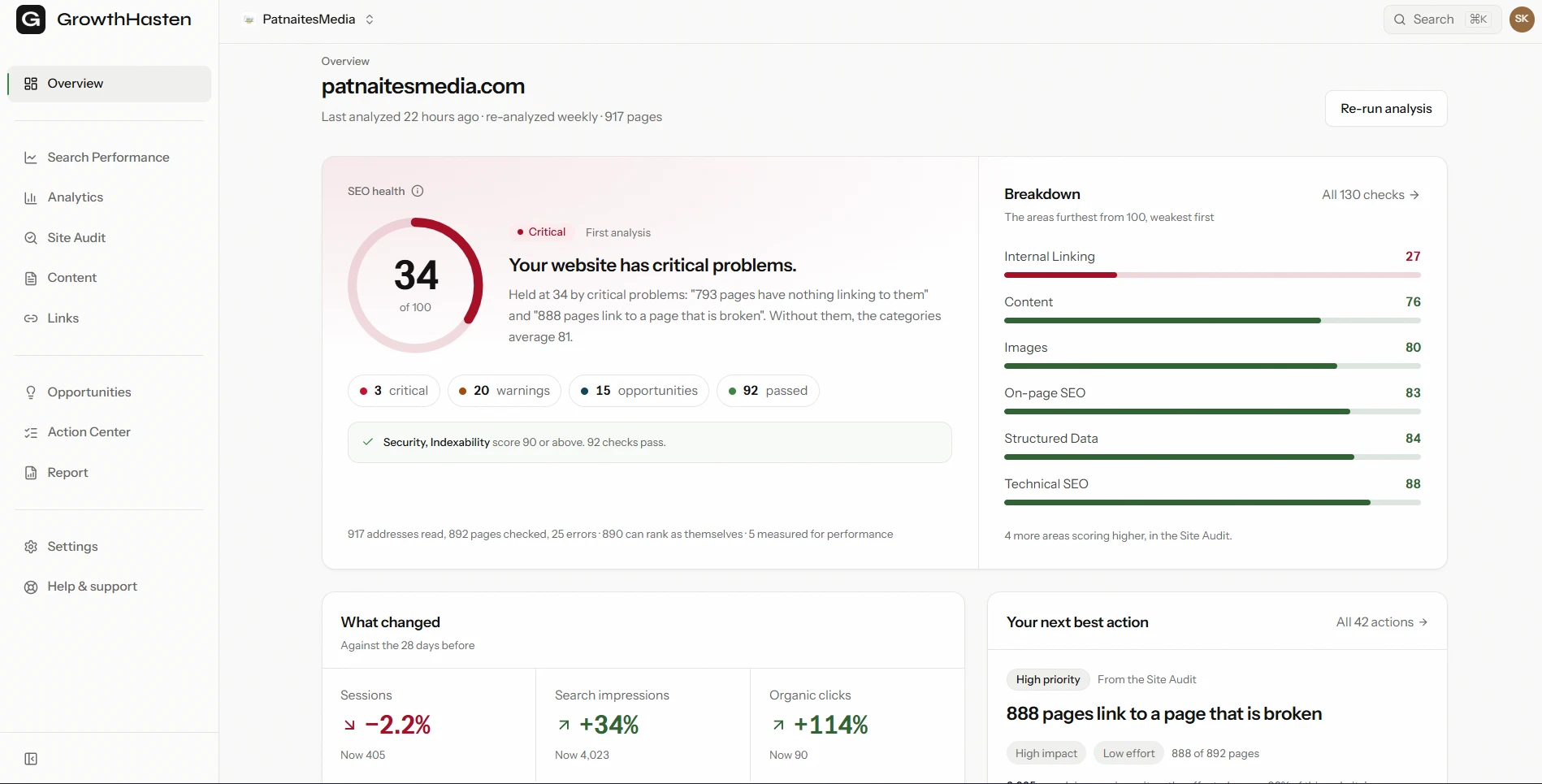
Run your site through GrowthHasten's Site Audit. It crawls your pages and returns a prioritized list of technical, on-page, performance and AI crawler access fixes. Free plan, no card.
Explore the Site AuditHow do you know if your website is SEO-friendly?
You verify it, rather than assume it, using the same tools Google gives you. Three checks tell you most of what you need to know.
- Render and index a sample page: run your most important pages through URL Inspection in Search Console. Confirm Google can fetch them, that the rendered HTML contains your real content and links, and that each page is indexed and canonicalizes to itself.
- Check performance on mobile: measure Core Web Vitals with real-user field data where you can, not only a lab score, and confirm pages load within the documented thresholds on a phone.
- Run an audit crawl: crawl the whole site to surface broken links, orphan pages, duplicate titles, missing metadata, and pages the internal link graph never reaches.
The failure signs are consistent: pages stuck in "Discovered, currently not indexed," a rendered HTML view that looks empty, titles duplicated across templates, and important pages buried five clicks deep. Any one of them means the build has an SEO gap worth fixing before you invest in content or links.
The one habit worth building is this: treat SEO as an acceptance criterion of the build, not a phase that starts after it. A site that a crawler cannot render or an important page no internal link reaches is a defect, and it should fail review exactly like a broken feature would.
This week, take the SEO build spec above and run it against your current or planned site, one row at a time. Every row you cannot demonstrate is either a fix to schedule now or a requirement to write into the next build brief, before it becomes a redirect map and a traffic drop later.
Audit the Site You Have Before You Build the Next One
GrowthHasten's Site Audit crawls your current website, groups repeated issues by template and names the pages each one affects, so you can see which problems a rebuild would actually solve and which a fix would. Free plan: one website of up to 900 pages, no card.
Analyze Your WebsiteQuestions
Frequently asked questions
What does an SEO-friendly website actually mean?
It means a site engineered so search engines and AI answer engines can crawl it, render its content, understand its structure, and trust its quality. In practice that is clean URLs and navigation, fast server-rendered pages, semantic HTML and structured data, and genuinely helpful content, rather than a single plugin or a set of keywords bolted on before launch.
Which website platform is best for SEO?
Any platform that outputs real HTML, lets you control titles, meta tags, URLs, redirects, and structured data, and loads fast can rank. WordPress, Webflow, a headless CMS, and a custom Next.js build can all be SEO-friendly. The wrong choice is usually a client-only build that ships an empty shell to crawlers and waits for the render queue to catch up.
Should SEO be done before or after building a website?
Before. Routing, rendering, URL structure, and redirects are cheap to set right in the spec and expensive to retrofit after launch, once URLs are live and indexed. Treat SEO as an acceptance criterion of the build, in the same bucket as accessibility and performance, rather than a marketing phase that starts after the developers hand the site over.
Does website design affect SEO?
Yes, both directly and indirectly. Design drives page speed, mobile usability, and how crawlable your content and navigation are, all of which feed ranking. Design that hides content behind scripts, buries it below heavy media, or builds navigation as an unlabeled script menu hurts both users and search engines. Clear, fast, well-structured design serves both at once.
How do I know if my website is SEO-friendly?
Verify it rather than assume it. Run your most important pages through URL Inspection in Search Console to confirm Google renders and indexes them, check that pages load within Core Web Vitals thresholds on mobile, confirm titles, metadata, and canonicals are set, and run an audit crawl to surface orphan pages and broken links. The failures show up fast.
Who owns SEO on a web build?
It is shared across three roles. Developers own rendering, performance, URLs, redirects, and structured data; designers own mobile layout, content hierarchy, and image handling; marketers own keywords, content, titles, metadata, and analytics. Builds ship un-optimized when no one is assigned the overlap, so a written ownership map with one accountable owner per element prevents the gap.

Written by
GrowthHasten Team
Editorial Team, GrowthHasten
Articles from the GrowthHasten editorial team, grounded in primary research, our own testing, and what analyzing real websites shows, fact-checked in-house.
View profile