
A featured snippet is the boxed answer Google lifts to the top of a search results page, above the regular blue links, in the slot people call position zero. It is not a separate ranking you apply for. Google pulls it from a page that already ranks, reformats a concise answer, and shows it with a link back to the source. This guide is for marketers, founders, and writers who want their pages quoted in that box, and it covers what snippets are, the main types, how Google chooses one, how to format for each, and when chasing the box is a waste of your time.
The short version
- You usually cannot win a snippet without first ranking on page one. Google builds the box from existing top results, so the ranking comes first and the box comes second.
- The format that wins depends on the question. Paragraph answers win definitions, ordered lists win processes, and tables win comparisons.
- Answer the question in plain text right below a clear heading, in roughly 40 to 60 words, before you elaborate.
- The same clean formatting that earns a snippet also feeds People Also Ask and AI Overviews, so the work compounds.
- Winning the box can lower your clicks when the answer is complete on the page. Not every query is worth the effort.
What is a featured snippet and where does it appear?
It is a short answer Google extracts from a ranking page and displays in a highlighted box at the top of the results. It sits above the standard organic listings, which is why people call it position zero, and it typically shows the answer, the page title, and the URL it came from. Google's own Search documentation describes these as listings that programmatically detect and pull content that answers the query directly.
The box appears most often for questions: what, why, how, who, and when. It also shows up for phrasings that imply a definition, a set of steps, or a direct comparison. Informational queries trigger it far more than transactional ones, so a search like how does crawling work is a candidate while buy running shoes is not.
What are the main types of featured snippets?
Four formats cover almost everything you will see: paragraph, list, table, and the definition or video variants that build on those. Each maps to a kind of question, and matching your format to the question type is most of the battle.
- Paragraph: A few sentences that define a term or answer a direct question. The most common type by far.
- List: Ordered lists for sequences and steps, unordered lists for collections and non-ranked items like ingredients or examples.
- Table: Rows and columns pulled from an
<table>on the page, used for pricing, specs, and side-by-side comparisons. - Definition and video: A definition snippet is a tight paragraph variant for
what isqueries. For some how-to and demonstration queries Google shows a video with a timestamped clip instead of text.
How does Google choose which page gets the snippet?
Google selects a page that already ranks well and whose content answers the query most cleanly, then reformats a piece of it into the box. There is no markup that forces a snippet and no setting to request one, and Google's Search Essentials set the same baseline of helpful, well-structured content that snippet selection rewards. The signals that matter are ranking on page one, a clear match between the heading and the query, and an answer written in a shape the algorithm can lift without editing.
Structure does the heavy lifting. A question as a heading followed immediately by a self-contained answer is easy to extract. A page that buries the answer three paragraphs into a section, or splits it across a sentence and a caption, gives Google nothing clean to pull. Clarity beats length here, and beats keyword density by a wide margin.
Do you need to rank on page one to win a featured snippet?
Almost always, yes. Google draws snippets from the pages already ranking for the query, and the overwhelming majority come from the first page of results. Chasing the box for a keyword where you sit on page three is the wrong order of operations: earn the ranking first, then optimize the format.
This changes how you prioritize. Look at queries where you already rank in roughly the top ten but do not hold the box. Those are your realistic targets, because the ranking is banked and only the formatting stands between you and position zero. Our keyword research guide explains how to pull that list of near-miss queries before you spend a minute on formatting.
How do you format a page to win a paragraph snippet?
Put the question in a heading, then answer it in one self-contained block of about 40 to 60 words directly underneath. Lead with the answer itself, not a windup. If the heading asks "What is technical SEO," the first sentence should define technical SEO in plain terms, and only then should the section expand with detail, caveats, and examples.
A few habits make the paragraph extractable. Write the answer so it reads correctly on its own, with no "as mentioned above" or pronouns that point elsewhere. Keep the sentence structure simple. Use <h2> or <h3> for the question so the heading and answer are visibly paired. These are the same moves that make a page quotable in general, and they line up with the fundamentals in our on-page SEO checklist.
How do you win list and table snippets?
Give Google a real list or a real table in the HTML, and label it with a heading that matches the query. For a process query like how to do keyword research, use an ordered <ol> with each step as a short, action-led item. For a collection like types of schema markup, an unordered <ul> works. Google frequently builds a list snippet by pulling your <h2> or <h3> subheadings, so name your steps well.
Tables win comparison and data queries. If the search implies rows and columns, pricing tiers, plan features, spec sheets, then a clean <table> with clear headers is what Google reaches for. Keep it simple: three or four columns, plain header cells, no merged rows or nested markup that confuses extraction. Structured data helps machines parse a page, though it does not award snippets on its own, and our schema markup guide covers where that structure genuinely pays off.
What is the snippet-type-to-format playbook?
Match the format to the question and you have done most of the work. This is the playbook we use when deciding how to shape a section aimed at position zero.
| Snippet type | Format that wins it | Example query |
|---|---|---|
| Paragraph / definition | Question heading, then a 40 to 60 word answer in plain text | what is a featured snippet |
| Ordered list | An <ol> of short, action-led steps under a how-to heading | how to win a featured snippet |
| Unordered list | A <ul> of non-ranked items under a plural heading | types of featured snippets |
| Table | A clean <table> with clear headers, three or four columns | featured snippet vs rich result |
| Video | A demonstration video with chapters and accurate timestamps | how to add schema markup |
How are featured snippets connected to People Also Ask and AI Overviews?
They run on the same engine: Google extracting a concise answer from ranking pages. People Also Ask expands questions into the same kind of boxed answer, and AI Overviews synthesize an answer from several sources using the same preference for content that is cleanly formatted and directly responsive. Optimize a page for a paragraph snippet and you have, in the same stroke, made it easier to pull into a PAA box and easier for an AI system to cite.
This is why the format work compounds instead of fragmenting your effort. A question heading with a tight answer underneath is the unit all three systems reward, and it's also the unit a voice assistant reads aloud: our breakdown of what changed in voice search SEO covers why the old snippet-chasing playbook now sits inside this same extractable-answer work rather than beside it. The same logic applies a layer earlier when the source material is audio rather than text: a podcast transcript structured with question-shaped subheadings is what makes an episode eligible for any of these three surfaces at all. If AI search visibility is a priority, our guide to Google AI Overviews goes deeper on how the extractable-answer approach carries across the whole answer surface, not just the classic snippet box.
How do you find featured snippet opportunities?
Start with the queries you already rank on page one for but do not own the box. That intersection is where a snippet is realistically within reach, because the ranking is already there and only the format is missing. Search Console is the fastest source: filter for queries where your average position sits in the top ten, then check each one in a fresh or incognito search to see whether a snippet exists and who holds it.
From that list, prioritize by three things: whether a snippet even appears for the query, whether the current holder's answer is weak or outdated, and whether the query is worth the click. A box held by a thin, poorly formatted answer is a soft target. A query with strong search intent and no box yet may be worth structuring for in case Google adds one. Feed the winners into your editing queue and reshape those sections one at a time.
How do you measure snippets and handle the zero-click trade-off?
Track position and clicks together, because the snippet can move them in opposite directions. In Search Console, watch average position improve toward the top and then read the clicks and click-through rate for that query. A snippet often lifts position and impressions while flattening clicks, since the box can answer the searcher completely on the results page. That is the zero-click trade-off, and it is real.
Judge each snippet on outcome, not vanity. For a definition query where the full answer fits in the box, you gain brand exposure but may lose the visit, and that can still be worth it for awareness. For a query where the box is a teaser that leaves the reader wanting the detail, the click usually still comes. Write the answer to be genuinely complete for simple questions, and to resolve the core point while signaling there is more for complex ones.
When is winning a featured snippet not worth it?
When the box answers the question so completely that it removes the reason to click, and the click was the point. If a page exists to drive sign-ups, demos, or considered reading, handing the entire answer to the results page can cost you the visit you actually needed. A snippet is a means, not a trophy, and the trophy is sometimes worth less than the traffic it replaces.
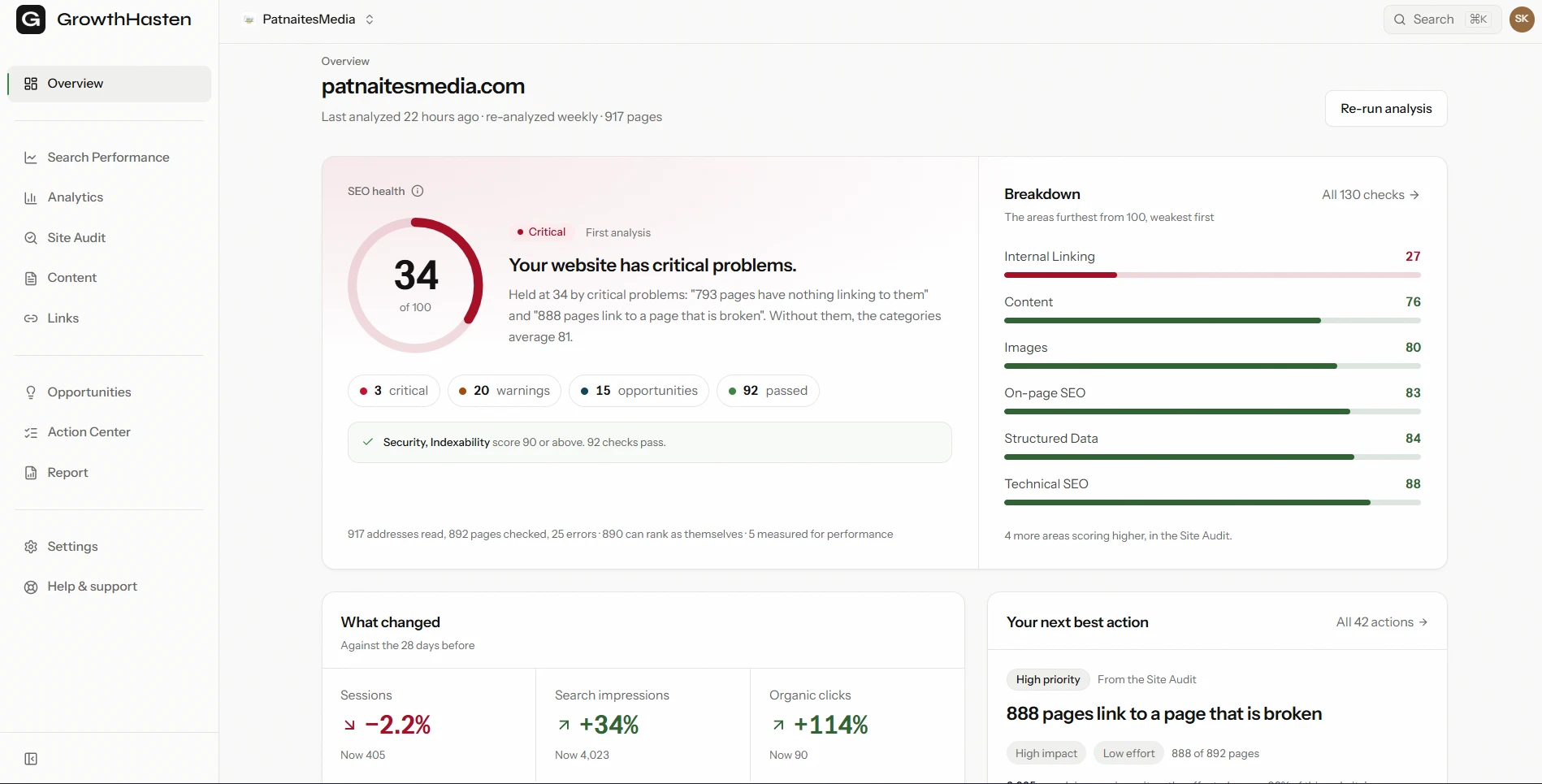
Skip or deprioritize the chase when the query has weak commercial or engagement value, when the answer cannot be given honestly in 60 words, or when holding the box would cannibalize a page that converts. Remember too that you cannot force a snippet: Google awards it, formats it, and can take it away, so treat it as an upside on top of a solid ranking rather than a goal you build a page around. If you sell a service on the strength of depth, keep the depth behind the click. For growth teams weighing these calls across a content program, GrowthHasten's Search Performance view flags queries that rank well but get ignored, and queries close enough to page one to be worth the push.
What mistakes cost people the snippet?
Most losses trace back to a handful of formatting errors, not to a lack of authority.
- Burying the answer: The response sits three paragraphs into the section instead of directly under the heading, so there is nothing clean to lift.
- Answers that are too long or too short: A 200-word wall or a five-word fragment both get passed over. Aim for a self-contained 40 to 60 words for paragraphs.
- Format mismatch: Writing prose for a process query that clearly wants an ordered list, or a list for a comparison that wants a table.
- Dependent phrasing: Answers that lean on "as noted above" or unclear pronouns cannot stand alone in a box.
- Chasing snippets on page three: Formatting a page that does not rank yet. Earn the ranking first.
The habit worth building is simple: for every important question your audience asks, put that exact question in a heading and answer it in a self-contained paragraph, list, or table immediately below. Do it consistently and your pages become extractable by every answer surface Google runs, not just the snippet box. This week, open Search Console, pull five queries where you already rank in the top ten without the box, and reshape the answer under each heading to match the format the query is asking for.
Read Your Search Console Data Without Exporting It
Connect Search Console once and GrowthHasten reads 16 months of your queries and pages, names the ones that rose and fell, and flags queries that rank well but get ignored and queries close enough to page one to be worth the push. Free plan, no card.
Explore Search PerformanceQuestions
Frequently asked questions
What is position zero in SEO?
Position zero is the featured snippet slot at the very top of Google's results, above the first regular listing. Google pulls a concise answer from a page that already ranks and displays it in a highlighted box with a link back to the source. It is called position zero because it sits ahead of the traditional number-one organic result, giving that page extra visibility.
Do you have to rank on page one to get a featured snippet?
In almost every case, yes. Google builds featured snippets from pages that already rank for the query, and the overwhelming majority come from page-one results. You cannot apply for a snippet or force one with markup. The practical order is to earn a top-ten ranking first, then reformat your answer so it is clean and easy for Google to extract into the box.
How long should a featured snippet answer be?
For paragraph snippets, aim for roughly 40 to 60 words of self-contained text placed directly under a clear question heading. That length is long enough to answer the question completely and short enough for Google to lift without editing. Lists and tables follow the natural shape of the content instead of a word count, but each list item should stay short and action-led.
Do featured snippets increase or decrease clicks?
It depends on the query. A snippet lifts your position and impressions, but when the box answers the question completely on the results page, it can reduce clicks because the searcher no longer needs to visit. This is the zero-click trade-off. For simple definition queries you may lose the visit while gaining exposure; for complex queries the box acts as a teaser and the click usually still comes.
Are featured snippets the same as AI Overviews?
No, but they are closely related. A featured snippet extracts one answer from a single ranking page, while an AI Overview synthesizes an answer from several sources. Both favor content that is cleanly formatted and directly responsive to the query, so the same question-heading-plus-tight-answer structure helps you win a snippet, appear in People Also Ask, and get cited in an AI Overview.

Written by
GrowthHasten Team
Editorial Team, GrowthHasten
Articles from the GrowthHasten editorial team, grounded in primary research, our own testing, and what analyzing real websites shows, fact-checked in-house.
View profile