

An XML sitemap is a machine-readable file that lists the URLs you want search engines to know about, along with a few signals about each one. It helps crawlers discover pages and understand when they changed. It does not force anything into the index. This guide is for site owners, marketers, and developers who want a sitemap that helps discovery instead of quietly working against it, and it covers what a sitemap does, who needs one most, how to build and submit it, the protocol limits, and the mistakes that turn a sitemap into a liability.
The short version
- A sitemap aids discovery. It never guarantees indexing. Google decides what to index on its own signals.
- List only canonical, indexable,
200-status URLs. Nonoindex, redirected, or blocked pages.<loc>and<lastmod>carry real weight.priorityandchangefreqare largely ignored.- One file caps at 50,000 URLs or 50MB uncompressed. Split larger sets with a sitemap index.
- A small, well-linked site may not need a sitemap at all.
What is an XML sitemap, and what does it actually do?
It is a file, usually named sitemap.xml, that lists your important URLs so search engines can find them faster. Think of it as a discovery aid, not a command. Google reads the file, learns which URLs you consider worth crawling, and schedules visits based on its own priorities.
The distinction matters more than any other point in this guide. A sitemap can get a page crawled sooner, especially a page with few internal links pointing to it. It cannot make Google index a page it judges low-value, duplicate, or thin. If you remember one thing: sitemaps influence discovery, not indexing decisions. Google's Search Central documentation is explicit that a sitemap does not guarantee crawling or indexing.
Who needs an XML sitemap most?
Large sites, new sites, and sites with poorly linked pages benefit the most. If your internal linking is weak or your site is too big for crawlers to reach every page through links alone, a sitemap fills the gaps.
- Large sites. Thousands of URLs, deep archives, or frequently rotating inventory. Crawlers may never reach the deepest pages through links alone.
- New sites. Few external links pointing in, so there are few discovery paths. A sitemap gives Google a starting map.
- Poorly linked pages. Orphan pages and pages buried many clicks deep are easy to miss. Listing them in the sitemap gets them crawled, but our guide to finding and fixing orphan pages covers the fix that actually matters: giving them the internal links they are missing.
- Sites with rich media. Image, video, or news content that you want surfaced in specialized results.
Our technical SEO guide covers how sitemaps sit alongside crawling, rendering, and indexing as one connected system.
When do you not need an XML sitemap?
A small site with clean internal linking often does not need one. If you run a handful of pages that all link to each other, and Google can reach every page within a click or two of the homepage, a sitemap adds little.
That said, the cost of having one is close to zero, so most sites keep it anyway. The real question is not whether it exists but what you put inside it. Never use a sitemap as a dumping ground: do not list noindex pages, redirected URLs, or pages blocked in your robots.txt file. A sitemap full of URLs you do not actually want indexed sends mixed signals and wastes crawl attention.
What goes inside a sitemap file?
Each URL entry is a <url> block, and the only required element is <loc>, the full absolute URL. The optional <lastmod> element tells crawlers when the page last changed in a meaningful way.
A minimal entry holds a <loc> such as https://example.com/page and a <lastmod> date such as 2026-08-05. Keep <lastmod> honest: Google may ignore the value if it consistently fails to match real changes, so stamping today's date on every publish trains crawlers to distrust the file.
The old priority and changefreq elements no longer matter. Google has stated it does not use priority and treats changefreq as a weak hint at most, so you can leave both out. Clean <loc> values and accurate <lastmod> dates are all a modern sitemap needs.
Which URLs belong in your sitemap, and which never should?
Only canonical, indexable, 200-status URLs belong. Get the canonical tag right first, since a sitemap full of non-canonical duplicates just amplifies the confusion. Every URL in the file should be one you genuinely want in search results, in its final, canonical form. Paginated URLs are a common edge case here, since page 2 and beyond are canonical, indexable pages in their own right, and our guide to whether paginated URLs belong in your sitemap works through when to include them.
| Include | Exclude | Why |
|---|---|---|
Canonical pages returning 200 | Pages carrying noindex | You would be asking Google to index and not index the same URL |
| Self-referencing canonical pages | Non-canonical or parameter duplicates | Duplicates split signals and waste crawl attention |
| Live, reachable pages | Redirected (301 or 302) URLs | List the destination, not the old URL |
| Publicly accessible pages | URLs blocked in robots.txt | Google cannot crawl what it is told to skip |
What are the size limits, and how does a sitemap index work?
A single sitemap file can hold up to 50,000 URLs or 50MB uncompressed, whichever comes first. Cross either limit and you split the URLs across multiple files, then list those files in a sitemap index.
A sitemap index is a sitemap of sitemaps: one file that points to your individual sitemap files rather than to pages. Large sites often organize these by section, such as one sitemap per content type. You submit the single index file, and Google follows it to the rest. You can gzip sitemaps to reduce transfer size, but the 50MB limit applies to the uncompressed file.
What other sitemap types exist?
Beyond the standard page sitemap, there are specialized formats for images, video, and news. Most sites only need the standard type, but media-heavy sites gain from the extras.
| Sitemap type | What it lists | When to use |
|---|---|---|
| Standard XML sitemap | Canonical page URLs with <loc> and <lastmod> | Almost every site; the default |
| Sitemap index | A list of other sitemap files | When you exceed 50,000 URLs or split by section |
| Image sitemap | Images tied to the page that hosts them | Image-heavy sites where visuals drive discovery |
| Video sitemap | Video URLs with metadata like duration and thumbnail | Sites hosting video they want in video results |
| News sitemap | Recent articles from roughly the last two days | Sites approved for Google News |
How do you generate an XML sitemap?
Most sites generate sitemaps automatically, and that is the right default. Manual sitemaps drift out of date the moment you publish, so lean on a tool that regenerates the file whenever content changes.
- CMS built-in. Many platforms output a sitemap at
/sitemap.xmlwith no setup. Confirm it lists only canonical, indexable URLs. - Plugins. SEO plugins generate and update sitemaps and usually let you exclude post types or sections you do not want indexed.
- Dynamic generation. Custom applications can build the file on request from the database, which keeps it accurate on large, fast-changing sites.
Whichever route you take, open the finished file in a browser and read it. Automated tools happily include pages you meant to exclude.
How do you submit a sitemap and reference it in robots.txt?
Submit it in Google Search Console under the Sitemaps report, and add a reference line in your robots.txt file. The two methods work together: Search Console gives you status and error reporting, while the robots.txt line helps any crawler find the file.
The robots.txt reference is a single line, Sitemap: https://example.com/sitemap.xml, pointing to the absolute URL. In Search Console, submit the sitemap once and Google rechecks it periodically. Watch the report for the count of discovered URLs and any parse errors. Google's Search Essentials lays out the baseline your listed pages still need to meet to qualify for indexing.
How do sitemaps help during a site migration?
During a migration, a clean sitemap of the new URLs speeds up how quickly Google discovers the changed structure. When URLs move, the faster Google crawls the new set, the faster it processes your redirects and updates its index.
A useful tactic is to keep the <lastmod> dates accurate on the moved pages so crawlers see they changed. Our site migration guide covers the full sequence, but the sitemap role is simple: give Google an accurate list of the new canonical URLs and let the redirects do the rest. Do not list the old URLs; list their destinations.
A sitemap hygiene checklist you can run monthly
Run this quick pass whenever you publish in bulk, and at least once a month otherwise.
Accuracy. Every URL returns 200. No redirect chains. No 404s. Each URL is canonical to itself.
Exclusions. No noindex pages. No pages blocked in robots.txt. No parameter or session duplicates.
Freshness. <lastmod> reflects real content changes, not the build date. New pages appear. Retired pages are gone.
Structure. No file exceeds 50,000 URLs or 50MB. A sitemap index is in place if you split files. The file is referenced in robots.txt.
Reporting. Search Console shows the sitemap as read with no parse errors, and the discovered-URL count roughly matches what you expect.
What are the most common XML sitemap mistakes?
The most common mistake is listing URLs you do not actually want indexed. A sitemap packed with noindex pages, redirects, or blocked URLs contradicts itself and dilutes the signal.
- Stale
<lastmod>dates. Setting every date to today on every deploy teaches Google to ignore the field. - Non-canonical URLs. Listing parameter or duplicate versions instead of the canonical one splits ranking signals.
- Blocked in robots.txt. Listing a URL you also disallow means Google can see it exists but cannot crawl it.
- Treating it as an indexing lever. Adding a page to the sitemap does not fix thin content or duplication. Fix the page.
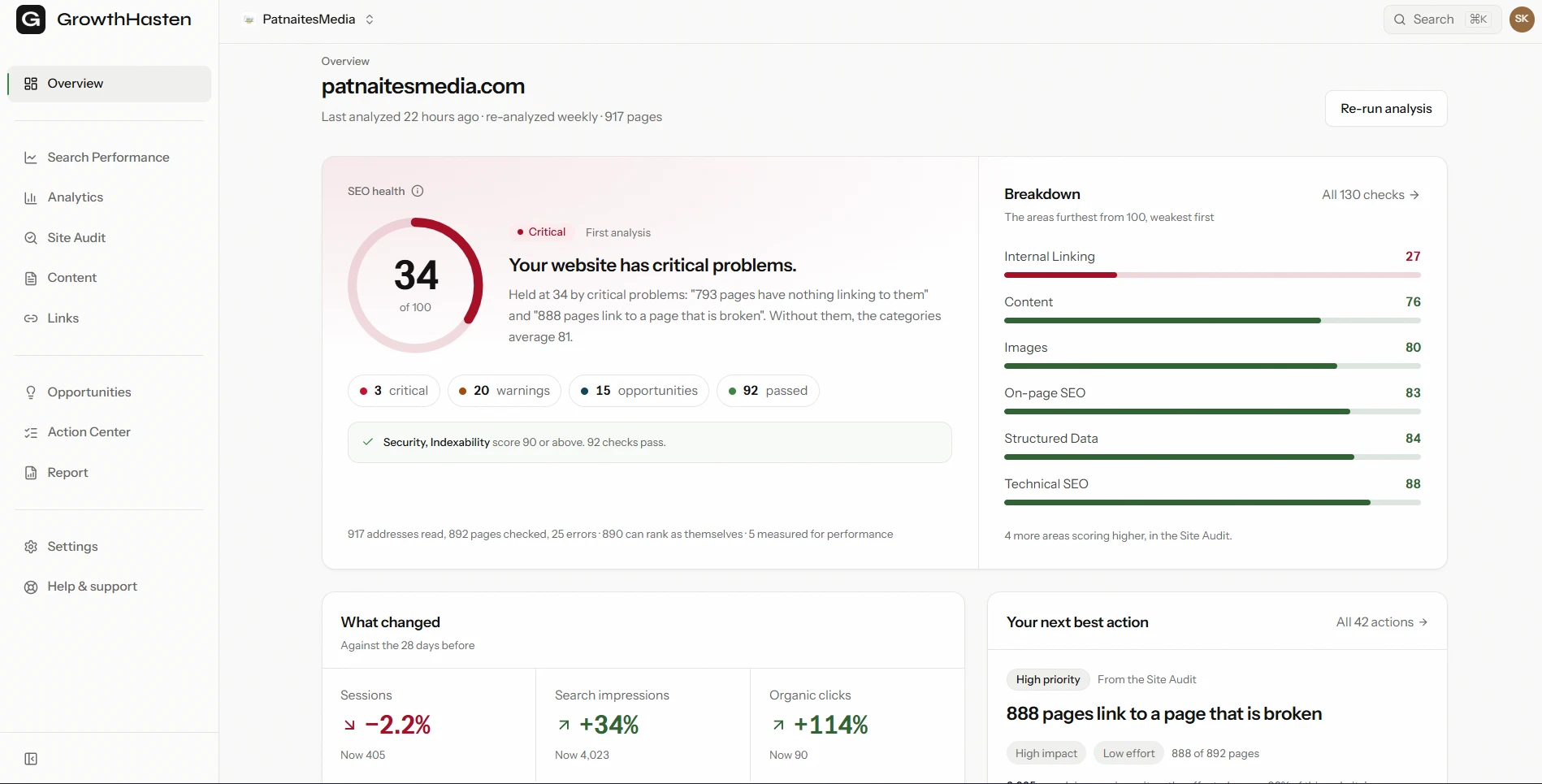
If you want to check that your sitemap pulls its weight, GrowthHasten's Site Audit reads every URL the sitemap declares alongside the pages it crawls. To see how discovery fits the bigger picture, our guide to how Google Search works traces a URL from crawl to result.
The habit worth building: treat your sitemap as a living inventory, not a one-time setup. Every time you publish, redirect, or retire a page, ask whether the file still reflects reality. This week, open your sitemap in a browser, pick ten URLs at random, and check that each one returns 200, is canonical to itself, and is not blocked in robots.txt. If any fail, you have found your first cleanup task.
Find Out What Search Engines Can and Cannot Reach
GrowthHasten's Site Audit reads your robots.txt, sitemap, canonicals, status codes and robots directives page by page, then groups repeated problems so a template issue reads as one fix. Free plan: one website of up to 900 pages, no card.
Analyze Your WebsiteQuestions
Frequently asked questions
Do I need an XML sitemap for SEO?
Not always. A small site with clean internal linking, where Google can reach every page within a click or two of the homepage, often works fine without one. Sitemaps matter most for large sites, new sites with few inbound links, and sites with orphan or deeply buried pages. Since the cost of having one is close to zero, most sites keep a sitemap anyway as a safety net for discovery.
Does an XML sitemap guarantee my pages get indexed?
No. A sitemap aids discovery, not indexing. It tells Google which URLs exist and helps crawlers find them faster, especially pages with few internal links. Google still decides what to index based on quality, uniqueness, and other signals. Adding a page to your sitemap will not fix thin or duplicate content, and it will not override a page's own quality problems. Treat the sitemap as a map, not a command.
How often should I update my XML sitemap?
Update it whenever your content changes, which is why automatic generation is the right default. New pages should appear, retired pages should drop off, and the lastmod date should reflect real edits. Avoid stamping today's date on every URL at each deploy, because Google may start ignoring an inaccurate lastmod field. Beyond that, run a hygiene check at least monthly to confirm every listed URL is still canonical and returns a 200 status.
Where should I put my sitemap and how do I submit it?
Most sites place it at the root, such as sitemap.xml, and reference it in robots.txt with a single line: Sitemap followed by the absolute URL. To get status and error reporting, submit the file in Google Search Console under the Sitemaps report. Google then rechecks it periodically. The robots.txt reference helps any crawler find the file, while Search Console shows you the discovered-URL count and any parse errors.
What is the maximum size of an XML sitemap?
A single sitemap file can contain up to 50,000 URLs or 50MB uncompressed, whichever limit you hit first. If your site is larger, split the URLs across multiple files and list those files in a sitemap index, which is one file that points to your other sitemaps. You can gzip sitemaps to cut transfer size, but the 50MB ceiling still applies to the uncompressed file, not the compressed one.

Written by
GrowthHasten Team
Editorial Team, GrowthHasten
Articles from the GrowthHasten editorial team, grounded in primary research, our own testing, and what analyzing real websites shows, fact-checked in-house.
View profile