

If your website is not showing up on Google, the cause is almost always one of six specific things, and they happen in a predictable order. This is for the founder, marketer, or site owner who shipped a page and then could not find it in search. It walks each cause from most to least likely, gives you the one check that confirms it, and points to the fix that owns it. Before any of that, it separates the two problems people confuse most: a page that is not indexed at all, and a page that is indexed but does not rank. In my experience, the simplest cause turns out to be the right one far more often than people expect.
The short version
- Often enough, nothing is actually broken. A brand-new site or page simply has not been crawled yet, and that needs a sitemap and patience, not a fix.
- If the page is not new, the usual culprit is a
noindextag or arobots.txtDisallowthat shipped by accident, often left on from a staging build.- A canonical tag pointing at a different URL tells Google to index that other page instead, so yours never appears on its own.
- A page with no internal links pointing to it (an orphan) can stay invisible because Google never found a path to it.
- Thin or duplicate content, and far more rarely a manual action, are the last two causes to check, not the first.
Is your site actually missing, or just not ranking?
These are two different problems, and the fix for one does nothing for the other. Run a site:yourdomain.com search in Google. If your pages appear in those results, they are indexed, and your real problem is ranking, which is a separate question entirely. If nothing appears, or a specific page is missing, open Google Search Console and run the URL Inspection tool on that exact address.
URL Inspection tells you whether Google holds the page in its index, when it last crawled it, and the reason it is or is not indexed. That one report decides which of the causes below applies to you. For the full method and its limits, see our guide on how to check if a specific page is indexed. Everything that follows assumes you have confirmed the page is genuinely not in the index.
In what order should you check the causes?
In order of likelihood, not severity. Work down this list and stop at the first branch that matches your situation. Each one ends in a check you can run in a minute, and each has its own section further down.
- Is the page new, published in the last few weeks? It is probably not crawled yet. Go to Cause 1.
- Does URL Inspection say "Excluded by noindex tag"? Go to Cause 2.
- Does it say "Blocked by robots.txt"? Go to Cause 3.
- Does it report a Google-selected canonical that is not your URL? Go to Cause 4.
- Do any other pages on your site link to this one? If nothing does, go to Cause 5.
- Does it say "Crawled - currently not indexed" or "Discovered - currently not indexed"? Go to Cause 6.
- Is there a message under Manual Actions in Search Console? Go to Cause 6, the rare case.
If you want the wider context for why crawling and indexing work this way, our guide to technical SEO foundations covers the full pipeline from discovery to the index.
Cause 1: Is your site or page simply too new?
If you published recently, the most likely answer is that Google has not crawled the page yet, and there is nothing to fix. There is no fixed timeline for this. A new page can be indexed within days or take a few weeks, depending on how easily Google discovers it and how much it trusts the site around it.
You can speed discovery rather than wait on it. Submit an XML sitemap in Search Console, add internal links to the new page from pages Google already crawls, and use URL Inspection to request indexing of your most important URLs. This is the cause people are least willing to accept and most often right about, so rule it out before you go looking for something broken.
Cause 2: Is a noindex tag telling Google to stay out?
A noindex tag is an explicit instruction to keep a page out of the index, and it is one of the most common blocks that should not be there in the first place. It ships silently in ways a human visitor never sees: a "discourage search engines" checkbox in the CMS, a plugin default, or a staging flag that stayed on when the site went live.
To confirm it, run URL Inspection and look for "Excluded by 'noindex' tag," or view the page source and search for <meta name="robots" content="noindex">. The same rule can also arrive as an X-Robots-Tag HTTP response header, which the source view will not show, so check the response headers too. The fix is to remove the tag, then request indexing. From my experience working on audits, a stray noindex left on from staging is the single most common silent blocker, precisely because the live page looks perfect to anyone reviewing it. Our deep dive on a noindex tag covers every way it reaches production. Google's own documentation on blocking indexing with noindex describes both forms.
Cause 3: Is robots.txt blocking the crawl?
A Disallow rule in your robots.txt file can stop Googlebot from crawling a page, which usually keeps it out of results, but not in the way most people assume. Robots.txt governs crawling, not indexing, and few mix-ups in technical SEO do more accidental harm than confusing the two.
| Behavior | robots.txt Disallow | noindex tag |
|---|---|---|
| What it controls | Crawling | Indexing |
| Can the page still appear in results? | Yes, if other pages link to it | No |
| Can Google read the page's content? | No | Yes |
| Reach for it to... | Manage crawler traffic | Keep a page out of the index |
To check it, load the robots.txt at your domain root and scan for a Disallow rule that covers the path of the missing page. The fix is to remove or narrow that rule. One warning: never block a page in robots.txt and put a noindex on it at the same time. If Google cannot crawl the page, it cannot see the noindex, so the page can linger in results with no description. For the full ruleset, see our guide to robots.txt and Google's introduction to robots.txt.
Cause 4: Is a canonical tag pointing somewhere else?
A canonical tag tells Google which version of a page to treat as the original, and if yours points at a different URL, Google indexes that one and leaves your page out of results on its own. This happens with duplicate or parameter URLs, after a migration, or when a CMS sets a single canonical across a template by default.
To confirm it, view the page source and find <link rel="canonical" href="...">, then check whether that address is the page you expect. URL Inspection also reports the "Google-selected canonical" next to your "user-declared canonical," and a mismatch is the signal. The fix is to point the canonical at the URL you actually want indexed. Google's guide on specifying a canonical URL explains how it weighs the signal against redirects and sitemaps.
Cause 5: Is the page orphaned, with nothing linking to it?
Google finds most pages by following links, so a page with no internal links pointing to it can stay invisible for a long time, even when nothing is technically broken. An orphan page often sits in the sitemap but has no path to it from anywhere a crawler already visits, so discovery never happens. The fix is straightforward: add internal links to it from relevant pages Google crawls regularly.
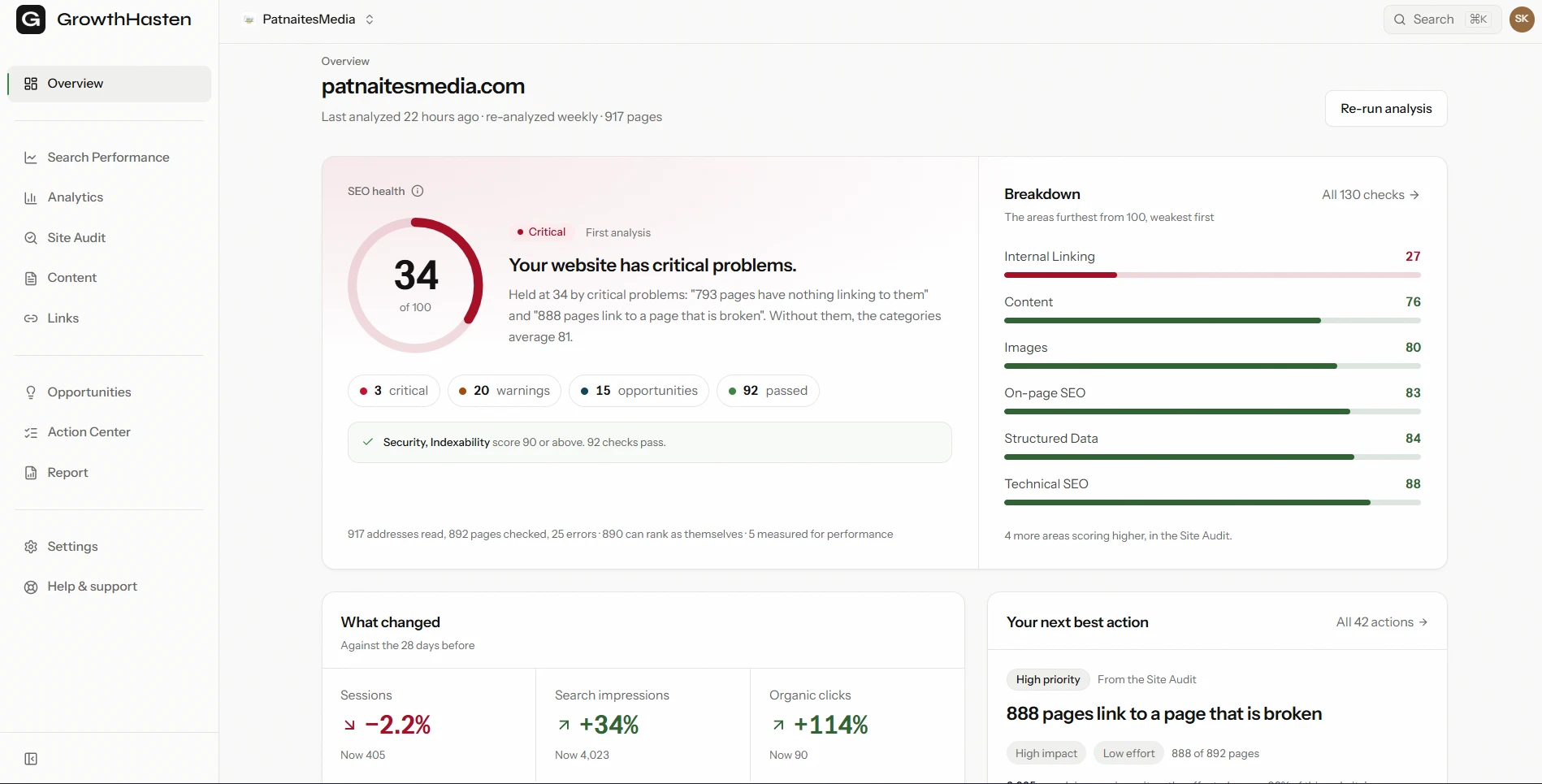
This is also where automated audits quietly go wrong, and it shaped a decision we made in GrowthHasten. Its Site Audit flags the blockers in this article, a noindex tag, a robots.txt Disallow, a canonical pointing elsewhere, and an orphaned page, as deterministic checks, which means the same markup always returns the same answer. The orphan check is the exception that proves the rule: it refuses to run on a crawl that stopped at its budget, because a page looks orphaned when the only page linking to it is one the crawler never reached. In that case it reports the result as not measured rather than as zero, so you are never told a page is an orphan when the truth is that the crawl simply ran out of room.
Cause 6: Is the page thin, duplicate, or penalized?
These are the last two causes to check, not the first, because they are far less common than a tag or a missing link. When URL Inspection reports "Crawled - currently not indexed" or "Discovered - currently not indexed," Google has seen the page and chosen not to index it, often because the content is thin, closely duplicates another page, or the site has little authority to spend on it yet. The fix is to improve, consolidate, or clearly differentiate the page, then request indexing. Our guide on Crawled - currently not indexed walks the difference between a real problem and a normal one.
A manual action is the genuinely rare case. It is a human review flag against Google's spam guidelines, it is reported in Search Console under Manual Actions, and it is far less common than any ordinary cause. A manual action is not the same thing as "my rankings dropped," which is a ranking question, not an indexing one. Check for a noindex, a robots.txt block, or a brand-new site first. A penalty is the last thing to suspect, not the first.
The one-page checklist: cause, how to confirm, and fix
Here is every cause in one place, with the check that confirms it and the fix that resolves it. Start at the top and stop at the first row that matches.
| Cause | How to confirm | Fix |
|---|---|---|
| Too new, not crawled | URL Inspection: "URL is not on Google," no crawl date | Submit a sitemap, add internal links, request indexing, wait |
| noindex tag | URL Inspection: "Excluded by noindex tag"; meta robots or X-Robots-Tag present | Remove the noindex, then request indexing |
| robots.txt Disallow | URL Inspection: "Blocked by robots.txt"; check /robots.txt | Remove or narrow the Disallow for that path |
| Canonical points elsewhere | Google-selected canonical differs; rel=canonical in source | Point the canonical at the URL you want indexed |
| Orphan page | No internal links point to it in a site crawl | Add internal links from pages Google already crawls |
| Thin or duplicate | "Crawled / Discovered - currently not indexed" | Improve, consolidate, or differentiate the content |
| Manual action | Message under Manual Actions in Search Console | Fix the violation, then request a review |
Checking indexability belongs before launch, not after you notice the traffic never arrived. Most of these causes are invisible to anyone viewing the live page, which is exactly why they survive the day a site goes live. Take your handful of most important URLs, inspect each one in Search Console today, and if a noindex rule, a blocked robots.txt path, or an unexpected canonical turns up, you have your answer before it has cost you a single visitor.
See What Your Site Needs Fixed First.
GrowthHasten is free SEO and content software. Point it at your domain and it reports what is broken, ranked by what to do first. An account takes a minute and costs nothing.
Start FreeQuestions
Frequently asked questions
How long does it take for a new website to show up on Google?
There is no fixed time. A new site can be indexed within days or take a few weeks, depending on how Google discovers it. Submitting an XML sitemap in Search Console and building internal links to new pages speeds discovery. Until then, "not showing up" usually means "not crawled yet," which needs patience, not a fix.
Why does my site appear for a site: search but not for keywords?
A site:yourdomain.com result means the page is indexed. If it does not appear for keywords, the problem is ranking, not indexing, which is a different question entirely. Check that the page targets the query and has enough authority and internal links to compete for it.
How do I get Google to index my website faster?
Submit an XML sitemap in Google Search Console, use URL Inspection to request indexing of key pages, and add internal links from pages Google already crawls. Discovery is link-driven, so an orphaned page with no inbound links can stay invisible indefinitely no matter how long you wait.
Why is my homepage indexed but my other pages are not?
The most common reasons are that the other pages are orphaned with nothing linking to them, carry a noindex tag, are blocked in robots.txt, or point a canonical tag at another URL. Check each page's index status in Search Console URL Inspection to see which applies before making any change.
Is my website not showing up because of a Google penalty?
Rarely. A manual action is specific, is reported in Search Console under Manual Actions, and is far less common than the ordinary causes. Check for a noindex tag, a robots.txt block, or a brand-new site first. A penalty is the last thing to suspect, not the first.

Written by
Anshuman Sinha
AI SEO Specialist, GrowthHasten
Anshuman Sinha is an AI SEO Specialist and Computer Science Engineer with over three years of experience in SEO and five years in web development. He specializes in Technical SEO, AI Search Optimization (AEO and GEO), SaaS SEO, and building high-performance websites with modern technologies.
View profile