

Faceted navigation is the filter interface on a listing page: the checkboxes and dropdowns that let a visitor narrow a set of items by whatever attributes those items carry. Most implementations encode each selection in the query string, so every combination a visitor can click becomes a distinct, crawlable URL. This guide is for the person who owns technical SEO at a SaaS, AI or B2B technology company and has just worked out that an integration directory, a docs tag index or a programmatic template set is generating more URLs than the company has pages. Three respectable sources will hand you three different answers about what to do with them. Google's own documentation, last updated on 18 December 2025, settles it, and its answer is not the one most of those sources reach for first.
The short version
- Google's current documentation lists
robots.txtfirst for filter URLs and saysrel="canonical"andrel="nofollow"are "generally less effective in the long term than the previously mentioned methods." Two of the three ranking guides checked for this article put the canonical tag first instead.- The Search Console URL Parameters tool has not existed since April 2022. Advice built on it is not merely dated, it is unrunnable, and one page still ranking for this query published that advice three days after Google announced the shutdown.
- The real decision is not which tag to use. It is which filter combinations deserve to exist as indexable URLs at all, and that is settled before any tag is chosen.
- A filter set multiplies rather than adds. Four filters over a sixty-item directory can produce several hundred valid URLs, every one returning
200, none of which looks broken from the server's side.- On a small site, none of this is urgent. Google's crawl budget guide opens by telling sites under its thresholds not to read it.
What is faceted navigation?
Faceted navigation is a filtering interface that lets visitors combine several independent attributes at once to narrow a list of items. An integration directory that filters by category, by pricing tier and by deployment model is faceted navigation. So is a docs index filtered by product area and version, a changelog filtered by release type, and a help centre filtered by topic and audience.
The distinction the search results keep blurring is worth getting right. Filtering narrows one dimension at a time and usually returns a subset of the same list. Faceted navigation combines several independent dimensions, which is why the number of reachable states grows by multiplication rather than addition.
The SEO consequence comes from a single implementation decision, not from the feature itself. Google's documentation is direct about where the damage originates: the feature is useful, but "its most common implementation, which is based on URL parameters, can generate infinite URL spaces." A directory whose filters live entirely in the interface has no SEO problem at all. A directory that writes every selection into the query string has one the moment a crawler finds a link to it.
Why does a filter set generate so many URLs?
Because filters compose. Each independent control multiplies the number of reachable states rather than adding to it, and the arithmetic runs away faster than the interface suggests it should.
Take an integration directory with sixty listings and four controls: a category filter with twelve values, a pricing tier with three, a deployment model with two, and a sort control with four orders. Each control can also be left unset. That is 13 x 4 x 3 x 5, or 780 distinct URLs standing behind sixty pages of actual content. Allow multi-select on the category filter and that one control alone contributes 4,096 subsets instead of 13, taking the total past 245,000. Append parameters in click order rather than a fixed order and each of those combinations acquires several more spellings.
Those are illustrative numbers, not measured ones. The point is the shape of the curve. Our guide to how to see facet crawl waste in your server logs runs the same arithmetic from a smaller template and lands in the same place.
What follows from that count is narrower than it is usually made out to be. Google's documentation names exactly two harms, and both of them are about crawling:
- Overcrawling: crawlers cannot tell whether a filter URL is useful without fetching it, so they typically fetch a very large number of them before concluding the URLs are useless.
- Slower discovery crawls: fetches spent on useless URLs are fetches not spent finding new, useful ones.
Two further consequences are real but secondary. Near-duplicate variants dilute the internal and external links that should have accrued to one listing page. And the index fills with pages nobody chose to publish, which is worth distinguishing carefully from the version of that problem our guide to index bloat from generated pages covers. There, someone decided to build the pages and the fix is an editorial one. Here, nobody authored anything. The template did it, silently, the first time a crawler followed a filter link.
What does Google actually recommend?
Blocking the URLs in robots.txt, in most cases, before any tag is considered. Google's page on managing crawling of faceted navigation URLs, last updated on 18 December 2025, splits the problem in two, and the split is the useful part.
If you do not need the filter URLs indexed, the doc says to prevent crawling, and it offers two mechanisms in order. The first is "Use robots.txt to disallow crawling of faceted navigation URLs," with the reasoning attached: there is often no good reason to allow crawling of filtered items, because it consumes server resources for no or negligible benefit. The recommended shape is to allow crawling of the individual item pages plus one dedicated listing page with no filters applied. Google's own example matches on the parameter key, in the form disallow: /*?*color=, with a narrower allow rule carving back the one combination worth keeping. Our post on how robots.txt pattern matching actually works covers the wildcard and anchor rules those lines depend on.
The second mechanism is an engineering answer rather than an SEO one. Move the filters into the URL fragment. Google states plainly that "Google Search generally doesn't support URL fragments in crawling and indexing," and therefore that a fragment-based filtering mechanism "will have no impact on crawling (positive or negative)." A team that has not shipped the feature yet can make the whole problem not exist by choosing #color=green over ?color=green.
Then comes the sentence the ranking consensus is behind. Google names rel="canonical" and rel="nofollow" as other ways to signal a crawling preference, and immediately adds: "However, these methods are generally less effective in the long term than the previously mentioned methods." That is narrower than "never use canonical," and the narrow version is the useful one. Google still describes canonical as something that "may, over time, decrease the crawl volume of non-canonical versions of those URLs." May, over time, less effectively. It is a hint with a slow feedback loop, not a control.
If you do want some filter URLs crawled and indexed, the same page sets out hygiene rules. Three of them are implementation details worth knowing:
- Use
&as the separator: Google calls it "the industry standard URL parameter separator" and warns that commas, semicolons and brackets are hard for crawlers to detect as separators, because most of the time they are not. - Fix the filter order: where filters are encoded in the path rather than the query string, the logical order has to stay the same every time and duplicate filters have to be impossible.
- Return a real 404 for empty combinations: "Return an HTTP 404 status code when a filter combination doesn't return results." Not a redirect to a generic error page, and not a soft
200with an empty grid. The 404 goes on the URL where it was encountered.
The recommendation is not a recent reversal, either. Two other Google documents point the same way, though the first does so more quietly than it usually gets credited with.
The first is the announcement that killed the tool a lot of this advice used to depend on. Google announced the deprecation of the Search Console URL Parameters tool on 28 March 2022, with a one-month wind-down, on the grounds that only about 1% of the parameter configurations then specified in it were useful for crawling. Read that post carefully, because it gets overstated: it names no replacement. It says no action is needed, because Google's crawlers would learn to handle parameters on their own, and offers robots.txt rules only "If you need more control", alongside hreflang. That is weaker than a recommendation. What it settles is that from April 2022 there was no parameter tool left to point at, and robots.txt was the control surface Google pointed at instead.
The second is Google's crawl budget guide, which contains the flat instruction that settles the noindex question. Under its section on blocking unimportant URLs it says: "Don't use noindex, as Google will still request, but then drop the page when it sees a noindex meta tag or header in the HTTP response, wasting crawling time." Read that in scope. It is advice about managing crawl, not a general position on noindex, and the two get confused constantly.
Why do most guides recommend canonical tags first?
Because the advice was written before the documentation was, and because canonical solves the problem people can actually see. Duplicate content shows up in a crawl report. Wasted fetches do not, unless somebody opens the logs. Three ranking guides were checked for this article, and this is the order each one puts its recommendations in.
| Page | Last updated | Order it recommends |
|---|---|---|
| Search Engine Journal | 6 October 2024 | Canonicalization, then noindex, then robots.txt |
| Ahrefs | 7 February 2025 | Canonical tag, then robots.txt, then nofollow, then noindex, then 404 |
| Botify | 31 March 2022 | Three buckets. Its crawl-blocking bucket names four methods, robots.txt first, Search Console parameter handling second |
The Botify row needs stating precisely, because the easy version of this criticism is the wrong one. That post leads its crawl-blocking advice with robots.txt, exactly where Google's documentation now starts. What dates it is the second item on its four-method list: parameter handling in Search Console. The post went live on 31 March 2022, three days after Google announced that tool was being switched off, and it has not worked since. The flaw is narrow rather than fundamental, and that is the more useful observation. Advice like this does not age by turning wrong. It ages by carrying one dead mechanism forward.
The other two are answering an adjacent question rather than getting it wrong. Search Engine Journal says explicitly that robots.txt is the best approach for crawl budget; it just arrives there third, after two sections on indexing. Ahrefs puts robots.txt second, behind the canonical tag. Both are also right about the one thing robots.txt genuinely cannot do: if external links already point at a filter URL, a canonical is the only mechanism that consolidates their value, because a blocked URL is never fetched and the rel="canonical" on it is never read.
So the position worth holding is narrower than either the consensus or an overcorrection against it. Decide the indexable set first. Block the rest at the crawl layer. Reach for canonical when a specific URL has already accumulated signals worth keeping, and treat that as the exception rather than the default. Our guide to when a canonical is the right consolidation signal covers the mechanics of the exception.
Which filter combinations are worth indexing?
The ones that pass three tests at once, and the "at once" is what makes the test useful. Here is the decision, stated so that someone who has never seen your catalogue could apply it.
- Demand: does the combination have search demand of its own, expressed the way a person would type it? "Slack integrations" usually does. "Slack integrations, enterprise tier, self-hosted, sorted by name" never does.
- Content: does the page carry something the unfiltered listing does not? A heading that names the combination, an introduction that answers the query behind it, and a set of items a reader would recognise as the answer. If the only difference is which rows are hidden, there is nothing there to rank.
- Inventory: are there enough items behind it that the page still makes sense in six months? A combination returning three results today and zero after one deprecation is a future 404, and by Google's own rule that empty state has to return a real 404 rather than an empty grid.
From my experience working on directory and template-driven page sets, the combinations that clear all three are much rarer than teams expect, and they are almost always single-facet. One attribute, named the way people search for it, with real inventory behind it. The second facet is where demand collapses and the URL count starts climbing.
Two worked examples, one of each answer. An integration directory filtered to ?category=crm passes: people search for CRM integrations, the page can carry a genuine introduction to that category, and there are enough listings to justify it. The same directory filtered to ?category=crm&tier=enterprise&sort=newest fails all three, and it is one of several hundred siblings that fail identically.
The stronger version of that conclusion is architectural. If a combination passes all three tests, it does not really want to be a filter URL at all. It wants to be a page: its own route, its own title, its own copy, its own place in the internal link graph. Faceted navigation is a browsing convenience that happens to leak URLs. Landing pages are the thing you were trying to build.
Which control should you use, and what does each one cost?
Every one of the three controls forfeits something, and choosing well means knowing what you are giving up rather than which one is generally best.
| Control | What it actually does | What it costs you |
|---|---|---|
robots.txt Disallow | Stops the fetch. The URL is never requested, so no server resources and no crawl allocation go to it. | The page is never read, so any noindex on it is never seen. A blocked URL that other pages link to can still surface as a bare link with no snippet. |
noindex | Keeps the URL out of the index reliably, because Google reads the directive and honors it. | The fetch still happens every time, which is the thing you were trying to avoid. Google's crawl budget guide advises against it for this purpose. |
rel="canonical" | Consolidates signals onto the URL you nominate, and may reduce crawling of the variants over time. | It is a hint, not a directive, and Google may choose differently. The effect is slow, and the documentation calls it generally less effective in the long term. |
The one combination that is always wrong is blocking and noindexing the same URL. The block guarantees the noindex is never read, so you get neither outcome, and nothing reports that anything failed.
Mapped onto the surfaces a B2B technology company actually operates, rather than a product catalogue, the decision usually resolves like this.
| Surface | Facets worth indexing | Control for the rest |
|---|---|---|
| Integration directory | The single category facet, where categories have demand of their own. Promote those to real routes. | Disallow the parameter keys. Keep one unfiltered listing crawlable. |
| Programmatic template set | The attribute combinations you deliberately generated and gave copy to. Nothing else. | Disallow the runtime filter parameters. The generated set is a separate decision. |
| Docs or changelog tag index | Usually none. Version and product-area filters have almost no standalone demand. | Disallow, or move the filters to URL fragments if the feature is still being built. |
| Marketplace or job-board listing | Location and role type frequently pass all three tests. Category plus location often does too. | Promote the winners to routes. Disallow anything carrying two or more parameters. |
| Help centre category filters | None. Individual articles are the ranking surface, not filtered views of them. | Disallow. Confirm article URLs are reachable without the filter first. |
| Blog archive tag filters | Rarely. A tag page that earns links or rankings is the exception, and it should be a real category page. | Disallow the sort and pagination-combination parameters. Leave an earned tag page alone and canonical it to itself. |
The last column repeats Disallow because that is genuinely where the answer lands most of the time, and the row that breaks the pattern is the one to look at hardest. Reach for a canonical instead when the URL already has links pointing at it from outside the site, which is a small and knowable set. Reach for noindex when the page has to stay crawlable for some other reason, usually because it is a route in the internal link graph that leads somewhere important.
How do you find out whether this is happening to you?
Three checks, in ascending order of effort, and only the last one counts requests rather than inferring them.
Search Console Crawl Stats: open the Crawl stats report under Settings and read it by file type and by response. Filter URLs show up as an HTML share with no relationship to the number of pages you know you publish. This is the cheapest signal available and it takes about a minute.
A site query against the parameter pattern: search site:example.com inurl:?category= and see what comes back. It tells you what is indexed rather than what is crawled, so it undercounts the problem, but a non-zero result confirms that crawlers are following the filter links.
The access log: the only place where fetches are counted rather than estimated. Our guide to reading Googlebot's requests in your server logs gives you the one-line command for pulling every query-string request out of the file and ordering it by frequency, plus the Googlebot verification step you have to run before you trust a single row of the output.
During our technical audits, Crawl Stats is usually where this surfaces first, before anyone has opened a log file. It is not conclusive on its own. The log is what turns a suspicion into a number.
See Which Indexability Controls Are Actually Live
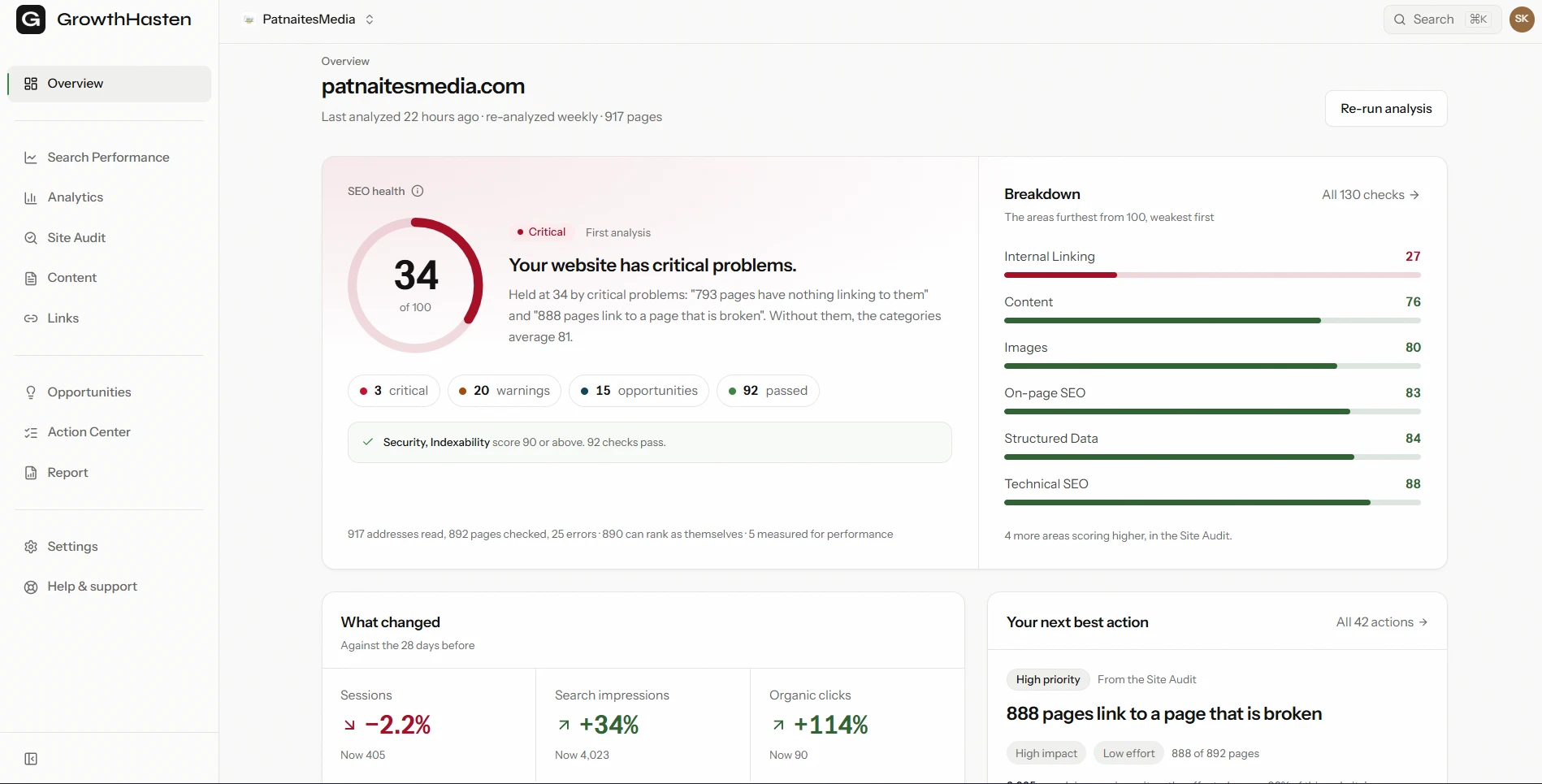
Run your site through GrowthHasten's Site Audit. It crawls your pages and reports the robots.txt rules that apply to each URL, the meta robots and X-Robots-Tag headers, and what each canonical points at, then groups repeated issues and names the pages they affect.
Explore the Site AuditOne honest limit on that, and it applies to every crawler including ours. A crawl discovers URLs from your sitemap and from the links on your pages, so it finds the combinations something links to. The ones generated only when a visitor clicks a third checkbox are invisible to it, and those are exactly the ones driving the count. Crawl Stats and the server log stay the instruments for scale. A crawl answers the other half of the question: which control is actually live on the URLs it can reach.
How is this different from a pagination problem?
Pagination is a sequence and facets are a combination, which is why one is bounded and the other is not. A twelve-page listing has twelve component URLs and the twelfth is the last one. A four-filter listing has no last one, and adding a fifth filter multiplies the set rather than extending it.
The two interact badly because pagination applies to every filter state. Our guide to how paginated URLs are handled differently draws the same boundary from its own side and hands the overlap here: once a paginated series layers onto a filter set, the multiplication is the whole problem, and it stops being a question about paginated series at all. This article is the other side of that handoff.
The practical consequence is an order of operations. Settle the indexable filter set first, then handle pagination inside whatever survives. Done the other way around, you end up canonicalizing paginated URLs that should never have been crawlable in the first place, and two sets of rules fight each other in the same directory.
What should you not do?
Treat robots.txt as a removal tool: it controls crawling, not indexing. A blocked URL that other pages link to can still show up in the results as a URL with no title and no snippet behind it, and our robots.txt guide covers that failure mode at length. If a URL is already indexed and has to come out, allow the crawl and serve noindex until it drops, then block it.
Canonicalize a facet page that has genuine demand: if a combination passes all three tests above, canonicalizing it away throws out a page that could rank. Promote it to a real route instead.
Manufacture urgency on a small site: Google's crawl budget guide opens by saying that if your site does not have a large number of pages that change rapidly, or your pages are crawled the same day they are published, you do not need to read it. Its rough thresholds are a million or more pages changing weekly, or ten thousand or more changing daily. A site with twelve filter URLs has a tidiness problem, not a crawl problem.
That last point has a real exception, and it is the one worth knowing. The same guide names a third trigger alongside the size thresholds: a large share of a site's URLs sitting in the state Search Console reports as "Discovered - currently not indexed". A four-thousand-page site whose filters have generated forty thousand crawlable variants can hit that condition without ever approaching those page counts, and that is the signal to act regardless of size.
None of the three controls is the thing worth building into a team, though. The decision is: settle the indexable set at design time, while the template is still being written. The cheapest facet URL is the one that never gets generated, and a fragment-based filter or a fixed parameter allowlist costs an afternoon before launch and a migration afterwards. That call belongs in the same conversation as the rest of the technical SEO layer this sits inside, and it is an architectural decision best made before a single page ships.
This week: open Crawl stats in Search Console, sort by response and by file type, and find out what share of your crawl is going to query strings. If the answer surprises you, you have a filter set to inventory.
See What Your Site Needs Fixed First
GrowthHasten is AI-native SEO software. It crawls your website, runs 130+ deterministic checks across 12 categories, and orders what it finds so the work worth doing first sits at the top. The free plan covers one website of up to 900 pages, with no card.
Analyze Your WebsiteQuestions
Frequently asked questions
What is the difference between filtering and faceted search?
Filtering narrows a list along one dimension at a time, usually returning a subset of the same items. Faceted search combines several independent dimensions at once, so a visitor can select a category, a tier and a sort order together. That difference is the whole SEO problem: combining independent dimensions makes the number of reachable URLs grow by multiplication rather than addition, which is how a sixty-item directory ends up with several hundred crawlable addresses.
What does faceted search mean?
Faceted search is an interface pattern that lets someone narrow a set of results by selecting values across several independent attributes at the same time, such as category, price band and availability. Each attribute is a facet. In search engineering the term describes query behavior over an index. In SEO it usually describes the filter sidebar on a listing page, and the URLs that sidebar generates when each selection is written into the query string.
Should you noindex or block faceted URLs?
Block them in robots.txt for most filter combinations. Google's faceted navigation documentation lists a robots.txt disallow first, and its crawl budget guide advises against using noindex for this purpose, because Google still requests the page before it sees the directive, spending the crawl you were trying to save. Reach for noindex only when the URL has to stay crawlable for another reason. Never apply both to the same URL: the block means the noindex is never read.
Does Google recommend canonical tags for filter URLs?
Not as the first option. Google's documentation, last updated in December 2025, names rel=canonical and rel=nofollow as ways to signal a crawling preference, then says they are generally less effective in the long term than the previously mentioned methods, which are a robots.txt disallow and URL fragments. That is narrower than saying never use canonical. It stays the right tool when a filter URL has already accumulated external links worth consolidating.
Can a filter URL ever be worth indexing?
Yes, when it passes three tests at once: the combination has search demand of its own, the page carries something the unfiltered listing does not, and there is enough inventory behind it to still make sense in six months. An integration directory filtered to a single category usually passes. Add a second and a third facet and it fails all three. If a combination does pass, build it as a real page with its own route rather than leaving it as a filter URL.
Do faceted URLs waste crawl budget on a small site?
Rarely enough to be urgent. Google's crawl budget guide opens by saying that sites without a large number of rapidly changing pages, or whose pages are crawled the same day they publish, do not need to read it, and its rough thresholds start at a million pages changing weekly. One exception is worth watching: if a large share of your URLs sit in the state Search Console reports as Discovered - currently not indexed, act regardless of your page count.

Written by
GrowthHasten Team
Editorial Team, GrowthHasten
Articles from the GrowthHasten editorial team, grounded in primary research, our own testing, and what analyzing real websites shows, fact-checked in-house.
View profile